

Security use is one of the few settings where the accessory list is more operationally important than the unit. A team can work with an imperfect device and a well-planned accessory set, and cannot work with a good device and a charging position nobody thought about. The reason is structural rather than incidental: a security deployment shares units, moves them between people, runs them across shifts and exposes them to conditions a desk product never meets — and every one of those facts lands in the accessory list rather than in the specification.
The published position an accessory list has to be built from. Case capacity and charging method are published configuration rows for the models where they apply and are not published for the models where they do not, so a shift-charging plan should be built against the figures we publish rather than against an assumed case. The published case capacities across the range are 1400 mAh on the CY05 and the CY03, and the L1 Pro, 900 mAh or 1400 mAh as a configuration choice on the L2 Utral, and 1200 mAh on the MT6's foldable case; the KY06 and the MT5 ship with a case whose capacity is not published, and the V03 Pro has no charging-case row. The charging method splits into three groups rather than two, and a fourth group publishes no charging-method row at all. Those rows, and only those rows, decide what the accessory list can contain.
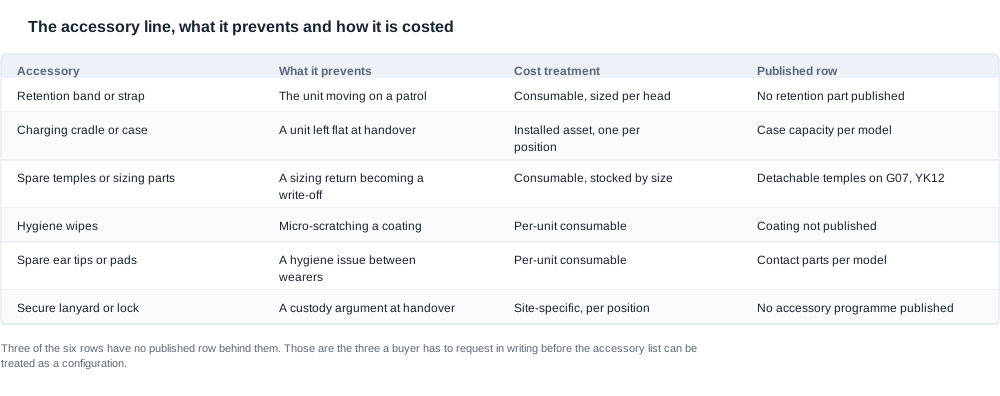
How to read the table above. Three of the six rows have no published row behind them, which is the most commercially useful fact on it. Those three are the retention part, the secure lanyard and the coating specification, and all three are things a security buyer will be asked to include whether or not a supplier has them. A buyer who treats them as standard is going to find out at the first delivery that the list is a wish list rather than a configuration, and the correction will be expensive because the unit is already deployed.
Smart glasses for security: the published configuration rows behind the accessory set
Charging method is the first row to read, because it decides whether the case is an accessory or an accessory that is also the charger. Seventeen models publish magnetic charging, seven publish Type-C, and four publish no charging-method row at all. A magnetic unit needs its contacts exposed in order to charge, which puts the case inside the charging architecture rather than beside it, and it means that a cradle which does not mate with the unit's own interface is not a cradle at all. A Type-C unit can be recharged from a cable a site already owns, which lowers the capital requirement and raises the risk of a unit left flat because nobody owned a cable. The four models with no published charging row are the ones a buyer has to ask about first.
Case capacity is the second row, and it is where the consumable-versus-asset decision is actually made. The published capacities are 1400 mAh on three models, a 900 mAh or 1400 mAh configuration choice on the L2 Utral, and 1200 mAh on the MT6's foldable case. A 1400 mAh case that lives at a charging position is an installed asset, and it should be costed as one. A case that travels with a person is a different cost line entirely, and a buyer who has one case specification for both purposes will either over-provide at the charging position or under-provide in the field. The KY06 and the MT5 cases are published as existing without a published capacity, which is exactly the row a buyer has to request in writing before the accessory list can be priced.
The structural rows come last, because they determine what a replacement costs rather than what a deployment needs. The G07 publishes ultra-slim detachable temples and the YK12 publishes slim detachable temples, which turns a sizing problem into a replaceable part rather than a scrapped unit. The V06 and the S7 publish a detachable inner frame. Those three published facts are what allow a security programme to stock sizing parts rather than replacement units, and they are worth more than any accessory in the table because they change the returns arithmetic.
And the rows that are not published anywhere, which is where the security buyer has to be most careful. The frame weight, the operating temperature range, the field of view, the video specification, the frame material, the lens material, the coating, the hinge specification and the cycle-life rating are all unpublished. There is also no published accessory programme, no published retention accessory, and no published per-model certification row anywhere in the catalogue. We will state which accessories exist and which do not for a given configuration rather than implying that a full accessory programme exists for every model.

Consumables versus installed assets in a shift deployment
The distinction that decides the accessory budget. An installed asset is per position: a cradle, a charging case, a wall position, a lock point. A consumable is per person, per shift or per unit: a hygiene item, a contact part, a sizing set. The two carry completely different cost treatments — an installed asset is capitalised and depreciated over a replacement cycle, a consumable sits in an operating budget and is replenished against a consumption rate. A security deployment that does not separate them will either over-order consumables or under-order assets, and both errors show up in the first quarter of use.
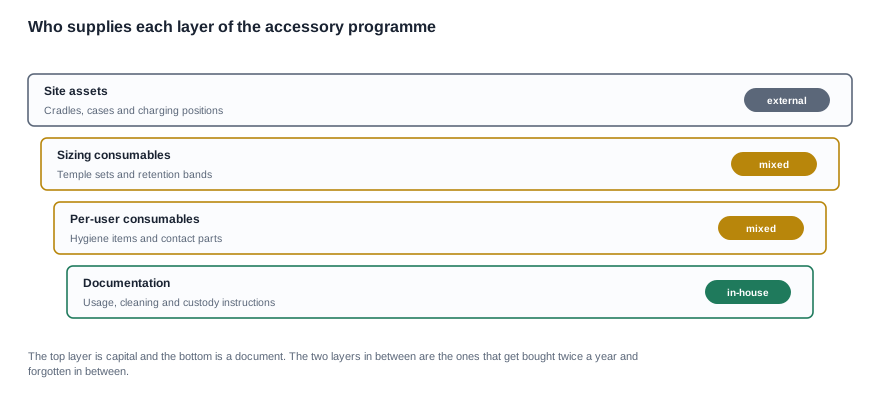
The four layers above, and why the top one is capital. Site assets are the cradles, the cases and the charging positions, and they are the layer with the longest replacement cycle and the highest unit cost. Sizing consumables and per-user consumables are the two layers that get bought twice a year and forgotten in between, which is exactly why they need a consumption rate and a reorder interval rather than a one-off purchase order. Documentation sits at the bottom because it is the only layer that costs nothing per unit and the only layer that decides whether the other three are used correctly.
The consumption rate is the number nobody publishes and everybody needs. A per-user hygiene item is consumed at a rate set by shift frequency and by how many people share a unit, and a security buyer knows both of those numbers and cannot easily express them to a supplier. The right negotiation criterion is therefore the restock interval rather than the unit price, because the interval is what the operations side actually carries and because a supplier who has thought about the consumption rate will have a view, while a supplier who has not will offer a number that is a guess.
Where the asset and the consumable meet. A shared unit in a team environment needs the hygiene item issued with every handover, not with every unit. That single decision changes the per-unit consumable cost by a factor equal to the number of people who share a unit, and it is one of the largest single levers in the accessory budget of a shared deployment. It costs nothing to implement — it is a decision about what goes in the charging position rather than in the box — and it is the kind of decision that is usually made by default rather than by design.
Retention parts and the sizing consumable that is not published
Sizing in this application is a retention issue, not a comfort issue. A patrol shift is hours of movement, and a frame that was acceptable in a showroom is frequently not acceptable at hour five, particularly under a helmet or a hood. Retention bands and temple sets are consumables in a way that batteries are not, because they degrade gradually rather than failing, which means they should be stocked as consumables and stocked in enough depth for the whole roster. A shift where one person cannot use a unit is a shift where the unit does no work, and that is the correct way to price a sizing part: against the shift, not against the individual.
The published rows that make this stockable. The G07 and the YK12 publish detachable temples, and the V06 and the S7 publish a detachable inner frame. Those are the four places where a sizing or a serviceability problem can be solved with a part rather than with a replacement unit, and they are the reason a buyer should ask which replacement parts exist before deciding whether to stock them. A published detachable feature without a published part availability is an assumption, and an assumption that turns out to be wrong at the first shift is a stockout rather than a paperwork problem.
What is not published, and therefore has to be requested. The frame weight, the temple length range, the retention accessories, and the replacement-part pricing. Each of these is a row a buyer should request in writing, and each is a row that determines whether the sizing consumable goes into the bill of materials or stays on a wish list. The office shift pattern covers a comparable handover pattern in a different setting, and the outdoor support resources covers the same five problem groups in a harsher environment.
The one accessory decision that is site-specific rather than product-specific. A device on site is both a tool and a liability, and whether it needs a secure lanyard, a lock, or simply a written custody rule depends entirely on the site. That decision belongs to the operator and not to the supplier, and the failure mode is rarely theft: it is a unit left on a counter, followed by an argument about custody rather than a claim. Deciding it explicitly, and writing it down as a custody rule with a named holder, is cheaper than arbitrating it a hundred times.

The hygiene consumable that protects a coating nobody can specify
Micro-scratching is permanent and it does not arrive as a quality return. A lens surface that has been micro-scratched by an abrasive wipe is degraded for the life of the unit, and it shows up to the person using the unit as a permanently hazier view rather than as a fault. That is why a hygiene consumable in a shared deployment has to be specified as a material and not just as a wipe: an unspecified wipe in a shared context will eventually be the wrong wipe. The content creation testing article covers the acceptance-testing discipline that the same logic applies to.
Why the specification gap makes this a purchasing decision rather than a hygiene decision. The lens material and the coating are not published for any model in our range. That means nobody can say that a particular solvent is safe, and it means the only defensible routine is the conservative one — a dry cloth first, no spray applied to the lens, and no solvent. That routine has to be written into the usage documentation that accompanies the consumable, which means the consumable and the documentation are one purchase, not two. Supplying a hygiene item without the instruction that constrains its use is how a coating gets damaged in a deployment that was trying to protect it.
The related consumable that teams routinely forget. Spare ear tips and equivalent contact parts, where the configuration uses them. These are hygiene items in a shared context and sizing items in a retention context, and both reasons argue for stocking them rather than treating them as a personal purchase. They also have the property that a unit without a serviceable contact part is a unit out of service for whoever was using it, which converts a small consumable into a shift-costing item.
How the consumable total should be built. Three numbers, each of them from the buyer's own roster rather than from a supplier: how many people share a unit, how many shifts each of those people works, and how many hygiene items are consumed per unit per shift. Multiplying those gives the annual consumable requirement, which is the number that should be negotiated as a reorder interval rather than as a unit price. A supplier who can quote against that number is quoting against the deployment rather than against a catalogue, and that is the difference between a programme that scales and one that runs out of wipes in month three.

How to choose an accessory supplier, and what to ask before you order
Five criteria for comparing two accessory offers. The criteria have to survive the fact that most accessory items are not published, which means they are about the supplier's process rather than about the goods.
- Does the supplier state which accessories exist for the quoted configuration, and which do not?
- Does it confirm a replacement part for every published detachable feature, with a price and a lead time?
- Does it confirm the case capacity and the charging method per model, so the charging positions can be specified?
- Does it state the accessory lead time separately from the unit lead time?
- Does it confirm the accessory list against the shipped configuration at the packing station?
What to ask, and why a request beats a question. A question can be answered with a description; a request has to be answered with a document. "What is the case capacity for the L2 Utral?" produces an answer. "Please confirm the case capacity and the configuration choice for the L2 Utral in writing" produces a line that can be copied into the purchase order, and that line is what an arrival inspection is checked against. The same applies to the retention accessory, the replacement part, and the accessory lead time.
The red flags that should stop an accessory comparison. A supplier that offers a complete accessory programme for every model without distinguishing which features are published. A replacement-part price with no lead time attached, because a part with an unknown lead time cannot be stocked against a roster. A case quoted for a model whose case capacity is not published. And an accessory list delivered as a marketing sheet rather than as a bill of materials with one line per item and one quantity per position. None of these is a defect; all four are signs that the accessory list has not been reconciled against the configuration rows.
The total-cost comparison, which is not the same as the accessory price. A per-position cradle that arrives after the units have deployed is not cheaper than one that arrives with them, because the deployment runs without a charging position in the meantime. A sizing part with a twelve-week lead time is not cheaper than one with four, because the roster cannot be stocked against a demand it cannot service. A hygiene consumable that arrives without its usage documentation is not cheaper at all, because it will be used incorrectly and will damage the coating it was bought to protect. The total cost of an accessory line is the landed cost plus the cost of the period in which the deployment cannot use it, and that second term is the one a unit-price comparison ignores.
The accessory bill of materials and how to confirm it
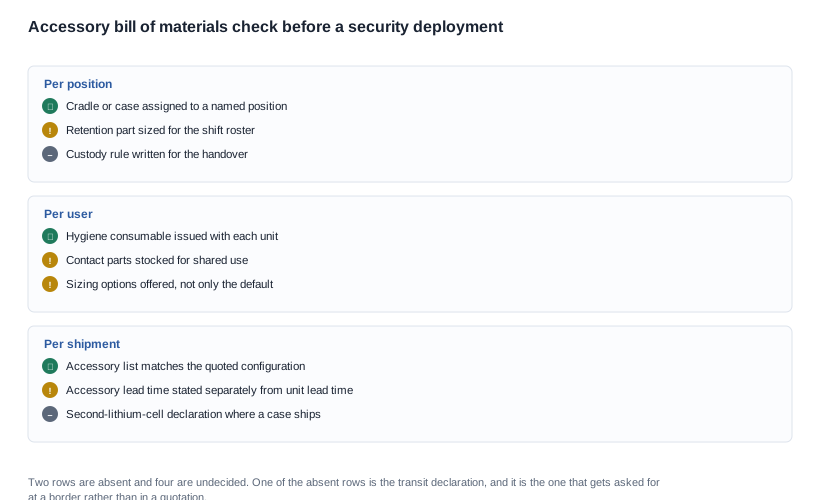
Reading the checklist as a pre-deployment gate. Nine rows across three groups. The per-position group holds one decided row and one undecided row and one absent row, and the absent row is the custody rule — a document rather than an accessory, and the one most often left until a disagreement makes it necessary. The per-user group holds one decided row and two undecided ones, both of which are about choice: contact parts stocked for shared use, and sizing options offered rather than only the default. The per-shipment group holds one decided row and one undecided row, and the absent one is the transit declaration.

The five steps in the sourcing flow, and where a security accessory list usually fails. The published configuration rows are read first, and each one implies an accessory requirement — a case capacity implies a charging position, an interface implies a cradle or a cable, a detachable feature implies a spare part. The list is then split into per-position assets, per-user consumables and optional parts, because the three carry different cost treatments and different lead times. The supplier is asked which of the optional parts exist and on what lead time. Each layer is priced separately. And the list is written into the purchase order as configuration rather than as a note, which is what makes it checkable on arrival.
The two failures this flow is designed to prevent. The first is an accessory list that exists only in a spreadsheet attached to an email, which is how a charge position ends up with a case for a model that was never ordered. The second is an accessory list with no published row behind it, which is how a retention band or a spare temple turns into a purchase that cannot be repeated when the deployment expands. Neither failure is a hardware problem and neither is visible on the unit; both are visible on the bill of materials.
The accessory questions a buyer should put in the request for quotation. Seven, and they are the accessory equivalents of the configuration questions. Which accessories exist for the quoted models, and which do not. Which of them are consumables and which are installed assets, and the unit cost of each. The lead time for each layer, stated separately from the unit lead time. Whether a replacement part exists for every published detachable feature, with its price and its lead time. The case capacity and the charging method per model, so the charging positions can be specified. Whether the accessory list is confirmed against the shipped configuration at the packing station, which is the only mechanism that catches a mismatch before it reaches a site. And whether the transit declaration covers the configuration with a second lithium cell in it.
What we will supply, what we do not, and how to confirm it. We will state, for a given configuration, which accessories exist and which do not — retention components, cradles, replacement temples — rather than implying a full accessory programme exists for every model. We will confirm the case capacity and the charging method where they are published, and we will tell a buyer plainly that they are not published for the models where they are not. We will not supply accessories we do not have, and we will say so early rather than listing them as available and confirming at the order. Where a part exists, we will confirm its price and its lead time in writing so that it can be stocked rather than assumed.
What to send us. Send the models under consideration, the number of positions, the number of people per unit, the shift pattern, the deployment environment and the destination market, and we will return the published configuration rows per model, the accessory implications of each one, which items we can confirm exist and which we cannot, and the questions that have to be settled in writing before the accessory bill of materials is issued. The security section covers the deployment around the unit.
Related reading
- Office real world — a comparable shift pattern
- Outdoor support — the same five problem groups
- Content creation testing — acceptance testing a unit
Send us the models, the positions and the shift pattern, and we will tell you which accessories exist for that configuration and which have to be requested in writing.


