
Smart glasses for security: the six-stage safety review, in order
Safety in the smart glasses category is usually written as a property of the device, which is why it is usually written badly. The real subject of a security safety review is not the hardware at all — it is the site, the task, the shift and the policy. The hardware enters the review at the third stage and contributes to two of the six. Everything before that is about the deployment, and everything after it is about what the organisation does with the record. A buyer who runs the review as six stages, in order, with a named owner per stage, will find that three of the six stages can fail even with a perfect device in the hands of a prepared operator — and none of those three stages appears in a supplier's specification.

The conclusion first, because it changes what gets bought. Safety review in this category is owned by the buyer, not delegated to the catalogue. The catalogue can tell you the resolution class, the cell capacity, the charge time, the rated run time, the charging interface and, on two camera models, an ingress marking. It cannot tell you whether the device is the right one for your post, whether your operators can carry out their task while using it, whether your site is wet, whether your shift break is long enough for the recharge, or whether your recording policy is compatible with the way the device stores files. Those are the six stages, and the first two of them are entirely about your organisation.
Who this is written for. The procurement or operations lead who will be asked to sign a safety review before a fleet ships, and who will be held to that signature afterwards. That reader's exposure is specific: a deployment that turns out to have been unsafe, or unverifiable, and a review document that either shows the questions were asked or shows they were not.
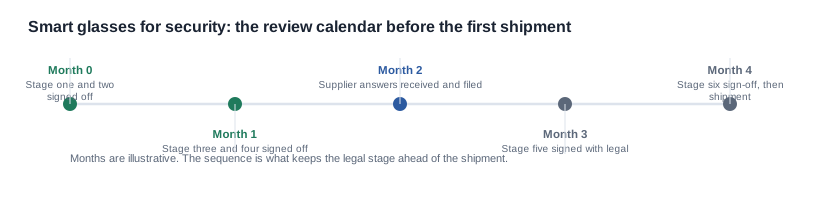
What a completed review looks like. Six stages, each with a named owner, each with a written output that can be produced a year later. The outputs are short: a one-sentence task definition, a per-post task-load note, an environment record matched to the published rows, a charging and shift plan, a recording and retention policy signed by the legal function, and a sign-off sheet. The review is not a large piece of work. It is a slow one, and it is slow because stages five and six need people outside the purchasing department.
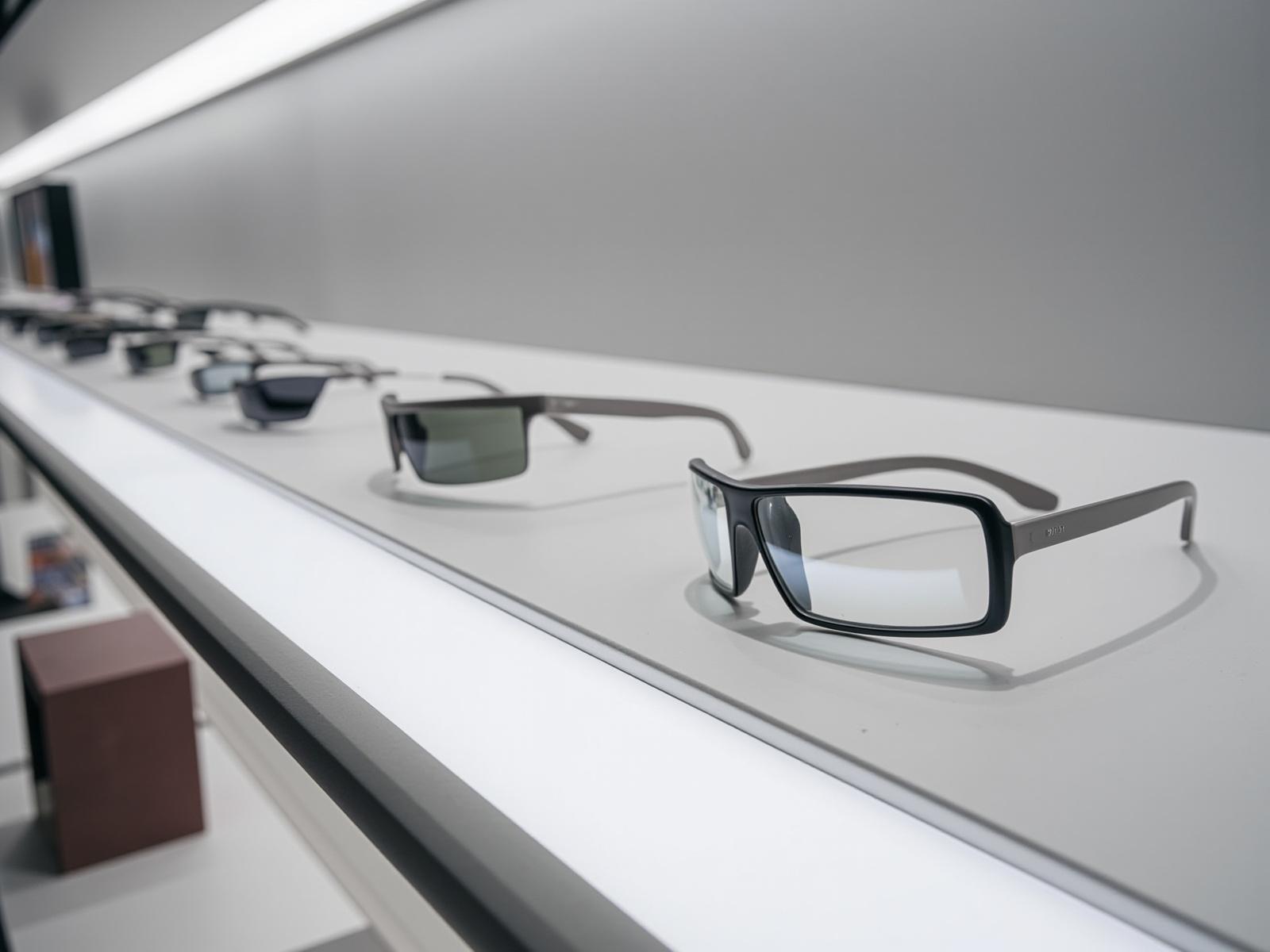
Stages one to three, where the site decides the outcome
Stage one: the task review, which is a sentence rather than a specification
The task review answers one question: what is the device being asked to do at this post. Not what it can do — what it is being asked to do. A post where the operator must read a licence plate at a gate, a post where the operator must keep both hands on a barrier, and a post where the operator must hold a conversation with a visitor are three different tasks, and they have different safety consequences even when the device is identical. The output of stage one is a single sentence per post, accepted by the operations team rather than written by the purchasing team. The failure mode here is specific and common: the task gets written in device terms ("wearing a camera for identification"), which describes a capability rather than a task, and leaves every later stage without a reference point.
Stage two: attention and awareness, where the organisation is the variable
Stage two asks what else the operator is doing while the device is in use, and it is the stage most often skipped because no supplier row can answer it. The published facts available here are thin and must be treated as thin: the catalogue publishes no field of view, no camera weight for any model other than the MT6 glasses body at 158 g, no capture latency, no thermal behaviour and no operating temperature range. So the review cannot be a calculation; it has to be an observation, made at the post, by the person who runs the shift. What that observation produces is a short list of the moments when the task and the device compete for attention, and a decision about which of those moments the device is allowed to be active at all. The output is a per-post note, and the important thing about it is that it is written by the site and not by the supplier.
What this stage is really deciding, and why it belongs to the buyer. Stage two decides whether the device is active, idle or removed at any given point in a task, and that decision has three possible answers with three different supply-chain consequences. If the device stays active throughout, the run time and the charging interval have to cover the whole shift without a mid-shift gap, which points at the longest published run times in the range and at the largest spare pool. If the device is activated only for specific task moments, the deployment acquires a handover step at each activation and an issue log that has to be kept, but the run-time requirement falls and the spare pool can be smaller. If the device is removed for parts of the task, the site needs somewhere to put it, and that becomes a physical property of the post rather than a software setting. The criteria a buyer should evaluate before choosing among those three are the number of activation moments per shift, the number of people who will handle the device as a result, and the total cost of the consumable and spare-pool line each option implies. A buyer who has not answered stage two cannot cost stages four and five accurately, which is why stage two is not an ergonomic nicety — it is a cost input.
Stage three: the environment, where the published rows finally apply
Stage three is where the catalogue becomes relevant, and it should be the shortest stage. The published position is narrow: an IP54 marking appears on two models in the whole range, the V06 and the S7, and on no other product. What IP54 covers is a dust protection level and protection against splashing water; it does not cover immersion, and it does not cover a sustained downpour. Neither the marking nor any test report behind it is published, so the marking can be stated as a catalogue attribute and nothing more can be stated on top of it. For every other model in the range, the ingress position is simply unpublished, which makes it a written question to the supplier rather than a decision the buyer can make. The camera group publishes run times of five to eight hours on some models and about seven on others, so the environment stage also has to record the shift length against the published figure for the specific model, because a stage-three record that does not connect the environment to the runtime is only half a record.
Stages four to six, where the review becomes a record
Stage four: power, heat and the shift
Stage four is the planning stage, and it has three components. The first is the charging interface, which for the camera group is published as magnetic on some models, Type C on some others, and not published at all for CY05 and L1 Pro, and MT6 and CY03 — a four-model gap that has to be closed before the base can be designed. The second is the recharge interval, which is where the charge-time row becomes a scheduling question: twenty-six of the twenty-eight catalogue entries publish a ceiling of two hours or less, and only the D17 and the ZH12 publish about one hour. If the site's recharge opportunity is a short break, only those two models are documented to be back in service inside it, and the remainder of the fleet has to be planned around a longer interval or a larger spare pool. The third component is heat, and here the catalogue publishes nothing at all — no thermal behaviour, no operating temperature range, no cycle life rating. A site running continuous recording in a warm environment has to request that answer in writing, and treat the answer as the acceptance criterion rather than the catalogue.
Stage five: recording and privacy, the stage that cannot be delegated
Stage five is where the deployment acquires a legal obligation, and it is the stage most often left until after the hardware arrives. The catalogue publishes no storage capacity, no overwrite behaviour, no notification before a limit, and no capture or transfer route for any model in the range, which means the device's recording behaviour is entirely a supplier question. The site's policy is entirely a site decision. The two have to be reconciled, and the reconciliation is what stage five exists to produce: what may be recorded, where a file goes, who may review it, how long it is kept and what happens to it afterwards. This is a stage with a named owner outside the purchasing department, and if that owner is not available, the correct outcome is that the review does not close. A device that records but cannot be shown to keep, overwrite or hand over a file in line with the policy is a device that has created an obligation the organisation cannot meet.
Stage six: sign-off, where the review becomes evidence
Stage six is the smallest stage and the one that decides whether the review will survive a later question. It is a sign-off sheet with one line per stage, a named owner per stage, the date, and the reference of the document that supports it. Its purpose is not administrative: it converts six stages of good intentions into six traceable decisions, and it is what a procurement audit, an incident review or an insurer will ask for. The output is one page. Its cost is one meeting. Its absence is the reason a deployment that went well still cannot be shown to have gone well.
The red flags a procurement reviewer should look for in a completed safety review. Six of them are worth naming, because each one has a distinctive signature and each one can be closed before an order is placed. A stage-one task written in device terms rather than as an action, which leaves the later stages without a reference. A stage-two note signed by the purchasing team rather than by the person who runs the shift, which means the observation was never made. An environment stage that names a model but does not name the marking, which implies a general weather tolerance the catalogue does not support for anything except the V06 and the S7. A power stage with a charge time and no break length, which produces a plan that cannot be executed. A recording stage without a named legal owner, which is the sign that stage five has been deferred rather than performed. A sign-off sheet with no dates, which turns the document into a statement of intent. Each of these is easy to spot and cheap to fix, and the question to ask before you order is simple: which of the six stages can be evidenced with a document, and which is currently only an intention.
The safety questions the catalogue cannot answer
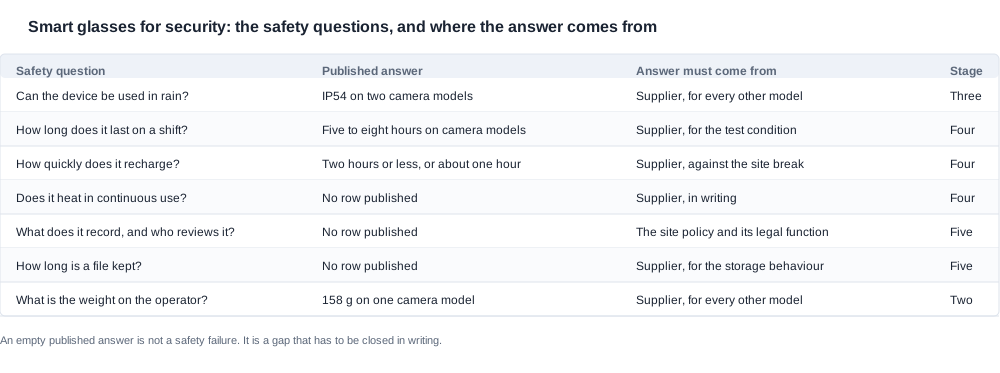
Seven questions carry most of the safety weight in this category, and only one of them has a published answer that a buyer can act on. The list below is the working set for the review, and each entry names the stage it belongs to and the party that has to answer it.
- Can the device be used in the site's weather? Published for two models only. Every other model requires a written supplier answer, and the answer must state what the marking covers and what it does not.
- How long does it last on a shift, and under what condition? The run time is published per model; the test condition is not published for any model.
- How quickly does it recharge, and is that inside the break? Published per model as a ceiling, and only two models publish a figure below two hours.
- Does it heat in continuous use? No row published for any model. This is a written question with an acceptance criterion attached.
- What does it record, and who reviews the file? No row published. This one is answered by the site's own policy and its legal function, not by the supplier.
- How long is a file kept, and what happens at the limit? No row published for any model. The answer determines whether the policy in question five is achievable.
- What is the weight on the operator? Published once, for the MT6 glasses body at 158 g, including the 265 mAh battery and the camera and excluding the foldable charging case. No other model publishes a weight and no frame-only weight is published anywhere in the range.
The underlying pattern is worth stating, because it decides how much of this review has to be a procurement exercise. Six of the seven are gaps in the catalogue rather than gaps in the supplier's cooperation, so a buyer should budget the time to obtain written answers and should not treat an unanswered question as a refusal. The seventh is a policy question that no supplier can answer at all.
A shortlist built from this review, and the criteria that produce it. The stages do not produce a model; they produce a set of criteria, and the criteria produce a shortlist. In a camera deployment, four criteria survive the review and they are answerable in this order. First, the recording criterion — the image must exist, so the camera group is in scope and the audio group is not, and the sport group is in scope only where a remote photo control is acceptable. Second, the environment criterion — the model must carry a published ingress marking if the site is exposed, which in this catalogue means the V06 or the S7 and nothing else. Third, the shift criterion — the published run time must cover the shift, or the gap must be closed with a documented spare pool. Fourth, the base criterion — the charging interface must be known for every model in the shortlist, which eliminates the four camera models whose interface is not published until the supplier answers. The trade-offs between the criteria are real and should be written down: a model that passes the environment criterion may fail the shift criterion, and a model that passes the shift criterion may leave the base criterion open. How to choose between those conflicts is a site decision, and the decision should be recorded in the same document that records the stages.
Two adjacent boundaries a security buyer should state explicitly in writing. The first is the medical boundary: no device in this range is a medical device, a hearing aid or a vision-care product, and no performance claim of that kind may appear on a deployment sheet or in a tender document. The second is the certification boundary. The catalogue carries a company-level export certification page that holds images rather than text, and the catalogue wording names no CE, FCC or RoHS. There is no per-model certification row anywhere in the range. The scope for a specific model in a specific market is therefore a supplier question to be answered in writing before the order, not an inference from a company-level page.
The boundary we draw around safety claims
We will not support a safety claim that the catalogue does not publish. That means we will not write that any device in this range is tested to IP54, because no test report is published behind that marking; we will state the marking on the V06 and the S7 as a catalogue attribute and stop there. We will not state a field of view, a video format, a low-light performance, a stabilisation figure, a capture latency, a thermal limit, an operating temperature range or a cycle life rating. We will not publish a unit weight for any model other than the MT6 glasses body, and we will not convert that single figure into a range for the camera group. We make no medical, hearing-aid or vision-care claim for any product, and the boundary is set out at the medical boundary.
What we publish, and what a safety review can be built on, is the resolution class on every camera model, the cell capacity and cell count, the charge time as a ceiling of two hours or less with about one hour on the D17 and the ZH12, the rated run times, the charging interface including the four camera models whose interface is not published, the charging-case capacity where the catalogue publishes one, the IP54 marking on two models, the Bluetooth version on the audio models, and the published structural features. Everything else in a safety review is either a supplier question or a site decision, and we would rather say which of the three it is than blur it.
What we will do is take a described site — the posts, the shift length, the environment, the vehicle and charging situation, the recording purpose and the target market — and return the published rows that apply to the models in scope, the supplier questions that close the remaining gaps, and the base design those rows imply. The operational counterpart to this review is at the deployment template, the handling questions are at how to pack smart glasses for security, and the failure patterns the review is meant to prevent are at security common problems. The product families are at AI camera glasses and Bluetooth audio glasses.
Related reading
- The scenario entry point — smart glasses for security
- The product families — AI camera glasses and Bluetooth audio glasses
- The deployment sequence — security deployment template
- The failure patterns — security common problems
Describe the posts, the shift, the environment and the recording purpose, and we will return the published rows, the supplier questions and the base design.


