

Smart glasses for security: the kit is specified backwards from the footage
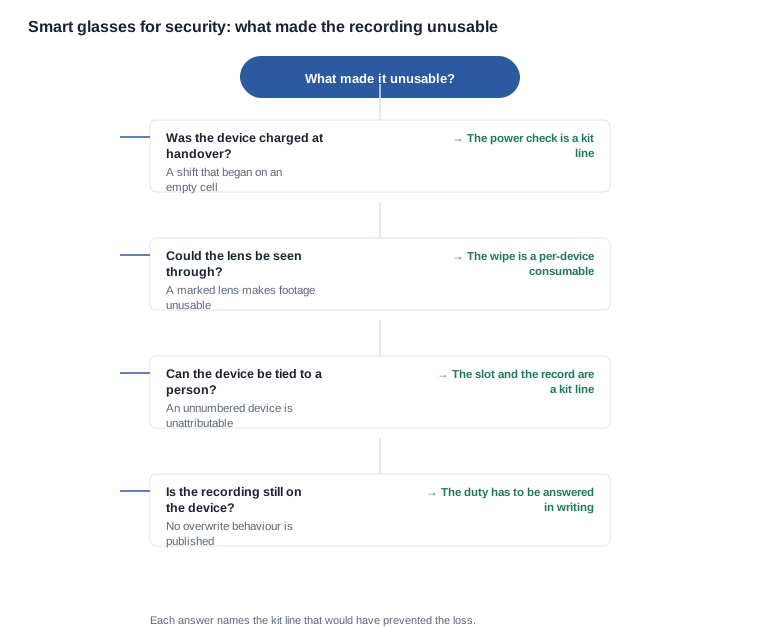
The short answer. A security deployment is the only channel in this catalogue where the product is not the deliverable — the recording is. An operator is not buying a device to wear; they are buying the ability to show a client what happened at a particular place at a particular time. That reverses the way the kit gets specified. Instead of starting with the accessories and asking what to add, a buyer starts from the footage and asks why it would be unusable, and there are only four answers: the device was flat when it was needed, the lens could not be seen through, the device could not be tied to the person who held it, or the recording was no longer on the device. Each of those four has a kit line attached to it, and three of the four rows that would settle them are not published for any model in the range — the storage and overwrite behaviour, the video specification, and the device identity scheme. So the security kit is a short list of physical items attached to a set of written questions, and the questions are the part that has to be settled before the order.
Who is specifying the kit, and what they are defending. The reader is a brand buyer, a channel buyer or a solution architect specifying a device for a security team, and the commercial setting is different from every other channel: the end customer of the deployment is often a third party — a site, an event organiser, a patrol contractor — and the operator has to be able to demonstrate what was recorded. What is being defended is therefore not the unit but the evidentiary value of the unit's output. A device that fails in the field is not a returns problem in this channel. It is evidence that does not exist, and it reaches the contract rather than the warranty desk, which is why the kit structure has to be agreed with the party that signs the service contract rather than with the party that signs the purchase order.
Why two security kits for the same device can cost very different amounts. The published rows for the camera tier are close together, so the divergence between two quotations is rarely the battery. It is the charging architecture, because the interface decides whether a patrol vehicle carries a dock, which is a fixed asset that has to be placed, maintained and insured, or a cable, which is a consumable that can be replaced at a base. Our catalogue splits the charging method three ways across the twenty-eight models: seventeen are magnetic, seven publish a Type C interface, and four publish neither a charging method nor a charging port row — the L1 Pro and the CY03, and the CY05 and the MT6, each of which does publish a charging-case capacity. The interface decisions are at charging solutions, and the logistics side is at OEM-ready logistics planning.
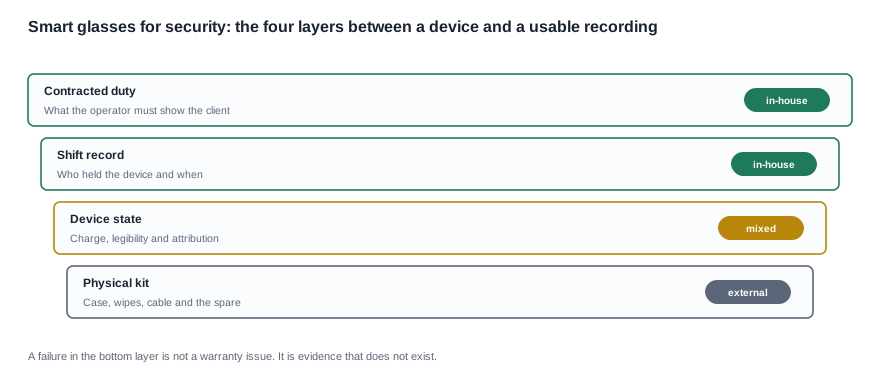

The four reasons a recording cannot be used
A security buyer's kit is a list of answers to four questions, and the questions are worth stating in the buyer's own words because the answers are what the bill of materials is built from.
First question: was the device charged at handover? This is the reason that produces the most unusable footage and the least paperwork. A shift that begins on an empty cell produces a blank hour, and a blank hour in the middle of a shift is invisible afterwards, because there is no artefact and no error. The kit answer is a power check at the issue point, a charge state that the operator can see, and a vehicle or base charging point that is specified rather than assumed. The published rows support the plan: twenty-six of the twenty-eight models publish a charge time of two hours or less, and the D17 and the ZH12 publish roughly one hour, which fits between shifts. What is not published for any model is the charge-time starting point, the indicator behaviour, or how many units a charging point can take at once — which is the number that decides how many charging points a vehicle carries.
Second question: could the lens be seen through? A marked lens makes footage unusable in a way that is discovered months later, because the recording looks like it happened. The lens material, the coating and the surface treatment are not published for any model in the range, so the instruction has to be restrictive rather than permissive, and the item that controls what reaches the lens has to be in the kit. Two models in the entire catalogue publish an ingress marking, the V06 and the S7, and both are sport camera models; the marking covers splashing water and a dust protection level, it does not cover immersion or a sustained downpour, and no third-party test report is published behind it. A kit insert that says the device is waterproof makes a claim the documentation cannot carry, and a patroller in the rain is the customer who tests it. The digit reading is at IP ratings.
Third question: can the device be tied to a person and a shift? An unnumbered device produces footage that nobody can attribute, and unattributed footage is unusable in exactly the situations that matter — a dispute, an incident report, an enquiry. The kit answer is a numbered slot or a numbered device identity, a written issue and return record, and a condition list with a stated judgement location and a visual reference so that two operators judge the same unit the same way. The catalogue publishes model designations and the model-level rows, but no per-unit identity scheme and no device management path, so both have to be requested, written into the requirement list and tested on a sample at the scale the operator will actually run. The common operational failures this addresses are collected at security common problems.
Fourth question: is the recording still on the device? This is the question that decides a deployment, and it is the one with no published answer at all. The camera models publish no storage behaviour, no overwrite behaviour and no video specification, so a buyer cannot state, from the catalogue, how long a unit records before earlier footage is replaced, nor at what resolution the recording is stored. A deployment that assumes a recording window it has not been told about is a deployment whose contract it cannot meet. The request is therefore specific: the recording window per model, the storage medium and its capacity, the overwrite behaviour, the file format, and whether the recording can be retrieved while the unit is still on charge.
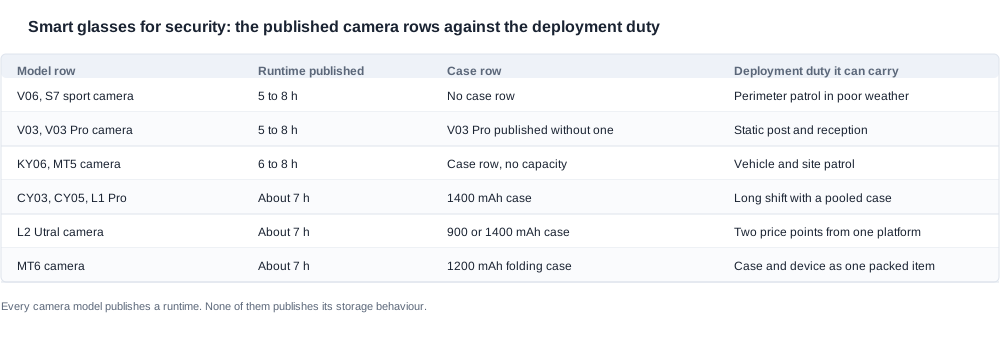
What the fleet counts are, and why they belong in the same file. Three numbers decide the shape of a security kit, and none of them is in the catalogue. The first is the number of units issued per shift, which sets the size of the issue point and the number of charging positions it needs. The second is the number of units held at the base as a spare pool, which is a bet on the operator's own failure history rather than a published rate, and which is therefore set during a pilot and adjusted from what the pilot showed. The third is the number of units that go out on a vehicle rather than on a person, and that number is set by the shift pattern rather than by the kit. A case held at the base only makes sense on a model that publishes a case row at all, and a pool of cases for a model with no case row is a pool that cannot exist — which is why the case position per model is the first row of the file and not a footnote to it.
What the published camera rows do support. Every one of the eleven camera models publishes a runtime, which is more than any other tier in the range publishes, and the values are specific. The V03 Pro and the V03, and the S7 and the V06 publish five to eight hours; the KY06 and the MT5 publish six to eight hours; the L1 Pro and the CY05, and the MT6 and the CY03, and the L2 Utral publish about seven hours. The resolution classes are published too: eight models publish an 8 MP camera and three publish a 13 MP camera, with no sensor part number for either, and no video specification behind them. The case positions are published for some models and not for others, which is what decides whether a pooled case strategy is possible on a given model at all. What is not published, for any model, is the sensor, the field of view, the video specification, the storage and overwrite behaviour, the thermal behaviour, the frame material, the lens material, the coating, a frame weight, an operating temperature range, a cycle life rating or a runtime test condition.
The file that makes a security kit quotable
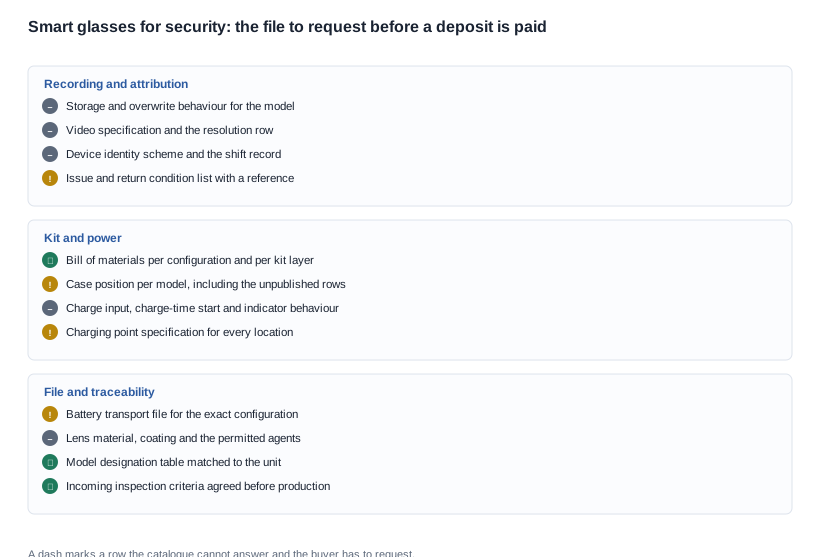
A security kit is quoted against a written requirement list, so the requests have to be phrased as things the supplier can answer and the operator can audit. Each request below has a completion standard.
- The storage and overwrite behaviour per model. The completion standard is a recording window with the storage medium, the capacity, the file format and the retrieval conditions, in writing, because the contract has to be written against it.
- The issue and return condition list. The completion standard is a written list with a visual reference and a stated judgement location, covering the lens surface, the charging contacts and the case if one is in the configuration.
- The device identity scheme, tested on a sample set. The completion standard is that a unit can be tied to a person and a shift at the scale the operator will run, demonstrated rather than described.
- The bill of materials per configuration and per kit layer. The completion standard is a document that separates the consumables from the orderable accessories, with the case position named per model rather than assumed.
- The case position per model. The completion standard is one of the three published states: a capacity, a case row without a capacity, or no case row at all. Four camera models sit in the third state — the V03 and the V03 Pro, and the V06 and the S7 — so the case question has to be put to the supplier for each of them, and the L2 Utral needs its configuration stated because 900 mAh and 1400 mAh are two different products.
- The charge input, the charge-time starting point and the indicator behaviour. The completion standard is a written answer per model, because the charge state has to be visible at the issue point for the power check to work.
- The charging point specification for every location. The completion standard is a plan with a count, stating power, dock or cable, how many units charge at once, and the physical protection of the contact.
- The lens material, the coating and the permitted agents. The completion standard is a statement per model, because the wipe instruction and the condition list both depend on it.
- The battery transport file for the exact configuration. The completion standard is a document reference naming the model, the case configuration and the cell count, because a pooled case strategy changes the declaration. The requirement is at battery transport, and the shipping mistakes that catch buyers are collected at smart glasses shipping common mistakes.
- The model designation table and the incoming inspection criteria. The completion standard is that the designation on the unit resolves to the paperwork, applied to a stated sample of the production lot. The register procedure is at certification checklist.

Where a security kit produces unusable footage
The shift that began on an empty cell. The device was issued from the pool without a charge check, and the first part of the shift has no recording. There is no artefact and no error, so the gap is found months later or never. The control is a charge state that is visible at the issue point, and a written answer on the indicator behaviour so the operator can read it.
The lens that was marked. A scratched or smeared lens produces footage that looks like it happened and cannot be used. The control is a per-device consumable and a restrictive instruction, and the condition list has to name the lens as a judged surface.
The recording that was gone. The unit overwrote its own storage before the recording was retrieved, and the client asked for footage that no longer existed. The control is the published overwrite behaviour, asked for in writing, and a retrieval procedure that is part of the handover rather than an afterthought.
The footage that could not be attributed. The device was unnumbered, so the recording could not be tied to the officer who held it, and the incident report had no subject. The control is the identity scheme, the slot numbering and the written issue and return record.
The unit that came back in an unusable state and went out again. Without a condition list, a unit with a fouled contact or a marked lens returns to the pool and fails again on the next shift. The control is a condition list with a visual reference, and a wipe at the issue point.
The claim the insert could not carry. A waterproof card on a model with no ingress marking, or on one of the two models that publish one. The control is the marking row, quoted in the words the row uses, and no test report claimed behind it.
The commercial terms of a security deployment, and what to send us next
The consumables are the cheapest part of the kit and the ones that decide whether a recording is legible. A lens wipe and a contact wipe cost a fraction of the unit price and address the two failures this channel produces: a marked lens and a unit that will not take a charge. The quantity to negotiate is the quantity per device per shift and the restock interval, and the interval should be set from the rate observed over the first month rather than from a forecast. A kit that has a case but no wipes is a kit where the wipes are bought separately in the field, at a local price, and used inconsistently.
Whether the case is issued per device or held at the base is a procurement decision with a compliance tail. Held at the base, a case is a pooled asset that is counted and that can be declared once for the pool; issued per device, it is a second object on every officer and a second item on every return, and it changes the vehicle load and the transit file. The two arrangements have different costs and different documentation, and the choice belongs in the kit structure rather than in the box. It is also constrained by the model: on the models that publish no case row, a pooled case strategy is not available at all.
Whether the supplier will provide a kit template is worth asking, because the operations team runs the kit and not the purchasing team. A template that states the layers, the counts, the issue and return procedure and the condition list is a document the operator's own staff can execute, and it removes the ambiguity that otherwise shows up at the first handover of the first month.
The pilot tier and the run tier are the same negotiation in this channel, because the pilot is where the recording window gets tested. A pilot that establishes the storage behaviour, the charge behaviour at the issue point and the condition list on real shifts is worth more than a discount, because it replaces the four unknowns with four numbers before the fleet order is placed.
What cannot be moved, because it is fixed before the commercial conversation starts. The cell configuration, the charging interface, the charge time, the runtime ceiling and the case architecture of any given model are published rows. The ingress architecture, and therefore the rating the product may carry, is fixed as well, because it is a property of two models in the catalogue. Certification cost and its lead time follow the process and the testing body rather than the order size. Tooling and mould cost is a third category and the one most often bundled: tooling is normally amortised across an order while certification cost follows the product family, and a blended line hides a cost that repeats on every future order next to one that does not. Ask which line the quotation is charging.
The terms worth putting in the order. The published rows for each model in the set. The bill of materials per configuration and per layer. The storage and overwrite behaviour, the video specification and the recording window. The device identity scheme and the shift record as named deliverables. The issue and return condition list. The case position and the pool arrangement. The charging point plan with its count per location. The battery transport file for the exact configuration. The incoming inspection criteria and the point in the flow at which they are applied, which is the point at which the payment node sits. The warranty period with a stated response, and the treatment of a unit returned with a missing accessory. The building blocks are at pricing, contract terms and MOQ.
What we publish, and where we stop. We publish the camera tier's resolution tiers, rated runtimes, charge times, cell capacities, charging interfaces, case capacities and colour availability exactly as the catalogue states them, and we publish the absence of the sensor, the field of view, the video specification, the storage behaviour, the thermal behaviour, the frame and lens material, a frame weight, an operating temperature range, a cycle life rating and an ingress test report with the same prominence. We do not read a case capacity as extra running time, and we do not put an IP54 test claim on any product, because no test report is published behind that marking.
What to send us. Send the shift length, the environments, the number of devices, the number of vehicles, the number of base locations and the markets, and we will tell you which kit lines answer each of the four questions above, which published rows apply, which four rows have to be requested in writing before the order, and where the contract can and cannot be supported by the documentation. The scenario entry point is smart glasses for security, and the product range is at AI camera glasses.
Related reading
- The scenario's starting point — smart glasses for security
- The catalogue range — AI camera glasses
- The logistics side — OEM-ready logistics planning
- The failure modes — security common problems
Tell us the shift length and the number of vehicles, and we will say which kit lines answer each of the four questions a security buyer has to settle.


