Smart glasses for security: sizing the warranty against the causes, not the headline
A security deployment's cost is not decided by its warranty provision; it is decided by what that provision is sized against. Set a percentage against the order value and you have sized the provision against a number that has no relationship to anything the supplier can control or the site can influence. Size it against the causes and the provision becomes meaningful: in this category, four causes account for nearly all of what comes back, three of them are the buyer's to control, and only one of them is genuinely a defect. That asymmetry decides everything about how the warranty should be written, and it is why a single blanket percentage produces both an expensive supplier liability and an expensive buyer surprise.
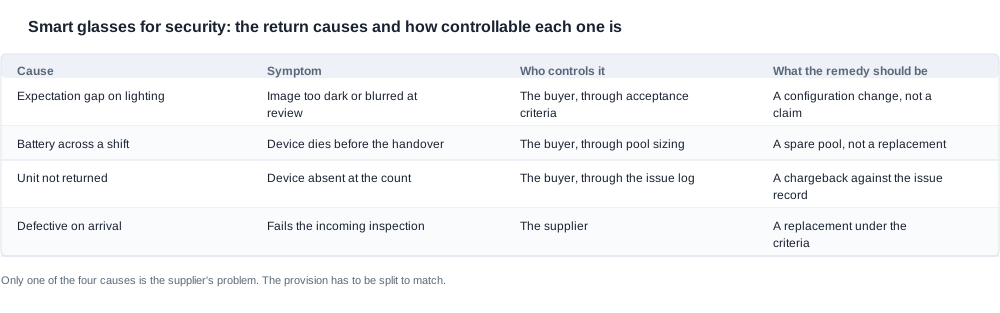
The conclusion, with the reasoning attached. Three statements, and they are the substance of this article. The warranty provision should be split into a supplier remedy and a buyer control, because the four causes have different owners and different remedies — a configuration change, a spare pool, a chargeback against the issue record, and an actual replacement. The largest cost in this category is not the warranty; it is the causes the warranty is being asked to cover. A device that dies an hour before the handover because the shift outran the published run time is not a defective device, and a provision that treats it as one will pay for it twice — once as a claim and once as the failed deployment. And the returns rate is a figure the buyer owns, not one the supplier provides. The catalogue publishes no return rate, no defect rate and no failure statistic for any model, so a warranty term written as a percentage of units is a number with no evidential basis on either side of the agreement.
Who this is written for. The buyer who is about to sign a supply agreement or a distribution arrangement for a security deployment, and who will be asked to put a warranty percentage on a form. That reader's real problem is usually not the percentage. It is that nobody has said what counts as a defect, what happens to a unit that comes back without evidence, or who pays the freight in either direction.
Cause one, the expectation gap on lighting
The first and most common cause of a return in this category is not a fault. It is a usable image that the reviewer expected to be better — a night frame that is darker than the one in the supplier's demonstration, a moving subject that is blurred, a doorway that is over-lit and washes out the foreground. The device did what the catalogue describes, which is publish a resolution class and nothing about light, and the buyer bought an expectation rather than a specification.
Why this cause is the buyer's, and what to do about it
The catalogue publishes no low-light performance, no field of view, no stabilisation figure, no video output format and no frame rate for any model. There is therefore no published row against which a lighting expectation can be tested, which means the expectation cannot be defended by a supplier and cannot be enforced by a buyer. The only place it can be resolved is in the acceptance criteria, before the shipment, and the criteria have to be written so that they can actually fail. A criterion that says the sample produces a usable image is unusable; a criterion that names a post, an hour and a lighting condition, and asks a reviewer who has not seen the site to reproduce the result, is enforceable. Where a sample proves that a configuration is not right for a post, the remedy is a configuration change — a different model, a different post, or a different duty pattern — not a warranty claim. A provision that treats this cause as a defect transfers the cost of a specification error to the party that did not make it.
The negotiation point that follows from it
This cause has a direct commercial consequence that belongs in the agreement: the buyer's remedy for an expectation gap is not a replacement but a reconfiguration, and the price of that remedy should be negotiated in advance rather than after the first argument about it. Ask what the supplier will do when a configuration is shown to be unsuitable for a post — a price, a credit, an exchange at a different specification — and write the answer down. A supplier that has not thought about the question will answer it slowly and expensively.
Cause two, the battery across a shift
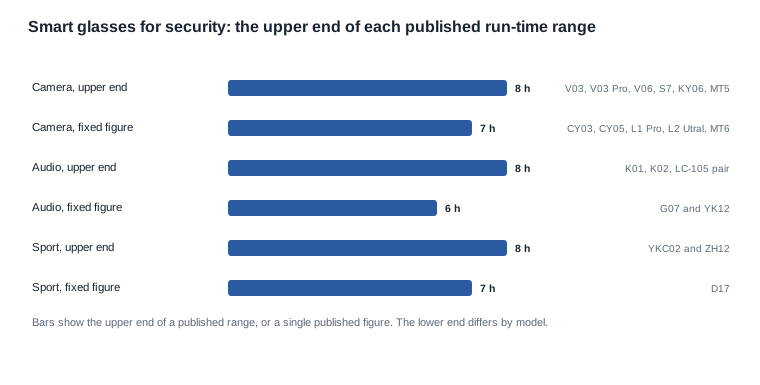
The second cause is the dead device at the end of a shift, and it is the cause most often misclassified as a defect. The published run times are five to eight hours on the V06 and the V03, and the V03 Pro and the S7, six to eight hours on the KY06 and the MT5, and about seven hours on the CY03 and the L2 Utral, and the CY05 and the L1 Pro, and the MT6. The audio group publishes about eight hours on the K01, the K02 and the LC-105 pair, and about six hours on the G07 and the YK12. The sport group publishes about eight hours on the YKC02 and the ZH12, and about seven hours on the D17. Where a shift outruns the figure for the specific model in service, the device is behaving as published and the deployment is under-resourced.
The three questions that decide whether this is a defect
- Does the shift length exceed the published run time for that model? If it does, it is a specification error and the remedy is a spare pool, a second model or a shorter duty at that post.
- What was the test condition behind the published figure? The catalogue publishes the figure and not the condition, so a supplier may legitimately hold that the figure was measured under conditions the site does not match. This is why the test-condition question belongs in the agreement and not only in the pre-purchase enquiry.
- What is the standby draw, and how were devices stored between shifts? No standby figure is published for any model, and a device left idle on a charge point overnight is a standby question that the published run time does not answer.
What the remedy should be
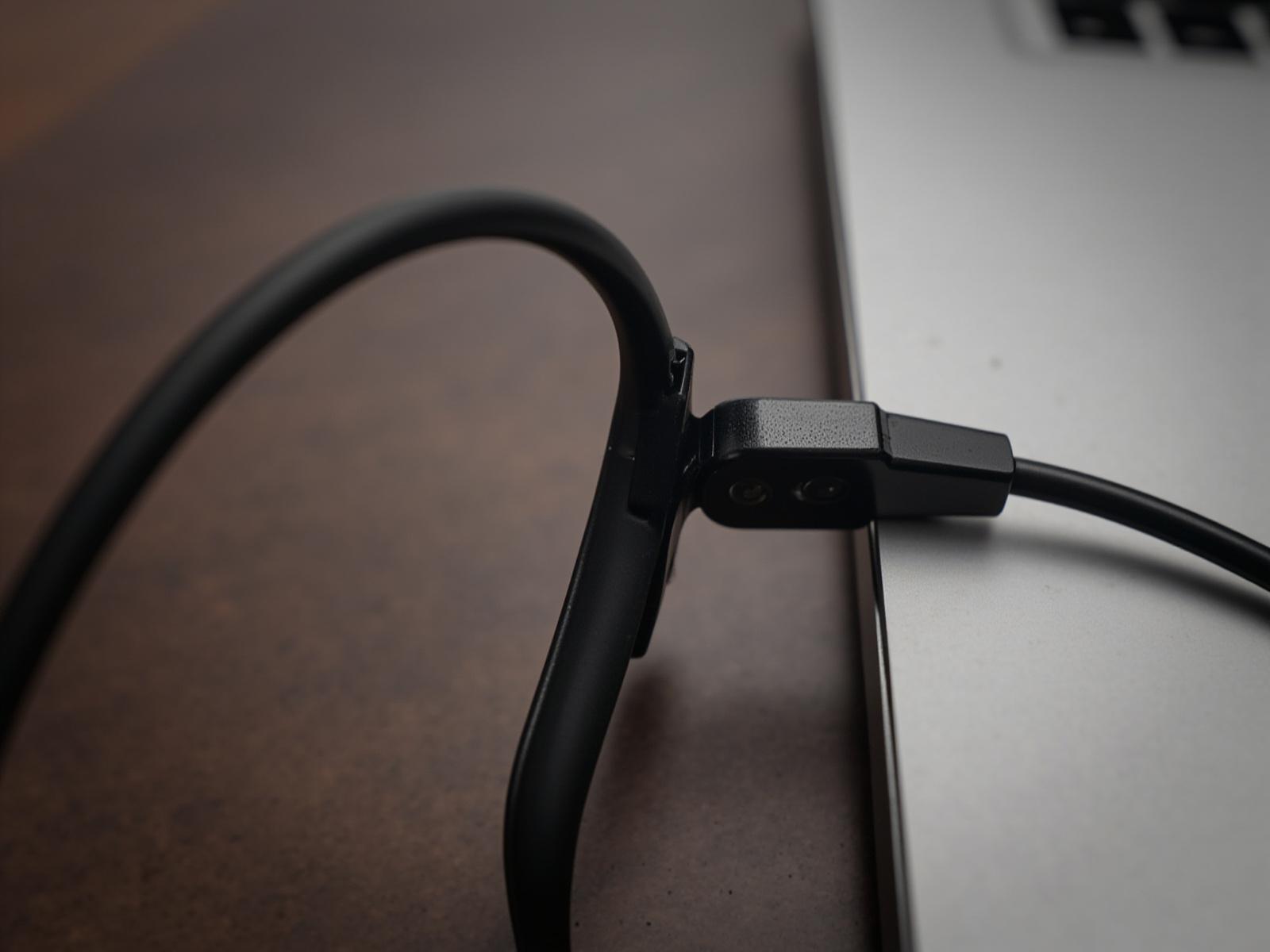
A spare pool sized to the gap. This is the remedy that actually removes the cost, and it is a buyer-side remedy, which is why it belongs in the operating plan rather than in the warranty clause. A warranty clause that covers this cause will be exercised at every shift change, and the supplier will eventually decline it — at which point the buyer has a provision it cannot use and a deployment that still fails. The charge-time row is relevant here too: the recharge interval has to fit the site's break, and only the D17 and the ZH12 publish a charge time of about one hour while the rest publish a ceiling of two hours or less. The published power rows are at battery life and the charging plan is at how to charge smart glasses for security.
The supplier's side of this cause, and what to negotiate
The argument on this cause almost always comes down to a missing number, and the missing number is the test condition behind the published run time. The catalogue publishes the figure and not the condition, so a supplier is entitled to say that the figure was measured under a particular duty, at a particular temperature, with a particular recording load, and that the site is not that condition. That answer is correct and it is not a refusal. What makes it negotiable is that the same supplier can usually state the condition, and can usually state a second figure for a heavier duty, because the manufacturer has run those tests for somebody. So the negotiation is not about the warranty at all: it is about obtaining the conditions, and then agreeing in advance which condition the deployment's warranty is measured against. A clause that says the run time applies under the duty described in the agreed acceptance criteria is worth more to the buyer than a clause that grants a percentage of units, because it tells both sides what evidence is required before a claim can be made — and it tells them that before the claim, not during it. This is also why the request belongs in the pre-purchase enquiry rather than in the returns annex: a condition obtained after the first dispute arrives is a condition obtained under pressure.
Cause three, the unit that does not come back
The third cause is a device that leaves the fleet and does not return, and it behaves differently from the other two because it is not a product question at all. The device may be lost, may be stolen, may be taken home by someone who leaves the organisation, or may simply be sitting in a vehicle. The evidence a buyer needs is the issue record: the unit number, who took it, which post, on which date, and what condition it was in.
Why the count is the whole remedy
Without a count there is no rate. A device that does not come back is a device that has to be bought again, and in the accounts that reads as a repeat sale rather than a loss, which is why the loss stays invisible until a budget does not reconcile. With a count, the loss rate becomes a number that a site can manage, a per-shift routine can be written against, and a recovery procedure can be applied to a specific unit rather than to a suspicion. The count is also what allows the loss to be charged against the right party — which is a commercial arrangement, not a warranty claim, and the distinction has to be written into the agreement so the two do not get confused when the first one happens.
The three questions that decide whether this is a loss or a defect
- Is there an issue and return log, with unit numbers? If not, the loss cannot be evidenced and the buyer cannot claim anything at all.
- What is the condition recorded at issue and at return? The condition list is what separates a device that failed from a device that was not returned.
- Who bears the loss, and under what commercial terms? The site, the channel, the insurer or a deposit scheme — and what evidence each of those requires.

Splitting the provision into a supplier remedy and a buyer control
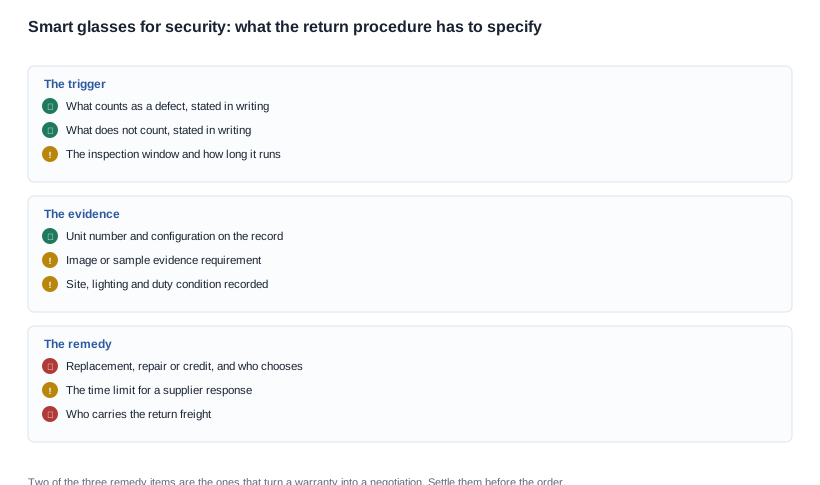
This is the section that turns the three causes into an agreement. The structure is simple and it follows directly from the table above: one cause belongs to the supplier, three belong to the buyer, and the clause structure has to say which is which.
The supplier remedy: one cause, defined precisely
The supplier's obligation covers units that fail the incoming inspection criteria, and the criteria are what makes the obligation enforceable. Two disciplines make the difference. The first is that "defect" is defined in writing, and so is what is not a defect — a unit that was damaged after issue, a unit that was used outside the stated environment, a unit with an expectation gap on lighting. The second is that the criteria are objective enough for the site's own people to apply without a supplier on the telephone. Where the criteria cannot be applied by the site, the supplier's obligation becomes a negotiation, and the negotiation happens at the worst possible moment.
The buyer control: three causes, three instruments
Each of the three buyer-side causes gets its own instrument rather than a claim. The expectation gap gets acceptance criteria and a reconfiguration remedy, priced in advance. The battery gets a spare pool and a duty pattern, sized in the operating plan. The missing unit gets an issue log and a chargeback, with the commercial terms agreed in advance. A buyer who has these three instruments in place will make far fewer claims, because each of the three causes is designed to be resolved without one.
The consequence for the percentage
Once the split is made, the percentage stops being a guess. It is sized against the one cause that is genuinely the supplier's, at the rate the site's own incoming inspection produces — and even that rate is a site figure, not a catalogue figure, because the catalogue publishes no return rate or defect rate for any model. A buyer who has run an inspection for a quarter has a real number; a buyer signing before the first shipment has an assumption, and should treat the number as provisional until the first real data point arrives.
How to open the negotiation without starting a fight
The split is easier to agree when it is presented as a cost reduction rather than as a limitation, and that framing is not a courtesy — it is accurate. A provision that covers the expectation gap, the battery shortfall and the missing unit has to be funded from somewhere, and in a negotiated agreement that somewhere is the price. Every cause that the buyer takes off the supplier's list comes out of the supplier's exposure, and the exposure that remains is the one that is genuinely a manufacturing question — which is the exposure a supplier can price and defend without difficulty. The practical sequence follows from that. Present the four causes and the owner's name against each. Attach the acceptance criteria to the cause they close. Ask the supplier to price the remaining exposure and to state the response deadline and the freight terms. What a buyer should not do is open with a percentage, because a percentage invites the supplier to price the wrong exposure, and correcting that afterwards is slower than setting it out correctly the first time.
What the return procedure has to specify, and the cycle it has to close
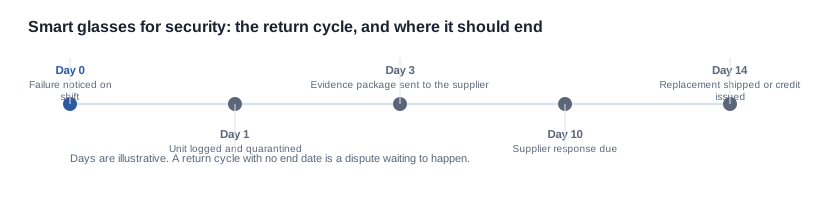
A return procedure is a cycle, and a cycle without an end date is a dispute waiting to happen. The five elements below are the minimum, and each one has been the missing element in a real return dispute more often than any other.
- What counts as a defect, in writing, and what does not. The second half of the sentence matters as much as the first.
- The inspection window and how long it runs. A window that never closes leaves both sides holding units indefinitely.
- The evidence package: the unit number, the configuration, the recorded condition at issue and at return, and the site and lighting condition of the failure.
- The remedy and who chooses between replacement, repair and credit. Leaving this to the supplier's discretion is the single most expensive omission in this category.
- The time limit for a response, and who carries the freight in each direction. Freight is small per unit and large across a fleet, and it is the item that turns a routine return into an argument.
The wider procurement sequence that sits behind this section — the buying-side list, the acceptance criteria and the commercial terms — is at the buying checklist and contract terms.
The limit we place on warranty commitments
We do not publish a warranty rate, a defect rate, a return rate or a failure statistic for any model, because the catalogue contains none and because every one of those figures describes a site rather than a product. We will not quote an industry average as though it were our own performance data, and we will not offer a term we cannot evidence.
What we can commit to is the product position, and it is the same position in every document. The resolution class on each camera model; the cell capacity and cell count; the charge time as a ceiling of two hours or less, with about one hour published for the D17 and the ZH12; the rated run times; the charging interface per model, including the four camera models whose interface row is absent; the charging-case capacity and case status per model; the IP54 marking on the V06 and the S7 stated as a catalogue attribute and nothing more; the Bluetooth version on the audio models; the group composition of eleven camera models, eight audio models and three sport models; and the published structural features.
What we will not commit to, in writing, on the basis of anything in this range: a field of view, a video output format, a frame rate, a stabilisation figure, a low-light performance figure, a capture latency, a storage capacity, an overwrite behaviour, a standby draw, a runtime test condition, an operating temperature range, a thermal behaviour, a cycle life rating, a frame or lens material, a coating, a hinge specification, a unit weight for any model other than the MT6 glasses body at 158 g, or a per-model certification scope. We will not write that a device is tested to IP54, because no test report is published behind that marking, and we make no medical, hearing-aid or corrective-lens claim for any product.
What we will do is agree a return procedure that names the trigger, the evidence, the remedy, the response deadline and the freight terms, and we will agree it before the first order rather than during the first argument. Send the deployment type, the shift length, the sites, the incoming inspection criteria you intend to apply and the target market, and we will return the clauses that match your acceptance criteria to the published product rows. The scenario entry point is smart glasses for security, and the deployment behaviour that produces these returns is set out in security real-world experience.
Related reading
- The scenario's opening — smart glasses for security
- The buying-side list — security buying checklist
- The deployment behaviour — security real-world experience
- The published power rows — battery life
Send the deployment type, the shift length and the acceptance criteria, and we will return the return-procedure clauses that match them to the published rows.