

Quality assurance on smart glasses for sport and cycling is a different exercise from quality assurance on a general consumer product, because the failure a rider actually experiences is rarely the cosmetic one. A sweat-soaked temple, a dropped temple, a lens fogging at speed and a battery that dies at the end of a long ride are the realistic failure modes, and the published documentation closes only part of each one. This page is written for the brand running that programme. It sorts the checkpoints into the ones the buyer controls, the ones the supplier holds, and the ones neither party can close alone.
Smart glasses quality assurance is a scope decision
Three roles normally sit around the same table when a sport programme is being qualified, and each of them needs a different answer from the supplier.
A brand owner is signing off on a product that goes outdoors and comes back when it fails, and needs to know which failures are covered by evidence and which are covered by hope. A quality manager is writing the inspection plan, and needs to know which checks belong in incoming inspection, which belong in a factory audit, and which only appear in the field after a season of use. A procurement manager is placing the order and needs the supplier-side evidence list before the deposit is paid, not after the first field failure.
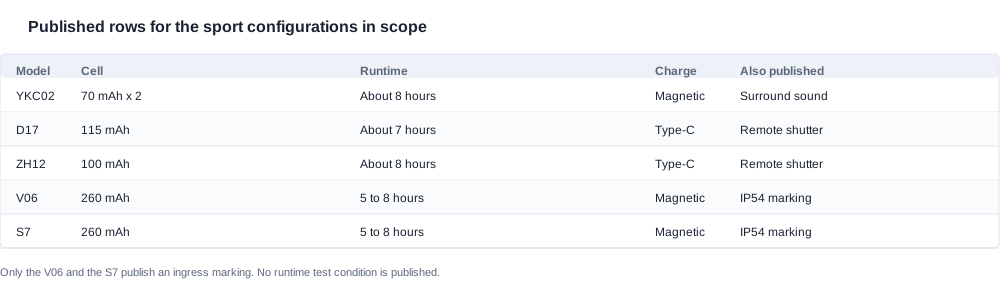
The reason this is a scope decision rather than a checklist exercise is that the sport tier in our catalogue is not uniform. Three models are published as the sport tier — the YKC02, the D17 and the ZH12 — and two further models, the V06 and the S7, are named for sport while sitting in the camera group. Their published rows differ in ways that change what a quality programme can even ask for, so the programme has to be written per configuration rather than for a family.
Before any of that, it is worth naming the four failure modes that decide whether a sport programme works, because they are what the rest of this page is organised around. A sweat-soaked temple is a materials and seal question. A dropped temple is an impact and joint question. A lens fogging at speed is a ventilation and geometry question that no amount of ruggedisation will fix. A battery that dies at the end of a long ride is a capacity and duty-cycle question. None of the four is a defect in the ordinary sense, all four happen to competent users, and all four are more expensive to fix after launch than before it. A programme that treats them as four separate issues will qualify a product for none of them.
Read the published rows for the configurations in scope before anything else, because they define both the risk and the limits of what can be qualified. The YKC02 publishes Bluetooth 5.4, two 70 mAh cells, a charge time of two hours or less, roughly eight hours of runtime, magnetic charging and surround sound. The D17 publishes Bluetooth 5.4, a 115 mAh cell, roughly one hour of charging, roughly seven hours of runtime, Type-C charging, a remote shutter and stereo surround sound. The ZH12 publishes Bluetooth 5.4, a 100 mAh cell, roughly one hour of charging, roughly eight hours of runtime, Type-C charging, a remote shutter and stereo surround sound. The V06 publishes 8 MP, a 260 mAh cell, a charge time of two hours or less, five to eight hours of runtime, magnetic charging, an IP54 marking, an ergonomic frame, a detachable inner frame and four colours. The S7 publishes 13 MP and the same 260 mAh cell with the same runtime, magnetic charging, the same IP54 marking and the same detachable inner frame.
That table is also where the programme's largest gap becomes visible. Not one of those runtime figures carries a published test condition, and not one of the frame weights is published, because the catalogue publishes a weight for exactly one model in the whole range. A quality programme that stops at the catalogue therefore qualifies almost nothing.
The V06 row also shows something that the other four do not: a published colour count of four, alongside the detachable inner frame and the ergonomic frame description. Colours turn a quality question into an inspection question, because a colour across a batch is exactly the kind of attribute a buyer can check on arrival with a reference unit, a light and a tolerance judgement. That is a cheap check, and it catches the class of production variation that generates the most visible complaints in a retail setting. Where a configuration does not publish a colour count, the equivalent reference has to be agreed in the purchase agreement instead.
Smart glasses checkpoints a sport programme cannot skip
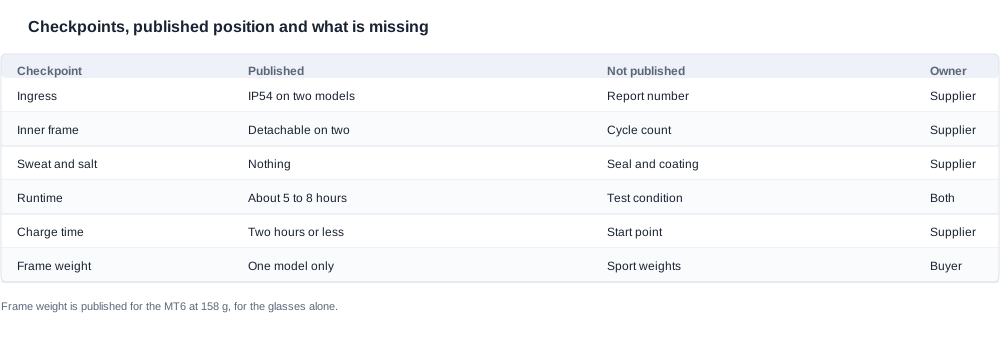
Six checkpoints decide whether a sport programme is qualified or merely ordered. They are listed here in the order that tends to expose problems earliest, because the first two are the ones that most often turn out to be closed by nothing at all.
1. Ingress — is the marking evidence or a label? Only the V06 and the S7 publish an ingress marking, and both publish IP54. No third-party test report number is published for either, and no charging case anywhere in the range carries an ingress marking at all. The distinction matters more than it looks, because IP54 is a narrow claim: limited dust ingress and protection against splashing water, nothing about immersion and nothing about a rider in a downpour. The ingress measurement discussion sets out what a rating can and cannot be stretched to mean, and it is worth reading before the marking goes anywhere near a product page.
2. The detachable inner frame — a service part and a failure point. The V06 and the S7 publish a detachable inner frame. That is a genuine benefit, because it separates fit from the electronics, and it introduces a joint that can work loose, a wear surface and a spare part to stock. The cycle count, the torque and the wear limit are not published, and neither is the joint's warranty status.
3. Sweat, salt and the materials. The seal material, the temple coating and the corrosion behaviour are not published for any model in the range. Sweat and salt water are different environments, and a product qualified in one is not automatically qualified in the other — a coastal deployment will find corrosion that an inland rider never sees.
4. The battery under a rider's load rather than a bench's. Published runtimes run from about five to eight hours across the camera models, roughly eight on the YKC02 and the ZH12, and roughly seven on the D17. The test condition behind every one of them is unpublished, so the figure tells you the order of magnitude and nothing else. The cycling use case works through what a rider is actually doing during those hours, and the difference between a bench figure and a duty cycle is the difference between a product that lasts a ride and a product that lasts a morning.
5. The charge-time advantage, on two models only. The D17 and the ZH12 publish roughly one hour, and both are Type-C models, so the fast charge comes with the interface that suits a shared cable. The magnetic models publish two hours or less, which is not slow but is a different product behaviour, and the case options differ as well. The charging options page covers the interface and case choices across the tier.
The charge-time checkpoint also carries a commercial consequence that belongs in the quality file rather than only in the price file. A Type-C configuration that charges in roughly an hour is a configuration a rider can top up over lunch, and that behaviour suppresses the most common complaint in the category. A magnetic configuration at two hours or less asks for the case to be carried, and the case is then a second lithium cell that has to be stored, charged and eventually replaced. The quality programme should therefore treat the charging accessory as part of the product, because in a magnetic build it is where a second failure mode lives.
6. Frame weight. Published for one model in the entire catalogue, the MT6 at 158 g for the glasses alone, excluding its 1200 mAh foldable case, and not published for the rest, including every sport model. This matters more in this tier than in any other, because a sport frame is carried on the head for hours and the rider decides in the first five minutes whether to keep wearing it. The weight optimisation discussion sets out the consequence in detail.

Each checkpoint needs a pass line, and a pass line is not the same thing as a number. "IP54" is a designation; the pass line behind it is the report number, the standard and the batch it was produced from. "About 7 hours" is a figure; the pass line behind it is the test condition the figure was measured under. A pass line that cannot be checked by a second party at the receiving end is a marketing line, and the discipline of writing one is what converts a catalogue annotation into a quality programme. Brands that write pass lines per configuration also find that the supplier can answer them faster than they can answer open questions, because a pass line has a shape that a test report can be produced to fill.

Smart glasses evidence requests and how to sequence them
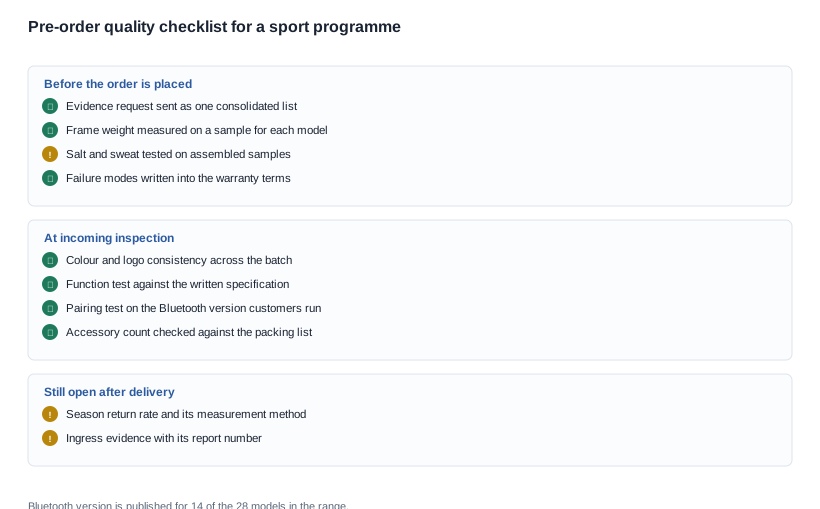
The sequence matters more than the list. Sending one consolidated request gets a faster and more complete answer than five emails sent over a month, because the answers are interdependent and a supplier answering them piecemeal will produce overlapping documents.
- Send the supplier-side evidence list in one request. The ingress report with its standard and sample batch, the drop and vibration data, the seal material and corrosion behaviour, the cell's cycle life, the frame weight, the inner frame's cycle count and wear limit, and the charge-time starting points.
- Build the incoming inspection from the published rows rather than from the catalogue picture. Colour consistency across the batch, logo and packaging consistency, a function test against your own written specification, a pairing test on the Bluetooth version your customers actually run, and the accessory count per carton. These checks are entirely inside your control, and they are the ones that catch a change in the build.
- Run a salt and sweat test on samples yourself. Not because the supplier will not supply the material data, but because the two environments behave differently and material data will not tell you how the assembled product responds to a rider's week.
- Measure the weight on a sample and record your own figure, for every model you intend to list, and keep the measurement sheet with the programme file.
- Write the realistic failure modes into the warranty terms. Sweat-soaked temple, dropped temple, lens fogging at speed, and a battery that dies at the end of a long ride. Each one needs a named owner, because a failure with two owners has none.
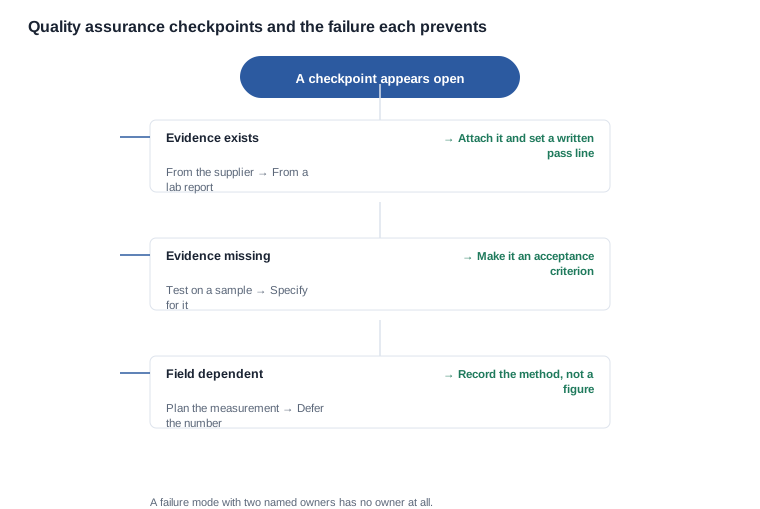
The order of those five steps matters less than the fact that all five happen before the order is placed. A brand that discovers a gap in step four after the first shipment has paid for the discovery twice: once in the unit price, and once in the returns. Where a step cannot be completed, the honest response is to record it as open with a named owner and a date, and to carry it into the inspection plan as an explicit acceptance criterion rather than as an unstated risk.
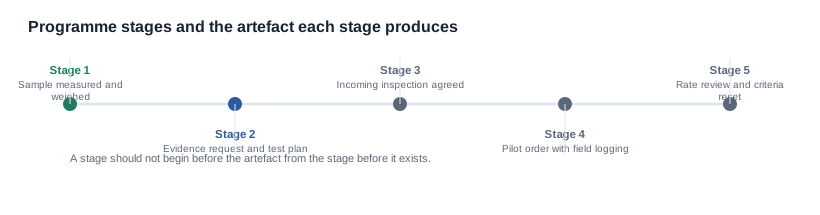
The programme stages below are the ones most brands use, and each stage has an artefact that should exist before the next one starts. A brand that skips a stage rarely skips it because of time; it skips it because the artefact would have revealed something the programme was not ready to handle, which is a much better reason to know it happened.
The stages also sequence the evidence naturally, which is why they work. The sample comes first because it is the only way to obtain a figure the buyer can own, such as a measured frame weight or a measured charge behaviour on the actual build. The evidence request follows because the supplier can answer it more completely once the buyer has a specific configuration to answer about rather than a product family. The inspection plan comes third because a pass line is only meaningful against a pass criterion, and the criterion is what the evidence produces. The pilot comes fourth because it is the first point at which a production build can be compared against the sample, and the field data comes last because it needs a season to mean anything.
Smart glasses programmes that go wrong in the field
Six failure patterns appear often enough to be worth naming in advance, because each of them has a recognisable symptom, an identifiable root cause and a prevention that costs nothing at the start of a programme.
An ingress marking treated as a waterproof rating. The symptom is a rider caught in a downpour returning the product with the brand carrying the cost. The root cause is a catalogue annotation being read as a test result. The prevention is the report, the standard and the sample batch, or nothing on the page.
An unqualified joint. The symptom is a loose inner frame joint in the field, with the customer told it is a wear item. The root cause is a wear limit that was never established. The prevention is to ask for the cycle count and the torque and to write them into the agreement.
A salt environment inferred from a sweat environment. The symptom is corrosion in a coastal deployment that passed a sweat test. The root cause is one environment qualified and the other assumed. The prevention is to test both and to ask for the corrosion behaviour in writing.
A runtime quoted without its condition. The symptom is a unit that dies mid-route, with the return attributed to the product rather than to the duty cycle. The root cause is that no test condition was requested. The prevention is to ask, and to publish the figure only with its condition attached.
An assumed weight. The symptom is a sport product that is not worn for a full ride, and a review that blames the design. The root cause is that no measurement was taken and the catalogue was read as complete. The prevention is to weigh a sample and record the figure.
A return rate put into the business case. The symptom is a business case built on a number nobody can evidence. The root cause is an assumed first-season figure rather than a measured one. The prevention is to plan it as a measurement with a method, and to say so in the model.
Two further patterns belong on the list because they are common in programmes that have outsourced the quality function rather than kept it in house. The first is a pilot order treated as a free sample, which removes the incentive to test it properly and guarantees that the pilot result tells you nothing about the production build. The second is an inspection plan written from the catalogue rows rather than from the buyer's own written specification, which means the inspection confirms what the catalogue already says and misses every difference between the catalogue and the unit in the carton. Both are cheap to fix at the start of a programme and expensive to fix afterwards, because by then the tooling has been paid for twice.
Smart glasses commercial terms a quality programme depends on
The charge-time and interface choice is the commercially significant decision in this tier, and the quality programme is where it becomes visible. The D17 and the ZH12 charge in roughly an hour over Type-C, which suits a customer carrying one cable and keeps the carton small and the parcel light. The magnetic models need a case or a pad in the box, and a case is a second lithium cell in every unit that ships with one, which changes the freight profile and the declared contents of every shipment.
Several terms are worth the negotiation time because they shape the quality programme rather than sit beside it: unit price and volume tiers, the accessory set and its minimum order quantities, the spare inner frames and their pricing, packaging specification, delivery splitting, payment nodes tied to inspection, the warranty period with a stated response time, the return terms, and the terms of a pilot order. The inner frame spares are the line most often forgotten in a sport range, and they are the line that decides whether a loose joint becomes a five-minute swap or a refund.
Payment structure deserves particular attention because it is the cheapest available form of quality leverage. A payment node released against a passed inspection is a mechanism that requires no legal mechanism at all and no argument with anyone; a payment node released on shipment is a mechanism that only discovers problems after the customer has them. Delivery splitting has a similar property, because a programme that arrives in three shipments can correct itself after the first one, whereas a single consolidated shipment concentrates every error into one reception event. Neither of these is exotic, and both are routinely negotiated away by a buyer who treats the payment terms as a formality rather than as part of the quality programme.
Some lines follow the process and cannot be moved by negotiation: certification cost and lead time, which depend on the testing body and the product family. Tooling sits differently, because it is usually amortised across the first order while certification cost is per family. Ask which one you are being quoted, because the two are frequently bundled into a single line that hides which is which.
The lines that belong in the purchase agreement are these: the published rows for the configuration ordered, the ingress evidence, the drop and vibration data, the seal material and corrosion behaviour, the inner frame's cycle count and wear limit, the cell's cycle life, the frame weight as measured, the runtime condition, the warranty period with a stated response time, and the return terms. The category overview sits in the sport smart glasses buying guide, and the wider programme structure is covered under sports and cycling brand solutions.
And the lines that should be left out are equally definite: any waterproof or immersion claim, any weight that was not measured, any runtime guarantee without its condition, and any return-rate figure that has not been observed.
What we will supply against this programme is the published specification set for the configurations ordered, the published charging rows, the ingress markings exactly as the catalogue states them, and the certification position as it stands per model — which, for the range as a whole, means no per-model certification row is published and the export certification material consists of ten patent certificate images, eight design patents and two utility models. What we will not do is describe the IP54 marking as a waterproof rating, because it is not one. Send the models, the sport, the salt and dust exposure you need to cover, and the destination markets, and we will tell you which checkpoints are closed, which are open, and what each open one would take to close.
Related reading
- The category overview — sport smart glasses buying guide
- What an ingress rating can and cannot establish — how to measure IP rating
- The accessory and interface choice across the tier — charging options
Send us the models, the sport, the exposure and the destination markets, and we will tell you which checkpoints are closed and which are open.


