

A travel budget for smart glasses has four lines, and only one of them is the unit price. The other three are the second battery, the box contents and the market access programme, and all three are discovered after a buyer has already committed to a configuration. The order in which a buyer prices them matters more than the size of any of them: price the configuration first, because a case changes the freight volume and the transit file as well as the unit price; price the box contents next, because what is in the box is the most common source of a first-week listing dispute in this category; and price market access as a schedule with a lead time rather than as a document that arrives with the goods. There is a fifth line that costs nothing and protects the other four, which is the discipline of matching every published claim on the listing to a row that supports it. A budget built in that order is defensible to a finance reviewer, and a budget built on the unit price alone is not.
Smart glasses for travel: where the money actually goes
Why the unit price is the least informative number in a travel quote
Two quotations for the same travel configuration can differ by a factor that has nothing to do with margin, and the reason is that the configuration is not the same. A cased configuration carries a second lithium cell, a larger carton, a different volumetric weight and a different transit file from a bare one. The device rows inside the two configurations can be identical. A buyer who compares quotations without decomposing them by configuration is comparing two different products and reading the difference as a supplier's price position.
That is the first budget lesson in this category: the comparison unit is the configuration, not the model. It has to include the case state, the interface, the bundled accessories and the packaging, because every one of those is priced differently by different suppliers and none of them is visible in a model number.
The four lines a travel quotation hides
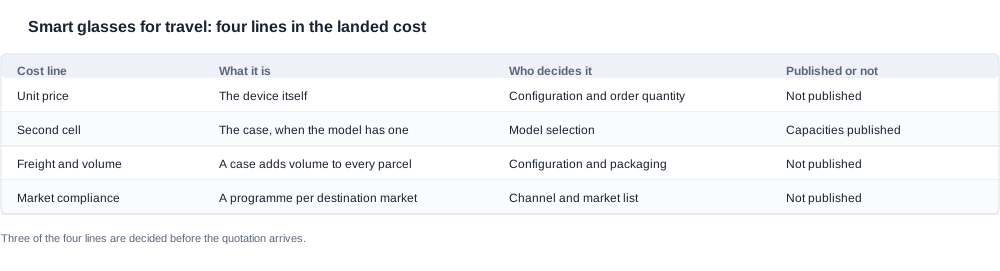
The table below names the four lines, who decides each of them, and what the catalogue publishes. Three of the four are decided before the quotation arrives, which is why the quotation is the last document in the process rather than the first.
The line that buyers most often omit entirely is market access, and the omission is expensive in a specific way. Market access is not a cost so much as a gate, and a gate has a schedule attached to it. A channel that plans to sell in two markets cannot treat the second market as a copy of the first, because the two pathways have different lead times and different document lists, and the seller's own listing has to carry market-specific information from the day it goes live.

The case is a second cell, not an accessory
What the published case rows settle, and what they do not
Case capacity is the one accessory figure the catalogue publishes, and it publishes it for five camera models: 1400 mAh on the CY05 and the CY03, and the L1 Pro, either 900 or 1400 mAh as a configuration choice on the L2 Utral, and 1200 mAh on the MT6's foldable case. Two more camera models, the KY06 and the MT5, publish a case row without publishing a capacity. The V03 and the V03 Pro, and the S7 and the V06 publish no case row at all, and a case for any of the four is an item to confirm rather than to assume.
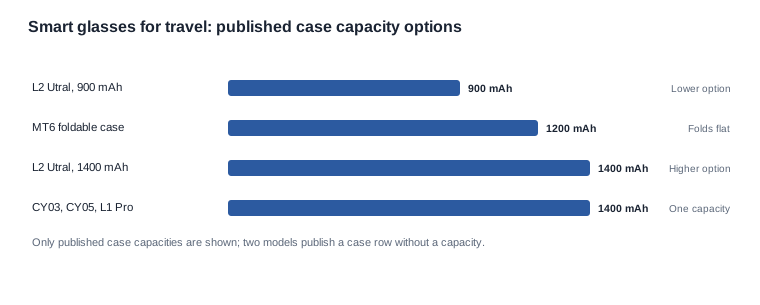
Those three states have three different budget consequences, and the difference is not cosmetic. A configuration with a 1400 mAh case is a two-cell shipment, which changes the carrier documentation, the packing instruction and often the duty and tax treatment of the parcel. A configuration with no case row is a one-cell shipment with a smaller carton and a different freight quote, and the risk is that a buyer assumed the larger box and budgeted the freight accordingly.
Two batteries, one declaration, and a rule the traveller will meet
The case is subject to the same passenger rules as the device, and that has a commercial consequence before it has a traveller one. A channel that ships a cased configuration is shipping a product with two lithium cells in it, and the transport file for that configuration is a different document from the file for a bare device. The requirement is at battery transport.
The case also has two rows the catalogue does not publish: its charge time and its weight. Both matter to a travel channel. The charge time determines whether a cased configuration is a one-night or a two-night reserve for a customer, and the weight determines whether the case is a pocket item or a bag item, which is a different answer in every channel. A buyer who budgets a cased configuration without either figure is budgeting an accessory whose behaviour is unknown, and the honest line in the budget is a request rather than an estimate.
Box contents, and the listing dispute it prevents
The most common first-week dispute in this category
Whether a charger or a cable ships with the device is not published for any model in the range. For a traveller the consequence is arriving with a device that cannot be charged, and for a channel the consequence is a first-week dispute: "what came in the box" is the first thing a customer checks, and it is the first thing a channel cannot answer from its own product page. In a travel category, where the customer is usually in an unfamiliar market with no shop nearby, the absence of a cable is a far worse experience than the absence of the same accessory at home.
The budget consequence is small and the commercial consequence is not. A cable is a low-value item, and bundling one costs less than the returns it prevents. The problem is not the cost; it is that a bundle nobody has written down cannot be inspected at goods-in, cannot be counted in the carton, and cannot be defended when a customer disputes it.
There is a second reason to write the bundle down, and it sits on the cost side rather than the service side. A bundled accessory changes the packed weight and the carton dimensions of the configuration, and both feed directly into the freight quotation and the volumetric weight calculation. A channel that bundles a case into a configuration without re-asking for the freight will find that the freight line and the unit price moved in opposite directions, and that the margin the business case was built on is not the margin the shipment actually produced.
The four questions to ask in writing
The requests are short because the catalogue has already closed most of the questions.
- The bundled contents per SKU, written as a list, with the case state exactly as published, including the four camera models whose catalogue publishes no case row. Completion standard: a list per configuration that the packaging can print.
- The cable type and length per model, matched to the interface row, with the four camera models that publish no interface row called out separately. Completion standard: a cable list that matches every shipped model.
- The carton and the packed weight per configuration. Completion standard: a weight figure that includes the case and the cable, because the freight quote is calculated from it.
- The carton print and the documentation language for each market. Completion standard: artwork approval before printing, not after.

Market access is a schedule, not a document
The three market routes and what each one needs
Selling a Bluetooth-equipped product into a market opens a radio route, a product-safety route and a chemistry route, and a travel channel adds the transport rules for the journey itself. The routes are familiar to any buyer who has imported radio equipment before, and the part that is specific to this category is the fourth cell in the table: the model-level documentation. A buyer who asks only "are you CE certified" is asking the wrong question, because the answer a supplier can give is company-level while the obligation is model-level.
For the EU, the online product page has to carry the details of an established economic operator, which is a requirement of the general product safety regulation, (EU) 2023/988, applicable since 13 December 2024. For the United States, a Bluetooth-equipped device needs the equipment authorisation that applies to it before it is sold. The radio route for the EU is the Radio Equipment Directive (EU) 2014/53/EU, and the harmonised standards behind it are a separate matter from the directive number. The chemistry route covers the restricted-substance declarations that travel with the goods.

Our own position in that chain is worth stating plainly, because a first-time buyer in this category tends to assume a supplier's catalogue settles it. The catalogue shows a company-level export certification page the content on it being images rather than text, the catalogue text leaves CE, FCC and RoHS unmentioned, and there is no per-model certification row anywhere. The certification material a channel needs is therefore a document request made against an exact model designation, and the check that matters is a lookup of every certificate number in the issuing body's public register. The document set is at the certification checklist.
Why the timelines do not run together
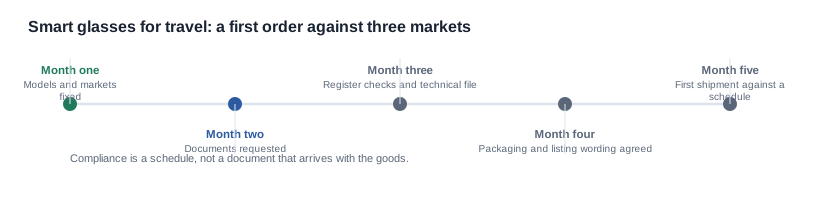
A travel channel selling into several markets multiplies the compliance programme, and the multiplication is not linear, because each market has its own document list, its own responsible-operator arrangement and its own register check. The schedule above is deliberately generic: fix the model list and the market list in the first month, request the documents in the second, run the register checks and assemble the technical file in the third, agree the packaging and the listing wording in the fourth, and ship against the fifth. A buyer who plans the first shipment against the date the documents were requested rather than against the date they were received will be late by exactly the amount the supplier took to answer.
The two points on that schedule that stop a shipment are the register check and the technical file. Both are cheap to do properly and expensive to discover late, because a shipment held at a border is a shipment whose freight has already been paid.

The total cost a buyer should write down
What to ask for before the configuration is fixed
The request list below is the whole programme, and it is deliberately ordered so that the answers arrive in the order they are needed.
- A quotation per configuration, with the configuration written out rather than referenced by a model code, and with the unit price, the price tier and the order quantity for each tier. Completion standard: one sheet per configuration, with the tooling line shown separately from the unit price.
- The minimum order quantity, the lead time and the production capacity behind the quoted date. Completion standard: a lead time that separates the sample stage from the production run.
- The payment terms and the deposit structure, including what happens to the deposit if the inspection criteria fail. Completion standard: clause language tied to the inspection criteria rather than to a general quality statement.
- The warranty terms and the defect remedy per configuration, and the returns policy that applies to a customer who loses the case. Completion standard: a written answer, because a warranty written against a model rather than a configuration leaves the cased version uncovered.
- The landed cost structure: the unit price, the packaging, the freight and volumetric weight, the duty treatment for a two-cell parcel, and the margin the channel needs to hold. Completion standard: a sheet that separates the supplier's margin from the channel's own cost of goods, so that a negotiation moves the right number.
The red flags in a travel quotation
Four patterns in a travel quotation are worth stopping on. The first is a single unit price covering every model, which means the case and the interface are not in the quote and will be added later. The second is a lead time quoted in calendar days without a sample stage, which means the buyer has no point at which the configuration can still be changed. The third is a certification answer given at company level when the obligation is model-level, which is the exact gap our own catalogue has and the reason we ask for the per-model documents. The fourth is a unit price that is lower than a comparable bare configuration, which usually means the quote excludes the second cell and the freight that comes with it.
None of the four is a supplier's fault. All four are the result of a quotation that was requested before the configuration was defined, and the cheapest correction is a one-page configuration sheet attached to the request.
There is a fifth pattern that is not a pricing fault at all, and it is the one that damages the asset rather than the budget. A quotation that arrives without a configuration sheet is not usually an attempt to mislead; it is a supplier reading the request the buyer sent. Which is the reason the configuration sheet has to travel with the request rather than after the response, because a buyer who defines the configuration only at comparison time has already spent the comparison on a category error.
A composite travel launch, and the three budget moments that went wrong
The four lines above fail in a predictable order, and the following composite of situations in this category shows the order rather than the individual mistakes. No customer is identified and no client project is being described; this is a reconstruction of the pattern the questions in this article come from.
A brand was preparing a travel line for a channel selling into two markets. The device decision had been made from the published rows, and the shortlist was sound. The budget was built from a quotation per model, which is where the first budget moment arrived. The cased configuration came back at a visibly higher unit price than the bare one, and the difference was large enough that the cased configuration was nearly dropped from the plan on the grounds that it did not fit the price band. The unit price was not the reason. The cased configuration carried a second lithium cell, a larger carton, a different volumetric weight and a different transit file, and the bare configuration was the one that did not fit the trip profile the channel had described. Decomposing the quotation by configuration would have shown the gap as freight and documentation rather than as margin, and the configuration would have survived the meeting.
The second moment arrived in the first week of sales, as a dispute about what was in the box. The cable was bundled, but the bundle was decided in a conversation rather than written into a specification, so the product page could not say what shipped and the support desk answered from memory. The cost of the week was not the cable; it was the trust in the listing, which is the asset a channel actually sells.
The third moment came at the artwork stage, when the listing was asked to carry the details of the economic operator for one of the two markets. The market access programme had started after the copy had been written, because the programme was treated as a compliance task rather than as a launch dependency. Nothing was wrong with the documents; they arrived. They arrived after the date the shipping plan assumed, which cost a staging cycle and a re-approval of artwork that was already in proof.
Three artefacts would have changed all three moments, and none of them is a new product decision. A one-page configuration sheet attached to the quotation request, which makes the comparison unit the configuration rather than the model. A bundled contents list per SKU, which turns the box contents from a support-desk memory into an inspectable line. And a dated compliance schedule built from the market list, which places the register check and the technical file on the launch critical path instead of in a compliance folder.
What we can put in a budget, and what we cannot
Concretely, we will put a travel configuration into a budget in the terms we can support, and we will name the gaps rather than fill them. Unit prices, minimum order quantities, production lead times and capacity are confirmed per enquiry rather than published, because each depends on the configuration. The published rows a budget can rely on are the cell capacity, the charge time, the case capacity where the catalogue states it, the rated runtime, the charging interface, the resolution class for the camera models, the structural features, and the IP54 marking on the V06 and the S7 stated as a catalogue attribute covering a dust protection level and splashing water.
What we do not publish and will not estimate: the case weight, the case charge time, the packed weight of a configuration, the box contents, the standby current, the runtime test condition, the verified device list, the certification documents per model, and the unit weight of every model except the MT6, where the catalogue publishes 158 g for the glasses whole unit with the battery and camera included and the foldable case excluded.
Send us the destination markets, the trip profile, the channel and the price band, and we will return the configurations that exist, the published rows behind each of them, the request list for the rows that are not published, and the cost lines that have to be priced separately from the unit price. The commercial structure is at pricing, the clause language is at contract terms, the charging arrangements are at charging explained, and the scenario entry point is smart glasses for travel.
Related reading
- How the scenario opens — smart glasses for travel
- The commercial structure — pricing and contract terms
- The certification documents — certification checklist
- The transport requirement — battery transport


