

Smart glasses for travel that survive a two-week itinerary are not built differently from the ones that fail on day four; they are specified differently. A travel unit spends its life in a bag, a hotel room, a train and a queue, and the components that decide whether it is still working at the end of that cycle are the charge contacts, the temple hinges and the lens surface. None of the three has a published cycle rating in the catalogue, so a buyer who wants a service life figure has to treat durability as a due-diligence question rather than a specification question. That is the difference this article is about: what the published rows do settle, what they leave open, and how to convert the open items into a number you can put in a contract and a budget.
Smart glasses for travel: the service life question a buyer has to answer
The reader here is a brand owner, a channel buyer or a category manager who has a travel product quoted and is trying to work out whether the quoted unit price is the real cost of the product. The decision in front of them is not which model looks right in a photograph. It is how many units per hundred the organisation will need to replace over a deployment year, what the spare pool costs, and whether the supplier will stand behind a number when the claim comes in at the end of the season.
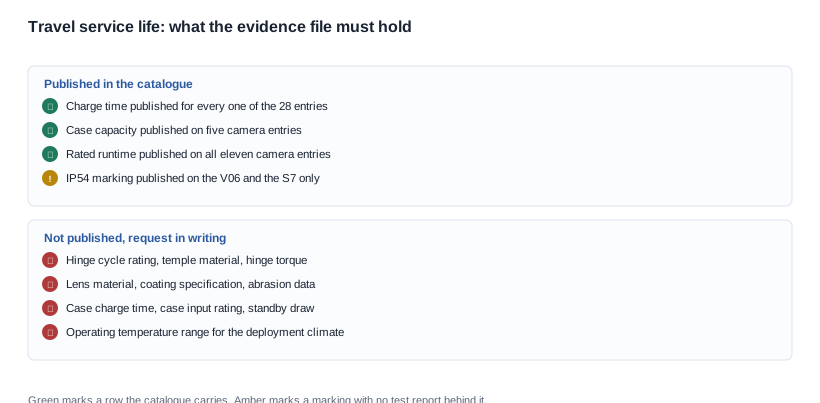
That question is harder than it looks, because the published data for this range is genuinely informative about what the product is and genuinely silent about how long it lasts. The catalogue carries 28 product entries. It publishes a charge time for every one of them — two hours or less on 26 entries and roughly one hour on the D17 and the ZH12. It publishes a rated runtime for every camera entry, a cell capacity for every entry, a charging interface for 24 of them, a case capacity on five camera entries, and an IP54 marking on exactly two, the V06 and the S7. What it does not publish, for any entry, is the cycle life, the standby draw, the hinge cycle rating, the lens material, the coating specification, the operating temperature range, or the abrasion behaviour of the surface. There is also no third-party test report published behind the IP54 marking.
A buyer reading that list has two honest options. The first is to treat the travel product as a consumable and price it that way, which is a legitimate decision but an expensive one if the units in fact last. The second is to commission the missing evidence as part of the order, which costs a few days of supplier correspondence and one sample batch, and turns a vague durability expectation into a contractual one. The rest of this article is how to run that second option.
The cost of getting this wrong is asymmetric. A unit that dies early shows up as a returns rate in the second month and as a review that names your brand. A unit that lasts too long is invisible, because nobody writes a review about the pair of glasses that survived three seasons. Buyers consistently over-inspect the visible failure and under-inspect the invisible one, and a travel category is where the invisible one lives, because the replacement is usually a replacement of the traveller's unit rather than of the traveller's money.

Where the published specification stops and the durability promise begins
Two quotations for the same travel model can differ by a wide margin, and the difference is rarely in the electronics. It sits in three places that a specification sheet does not price: the housing and hinge quality, the surface treatment on the lens, and the tolerance of the charging interface. A factory that buys a better hinge and a plainer coating can still quote a lower unit price than one that buys a worse hinge and a better coating, because the two suppliers are optimising against different failure assumptions. Neither is wrong; they are answering the question "what does this unit have to survive" with different numbers in their heads.
This is why the buying conversation has to move past the unit price and onto the failure distribution. A quote without a failure distribution is a quote about the average unit, and in a travel deployment the average unit is not the expensive part. The expensive part is the tail: the 2% of units that arrive with a defective contact, the 1% whose hinge is out of tolerance on arrival, the units that go into a returned parcel because the case did not hold a charge in a cold airport. Those costs land on your support line, your reverse logistics, and your replacement stock.
Where the cost actually sits. In a travel channel the replacement chain is expensive because the failed unit is in another country. Reverse logistics across a border cost more than the unit; the customs handling on a returned consumer electronic device can exceed the value of the goods; and a refund in a foreign market is a payment-processing problem before it is a customer service problem. This is the reason the inbound inspection criterion matters more here than in a domestic channel, and the reason a supplier who will fund a baseline measurement on the production batch is worth more than one who will shave the unit price.
The audit question that settles most of it. Ask the supplier how they measure a unit that has come back. A factory with a systematic return-reason process can tell you that 40% of returned units are contact faults and that the fault rate falls when the contact cleaner is included in the box. A factory without one will tell you the returns are random. The first answer gives you a mitigation you can buy; the second means every returned unit is an unsolved problem, and your support cost per unit is unbounded because you cannot tell your supplier what to fix.
The three load paths that decide the replacement interval
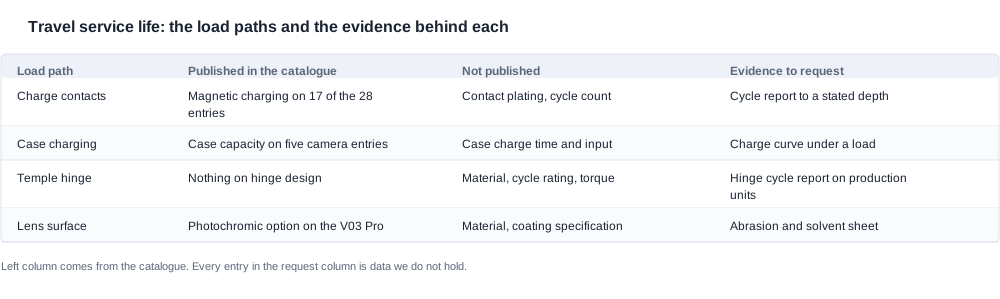
Charge contacts and the charging interface
The charging interface is the most visible published row in the range, and it is also the row with the most hidden variation behind it. Seventeen of the 28 entries charge magnetically, seven use Type-C, and on four entries — the MT6 and the CY03, and the L1 Pro and the CY05 — the catalogue publishes no charging method row at all, only the case capacity. That absence is worth knowing before an order, because a magnetic interface and a Type-C port fail differently and are handled differently in the field.
Magnetic charging is the interface most exposed to a travel environment. The contacts sit proud of the housing, they collect lint and grit, and a magnet actively draws ferrous debris towards them. The characteristic failure is not a dead unit; it is an intermittent unit that charges in a hotel and fails on a beach, which is the hardest version of the fault to diagnose remotely because it reproduces so rarely and always reproduces for the customer. Type-C avoids the debris path almost entirely, at the cost of needing a cable in a country where the traveller may not have one.
The published rows settle what the interface is. They settle nothing about how many cycles it survives, how the contact is plated, what the contact resistance is when it has been through a salt spray, or what happens if the unit is charged in the case while the case is on mains. Those are the four items to request in writing, and the request should name the configuration. A cycle number produced on a different platform than the one you are ordering does not transfer.
The temple hinge
A travel unit is opened and closed dozens of times a day by someone who is holding a passport, a boarding pass and a phone in the other hand. Hinge fatigue is the mechanical failure that dominates this category, and the catalogue publishes nothing about it: no hinge material, no cycle count, no torque figure, no tolerance. This is the single largest gap between what the catalogue says and what determines whether the unit survives a trip.
What you can do without unpublished data is test the thing you are actually buying. A hinge check on a production unit, with the unit in the state it will ship in, is measurable: open and close it a stated number of times under a stated single-hand grip, then inspect for play at the temple-to-lens joint and for any change in the temple's return angle. The pass condition is yours to write, but it has to be written as a number with a condition attached, because a supplier cannot pass or fail a phrase. The cost of running this on a sample batch is small. The cost of discovering hinge play in a public review, after 4,000 units, is a tooling conversation you will lose.
The lens surface
A lens is damaged as often by what it rests against in a bag as by what is done with it. The catalogue publishes one lens option in the camera range, the photochromic lenses on the V03 Pro, and publishes nothing at all about lens material, coating specification, solvent resistance or abrasion behaviour. There is a separate electrochromic entry in the catalogue that carries its own published rows, and it should be treated as its own product rather than as a variant of the camera range.
The procurement consequence is that the surface specification is a request, not an assumption. If your listing will carry a care instruction, and most travel listings do, the instruction has to be defensible, which means it has to be consistent with whatever the coating actually is. A "wipe with a dry cloth" instruction is safe against almost any coating and is the only one we would write without the material in hand. An instruction that says a specific solvent is safe is a claim you should not publish unless the coating sheet supports it.
A note on the units that carry an ingress marking. The IP54 marking appears on two entries only, the V06 and the S7, and it appears in the catalogue as a product attribute rather than as a tested result — there is no published third-party test report behind it. IP54 as a marking covers protection against splashing water and a dust protection level; it does not cover immersion, and it does not cover a sustained downpour. For a travel buyer the useful reading is narrower than the marketing reading: these two entries can be described as carrying an IP54 marking, and that is the whole claim.

Building the evidence file that supports a service life number
The method below is deliberately short, because the requests that fail are the ones that get complicated. Five steps, each with a completion standard, and the fifth is the one that turns a demonstration into a criterion.

- Ask, in writing, per configuration. Request the cycle test result on the production units you will receive, the hinge cycle and play tolerance, the contact plating and cycle rating, the lens material and coating specification with its abrasion and solvent data, the case charge time and input rating, the standby draw, and the operating temperature range for the deployment climate. The completion standard is a written answer per item, including "not available" as an answer. A supplier who will not write "not available" is telling you something.
- Hold two units from one batch. One unit cannot separate a design characteristic from a manufacturing inconsistency, and the two have completely different remedies. The completion standard is that you can say which kind of fault you have before you open a supplier conversation.
- Run the checks against production, not against samples. Engineering samples are built to a different tolerance and are the most flattering units in the business. The completion standard is that the test sheet names the batch and the unit count.
- Write the pass condition into the incoming inspection. Not into a report, not into an email, into the document your goods-in team actually works from. If a unit arrives with a hinge that has play, there has to be a line in the inspection sheet that catches it. The completion standard is a criterion per measured characteristic, with the number and its condition attached.
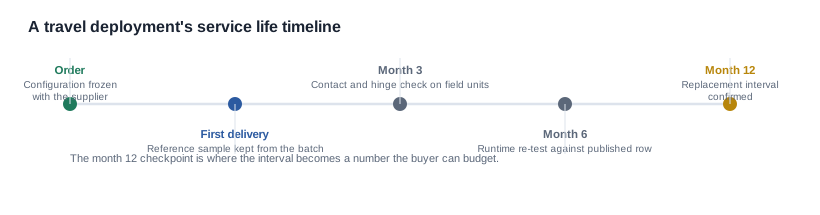
- Agree the replacement interval against a stated measurement. This is where most travel programmes lose the argument, because the interval gets written as a feeling. Write it as a measured condition: a number of charge cycles, a hinge operation count, or a stated calendar period with the operating assumption attached, and tie it to the remedy in the agreement. The completion standard is a clause that a claim can be measured against.
The two questions that are worth more than the rest. Is the standby figure published for the model, because a travel unit spends most of its life in a gap and a device that drains in a bag is a different product from one that does not. And does the documentation set cover the exact configuration being shipped, including the case, because that answer is required at a border and not in a quotation. Both are gating. Everything else on the list is negotiable in order of importance; those two are not, because one of them stops a shipment and the other determines whether the product works on a long journey.
Documents to request before a deposit. The signed evaluation sheet with its conditions, the output parameter sheet with methods, the runtime figures with their conditions, the standby figure, the hinge cycle and play report, the contact and coating sheet, the case specification, the battery transport file for the configuration, the model designation table, and the agreed incoming inspection criteria. The clause wording is published at contract terms, and the commercial structure of a first order is published at pricing.

Costing the replacement cycle against the price tier
The commercial question is simple and it is usually skipped: what does a failed unit cost in total, and how does that number compare against the unit price you negotiated? A replacement unit is the smallest term. Reverse logistics across a border, the handling fee on a returned consumer electronic device, the customer service time, the refund or the credit, and the freight on the replacement are all larger or comparable. Add the share of units that come back and the total cost of ownership of a travel unit can be several times the unit price.
That ratio changes what you can negotiate, because the negotiation is not actually about the unit price. It is about the terms that reduce the tail. A supplier who will include a contact-cleaning consumable in the box has put a mitigation at the fault site for a fraction of a unit. A supplier who will fund a baseline measurement on the production batch has given you the document that resolves every second-year dispute. A supplier who will accept a return-reason code on the RMA has built the mechanism that tells you which of the three load paths is actually failing in your market. Each of those is worth more than a small price reduction, because the price reduction only shows up in the unit cost line and the other three show up in the returns ratio.
The commercial terms worth writing into the first order. A spare-unit allocation at a stated percentage of the order, released against a returns-reason report. The return-reason code set, agreed before the first shipment. A spare-parts and consumables list, priced separately, so the channel can buy what it needs without a new moulding conversation. A reference sample retained from the production batch, retained by you and producible again from the same batch on demand. And an inspection-criteria annex that is a contractual document rather than an attachment somebody can reinterpret.
The number to ask the supplier for rather than to assume. Ask what fraction of shipped units their travel customers have replaced in the first year, and ask how that fraction is measured. The answer may be that they do not track travel separately, and that is itself informative: it means the travel category is new to their quality process, and it means your returns-reason data will be the first real signal your channel generates. Put it in the agreement, because a number you generate alone is not shared with the party that can fix the cause.
What we publish on durability, and what we will not estimate
It is worth being precise: the published rows for this range are enough to qualify a product and are not enough to certify its service life, and we would rather draw that line than fill the gap with a figure that cannot be traced. What we publish is the charge time for every one of the 28 entries, the cell capacities, the rated runtimes on the camera entries, the charging interface where the catalogue carries one, the case capacities on the five camera entries where they are published, the resolution class on the camera entries, and the IP54 marking on the V06 and the S7 stated as a catalogue attribute. What we do not publish and will not estimate is the cycle life, the standby draw, the hinge rating, the lens material and coating specification, the per-entry unit weight beyond the single whole-unit figure the catalogue gives for the MT6, and the operating temperature range.
Two specific corrections to numbers that circulate in this category. The MT6 figure of 158 grams is the weight of the glasses including the battery and the camera; it does not include the foldable charging case, whose own capacity is published at 1200 mAh and whose weight is not published at all. And a charge time of two hours or less is a ceiling, not an estimate; only the D17 and the ZH12 are published at roughly one hour, and those are the only two entries where a one-hour figure is a published fact.
What we will do. Take the deployment profile, the climates, the trip lengths, the channel and the price band, and tell you which published rows apply to it, which claims the documentation supports, which tests have to be run on production units rather than argued about, and which criteria belong in the purchase order. The battery rows are at battery life, the ingress marking is at IP ratings, and the transport requirement for a shipped configuration is at battery transport.
What to send us next. Send the deployment profile, the climates, the trip lengths, the channel and the price band, and we will return the published rows that cover it, the list of durability evidence we do not hold, and the inspection criteria we would put on the first delivery. The scenario entry point is smart glasses for travel, the model shortlist is at travel product recommendations, and the servicing side of the same deployment is at travel troubleshooting.
Related reading
- The scenario's starting point — smart glasses for travel
- The lighter end of the range — Bluetooth audio glasses
- The surface procedure — cleaning lenses for travel
- The commercial side of the same deployment — travel warranty and returns


