Smart glasses for travel safety considerations are decided in a register, not in a product document, because a travel deployment leaves the country it was bought in and comes back through jurisdictions whose rules on batteries, radios and recordings are not the rules it was purchased under. The conclusion is specific: build a risk register with three columns — the exposure, the control, and the evidence the control depends on — and sort every line into either the programme can control this or this needs a document from outside the product. The second column is where the procurement conversation actually lives, because those are the items a supplier, a carrier, a regulator or a data processor has to supply, and until they arrive they are open risks rather than solved ones.
Smart glasses for travel: the risk register for a deployment that crosses a border
The reader is a brand owner, a channel buyer or a product manager who has to put a travel product into a market where it will be carried, charged, recorded with and, eventually, returned from. The decision they are making is what the deployment pack has to contain before the first unit ships, and who signs for each item in it.
The three facts that shape the whole register. First, a travel unit is used in environments it was not designed for: a hotel room, a train, a queue, a parked vehicle, a beach. Second, the catalogue's published rows describe a desktop product — the charge time on every one of the 28 entries, the cell configurations, the rated runtimes, the charging interface on 24 of them, the case capacities on five camera entries — and they do not describe any of those environments, because the catalogue publishes no operating temperature range, no standby draw, no lens material or coating specification, and no third-party test report behind the IP54 marking on the V06 and the S7. Third, some of the exposures are not the product's to carry at all: the rules on recording other people in transit, the carrier's rules on carrying a lithium cell in hand luggage, and the rules on moving recorded material across a border are set by other parties.
What this means for the register. A safety discussion that stays inside the product's specification will produce a short list of handling notes and will miss every risk that actually causes an incident. A register built by exposure type — thermal, electrical, physical, legal, data, documentation — catches them, and the sort into "ours" and "external" tells the buyer where the remaining work is. That is the difference between a safety section in a listing and a safety programme.
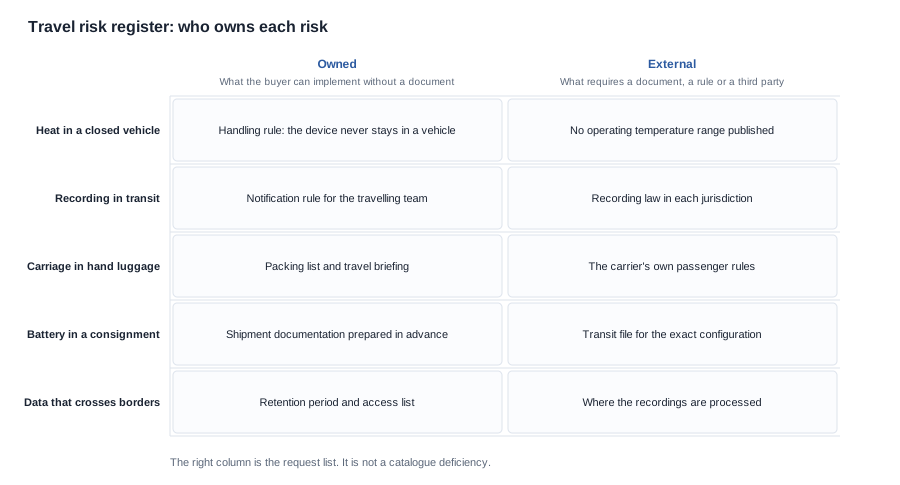
The cost of skipping the register. Every item in the external column has a lead time attached to it, and the lead times are longer than the order lead time. A transit file for the shipped configuration has to be prepared before the consignment is booked, not after the border asks for it. A recording-law review for a destination market has to happen before the listing is written, not after a complaint arrives in a language neither the brand nor the supplier chose.

The risks a programme controls by itself
Heat in a closed vehicle
A unit left in a parked vehicle sits in a genuinely hot enclosure, and a charging case makes that marginally worse because it encloses a second cell. The catalogue publishes no operating temperature range and no thermal data for any entry, so there is no published limit to design a handling rule around. The rule has to be conservative rather than derived: the device does not stay in the vehicle, and it is not charged until it has cooled. The reasoning for keeping the unit in its case in the bag rather than on a dashboard is the same reasoning, and it is a material-layer argument rather than a specification argument.
The control: a handling rule, printed in the travel briefing, with a named owner. The measurement: heat-related returns counted by month and by market, which is also the substitute for the temperature range the catalogue does not publish. The open item: a published operating temperature range, requested from the supplier as a document.
Charging on a contaminated or wet contact
Magnetic charging is published on 17 of the 28 entries, Type-C on seven, and no charging method row at all on four — the L1 Pro and the MT6, and the CY05 and the CY03. On a magnetic interface the contacts sit proud of the housing, they collect lint and grit, and a magnet actively draws ferrous debris towards them. The characteristic failure is intermittent rather than total: the unit charges in the hotel and fails on the beach. On a Type-C interface the exposure is different in kind but not absent, because the port still has to be dry before it is charged.
The control: the contacts are wiped before charging, the unit is never charged wet, and a wipe ships in the box. The measurement: intermittent charge returns per hundred units per month. The open item: the contact plating and the cycle rating, neither of which is published.
The lens surface in an abrasive bag
A lens is damaged as often by what it rests against as by what is done with it, and a travel bag is the most abrasive environment in this category. The catalogue publishes the photochromic lens option on the V03 Pro and a separate electrochromic entry with its own published rows, and it publishes no lens material, no coating specification and no abrasion or solvent data for any entry. The consequence for the safety register is a hard rule rather than a graded one: loose grit is brushed off before it is wiped, because grit wiped across a plastic lens acts as a sanding compound.
The control: a storage rule — the frame lives in its case or its sleeve, never loose in a bag — and a cleaning order, dry first and no solvent. The measurement: surface-related returns, which are hard to attribute at first and become visible once the return-reason coding exists. The open item: a coating specification and a solvent resistance sheet.
Awareness in the moving environment
The open-ear architecture is the format's strongest safety property and it is a product characteristic rather than a policy item. The ear canal stays clear, so a traveller continues to hear announcements, traffic and people while listening, which is the opposite of the sealed in-ear earbud. A bone-conduction entry goes further, producing no sound in the room at all, and it carries its own trade-off, because amplifying one source deliberately reduces the relative prominence of the others.
The control: a use rule that keeps the volume at a level where announcements remain audible, and a listing line that says so. The measurement: complaints or returns attributed to the audio category rather than to the channel. The open item: the microphone pickup distance, which is not published for any entry and is the row that would let the claim be made precisely.
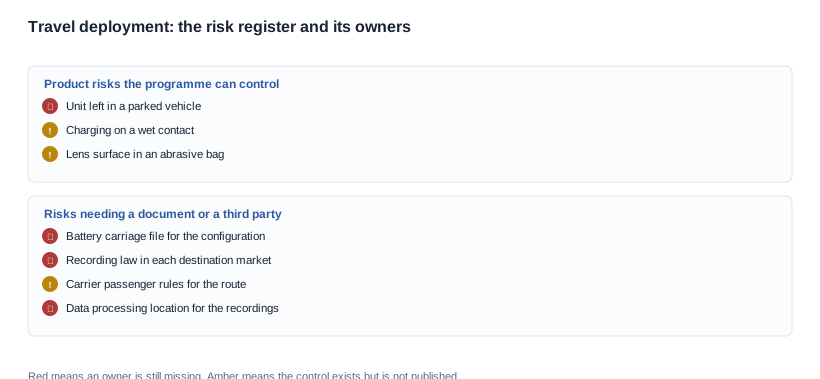
The risks that need a document from outside the product
Recording other people in transit
A traveller wearing a camera records fellow passengers, airport staff, and whoever is behind them in a queue. Whether that is permitted, and whether notification is required, is jurisdiction-specific and it is not a property of the product. The product-side fact that bears on it is the recording indicator, and the catalogue publishes no indicator specification for any entry. That means the organisation cannot rely on a device feature to discharge the notification duty, so the duty has to be discharged by the programme: a written rule on when recording is acceptable, a briefing to the team, and a jurisdiction review for each destination market.
The control: a written notification rule plus a per-market review. The evidence: a legal review per market, held before the listing is published. The open item: a recording indicator specification, requested from the supplier.
Carriage in hand luggage
Worth separating from the shipping rules, because they are different rules and they are constantly confused. Battery transport rules govern a consignment; a passenger carrying a personal device is governed by the carrier's own rules, which are not the same instrument and are not written by the same body. The confusion is why a traveller ends up with a device that cannot go in hand luggage and was never told, and in a travel channel it is a returns driver rather than an inconvenience.
The control: a travel briefing and a packing list that states the carriage position before departure. The evidence: the carrier's own passenger rules for each route in the itinerary. The open item: the transit file for the exact configuration being shipped, which is a different document and has to be requested before the consignment is booked.
Moving recorded material across a border
A device that travels accumulates recordings of people in several jurisdictions, and the organisation that owns the device has to be able to answer where that material lives, who can retrieve it and what happens to it at the end of the trip. The catalogue publishes no data flow for any entry — not the storage path, not the overwrite behaviour, not the processing location — so this is a policy the organisation must state before the traveller leaves, and it belongs in the deployment pack rather than in a support script.
The control: a retention period, an access list and a stated processing location. The evidence: a description of where the material is processed and under what terms. The open item: the storage and overwrite behaviour for each configuration.
Certification, and what the catalogue actually carries
Buyers will ask about CE, FCC and RoHS, and it is right that they ask. The honest position is specific and it is worth stating precisely rather than approximately: the catalogue carries a company-level export certification page whose content is images rather than text, and the catalogue text contains no reference to CE, FCC or RoHS at all. There is no per-model certification row anywhere in the range, and there is no record of a pending per-model certification either. A company-level page is a statement about the organisation; it is not evidence about a specific entry, and it cannot be cited as though it were.
The control: treat the per-model certification scope as a documentation request, attach it to the purchase order, and do not publish a certification claim for an entry until the document for that entry exists. The evidence: a per-model document with a number that can be checked against the issuing body's public register. The open item: the certification scope of every entry in the shortlist.

Turning the register into controlled items with owners

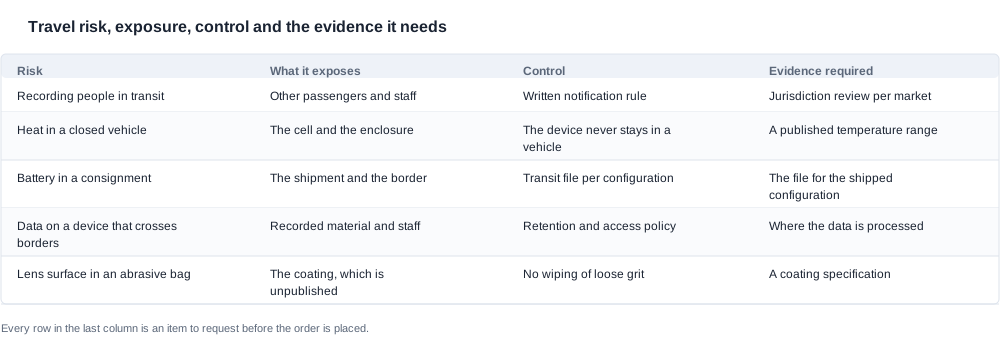
A register that stays a register does not reduce incidents. Five steps turn it into controlled items, and the third one is the step that most registers are missing.
- Name the risk with its trigger. Not "heat" but "the unit stays in a parked vehicle between two appointments on a hot day". The trigger is what makes the control testable. The completion standard is a sentence a team member could evaluate against a real situation without asking anyone.
- Sort it into owned or external. A risk that needs a document from a third party cannot be closed by a policy; it can only be tracked. The completion standard is a column, and every external line has a named party to chase.
- Name an owner by person, not by department. "Operations" is not an owner, because a department cannot be chased at six in the evening in a market where the unit failed. The completion standard is a name and a channel for each line.
- Attach the evidence. A policy line, a briefing note, a transit file, a legal review, a specification sheet. The completion standard is a document reference on the line, and a line with no document reference is still open.
- Review at the season boundary. Before the next order, not after the next incident. The review produces three outputs: the lines that can be closed because their evidence arrived, the lines that have to move to the supplier as a specification request, and the lines that have been retired because the control worked. The completion standard is a dated review with a closed count.
The two reviews that should happen before the first shipment rather than after it. The legal review for the destination markets, because it changes what the listing is allowed to say and what the team is told. And the transit file for the exact configuration, because it determines whether the consignment can move at all. Everything else in the register can be gathered during the first season; those two cannot, because they gate the launch.
How to choose which risks go into the register first
A register that starts with everything is a document nobody reads. The criteria for what belongs in the first version are narrow and testable, and applying them is how to choose which lines justify the launch delay they cause.
- Does the exposure reach a third party? A risk whose consequence lands on a passenger, a colleague, a carrier, a border officer or a customer is a first-version line even if the likelihood is low. The unit left in a vehicle is an internal nuisance; a recording of a stranger on a train is not.
- Does the risk stop the launch if it materialises? A line that blocks the shipment, the listing or the legal position belongs in the first version. The transit file and the per-market recording review both meet this test, and both have a lead time longer than the order.
- Is the control within the programme's own reach? If the programme can close it with a rule, a briefing or a packaging change, it costs a decision rather than a document, and it should be closed before the launch rather than tracked through it.
- Is the exposure seasonal or route-dependent? A line that only appears in a summer market or on a particular route does not need to block the launch, but it does need an owner and a trigger before the season arrives, otherwise the programme will discover it in the field.
Everything that fails all four tests goes into a second-version register, reviewed at the season boundary. The questions to ask the supplier are the ones attached to the external column, and the most valuable of them is the narrowest: ask for the operating temperature range for the exact configuration in the order, because a range turns the thermal line from a handling rule into a criterion.
The questions to ask before the register is signed off
Five questions, and each one has a completion standard that a buyer can check without a laboratory.
- Does a charging method row exist for this configuration, and if not, what interface does the unit actually use? Four entries publish no charging method row, and the answer changes both the handling rule and the transport file. The completion standard is a written answer naming the interface.
- Is there a per-model certification document for this entry, and what does it cover? The company-level export certification page does not answer this. The completion standard is a document with a number that can be checked against the issuing body's public register.
- What is the operating temperature range and the runtime test condition for this entry? Neither is published for any entry, and both are needed to turn the thermal and the endurance lines into criteria rather than rules.
- Where are the recordings stored, who can retrieve them, and what happens to them at the end of the trip? The completion standard is a written data flow for the configuration being shipped.
- Does the transit file cover this configuration, including the case? A file written for a configuration without a case is not evidence for one with a case. The completion standard is a file reference on the order that names the case capacity.

The two questions a travel risk register cannot answer
Whether the product will perform in the environment the itinerary creates. No operating temperature range, no thermal data, no verified handset list and no runtime test condition are published for any entry, so the register can say that the risk is controlled by a handling rule and cannot say the handling rule is sufficient. The honest position is that sufficiency is established by measurement in the deployed base, over a season, in the markets that matter.
Whether a specific configuration is certified for a specific market. Because the catalogue carries no per-model certification row, the register cannot close this line from the product documentation at all. It has to be closed from a document the supplier provides per entry and per configuration, and it has to be closed before the claim is published rather than after a market asks.
What we publish on safety, and where we stop
The boundary we hold: we publish the hardware configuration and the gaps in it, and we will not present a stored-forever recording as a neutral product choice, nor imply an indicator, a temperature limit or a certification scope we have not confirmed. What we publish is the charge time on every one of the 28 entries, the cell configurations, the rated runtimes, the charging interface on the 24 entries where the catalogue carries one, the case capacities where they are published, the radio version on the audio and sport entries, the IP54 marking on the V06 and the S7 stated as a catalogue attribute rather than as a tested result, and the published feature lines. What we do not publish and will not estimate is the operating temperature range, the thermal behaviour, the standby draw, the runtime test condition, the recording indicator specification, the storage and overwrite behaviour, the microphone pickup distance, the lens material and coating specification, and any per-model certification row.
What we will do. Take the destinations, the trip lengths, the channel and the configuration, and return a register drafted against your own exposures: which lines are yours to close with a rule, which lines need a document from us, from a carrier, from a legal review or from a data processor, and which lines cannot be closed at all without a published specification we do not hold.
What to send us next. Send the destinations, the markets, the trip lengths and the configurations under consideration, and we will return the risk register skeleton, the document request list, and the published rows that bear on each exposure. The training programme is at how to train for travel, the seasonal exposures are at travel seasonal considerations, and the scenario entry point is smart glasses for travel.