Six claims that appear in travel listings and that our documentation does not support. None of them is dishonest on its own; each becomes a return when the customer's week disagrees with the page.
The reason this is a procurement problem rather than a copy-writing problem is that the claim and the evidence travel together through the supply chain. A supplier's product sheet states "waterproof", the distributor's listing repeats it, the marketplace listing repeats it again, and the buyer's name is on all of it. By the time a customer writes a review saying the device failed in the rain, the claim is four handovers old and nobody in the chain remembers where it came from. Smart glasses for travel therefore has one decisive question attached to it: does the wording on the page match a row that exists in the documentation the supplier actually holds?
Six claims fail that test in this category, and they fail in a predictable order — two of them fail within a week, and four of them fail quietly enough that they cost margin for a season before anyone connects them to the page.
Smart glasses for travel: who writes the page, and why the supplier's sheet is not evidence
The reader is a brand buyer, a channel buyer or an e-commerce selector who is about to put a travel SKU on a page, usually in more than one market and often in more than one language. The decision in front of them is not whether the product works. It is which words may go on the page, and what happens to the return rate when a customer's experience disagrees with those words.
The structural point is that a claim sheet from a factory is not evidence. It is a summary of a summary. The catalogue behind it publishes a resolution class and nothing about the video format or the frame rate; it publishes a charge ceiling and nothing about the state the device starts charging from; it publishes an ingress marking on two models and nothing at all about the rest. A summary that says "waterproof" has compressed four separate distinctions into one word, and the compression is where the liability is created — not in the word, which is what everyone argues about, but in the collapse.
The practical consequence is that the buyer is the last person in the chain who can still fix this, and the only person who can fix it by changing the page rather than by paying for the difference. Every other party in the chain will pass the claim along, because passing it along costs them nothing and the claim is not tested until a customer tests it.
How to choose between the models for a travel page. The criteria are narrow, and they are the same criteria that decide the listing copy, because in this application the two questions are one question. First, does the trip need a case — if it is longer than a day, the case states decide it, and only five camera models publish a case capacity. Second, does the trip happen in rain, because only two models carry an ingress marking and a page has to say so. Third, does the customer need video at all, since the camera tier is eleven models and the audio tier is eight. A buyer who applies those three criteria produces a shortlist of one or two models and a page that can be defended. A buyer who starts from the supplier's sheet produces a page that cannot.
The six claims, and how each one fails on a trip
Waterproof
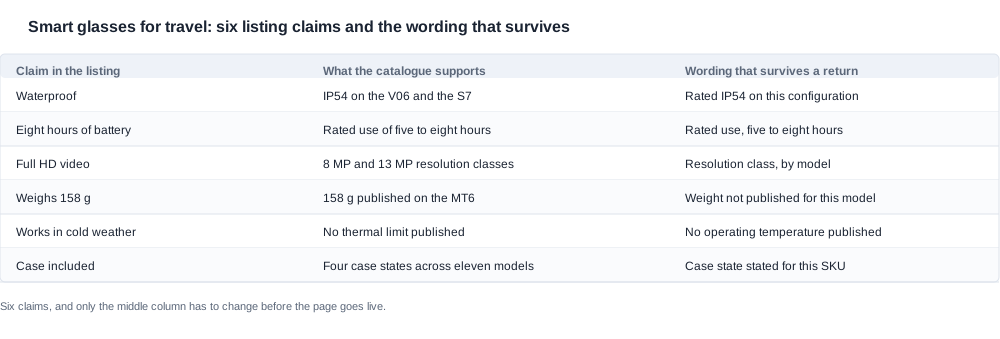
Exactly two models in the range carry an ingress marking: the V06 and the S7, both of which publish IP54. An IP54 marking describes a dust protection level and protection against splashing water. It does not describe immersion, it does not describe driving rain, and it does not describe a week of travel. No test report behind the marking is published for either model, and the remaining twenty-six models carry no ingress rating at all.
The claim fails fastest because a trip contains rain by definition. A customer who buys on "waterproof" and then stands in a shower on the second day has grounds for a return, and on most marketplaces those grounds are strengthened by the word itself — a page that said "waterproof" and a page that said "rated IP54 on this configuration, describing water splash protection" produce a completely different dispute.
The wording that survives is the longer one: rated IP54 on this configuration, describing protection against water splash. It is longer, which is why it gets cut, and cutting it is exactly how the claim comes back. The comparison method is at IP ratings and their limits.
Eight hours of battery
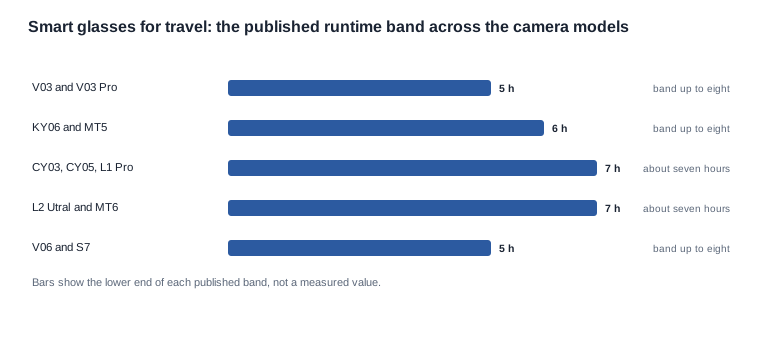
The camera models publish cell capacities from 220 mAh to 290 mAh and rated use figures that sit between five and eight hours depending on the model — five to eight hours on the V06 and the V03, and the V03 Pro and the S7, six to eight on the KY06 and the MT5, and roughly seven on the CY03 and the L2 Utral, and the CY05 and the L1 Pro, and the MT6. No runtime figure in the range carries a published test condition, so no figure in that band can be converted into a trip length.
The failure is that "8 hours of battery" collapses a band into a point and a point into a day. A travel customer plans in days, not hours, and a unit that lasted a working day is not a unit that lasted a trip. The page is then correct in the narrow sense and misleading in the sense the customer will act on.
The wording that survives names the band and the models: rated use of five to eight hours depending on model, published without a test condition. The published rows are at battery life.
The four claims that fail quietly
Any resolution claim beyond the class
Video resolution, frame rate and field of view are not published for any model in the range. What is published is a camera resolution class: 8 MP on eight camera models — the CY03 and the V06, the MT5 and the V03, and the MT6 and the KY06, and the V03 Pro and the CY05 — and 13 MP on three, the S7 and the L2 Utral, and the L1 Pro. A listing that says "8 MP" is stating a published row. A listing that says "Full HD" or "4K" or "1080p" is stating a specification the documentation does not hold, and the customer who receives something else calls it a misdescription rather than a difference of opinion.
The rule for a travel listing is narrow and easy to apply: state the class, name the model, and leave the video format alone. If the format matters to the channel, it is a question for the supplier and it belongs in the evidence file before the page is written, not in the copy after the page has gone live.
Any weight claim
Unit weight is published for exactly one model in the catalogue, at 158 g for the MT6 — and that figure is the weight of the glasses body including its cell and camera, excluding the foldable charging case. No frame weight is published anywhere in the range, and the MT6 is not a children's model, so its number cannot stand in for anything else. A travel page that states a weight for a different model is stating a number that does not exist.
Any temperature claim
No operating temperature range is published for any model, and no runtime figure is tied to a temperature condition. A cold-morning street is not the same measurement as a laboratory one, and a channel that implies a winter capability will hear about it in January rather than in a review summary. The wording that survives is the one that says the operating temperature range is not published for this model — which sounds like a weakness on a page and reads as carefulness to anyone who has bought hardware before.
Implying the case is included
This is the claim that most often arrives by accident, because the case appears in a photograph. The camera models sit in four different case states. Five publish a case capacity — 1400 mAh on the CY03 and the L1 Pro, and the CY05, 900 or 1400 mAh as a configuration choice on the L2 Utral, and 1200 mAh on the foldable case of the MT6. Two ship with a case whose capacity is not published, the KY06 and the MT5. Four have no case row at all in the catalogue, the V03 and the V06, and the V03 Pro and the S7, and a travel kit quoted for one of them without a written case position is a kit whose weight nobody has confirmed.
The difference matters more for a travel SKU than for any other application, because the case is what makes a multi-day trip workable and because the case is a second lithium cell that has to be declared in the transport file. A listing that implies a case in a photograph, a packing diagram or a "what's in the box" graphic will produce a "missing accessory" complaint on the first order, and the buyer will have paid for the cell in the freight without knowing it was there.
The questions to put in the RFQ
Most of the damage on a travel page is done before the sample arrives, and it is done by claims nobody asked about. The due diligence for a travel SKU is a short document request, and every item on it corresponds to a claim that would otherwise reach the page.
- Ask for the video format, the frame rate and the field of view for the models you are considering. These are unpublished, and they are the first thing a video-led channel will want to put on the page. If the answer cannot be given in writing, the page cannot claim them.
- Ask for the runtime figure with its test condition, per model. A rating without a condition cannot be checked, and a buyer who cannot check it will be told by a customer that it does not hold.
- Ask for the operating temperature range, or for a written statement that it is not published. Either answer is usable on a page; silence is not.
- Ask for the per-model unit weight, excluding any case. One model publishes a weight. The rest do not.
- Ask for the per-model case position in writing, including for the models where the catalogue publishes no case row. Unpublished is a legitimate answer; silence reads as "included" to a packing list.
- Ask for the evidence behind the ingress marking on the V06 and the S7, for the configuration being ordered.
- Ask for the per-model designation and the configuration list, so that the page, the packing list and the invoice all name the same thing. A truncated designation is worth more than a tidy one, because it is traceable.
- Ask for the conformity file for the destination markets, per model. The catalogue carries a company-level export certification page whose content is images rather than text, and the catalogue text contains no reference to CE, FCC or RoHS, so a per-model position is a document to request.
The answers that come back in writing are what the page is built from. The answers that come back verbally are what the page is built from when somebody is in a hurry, which is the situation in which the claim errors appear.

Rewriting the claim: the evidence pass
The correction is a procedure, and it takes one page of the supplier's own material. Six steps, in this order, because each one narrows the next.
- List every assertion on the supplier sheet that names a number or a capability. Include the ones that look harmless, because the harmless ones are the ones that survive into the listing unexamined.
- Match each assertion against a published row, model by model. The published rows are the cell capacity, the charge time, the rated use, the charging interface, the resolution class, the case state where one exists, the ingress marking where one exists, and the structural features that are named.
- Mark everything with no published row as unpublished. Then decide, per claim, whether to remove it, rephrase it as unpublished, or request the document that would let you make it. Removal is the safe default; requesting the document is the right default when the claim is central to the page.
- Rewrite the runtime claim as a band with model names attached, and never convert the published charge ceiling of two hours or less into a shorter window.
- State the case configuration for the exact SKU in the listing, and make the packing list agree with it.
- Read the finished page against a plausible complaint from a trip. If every plausible complaint maps to something the page actually said, the page is doing its job.

The four sentences that carry the page. The rated battery figure with its band and its models named. The designation exactly as written in the catalogue, including the truncated part. The case configuration stated either way. And one line saying that the video, storage and weight specifications are not published for this model.
Four sentences, all of them true, and each one removes a category of return that would otherwise be paid for out of margin. The sentence that does the most work is the last. A listing that says which rows are not published reads as more trustworthy than one that quietly omits them, because a customer can tell the difference between a short specification sheet and a careful one — and because the omitted rows are exactly the rows a customer will test on a trip.

Where a travel listing goes wrong, and what the terms can carry
A claim carried from the supplier sheet without a row behind it. The symptom is a return that arrives with a complaint about a capability the documentation never claimed. The root cause is a summary treated as evidence. The prevention is step two of the evidence pass, which takes ten minutes per claim.
A band collapsed into a point. The symptom is a runtime complaint in the second week of a trip, from a customer who expected a point and received the bottom of a range. The root cause is a single figure chosen from a band because a single figure fits in a bullet. The prevention is naming the band and the model on the same line.
An ingress marking generalised to the range. The symptom is a cluster of weather-related returns in one season. The root cause is two models' marking applied to a page selling several. The prevention is naming the models that carry it, and leaving the other pages silent.
A case implied by a photograph. The symptom is missing-accessory complaints on the first order, and freight paid for a cell the buyer did not know was in the box. The root cause is a packing image that was never checked against the case states. The prevention is the per-model case position in the evidence file, which the catalogue supports for five models and leaves open for the rest.
A weight carried across models. The symptom is a specification comparison that a customer or a reviewer finds to be wrong. The root cause is a single published figure for one model, applied to a page selling several. The prevention is to treat weight as unpublished for every model except the MT6, and to say so.
The commercial terms worth negotiating. Two of the six claim failures are bought out rather than written out, and both belong in the agreement rather than in the copy. The first is the returns reserve: a travel listing carries a higher return rate than most hardware listings because the customer is away from home when the claim appears, and a reserve set from the first shipment's actual ratio is cheaper than one set from a guess. The second is the packaging and artwork change window, because a travel SKU is the one most likely to be reprinted when the case configuration or the designation changes between runs, and reprinting after the artwork is printed is one of the most expensive avoidable costs in this category.
Everything else in the commercial conversation is settled by the product rather than by the relationship: the cell configuration and therefore the charge ceiling, the charging interface, the rated-use band, the resolution class, the case architecture, and the cost and lead time of conformity testing. A mould charge is a one-time cost and belongs in a separate quoted line rather than folded into the unit price. The minimum order quantity tiers, whether two configurations can share a purchase order, the payment milestones and a split first run into two deliveries are negotiable in principle, and the one to hold is the pilot quantity — because on a travel line the pilot is where the return ratio is measured, and the ratio is what makes the second order safe. The commercial structure of a first order is at pricing and the clause language is at contract terms.
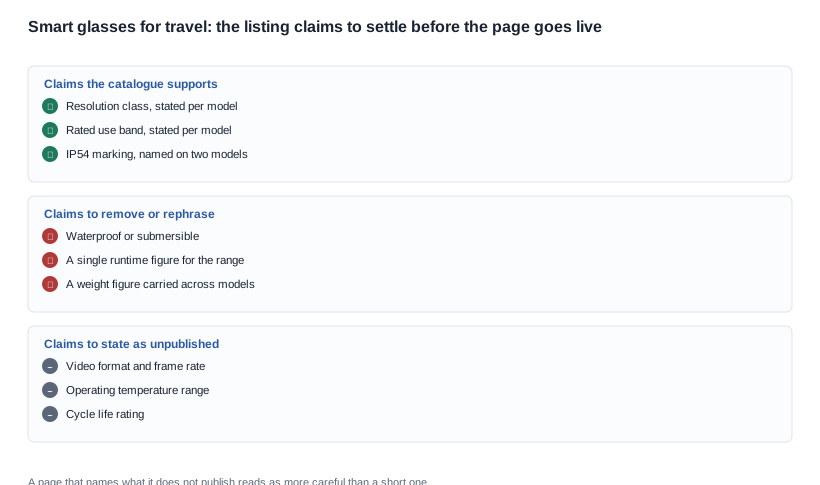
What the catalogue supports for a travel page, and what it does not
Here, we publish the configuration and we will tell you plainly where a claim would exceed what we hold. Cycle life, thermal limits, coating specifications, the video format, the frame rate, the field of view, the storage and overwrite behaviour and any ingress beyond the IP54 marking on the V06 and the S7 are all not published, and we would rather say so than have a page say it for us.
We also hold a position on the charge ceiling. Two hours or less is what the catalogue publishes on twenty-six of the twenty-eight models, and roughly one hour on the D17 and the ZH12. Two hours or less allows exactly two hours, so we will not write "under two hours" or "within two hours" on a listing, because those are different claims and the difference is the sort of thing a customer will notice on a trip.
What we will do: take the destination markets, the trip profile you are selling to, the models you are considering and the price band, and return the configuration list with the published rows attached, the claims those rows can carry, the claims that have to be rephrased, and the documents that would let a claim be made in full. For the application framework, see smart glasses for travel, for the buyer's version of the same material see what to avoid when buying, and for what fails across a trip rather than across a listing see long-term use in travel.
Related reading
- What to avoid when buying — the buyer's version
- Long-term use in travel — what fails over a trip
- IP ratings and their limits — reading the designation
Send the destination markets and the models you are considering, and we will return the claims those models can carry and the ones that have to be rephrased.