

What to bring to know about smart glasses for travel: where the evaluation really happens
A travel product is evaluated by a buyer in an office, and then it is used by a customer in a hotel room, at the end of a long day, in a country whose sockets and network they have just joined. The gap between those two moments is where this category's failures live, and closing it is what the evaluation kit is for. Every item on the list below exists to reproduce one of the conditions of that moment — the charge, the pairing, the bag, the record — so that the result can be written into a listing and a specification rather than assumed.
Who is buying and what they are deciding. The reader is a sourcing manager at the brand, a channel buyer or a product manager qualifying a travel product before a channel commits to it. The decision is which claims the listing may carry, which configurations are worth stocking for which itineraries, and which of the published figures the buyer can defend when a customer returns a unit after a wet weekend. The fear behind it is that the failure arrives publicly: a review that says the image was soft, a review that says it stopped working abroad, and a return rate that cannot be explained because nothing was measured before the order.
Why the published documentation does not plan the evaluation. Our published position across the range is a resolution class, cell capacities from 40 mAh to 290 mAh, charge times of two hours or less with roughly one hour on the D17 and the ZH12, rated runtimes of five to eight hours on the camera tier and six to eight on the audio tier, the charging interface per model, structural features on specific models, and case capacities on four camera models. The IP54 marking on the sport camera models carries no published third-party test report. Not published for any model: the sensor, the field of view, the video specification, the low-light behaviour, the storage and overwrite behaviour, the per-model frame weight, the operating temperature range, the cycle life rating, the runtime test condition and the standby draw. The published rows tell the buyer what the product is; they do not tell the buyer whether the product survives the trip it is sold for.
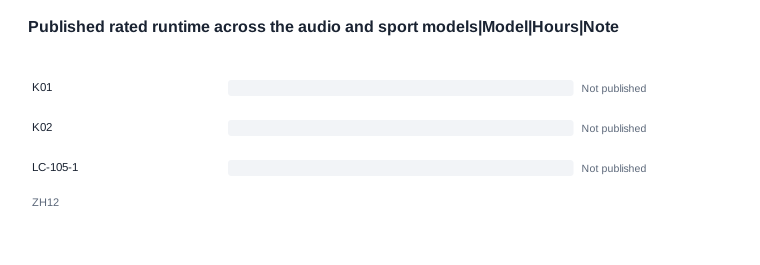
How to read the chart above, carefully. The figures are the published rated runtimes, and they are not comparable to one another as working-day figures. No runtime in this range carries a test condition, and the models differ in what they are doing while the number is measured — the children's entries publish about twenty hours on a light duty cycle with long idle periods, and the camera models publish five to eight hours with a sensor drawing continuously. The spread is narrow enough that the cell configuration is the more informative row, and a doubled-cell model publishing eight hours and a single-cell model publishing seven hours are describing two different architectures rather than two different days.

The kit, item by item
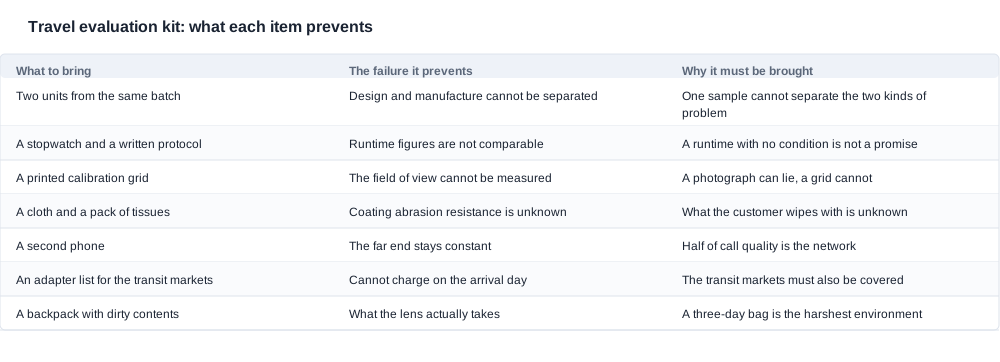
| What to bring | What it is for | The question it answers | Why it cannot be substituted |
|---|---|---|---|
| Two units from the same batch | Separating design from manufacture | Is this a product characteristic or a unit fault | One unit cannot answer it, and the remedies differ |
| A stopwatch and a written protocol | Making the endurance comparable | What the runtime figure actually means | A stopwatch without a protocol measures the tester |
| A printed calibration grid | Measuring the field of view | How much the listing photographs can claim | A photograph can be cropped; a grid cannot |
| A cloth and a pack of tissues | Reproducing the improvised wipe | What the coating has to survive in practice | The lens material and the coating are not published |
| A second phone, of a different make | Holding the far end constant | Is the call quality the device's or the network's | The far end changes the result more than the device does |
| An adapter list for the transit markets | Reproducing the arrival charge | What the customer finds on landing | A kit that covers only the home market fails at the first stopover |
| A backpack with something dirty in it | Reproducing the three-day carry | What a lens is actually pressed against | A clean table is not a bag |
The two units remain the most important item. One sample cannot separate a design characteristic from a manufacturing inconsistency, and the two need completely different remedies — a product change and a supplier conversation. A buyer who finds a problem on one unit and cannot say which kind it is has to resolve that before they can act on it, and resolving it after production has started is the expensive version of the lesson.
The adapter list is the travel-specific item, and it is a market question rather than a product question. A traveller arrives with a bag full of devices and sockets they have not seen. A Type-C device recharges from a cable that also charges the phone and the laptop, and the range publishes Type-C on the L2 Utral and the D17, the D12 and the V03 Pro, and the D11 and the ZH12 — with the D17 and the ZH12 publishing roughly one hour of charging, a window that fits between a flight and a dinner. A magnetic device needs its own cable or its case. The list has to cover the transit markets and not only the destination, because the first stopover is where the support contact is generated.
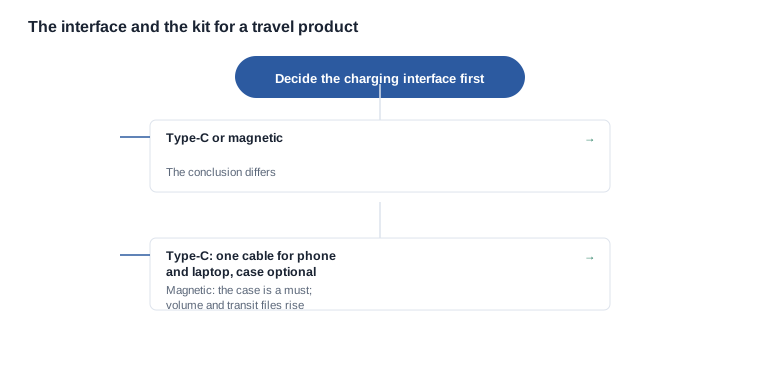
The bag test produces the storage rule, and the storage rule is what the listing has to promise. A lens is damaged as often by what it rests against as by what is used on it, and a three-day bag is the most abrasive environment in the category. The test output is therefore a pocket, a sleeve or the case, and the case capacities are published on four camera models — 1400 mAh on the L1 Pro and the CY03, and the CY05, 900 or 1400 mAh as a configuration choice on the L2 Utral, and 1200 mAh on the MT6's foldable case — with a second lithium cell to declare in each. The transport requirement is at battery transport, and the longer-run behaviour is at travel long-term use.
Turning the evaluation into a criterion
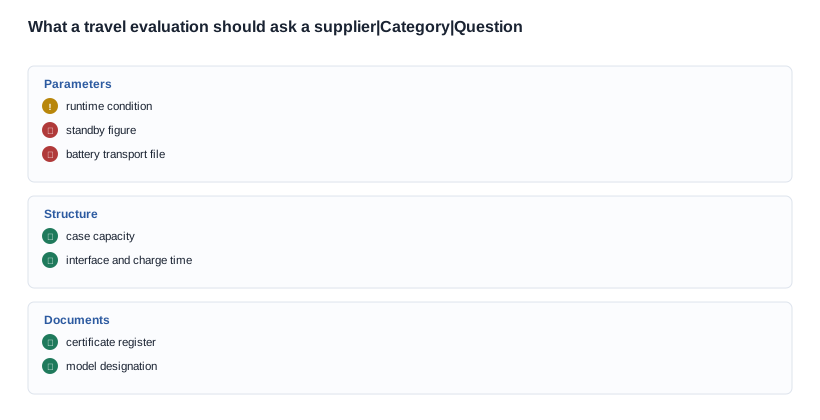
Numbers that carry no criterion are a demonstration, and a demonstration is the supplier's document rather than the buyer's. Five steps, each with a completion standard, and the fifth is where the demonstration becomes a criterion:
- Ask. Request the output parameter sheet with methods, the runtime with its condition, the standby figure, the storage and overwrite behaviour, the interface and charge time, the case capacity, the battery transport file, the model designation table and the certificate register. The completion standard is a written answer per item.
- Measure. Run the baseline still set, the measured field of view, the video with the frame rate held while moving, the low-light repeat, and the storage wall. The completion standard is a file set with the conditions recorded next to it.
- Record. Capture the conditions for every result: volume, phone state, light level, distance, speed, movement, storage state and ambient temperature. The completion standard is that a colleague could re-run the test from the sheet alone.
- Check. Look up every certificate number in the issuing body's public register, confirm the model and the configuration covered, and confirm the transit file covers the case. The completion standard is a register entry per model.
- Judge. Write the pass lines into the incoming inspection criteria. The completion standard is a criterion per measured characteristic, with the number and its condition attached.
What the water test can and cannot produce. The IP54 marking on the sport camera models covers splashing water and a dust protection level, not immersion and not a sustained downpour, and no test report behind it is published. An evaluation in the rain can therefore produce a statement of the form "tested in conditions of X for Y hours, after which the pass lines were still met" — a defensible observation with its conditions attached. It cannot produce "IP54 tested" or "rainproof", because those assert something the documentation does not support. The digit reading is at IP ratings.
Documents to request before a deposit. The signed evaluation sheet with its conditions, the output parameter sheet with methods, the runtime figures with their conditions, the standby figure, the storage and overwrite behaviour, the case specification, the battery transport file for the configuration, the model designation table, the certificate register, and the agreed incoming inspection criteria. The clause wording is published at contract terms, and the commercial structure of a first order is published at pricing.

Where a travel evaluation produces a false result
A room, a desk and a short session. It describes a product that will not be used that way, and the buyer's shortlist survives the evaluation and then fails in transit.
One unit. The most expensive mistake available, because it turns a solvable question into an argument.
A protocol that changes between candidates. If the light, the distance or the movement moves between runs, the comparison measures the setup rather than the products.
Testing the picture and stopping. A still is the easiest thing to shoot and the least predictive thing to sell, because the customer is filming while moving.
A water test read as a waterproof claim. The test shows what the marking means; it does not convert the marking into a different marking.
An adapter list that covers only the home market. The first stopover produces the support contact.
A permissive cleaning instruction. A bag is the least clean object a lens spends time against, and a T-shirt is the most available cloth in it.
A result that never becomes a criterion. A measurement nobody writes into the incoming inspection is a demonstration.
A runtime quoted without its conditions. It is the sentence that costs most in a travel procurement file, because the customer will supply their own workload in a review, and the buyer ends up defending a number they did not choose.

Smart glasses for travel: which parts of the evaluation stay open commercially
Fixed, and not a negotiation target. The camera and audio architecture, the cell configuration, the charging interface and the ingress architecture. The lens material, the coating and the frame material. Certification cost and lead time. The battery transport documentation. Tooling, amortised across the first order and quoted as a separate line.
Negotiable, in the order the money is. Whether the supplier will run the protocol against production units rather than engineering samples, and whether they will supply the recordings so the result can be re-judged — that clause converts a supplier's demonstration into a buyer's criterion, and it is worth more than any unit price reduction in this category. Whether a case is included and at which capacity, which is the cheapest way to build two price points from one platform and which also decides the transit file. The incoming inspection criteria, which are a negotiation between two parties. Whether the supplier funds a baseline measurement on the production batch, which is the document that answers every complaint in the second year. Whether an adapter ships for the transit market. Minimum order quantity tiers, and whether two models can share a purchase order. Logo, lens tint and packaging, including the kit contents and the documentation language for the target market. Splitting a first run into two deliveries against a staged payment. The quantity a travel line holds back at pilot tier.
A worked example. Take a travel brand evaluating two configurations for a launch into three markets, with a second market in the middle of the itinerary rather than at the end. The first move is the claim set, because it decides the plan: the listing describes the IP54 marking as a catalogue attribute covering splashing water and a dust protection level, it does not say waterproof, and the evaluation is written to produce observations with conditions rather than a waterproof claim. The second move is the protocol, fixed before the first run across the volume, the phone state, the light level, the distance, the speed, the movement, the storage state and the temperature. The third move is the two-unit rule, which is what makes the outcome actionable. The fourth is the adapter list, which covers the transit market rather than only the destination, and which is the item that decides whether the arrival charge works. The outcome is a claim set the documentation carries, an inspection criterion per measured characteristic, and a first shipment that produces the returns ratio needed to decide the second year's configuration.
What the evaluation leaves the buyer with. Three artefacts, and they are worth more than any single number the run produces. A claim set that the documentation carries, which is what stops the listing from promising more than the marking supports. An inspection criterion per measured characteristic, which turns the evaluation into something enforceable on a delivery rather than a memory. And an arrival test, because the arrival is the moment the customer will judge the product, and a buyer who has only tested on a desk has tested the wrong moment.
The questions a travel buyer should never skip. Four, and they are the ones that get deferred because they look bureaucratic. Is the battery transport file complete for the exact configuration, including the case, because the answer is required at a border and not in a quotation. Is the standby figure published for the model, because a travel product spends most of its time in a gap and a device that drains in a bag is a different product from one that does not. Does the case's own charge time and input have a published value, because a second product with a second specification needs a second answer. And does the listing photography show the unit that actually ships, because a marketplace listing is judged on one image and that image is the product's only argument.
What the kit decision produces for the buyer. Three artefacts. A bill of materials per configuration that can be quoted, inspected and compared against a second supplier. A transit file that covers the exact configuration being shipped, including the case, which is the item that gets asked for at a border. And a storage rule that the packaging can print, which is what keeps a lens from being pressed against a shoe for three days. All three are produced by the evaluation, and none of them is produced by a datasheet.
The two questions a travel buyer should never skip. Whether the battery transport file is complete for the exact configuration being shipped, including the case, because that answer is required at a border and not in a quotation. And whether the standby figure is published for the model, because a travel product spends most of its time in a gap, and a device that drains in a bag is a different product from one that does not. Everything else on the evaluation list is negotiable in order of importance; those two are gating, because one of them stops a shipment and the other determines whether the product works on a long journey.
The one line a travel listing must not get wrong. The listing is judged on one image and one paragraph, and the paragraph that fails most often is the endurance sentence, because the published figure looks like a promise and is not one. Write the number with its condition attached, or write the condition without the number. Both are defensible; the bare figure is not, and the customer will test it in a way that produces a review rather than a question.
What to bring to know about smart glasses for travel: what we publish, and where we stop
Concretely, we publish the rows a buyer can order from and we will not fill the gaps with industry averages. Across the range that means the cell capacities, the charging interface, the charge times, the resolution class, the rated runtimes, the structural features that are published, the colour counts, the case capacities where they are published, and the IP54 marking on the sport camera models stated as a catalogue attribute.
On the far side of the line, the gap list is the same in content and different in emphasis. No sensor part number is published for any model. No field of view, no video resolution or frame rate, no stabilisation figure, no low-light behaviour, no storage or overwrite behaviour, no capture latency, no thermal behaviour, no operating temperature range, no cycle life rating, no runtime test condition and no standby draw appears anywhere in the range. The per-model unit weight is published for exactly one model, the MT6, and that 158 g is the weight of the glasses body with its cell and camera and without the foldable case. We make no IP54 test claim for any product in our range, because the catalogue publishes nothing behind that marking that could support one, and a demonstration is not something we will offer as proof.
What we will do: take the itineraries, the markets, the trip lengths, the channel and the price band, and tell you which published rows apply, which claims the listing can carry, which tests have to be run on a production unit, and which criteria belong in the purchase order. The product families are at AI camera glasses and Bluetooth audio glasses, the model comparison is at comparing models for travel, and the scenario entry point is smart glasses for travel.
What to send us next. Send the itineraries, the markets, the trip lengths, the channel and the price band, and we will return the evaluation plan, the published rows that cover it, the claim set the documentation supports, and the criteria to write into the purchase order. The product recommendations are at travel product recommendations, and the adjacent cleaning procedure is at cleaning lenses for content creation.
Related reading
- The scenario's starting point — smart glasses for travel
- The product lines — AI camera glasses and Bluetooth audio glasses
- The transport requirement — battery transport
- The longer-run behaviour — travel long-term use
Tell us the itineraries and the markets, and we will return the evaluation plan and the claim set the documentation supports.


