

Smart glasses frame materials smart glasses certification requirements is an unusual search phrase, and the reason it is unusual is that the compliance conversation in this industry runs around the electronics while the frame is where the chemistry is. A circuit board is a component inside a product. A frame is a product surface that carries the base polymer, the pigment, the surface coating, the plating on the hinges, the adhesive at the temple joint and the nickel in the skin-contact areas — and it is also the part a brand changes most often. A new colour is a new material. A new temple shape is a new material with new tooling.
Two conclusions follow, and both of them are about sequencing rather than about law.
The first is that every frame change is a material event. A programme that alters colour, temple profile, hinge supplier or polymer grade after the compliance file has been assembled has reopened the declaration, the traceability record and possibly the configuration that an ingress marking covers. Discovering that at the artwork stage costs a reprint and a schedule move. Discovering it at the quotation stage costs one email.
The second conclusion is about our own catalogue, and we will state it before anything else. Our catalogue's front page carries a company-level export certification page whose content is images rather than text, and the catalogue body states no certification position in words. There is no per-model certification row anywhere in the catalogue, so nothing on that page can be read as a statement that any particular model holds a particular certificate, and we will not allow a buyer to infer one.
Smart glasses frame materials: what arrives before the electronics do
Compliance for a smart glasses product is usually discussed as a radio-and-battery conversation, and the frame arrives later in the file than it should. Six instruments touch a smart glasses frame. Three of them touch it harder than they touch the electronics, because the frame is the surface, the skin-contact part and the enclosure all at the same time.
The substance rules sit on the skin-contact surface
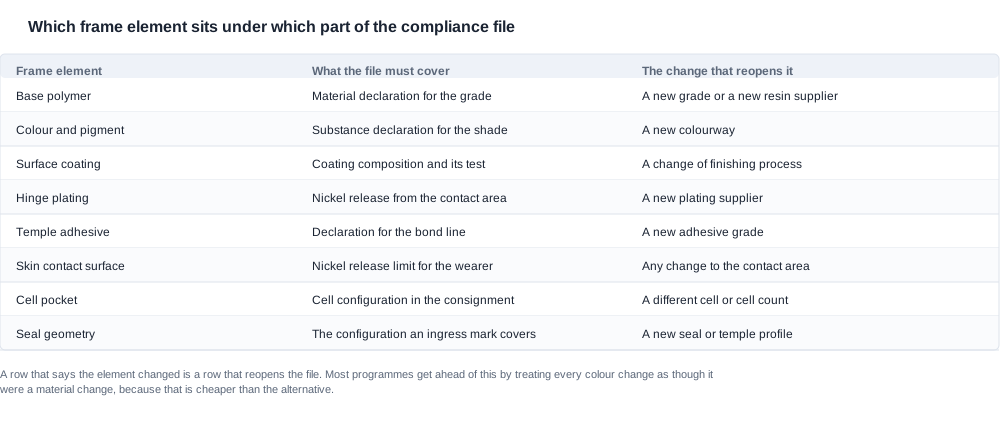
RoHS and REACH reach further into a smart glasses frame than they reach into the electronics. A board has a fixed bill of materials: the components are what they are, and the declaration names them. A frame is a stack of chemistries that sit on or beside the skin — the base polymer, the pigment, the coating, the plating on the hinges and temples, the adhesive, the soft tip material and the nickel released from the skin-contact surfaces.
Three practical consequences follow for a buyer writing a specification.
The first is that a declaration for a raw polymer is not a declaration for a finished frame. Ask for a material declaration that names the frame and the finish as shipped, not a general statement that the product complies. Our substance guidance sits under rohs and reach, and it is worth reading as a scoping document rather than as a compliance summary.
The second is that a colour change is a different declaration from the base colour. Pigment, coating and surface treatment are separate substance questions from the polymer, and the one that carries a certification body attached to it is rarely the polymer. This is why colour count is a compliance decision and not only a marketing one. Our range publishes three colour options on the V03 Pro and four on the V06; every one of those is a configuration question in the file, not a picture on a product page.
The third is that nickel release is a frame question, and it is a buyer question. Which surfaces are in skin contact, which of them are plated, and what evidence exists for that plating are frame rows that the catalogue does not carry and that your own quality assurance function will ask for during supplier evaluation.
That third point is where a buyer most often gets a soft answer, because "the product is RoHS compliant" is a true statement about a range and useless as an answer about the frame in the box. The criteria you should hold are narrow and testable: the declaration has to name the finish, the plating has to be identified as the surface treatment on the skin-contact areas, and the evidence has to be a document with a number rather than a sentence. If a supplier cannot produce those three things for a specific colourway, that is a red flag you want at quotation stage, because the alternative is discovering it during the compliance review of the finished product.
The radio directive reaches the frame as an antenna environment
The Radio Equipment Directive (EU) 2014/53/EU is the instrument most people picture as an electronics matter, and in a smart glasses product it is largely one. But the frame is the environment the radio has to work inside, and it is worth being precise about why that matters to a procurement decision.
A radio in a pocket has a body around it. A radio in a temple has a body, a head and a frame around it, and all three change the antenna's behaviour. A metal frame, a frame with a metal plate, a frame with a metal hinge at the ear end, and a frame held against a human head are all antenna questions. They are design questions rather than documentation questions, and they are the reason a supplier who treats the frame and the radio as separately specified items will eventually produce a unit that has to be retuned.
The directive reference matters for the same reason. The Radio Equipment Directive is (EU) 2014/53/EU. The electromagnetic compatibility directive is a different instrument with a different number, (EU) 2014/32/EU, and the harmonised EMC standards that appear in a conformity file sit underneath that second one. A document request that mixes the two will get you a supplier who has answered a question you did not ask, and the ambiguity will surface again at the customs stage.
For a buyer, the practical consequence is a question about co-design rather than a question about paperwork: does the frame design and the radio design belong to the same team, and was the frame released before the radio was tuned? A frame change after radio tuning is a change to the antenna environment, and it belongs on the change-control list next to the material declaration.
The safety and traceability regime treats the frame as a part of the product
General product safety and traceability obligations reach the frame as parts of the finished product, and the practical point is a joint one. The finished unit has to be traceable to its batch, and the frame has to be identifiable within that batch. A brand that changes frame supplier mid-programme has changed its traceability position, not merely its appearance.
That has a supplier evaluation consequence. The question a quality assurance auditor asks is not "is the frame compliant" but "if a unit is pulled from the market in six months, can you tell which resin, which pigment batch and which plating run it came from". The answer lives in the frame supplier's records, and whether they exist is something you have to establish before the first order, because the answer is not reconstructable afterwards.
Traceability is also where private label programmes get caught. A branded unit assembled from an unbranded platform is a different traceable object from the platform itself, and the labelling and file questions that follow are frame questions in the sense that the frame carries the branding.
Battery transport reaches the frame because the frame is the shipping configuration
The cell is carried by the temple and the temple is the packaging. A frame change that alters the cell pocket, the cell count or the cell's position in the assembly alters the battery configuration in the consignment, and the transport rules apply to the consignment as a whole rather than to the cell in isolation.
Our catalogue publishes cell configurations as they are printed: 55mAh×2, 70mAh×2, 90mAh×2 and single-cell entries at 100mAh, 115mAh, 200mAh, 220mAh, 260mAh, 265mAh and 290mAh. A cell count of two in a temple is a different physical arrangement from a single cell in the same volume, and it is the arrangement, not the nominal capacity, that determines the transport documentation.
For a buyer this lands in one place: the frame, the cell pocket and the transport file are one workstream, and a supplier who quotes a cell configuration without saying how it is carried in the frame has not answered the question. The UN38.3 summary and the cell specification are the two documents worth asking for together.
The ingress marking is a claim about the frame
In this category the ingress marking is a claim about the enclosure, and the enclosure is the frame. A change to the sealing approach, the hinge, the temple profile or the colour process is a change to the thing the marking was about.
Two boundaries should be stated plainly. First, in our catalogue the IP54 marking appears on the V06 and on the S7, as an annotation on those two products; no other model in the range carries a published ingress marking. Second, and this is the part that matters to a procurement file, we publish no third-party test report number behind it, no standard, no test condition, no sample size and no laboratory, because those details have not been confirmed to us. A marking without a resolvable document is a catalogue statement, and it cannot be carried onto your product page as a substantiated claim.
That is not a criticism of the marking. It is a statement of what a marking is worth without a document behind it, and the distinction between the two decides whether a buyer can defend the claim when a retailer, a marketplace or a customs inspection asks.
Children's product rules reach the frame first
Where a product is sold for an age range below the adult market, the frame carries the questions before the electronics do. Skin contact and its surface treatments, small parts, the age grade of the product and the labelling of the age grade are frame questions before they are electronic ones. The harmonised standards a supplier works to in that space — EN 71 and ASTM F963 — are constraints on the supplier's own test programme.
We are not making a children's product claim, and we will not infer one. Our catalogue's export certification page carries images rather than text and states no certification position in words, the children's product certification position is not published to us model by model, and the absence of a per-model row is not evidence either way. What a buyer can do is ask the supplier directly which models are tested to which standard, on what date, against which sample, and to produce the report number.

A frame change is a material event, not a colour change
The four rows in the table above are the changes a programme actually makes, and the interesting part of that table is the third column. It is not that a colour change is invisible to the file. It is that a colour change, a hinge change and a temple change all reopen something, and only one of them reopens a qualification.
Here is how a frame change actually travels through the file. The sequence matters because each step assumes the previous one passed, and a step that fails tells you what the next step would have told you at a fraction of the cost.
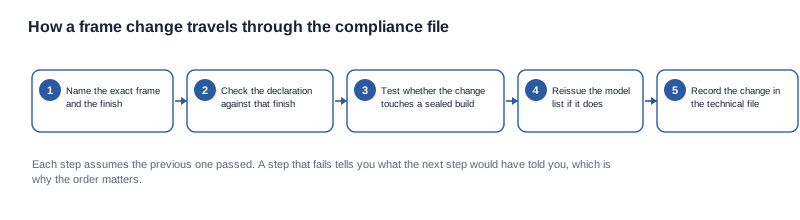
The first step is naming. A change control entry that says "temple updated" is not a compliance record, because it does not identify the polymer, the coating, the plating or the seal that were touched. The entry has to name the element and the finish, and that requirement is small enough to write into a purchase order as a standing clause.
The second step is the declaration check, and this is where most programmes discover the problem. A supplier is asked whether the new colour is covered. The answer is frequently "the base material is the same", which is true and incomplete. The base polymer being the same says nothing about the pigment, the coating or the surface treatment. The question that closes the row is whether the material declaration for the shipped finish names the new colour, and if it does not, when it will.
The third step is the sealed configuration. If the product carries an ingress marking, the frame is the enclosure, and any change to the temple profile, the hinge or the seal has to be checked against the configuration the marking was written for. For the V06 and the S7 this is a live question, because both carry the IP54 marking in our catalogue and both have a detachable inner frame — a detachable inner frame is exactly the kind of element whose change has to be watched.
The fourth step is the model list. Where the documentation names a set of models or configurations, a change that adds a configuration outside that set means the list has to be reissued. This is administrative, it is cheap, and it is the step most often skipped because nothing is visibly wrong until the file is examined.
The fifth step is the technical file itself, and it is the step that makes the other four retrospective rather than preventive. A change that is not recorded in the file is a change that will be found by somebody else.
The commercial consequence of this sequence is straightforward. The three customisation lines we run that are genuinely commercial — logo, Bluetooth name, packaging — do not touch the frame's chemistry. The lines that do touch it are the ones with a file attached, and they are not decided at the artwork stage.
Before you order a colour range, put this sequence on the purchase order as a checklist rather than as a conversation. The criteria that belong there are specific: a change notification clause covering polymer, pigment, coating, plating and seal; a declaration reissue obligation; the exact model string that the documentation names; and an acceptance criterion for the inspection standard of the finish. A supplier who accepts those four lines has a compliance function, and a supplier who objects to them has told you where the risk sits before you paid for it. The trade-offs are worth naming too: strict change control costs the supplier flexibility and may cost you a colour, while loose change control costs you the file, and the second of those is the one you cannot fix later.

The export certification page, and the rows it does not contain
Our catalogue's front page carries a company-level export certification page whose content is images rather than text, so it carries no certification statement in words at all, and the catalogue body names no CE, FCC or RoHS. There is no per-model row, no certificate number, no issuing body and no validity date against any individual product.
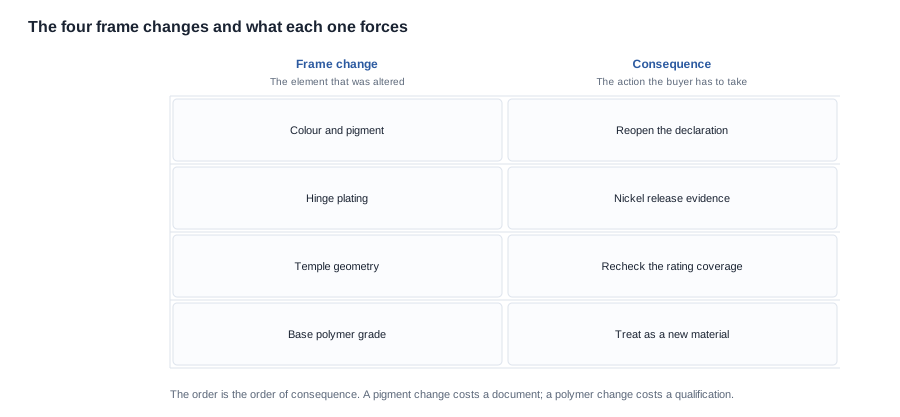
The four rows of that matrix are the four frame changes again, ranked by consequence rather than by likelihood, and they are worth ranking because a buyer triaging a colour change against a polymer change will otherwise treat them as the same size of decision.
A pigment change costs a document and a question to the supplier. A plating change costs nickel release evidence for the skin-contact area, because the plating is what stands between the metal and the skin. A temple geometry change costs a check of the sealed configuration, because the geometry is part of the enclosure. A base polymer grade change costs a qualification, because a different grade is a different material in every file that references the old one, and because the stiffness and thermal consequences of a different grade propagate into the electronics bay.
What the company-level export certification page does not do is transfer to a model. Its content is images rather than text, so it says nothing about which model holds which certificate, in which configuration, from which body, with which validity dates, and it certainly does not say anything about a children's product certification or a medical positioning for any individual product in the range. Any of those would be an inference, and an inference is exactly the thing that fails an audit.
The consequence for a procurement file is that the certification rows have to be requested per model, with a number that can be resolved later. A brochure line cannot be resolved. A certificate number can be checked by your compliance team, by a marketplace, by a broker or by a customs inspection, and that checkability is the property you are actually buying.
The due diligence rule that follows is simple enough to put in a supplier evaluation form: for each model in the shortlist, ask what to ask — certificate number, issuing body, standard and edition, model list, tested configuration, validity dates — and record the answer against the model string rather than against the product family. When a supplier answers for a family instead of a model, that is not a helpful shortcut, it is the single most common red flag in this category, because a family document is the natural artefact of a supplier who has not configured anything. Which model a certificate belongs to is a question with a factual answer, and a buyer who has the answer at quotation stage has no compliance risk to schedule around.

The two frame questions that decide a programme
Most of the frame-specific compliance questions resolve into two, and both of them are the kind that get deferred until they are expensive.
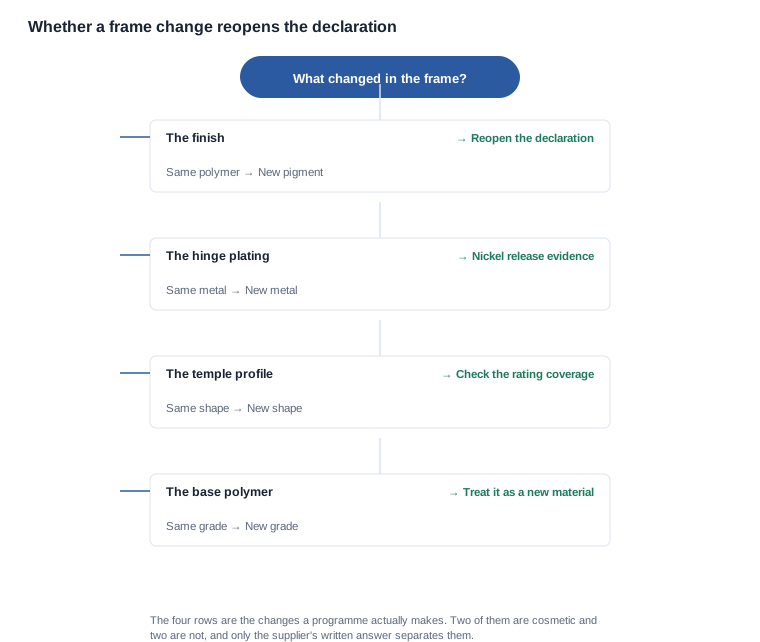
The first is whether the material declaration covers the finish you are shipping. Not the base material — the finish, the coating and the plating, for the exact colourway and the exact temple build in your order. A declaration for a raw polymer is not a declaration for a finished frame, and a declaration for one colour is not a declaration for the second colour added in the launch range. This is the question with the largest effect on the artwork schedule, because the answer arrives in weeks and the packaging artwork does not wait for it.
The second is whether a replacement frame can be fitted without invalidating the file. This is the question with the largest effect on the after-sales budget, and it is a frame question rather than a product question. Where the electronics can move to a different temple, the new temple is a different material in the declaration and a different configuration in the traceability record. That is true whether the replacement is a warranty event, a colour-matched spare part for a channel programme or a seasonal variant.
There is a third question that a lot of buyers ask first and that should be asked last: does the product need certification for the market I am selling into? That is a decision, it belongs to you, and it is the one question in this set that a supplier cannot answer for you. When to ask it is worth deciding early, though, because the answer changes which documents you request, and a request sent after the range is fixed tends to come back as a reissue rather than as a row.
The pitfalls in this area are all of the same shape: a question asked at the wrong stage. Asking whether a document exists after the artwork is printed, asking whether a colour is covered after the tooling is cut, and asking whether a replacement temple is compliant after the spare parts are in the warehouse. Each of them is recoverable in principle and expensive in practice, and each of them was answerable with one email at a point when the email cost nothing but attention.
Where we will state a boundary and stop
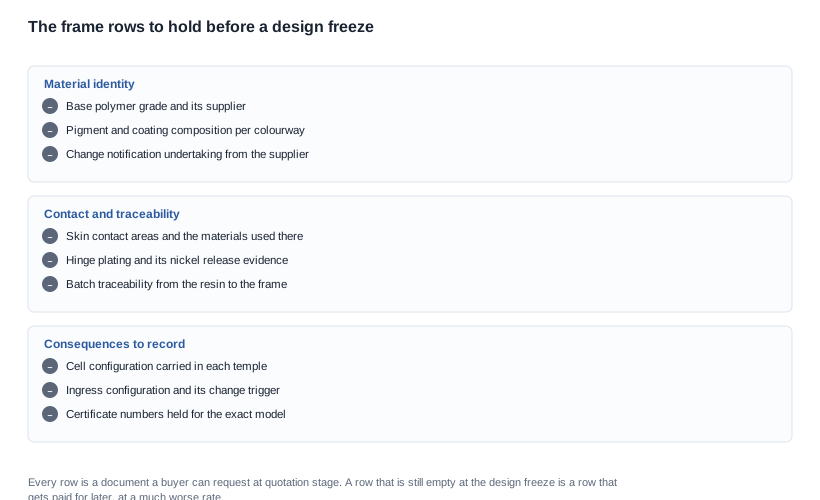
It is worth being precise: we publish no certification claim the catalogue does not make and no per-model certification row to copy, and we publish the empty rows next to the published ones rather than filling them with typical values. We will not print a certificate number we cannot quote, and we will not present a company-level export certification page as though it were a per-model frame declaration for a specific finish.
We will also say what is missing rather than leaving the reader to infer it. The catalogue publishes no material declarations, no frame dimensions, no temple lengths and no material composition for any model. It publishes one weight figure for the whole range, and that figure needs its exact terms: the MT6 glasses unit is published at 158 g including its battery and its camera, excluding the foldable charging case, whose capacity is 1200 mAh and whose weight is not published. The weight of a bare frame is not published for any model, and we will not present the 158 g figure as one. In a range of twenty-eight product entries, eleven of which carry a camera, that is the honest state of the frame data.
What we can do is tell you, for a specific model and a specific finish, which instruments reach the frame and which documents we can supply for it. The wider compliance context is under market compliance centre, the substance rules are under rohs and reach, the material context is under materials and ergonomics, and the change consequence for a customisation is set out under customization options certification impact.
Send us the model, the finish and the target market, and we will tell you which rows of the documentation we hold today and which ones have to be obtained.
Related reading
- The substance rules — rohs and reach
- The material context — materials and ergonomics
- The change consequence — customization options certification impact
Tell us the model and the finish, and we will tell you which instruments reach the frame and which documents we hold for it.


