

Frame material cost in a smart glasses product is usually discussed as though the material were the main variable, and it is not. The material is a fraction of the frame cost, and a smaller fraction of the product cost. The variables that actually move the number are the ones that determine how much of the frame has to be built, how many of them have to be changed, and how much of the finish has to be redone when something is wrong.
Which means cost control in this category is a design control problem before it is a purchasing problem, and a buyer who treats it as a purchasing problem will negotiate the wrong line in the quotation.
Our published data illustrates the point better than any argument could. The catalogue lists twenty-eight product entries and eleven of them carry a camera. The unit weight is published for exactly one model in the whole range, and that figure needs its exact terms: the MT6 glasses unit at 158 g including its 265mAh cell and its camera, excluding the foldable charging case, whose capacity is 1200mAh and whose weight is not published. The weight of a bare frame is not published for any model. The material itself is not published for the range. The published colour options are three for the V03 Pro and four for the V06.
So the published data tells you almost nothing about the material and nothing whatsoever about the cost. That is exactly the point, and it is why smart glasses frame materials smart glasses cost factors is a question about what actually determines the number.
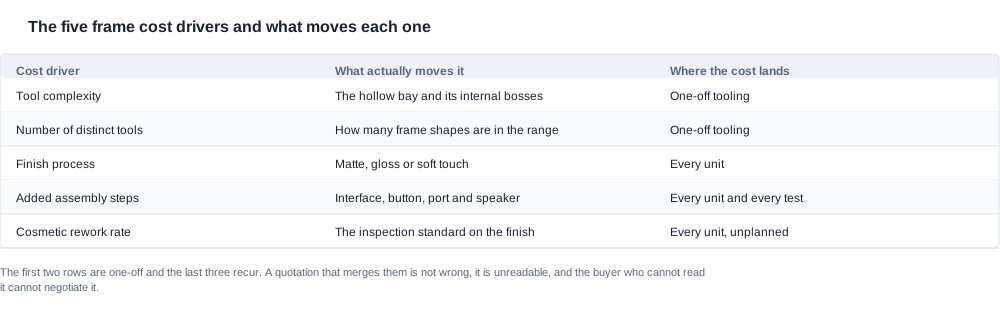
Smart glasses frame materials: the five cost drivers and their order
One: the complexity of the mould, not the material. A frame with electronics in the temple has a hollow section with internal bosses, ribs, a cavity for the board and a run for the cell. That is a more difficult tool than an optical frame, and it is where most of the tool cost sits. The material changes the tool cost at the margin. The geometry changes it by an order of magnitude. A buyer who negotiates the material line in a quotation is negotiating the smaller of two numbers.
Two: the number of distinct tools. A programme with three colour options has one frame tool and three finishing processes. A programme with three different frame shapes has three frame tools. Our range publishes colour options within single models — the V03 Pro at three and the V06 at four — which is the cheaper arrangement, and it is worth understanding why before choosing a range structure. The mistake this cost is the one where the colour range grows to eight in the launch and the shape range grows to two, because someone assumed colours were free after the first tool.
Three: the finish, which recurs on every unit. Matte, gloss and soft-touch are three different process steps with different consumables and different cycle times. A gloss finish is slower to produce and stricter to inspect, and both of those show up in the unit price rather than as a one-off. This is the point where a buyer who compared two quotations at the same unit price can be looking at two different products, because one of them has a stricter inspection standard folded into its cost.
Four: the assembly steps the electronics add. A charging interface, a button, a port, a microphone, a speaker. Each one adds an assembly operation, a test operation and a failure mode, and the test operations are frequently the largest hidden cost in the whole programme. The reason they are hidden is that they are quoted as a cycle time inside a production line rather than as a line of their own.
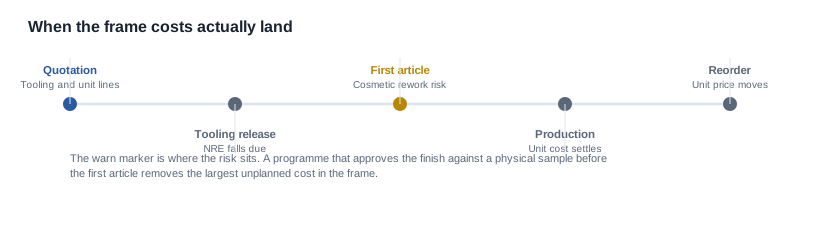
Five: the rework rate, which nobody forecasts. The most common first-article rejection in this category is cosmetic, and a cosmetic rejection at the first article costs a rebuild, a new first article and a schedule move. The cost of approving the finish against a physical sample before the first article ships is a fraction of it, and it is the cheapest cost control available to a buyer in this category.
The two costs that are almost always quoted as one
Two items in a frame quotation are almost always merged, and the merge is what makes the quotation hard to compare. They are the tooling itself and the non-recurring engineering that surrounds it.
The tool is the physical cavity: the steel or aluminium that forms the front and the temple. Its cost is driven by the number of cavities, the complexity of the geometry and the number of shots it has to survive before it is running well. It is a genuine one-off per frame shape, and it is the one line in the quotation where a change in quantity changes the price only through amortisation.
The non-recurring engineering around the tool is everything else: the design work, the trial shots, the material and process development, the sampling, the fixture design and the engineering hours. It is also largely a one-off, but it is not a constant, because it is the part that grows when the design is not settled.
The reason the merge matters is that these two respond differently to quantity. The tool cost per unit falls as the volume rises. The engineering cost per unit falls much faster, because the engineering is finished once and then repeated across the whole run at zero marginal cost. A buyer who negotiates the merged line at a single quantity is negotiating against a number that will fall on its own, and is likely to negotiate it harder than it deserves.
The practical question that separates them is short: what is the amortisation volume the supplier has assumed, and over how many units is the engineering spread? A supplier who states it plainly is a supplier whose quotation will hold. A supplier who gives you one blended number has given you a number you cannot check.
There is a third question that belongs in this group, and it is the one that decides the disposal risk: what happens to the tool if the programme is discontinued or transferred? Tool ownership is a negotiable term, it is worth negotiating, and it is worth negotiating in writing before the deposit rather than after the programme has proved itself.
The four costs quoted as one-off that recur on every unit
Four items in this category are habitually bundled into a one-off block, and every one of them is a recurring cost. This matters because the one-off block is the block a buyer negotiates hardest, and the block they negotiate hardest is usually the one with the least leverage in it.
Soft tooling. Silicone tips, pads, straps, and the finishing on the temple tips. These recur on every unit and are often quoted inside a tooling line because they were introduced at the same time as the tool.
Packaging inserts and the printed manual. Both recur on every unit, and both have print minimums that make the first order disproportionately expensive. A programme with a manual in four languages has one artwork file and four print runs, and the artwork cost is the smallest part of it.
The fixture for the inspection plan. Where a specific measurement is required, the fixture is a genuine one-off. The maintenance, the calibration and the replacement of a worn gauge are not, and they are not in the quotation at all.
The per-language artwork. This is the one that appears as a single line and behaves like many. Artwork changes during a programme are normal, and every change triggers a reprint across the number of languages in the range. A programme with four languages and four artwork rounds has sixteen print runs, and the ones after the first round are the reason the unit price moved after the order was placed.
The test for a buyer is simple and it is worth applying to every quotation in this category: take the one-off block and ask, for each line, whether this figure changes when the order volume doubles. If it does, it is not a one-off and it should not be negotiated as one.
How to audit a one-off block in twenty minutes
The audit is mechanical once you know what you are looking for, and it takes less time than most buyers spend arguing about a unit price. Four passes over the block.
Pass one: mark every line that mentions a unit, a colour, a language or a market. These are the recurring lines hiding inside a one-off block. Packaging inserts, printed manuals, soft tips, straps, per-language print runs and per-market labelling all carry one of those words, and all of them recur.
Pass two: mark every line that mentions a mould, a tool or a fixture. These are the genuine one-offs, and they are the lines worth negotiating hard because a supplier's margin on a tool is negotiated in a different place from its margin on a unit.
Pass three: mark every line that mentions artwork, sample or approval. These are the lines that recur conditionally — they recur every time the artwork changes, and the artwork changes more often than anyone forecasts. They are the hardest lines to see in a quotation and the most expensive ones to miss, because each recurrence is a print run and a schedule move.
Pass four: ask what is not on the list at all. Things like the calibration of the inspection fixture, the maintenance of the gauges, the cost of a rejected first article and the cost of a second tooling attempt are frequently absent rather than merged. An absent line is a line you will pay for later, and the price of it will be a schedule move.
The output of the audit is a shortlist of four or five lines that are genuinely one-off and a list of the recurring lines that were hidden. That list is what you negotiate against, and it is a much shorter list than the quotation was.

The four questions that expose a frame quotation
A frame quotation is not opaque, it is just structured differently from the way buyers are used to reading. Four questions move it from a number into a programme.
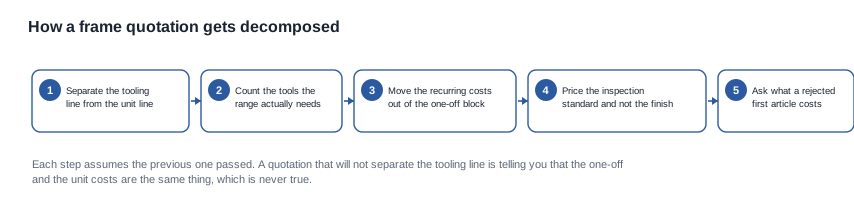
Question one: how many distinct frame tools does this programme need, and which of them are new? The answer separates a configuration programme from a development programme, and it is the question with the biggest effect on the total cost of the range. A programme with one new tool and four colourways is a different commercial proposition from a programme with four new tools, and both can be described as a range.
Question two: what is the finish process, and what is the inspection standard for it? This determines both the unit cost and the rework risk, and the two are usually quoted as one number. Ask for the standard in physical terms — against what, judged how, by whom — and the unit price becomes comparable with another supplier's for the first time.
Question three: what is the assembly step count with and without the electronics, and what does each added step add to the test cycle? The test cycle is where the cost hides. A supplier who will give you the step count has a production engineering function, and the step count is also the number you will need for your own landed cost and lead time model.
Question four: what is the expected cosmetic first-pass rate, and what does a rejection cost? If the answer to the first half is a specific number, the supplier has done this before. If the answer to the second half is "we rework it", you now know the cost is in your schedule rather than in their invoice, and you should price it yourself.
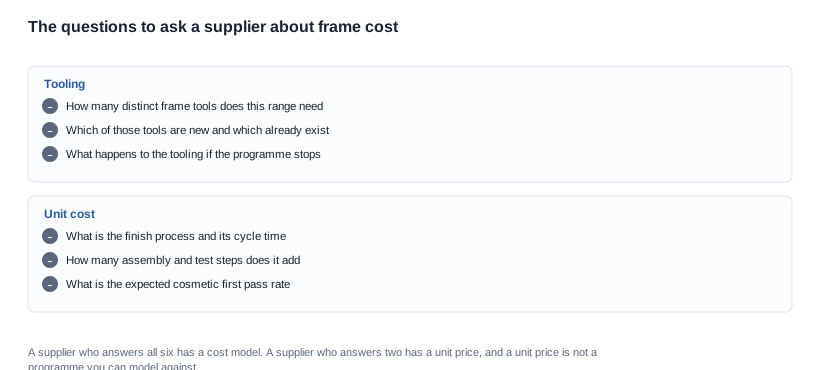
The checklist version of the same thing is worth sending as a document rather than as four questions in an email. A numbered list gets a numbered answer, and a numbered answer can be attached to a purchase order as an acceptance criterion. Four questions in an email get four paragraphs, and four paragraphs cannot be audited.

The three cost decisions a buyer controls
Not all cost is in the supplier's hands, and the three decisions that are in a buyer's hands are worth more than most of the negotiation.
Consolidate the colour options into fewer moulds. Our range publishes four colours within one frame on the V06, which is the right structure. Four frames with different shapes is four tools. The decision to add colours inside one frame rather than shapes is a cost decision, and it is cheaper than the reverse by an order of magnitude.
Approve the finish against a physical sample before the first article. This is the cheapest cost control in the category and it is entirely within the buyer's control, because it costs a sample and a decision rather than a negotiation. A finish approved in principle and rejected in production is the single most expensive avoidable event in a frame programme.
Decide the frame geometry before the cell, not after. A frame designed for a cell and then fitted with one costs a second tool. A frame designed around a known cell and a known charging interface does not. Our published cell configurations — 55mAh×2, 70mAh×2, 90mAh×2, and single cells at 40mAh, 70mAh, 100mAh, 115mAh, 200mAh, 220mAh, 260mAh, 265mAh and 290mAh — are the inputs to that decision, and choosing among them is a decision a buyer can make early and cheaply.
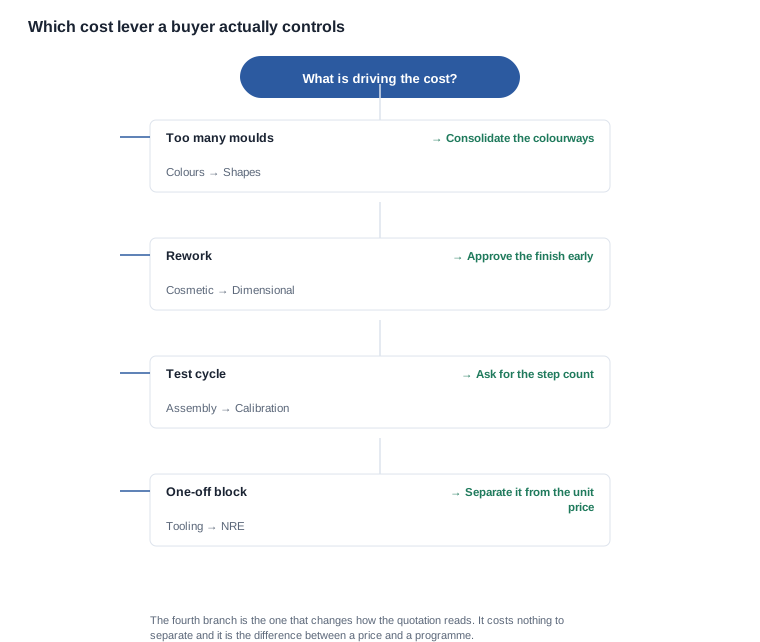
There is a fourth decision that is more of a negotiation than a control, and it is worth naming: the number of configurations you commit to. A supplier prices a programme with a stated configuration count, and that count is a commercial variable in the same way the unit count is. A buyer who commits to two configurations and a later one who commits to six are not buying the same thing, even at the same unit price, and the second buyer pays for the first one's optionality.
What makes two frame quotations comparable at all
Two quotations for the same product title can differ by a factor of two, and in this category the reason is almost never the material. It is that the two quotations describe different products, and the difference is usually invisible until you ask.
Four questions close the gap, and they are worth asking in this order.
Are both quotations for the same cell configuration? Our catalogue publishes several configurations across the range, from 40mAh single cells in the children's models through 55mAh×2, 70mAh×2 and 90mAh×2 dual arrangements to single cells at 220mAh, 260mAh, 265mAh and 290mAh. A frame with two cells in the temple is a different tool from a frame with one, and a quotation that does not name the configuration cannot be compared with one that does.
Are both quotations for the same frame geometry? Two frame shapes means two tools, and the second tool is usually quoted as an incremental line rather than as a second tool. A range with one shape and four colours is not the same programme as a range with four shapes and one colour, even where the unit count is identical.
Do both quotations carry the same finish standard? A gloss inspection is a stricter inspection, and the cost of that stricter inspection appears in the unit price and not on a separate line. Asking for the standard in physical terms — against what, judged how, by whom — is what makes the two numbers comparable.
Do both quotations include the same test and assembly scope? The step count is where the largest hidden cost in this category sits, and it is frequently quoted as a cycle time inside a production line rather than as a line of its own. Two quotations with the same unit price and different step counts are not the same product.
None of these four questions is difficult, and each one is worth more than the unit-price negotiation that usually takes the time instead. The trade-offs are real and they are not symmetric: asking them costs a round of correspondence, and not asking them costs a reorder at a price you cannot predict.
Why we publish no frame cost figure
Concretely, we will not publish frame material costs, unit prices or tooling charges, because they depend on the geometry, the finish, the quantity and the tooling position, and a number quoted without that context is not one you can model a programme against. A price that reads as a bargain in isolation can be a programme that costs twice as much by the second reorder, and the context is the part that matters.
What we will do is itemise a quotation so that the tooling appears as a separate line from the unit price, tell you how many tools a given programme needs, tell you which costs recur per unit and which are genuinely one-off, and tell you what the four questions above will reveal. Our standard for that itemisation is in standard OEM pricing drivers, and the tooling side of it is in standard OEM tooling requirements.
We will also be honest about the published position, because it is thin and it is the reason this article exists rather than a price list. The frame material is not published for the range. The glasses-unit weight is published for one model only, at 158 g for the MT6 including its cell and camera and excluding the foldable case. No bare frame weight is published for any model. If any of those is a decision variable for your programme, ask for it in writing, per model, per build, and treat the answer as a data request rather than a courtesy.
If you are new to the category, the orientation is under frame materials for beginners, and the wider material context is under materials and ergonomics. Send us the frame geometry and the finish requirement, and we will tell you how many tools the programme needs.
Related reading
- Materials and ergonomics
- Frame materials for beginners
- Standard OEM tooling requirements
- Standard OEM pricing drivers
Send the frame geometry and the finish requirement and we will tell you how many tools the programme needs.


