

The frame material trade-off in a smart glasses product is not the trade-off a buyer expects from the optical industry, because the frame is not carrying a lens. It is carrying a cell, a protection circuit, a control board, possibly a camera module and a speaker, and every one of those has a thickness, a stiffness and a thermal requirement.
That makes the material decision a set of engineering constraints rather than a choice between acetate and metal, and a buyer who treats it as the latter will end up with a frame that is too heavy, too thick, or neither.
Our published data illustrates the narrowness of the question. The catalogue lists twenty-eight product entries and eleven of them carry a camera, eight at 8 MP and three at 13 MP. The unit weight is published for exactly one model in the range, and that figure carries exact terms: the MT6 glasses unit at 158 g including its 265mAh cell and its camera, excluding the foldable charging case, whose capacity is 1200mAh and whose weight is not published. The weight of a bare frame is not published for any model. The material itself is not published for the range. The published colour options are three for the V03 Pro and four for the V06.
So smart glasses frame materials smart glasses cost vs performance is a question about which variable the material actually controls, and the set is much smaller than buyers assume.
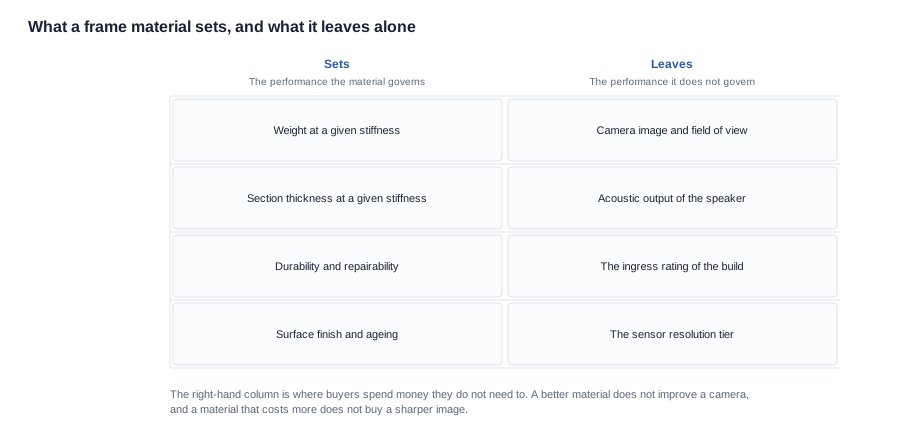
Smart glasses frame materials: the three performance axes a material actually sets
One: weight, at a given stiffness. This is the primary relationship and the reason the frame's mass is the row that matters most. For the same structural requirement, a lower-density material gives a lighter frame. This is the trade with the best engineering behind it, and it is also the trade with the least published data in our range, which is exactly why the weight figure has to be requested rather than derived. A buyer who wants a weight target and expects to find it on a specification sheet will not find it anywhere.
Two: section thickness, at a given stiffness. Stiffness in a beam scales with the cube of the thickness and with the modulus of the material, so a stiffer material allows a thinner temple. In a smart glasses product the thickness is not a free variable, because it is set by what has to go inside it. The material determines how much of the section allowance is consumed by the structural requirement and how much is left for the cell, the board and the speaker.
Three: durability and repairability. This one is less obvious and it is where material choice has the most commercial consequence. A moulded plastic temple can be thin, light, produced in volume and made into a serviceable part. An acetate temple with a wrapped core has a different failure mode and a different repair story, and the repair story is what decides whether a service event is a spare-parts line or a returns line. A metal temple is stiff and can be thin, and it is heavier per unit of volume and cannot be re-finished easily.
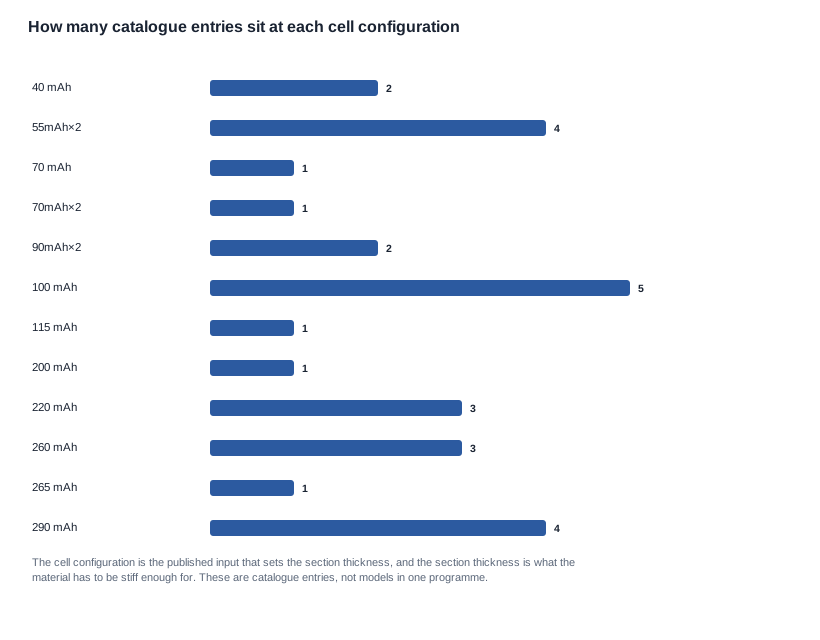
The chart above is the second of these three axes in its published form. The cell configuration is the input that sets the section thickness, and the section thickness is what the material has to be stiff enough for. Across the catalogue the entries sit at twelve different cell configurations, from 40mAh single cells in the children's models through the dual arrangements at 55mAh×2, 70mAh×2 and 90mAh×2 to single cells at 220mAh, 260mAh, 265mAh and 290mAh. A material decision that ignores which of those it is being made for is a material decision made in the abstract.
Why the weight trade-off is the best founded and the least documented
It is worth being precise about why the weight relationship is the most reliable of the three, because the reason also explains why it is the hardest to use in a procurement file.
The relationship is a materials property, and materials properties are the part of this category that generalise. Given a required stiffness, a section geometry and a material density, the resulting mass is calculable before anything is built. That is why the trade-off can be reasoned about at the quotation stage, before tooling, and why a supplier who is competent in this area will talk about it in engineering terms rather than in material names.
The difficulty is that the input to the calculation is the section geometry, and the section geometry is exactly what is not published for any model in our range. So the calculation is available to the supplier, who knows the geometry, and unavailable to the buyer, who does not. That is the structural asymmetry behind most of the missing frame data: the numbers exist inside the factory and not in the catalogue, which is why requesting them is a data request rather than a general enquiry.
Two practical consequences follow for a buyer who is weighing cost against performance.
The first is that a weight target has to be expressed as a build rather than as a model. "Under 50 g for the MT6" is not a requirement; "under 50 g for the MT6 in the build with the single 265mAh cell, excluding the foldable case" is a requirement that can be quoted and tested. The first version cannot be satisfied unambiguously, because the configuration is doing half the work.
The second is that a weight target negotiated before the section is settled is not a target at all — it is a request for a supplier to find a geometry that satisfies it. Sometimes that is exactly what you want. It is worth knowing which of those two conversations you are in, because the second one has a tooling cost that the first one does not.
The three axes buyers assume material controls and it does not
One: the camera's performance. A better material does not improve the sensor, the resolution tier or the stabilisation. Our camera data across the eleven camera models is thin in the same way the frame data is, and the frame's own geometry affects the usable field of view rather than its material. A buyer who pays for a material upgrade expecting a better picture is buying a different product's advantage.
Two: the acoustic performance. A temple's acoustic chamber is determined by its internal geometry and its seal, not primarily by the outer material. Material matters for damping and for the transmission into the head, and a stiff temple will transmit more vibration, which is a real effect — but it is second order, and it is a consequence of the section rather than an argument for a material.
Three: the ingress rating. The IP54 marking published in our range appears on the V06 and on the S7, and it is a property of the enclosure and the seals rather than of the frame material. It appears on the V06 and on the S7 and on no other model in the range, and it is published as a catalogue marking with no third-party test report number behind it. A better material does not give a better rating, and a different material in a sealed build is a change to the configuration the marking was about — which makes it a re-check rather than an improvement.
The pattern across these three is worth naming, because it is the reason the cost-versus-performance question keeps producing the same surprise. Buyers are usually comparing a material cost against a performance gain in the wrong column. The gain they are hoping for is in a row the material does not write to, and the cost they are worried about is in a row it writes to only marginally.
Three questions to ask before you buy a performance claim
A material claim arrives with a number attached, and the number is usually the right number in the wrong context. Three questions separate the two, and they are quick to ask.
Which row of the specification does this number belong to? A supplier quoting a figure in support of a material claim should be able to say which property the figure belongs to — mass, section, stiffness, surface finish — and what the measurement condition was. A figure that cannot be attached to a row is a figure about the supplier's impression of their own product.
Is the figure for your configuration or for the one they prefer to talk about? This is the same trap as the weight above, and it is where the catalogue's own spread of cell configurations makes the point: a platform with two cells in the temple and a platform with one are different products with different masses and different sections. A claim that is true for one build and quoted for another is not wrong; it is unusable.
What would change if the requirement changed? A claim that survives a change in the cell configuration, the section or the finish is a structural claim. A claim that only holds for one exact build is a description of that build, and it will not transfer to the second build you order.
The red flags are recognisable once you have asked the three questions. A figure with no measurement condition. A figure for a build you did not ask about. A claim that cannot survive a small change in the requirement. And the fourth, which is the most common of all: a performance claim attached to a material name, with the material name doing the work that the number was supposed to do.

The four trade-offs a buyer is really making
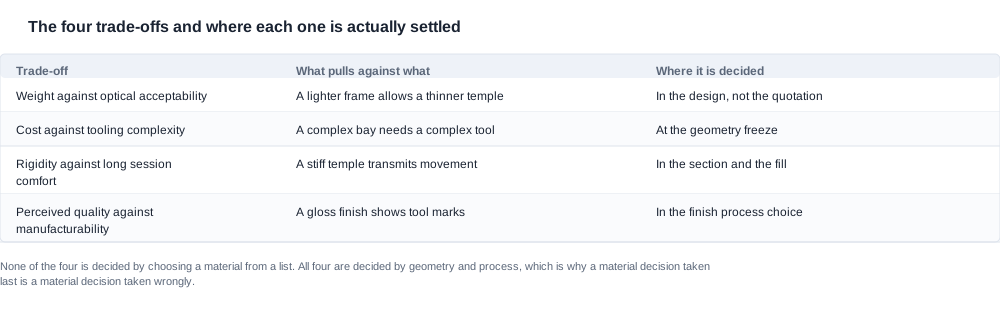
Weight against optical acceptability. A lighter frame allows a thinner temple, and a thicker temple is optically heavier to the eye. These pull in opposite directions, and the resolution depends on the design rather than on a material choice in the abstract.
Cost against tooling complexity. A complex hollow section in a filled material is a different tool from a simple section in a simple material, and the tooling is a one-off that dominates the early economics of a programme. The material is a smaller variable than the geometry, and the whole of the cost discussion in this category follows from that one fact. The detail is in frame materials cost factors.
Rigidity against long-session ease. A rigid temple transmits movement to the head. In a sport product where the frame takes vibration, this is a pressure and a retention issue rather than a structural one.
Perceived quality against manufacturability. A gloss finish in a moulded material needs a different process and a stricter inspection than an acetate finish, and the inspection is where the first-article rejections come from. This is the trade-off where the material, the finish and the cost are least separable, and it is the one most often resolved by a decision rather than by a calculation.
None of these four is decided by choosing a material from a list. All four are decided by geometry and process, which is why a material decision taken after the geometry is a material decision taken in the wrong order.
How to price a trade-off you cannot measure
Two of the four trade-offs above — rigidity against long-session ease, and perceived quality against manufacturability — cannot be settled with a number, because the numbers are not published for any model and would not be comparable if they were. That leaves a practical question: how does a buyer price a trade-off when there is nothing to price it against?
Three approaches work, and they are worth using in combination.
Price it as a process decision rather than a material decision. The perceived quality trade-off is settled by the finish and the inspection standard, both of which can be agreed in physical terms before any tooling. Put the finish approval on a physical sample, agree the inspection standard against a reference board, and the trade-off becomes a routine approval with a known cost of failure. That is much cheaper than paying for a material upgrade and discovering that the finish was the actual problem.
Price it as a schedule decision. The rigidity trade-off is settled by how long the product has to be used before the geometry shows. A frame that is fine for a demo session and poor over a full shift is not a material failure; it is a programme that was evaluated on the wrong timescale. Extending the evaluation to a full working day costs days, and it converts an unpriced trade-off into a measured one.
Price it as a returns rate you are willing to carry. Where a trade-off genuinely cannot be closed before ordering, it can be carried explicitly. Set the acceptance criteria you will hold the production against, set the return rate you will accept, and put the difference into the landed cost model as a line. This is less satisfying than a specification, and it is more honest than pretending the trade-off is closed.
The trade-offs between these three approaches are real. Carrying a risk in the returns model is cheaper up front and more expensive later, and the total cost is usually lower than the cost of the specification work that would have closed it. Which of the three applies depends on whether the trade-off is structural, temporal or commercial — and answering that question is worth more than any material list.

The four inputs a material recommendation needs
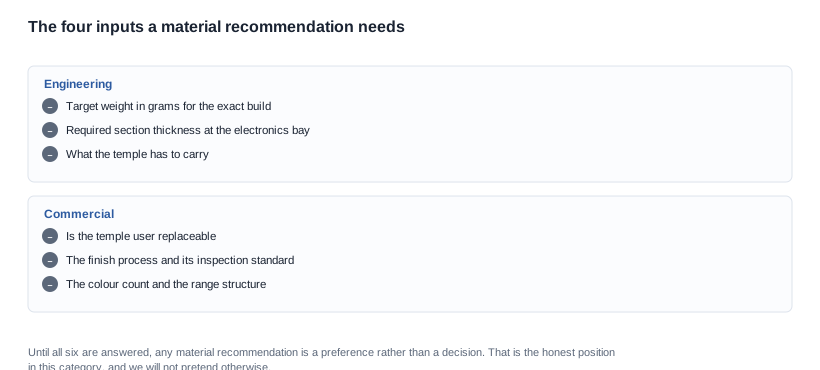
A recommendation is a function of inputs, and a recommendation given without all four of them is a preference dressed up as an answer. These are the four.
One: the target weight in grams, for the exact build. The currency of the trade-off, and the figure our range publishes for one model only. If weight is the variable you are deciding on, ask for it in writing per model and per build and treat the answer as a data request rather than a courtesy.
Two: the required section thickness at the electronics bay, and what the temple has to carry. The cell configuration is the published input to this: 55mAh×2, 70mAh×2, 90mAh×2, or a single cell at 40mAh, 70mAh, 100mAh, 115mAh, 200mAh, 220mAh, 260mAh, 265mAh or 290mAh. A camera module and a speaker add volume and stiffness beyond the cell alone, which is why the camera tier and the audio tier cannot share a section.
Three: the repairability position. Is the temple user-replaceable, and is it riveted, screwed or bonded? This decides the material more often than any performance argument does, because a serviceable assembly constrains the construction before the material is even chosen. The G07's published detachable temple is the precedent in the wider range.
Four: the finish process, and the inspection standard that goes with it. Because the finish determines the first-article rejection risk, and the rejection risk is the largest uncontrolled cost in the frame. A finish approved in principle and rejected in production is the classic way a material programme ends up paying twice.
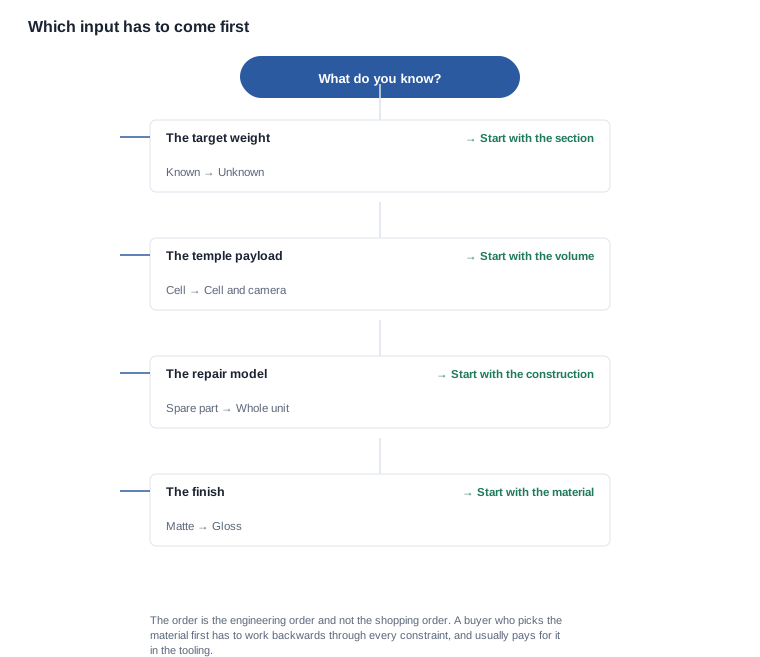
The order of those four matters too, and it is the engineering order rather than the shopping order. Weight and section come first because they are the structural constraints; repairability comes next because it constrains the construction; the finish comes last because it is the one input that can be changed without a new tool.
Why the price is the last input and not the first
It is worth being precise: we will not publish a frame material recommendation, because a recommendation is a function of the target weight, the required section thickness, the repairability and the finish — four inputs we do not have for your product. We will publish the unit weight where we hold it, at 158 g for the MT6 glasses unit including its cell and its camera and excluding the foldable charging case, and not published for the rest, and we will tell you which published rows are available for each model.
We will also say where the price sits in the sequence, because this is the part buyers most often get wrong. The price is the last input, not the first, and a material chosen because it is cheap is a material chosen after the decision that mattered.
The reason is structural. The material changes the tool cost at the margin and the geometry changes it by an order of magnitude. It changes the section thickness at the margin and the cell configuration changes it outright. It changes the finish inspection at the margin and the finish choice changes it outright. So a material saving on a programme whose geometry, cell configuration and finish are already fixed is real but small, and a material saving on a programme where those three are still open is an illusion — because the material is not what is being optimised.
The alternative framing is the one we use internally and the one we would suggest to a buyer. Ask what the material has to achieve, then ask which materials can achieve it at the section thickness the cell configuration forces, then ask what the cheapest of those turns out to be once the finish is fixed. That sequence costs a conversation. The other sequence — pick the material, then see what the geometry has to become — costs a tool.
If you are new to the category, the orientation is under frame materials for beginners, and the frame assessment procedure is under frame assessment from a sample.
Related reading
- Materials and ergonomics
- Frame materials cost factors
- Frame materials for beginners
- frame assessment from a sample
Send the target weight, the required section and the repairability position, and we will tell you which materials are viable.


