

Smart glasses frame materials: a property decision, not a name decision
If a supplier answers a frame material question with a polymer name, you have been given a label rather than a specification, and no two suppliers using the same word are describing the same physical behaviour. The decision that matters is which physical properties your channel will expose the frame to, what the pass line is for each of them, and whether the supplier will state a number instead of an adjective.
That is the whole method: convert the use case into four properties, put those properties into the same request sent to every supplier, and decide on a measured sample rather than on a name. A buyer who asks "which material" first gets a confident answer that cannot be checked. A buyer who asks "what is the flex limit, what is the hinge cycle rating, what is the mass and where does it sit, what does the surface resist" gets an answer that can.
So do not shortlist on material, and do not accept a comparison table whose weight column was filled with typical values. Our own catalogue publishes no material name, no temple dimension and no hinge rating for any model, and we will not estimate them. What we do publish is the structural features that follow from a material decision, and this page explains how to use them, what to demand, and where the money actually sits.

Who signs the frame order, and what the supply chain is actually made of
The four roles that arrive at this comparison
A brand product manager is opening a frame line and needs to convert a positioning into a physical specification before anything is quoted, because the specification is what the tooling is cut against and the tooling cannot be changed cheaply afterwards.
A procurement manager has three supplier quotations in front of them and has been told by all three that the frames are the same thing. The task is to find out whether that is true, and the answer is usually no.
A channel buyer listing on a marketplace is buying a product that will be shipped, handled, returned and discounted, and the frame is the part that arrives broken. Their question is which property has to be strong enough for that channel, and their fear is a returns trend with no explainable cause.
A product developer owns the mechanical design and needs the frame to be describable in a drawing, because a frame that cannot be inspected against a drawing cannot be inspected at all.
The fear underneath all four is the same: a frame that passes a showroom and fails in month three, when the hinge develops play and the temple takes a permanent set. By that point the packaging artwork is printed, the listing copy is live, and the cost of the fix is a new tool rather than a new specification.
Why the same frame can cost twice as much
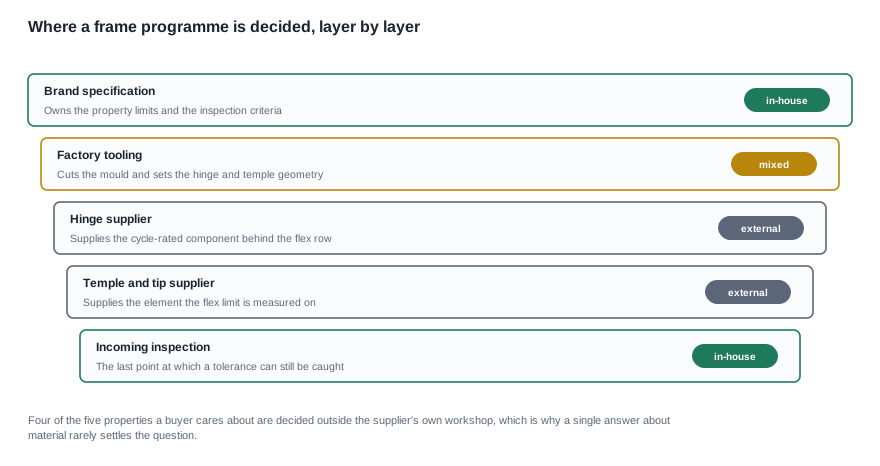
A frame is not one part. It is a moulded front, one or two temples, hinges, end tips, fasteners, a battery compartment, a speaker or camera cavity depending on the platform, and a coating. Those parts come from different suppliers, they are assembled by the factory, and they are inspected by the brand. Most of the properties a buyer is worried about are properties of the assembly rather than of the front.
This is why two quotations for the same-looking frame can differ by a factor of two, and why the difference is not always visible in the unit price. The lower quotation may use a hinge with a lower cycle rating, a temple that takes a set sooner, a front with a thicker wall in the battery bay, or a coating that wears differently. None of those appear in a materials list, and all of them appear in a returns curve.
The composition of the frame is also where the variant cost hides. A colour change usually means a different pigment batch and a re-tool-free re-colour; an inner-frame or temple change can mean a new tool. The cost of a programme is therefore a function of how many distinct frame configurations the brand commits to, and the number of configurations is a merchandising decision made long before the purchase order. The negotiable part of a frame programme is almost never the unit price. It is the configuration count, the artwork round count, the tolerance on the first article, and the inspection criteria you sign off before the run.
Turning a channel into four physical properties
The four properties that decide the outcome
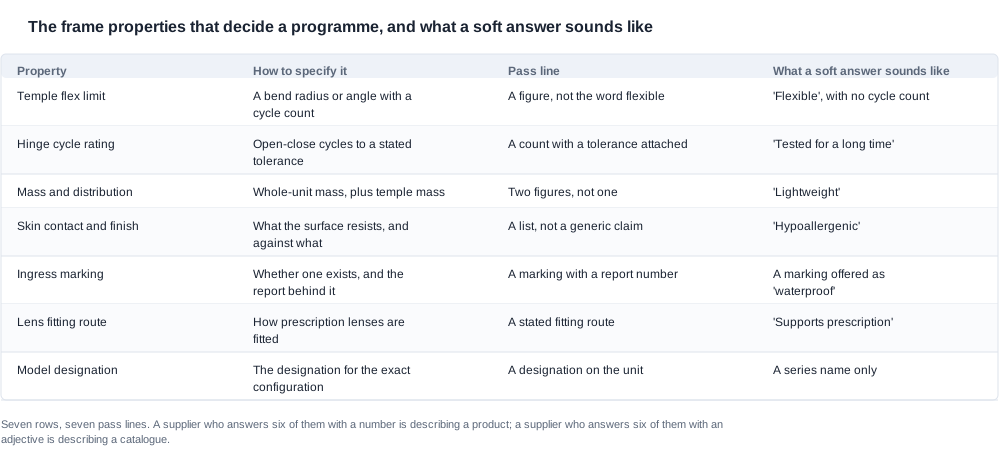
The table above is written as a request to the supplier rather than as background reading. Each row has a way of specifying it, a pass line, and the shape of an answer that carries no information. Send it unchanged to every candidate, because a comparison where the questions differ is not a comparison.
The flex limit at the temple. This is the property that separates a frame for a desk from a frame for a field. A bend radius or angle, a number of cycles, and a stated endpoint — a permanent set beyond which the temple is no longer straight. A frame that is described as flexible with no cycle count behind it has been tested once, by hand, and that is what is being offered.
The mass and where it sits. Total mass is the number most suppliers will give, and the number that matters least on its own. Two frames can differ by a few grams in total and behave completely differently, because what the ear carries is the temple mass and the position of the electronics relative to the ear. Ask for the temple mass separately. If the supplier will not separate it, record that as a finding rather than filling the cell with an estimate.
The hinge cycle rating. This is the highest-return component in the category and the only property that can be priced. The pass line is a cycle count with a tolerance attached, because a count without a tolerance describes a test that stopped somewhere convenient. A supplier who quotes a cycle number but not a tolerance has told you they have not agreed what failure is.
What the surface resists, and against what. Skin contact, sweat, a cleaning agent, a coating. The pass line is a list, and a list is what a support team can act on. A generic hypoallergenic claim is not a list, and it transfers a documentation burden onto the brand's own customer service operation.
Two further rows matter enough to carry in the same request even though they are not material properties. The ingress position, because a marking copied into a listing as a waterproof claim is a marketing exposure rather than a specification, and the background on the marking itself is at IP ratings. And the lens fitting route, because a prescription channel that receives a frame with no fitting route produces returns that have nothing to do with the frame's material and will be blamed on it.
Why the channel changes the requirement
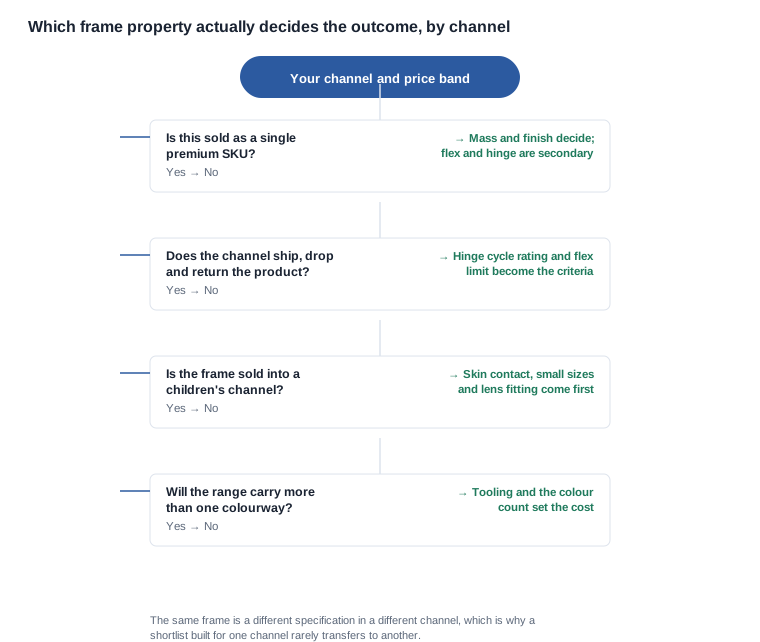
The four properties do not carry equal weight in every channel, and treating them as equal is the most common way a specification ends up over- or under-built.
A single premium SKU sold through a specialist retailer can accept a heavier frame, a higher unit cost and a lower cycle rating, because the buyer is a person who values the object and replaces it rarely. A marketplace channel that ships, drops and returns the product needs the hinge and the flex limit to be the acceptance criteria, because the frame is the part that arrives broken. A children's channel changes the priority again: fit across a size range, skin contact, and a stated lens fitting route come before any of the mechanical rows, and the background on that sizing problem is at prescription lenses.
A product sold to a sport channel inherits a different requirement again, and our catalogue publishes the structural features that answer it. The V06 and the S7 are published with a removable inner frame, the G07 with an ultra-slim detachable temple, the YK12 with a slim temple, and the V03 Pro with flexible temples. These are facts a buyer can use, and they are the direct result of a material and geometry decision.
The tool for choosing among them is the decision tree below. Its output is not a material; it is a shortlist of properties with pass lines attached.

The bench sequence that produces evidence nobody has to take on trust
The verification route for a frame is physical, and it is quick. The reason to do it rather than argue from a specification sheet is that the properties that decide a returns curve are properties of an object in a hand, not of a document.
- Ask for the four numbers before the sample arrives. Flex limit with its cycle count, hinge cycle rating with its tolerance, total mass, and temple mass. If the supplier cannot supply them, that is a finding, and it should be written down as one rather than argued around in the meeting.
- Weigh the sample, and weigh it in parts where the supplier will allow it. The whole-unit mass of 158 g for the MT6 is the only mass figure we publish in the whole range, and it is a starting point for a conversation rather than a specification to select on.
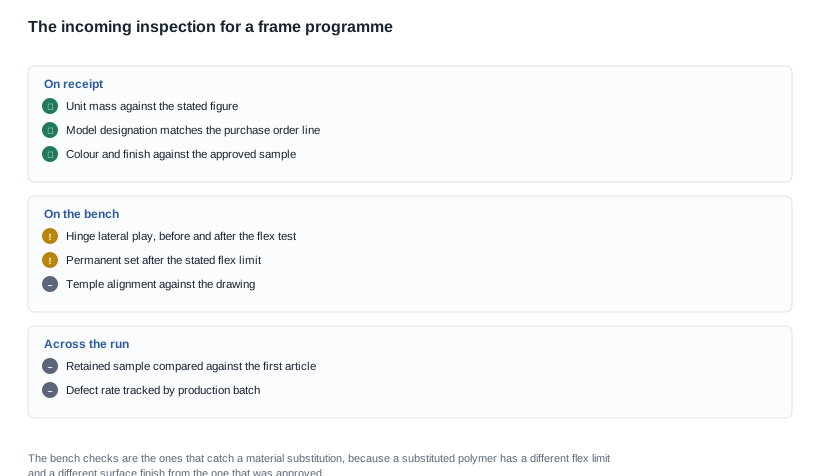
- Run the flex test on the sample and on a production unit, and compare the two. Bend the temple to the stated limit for the stated number of cycles, then check for a permanent set and for lateral play at the hinge. The procedure used in this category is set out in how to test frame materials.
- Check hinge play before and after the flex test. Play is the first mechanical symptom and it is visible without instruments, which makes it the cheapest early warning in the whole inspection.
- Compare temple alignment and lens mounting against the drawing. A frame can pass the flex test and still ship with a temple out of alignment. The inspection criterion for that is a drawing, not an opinion.
- Confirm the model designation on the unit against the paperwork. A frame without a traceable designation cannot be tied to a production batch, and a defect rate without batch traceability cannot be argued with a supplier.
- Compare the sample against the production configuration explicitly. A sample drawn from a promotional batch is not a sample of the shipping product, and the sampling procedure that avoids that confusion is at samples.
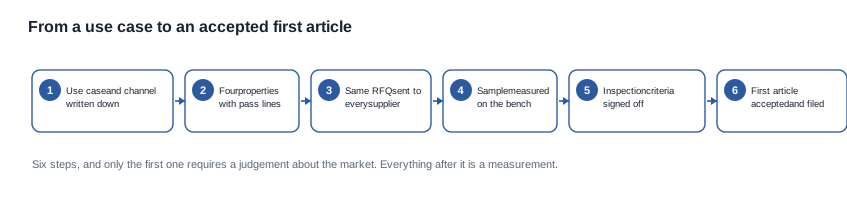
The last three steps are where a supplier's cooperation is usually what makes the difference. A supplier who will let you weigh the temples, check hinge play before and after flex, and hold a production unit alongside the sample is telling you the process is controlled. One who will only show a finished unit in a showroom is telling you something else.
The checklist form of the same inspection is at frame materials buying checklist, and the published configuration rows are at frame materials key specifications. Both are the same method written down, so a second buyer in your own organisation does not have to rebuild it.

The breakdowns that end a frame programme before launch
Four breakdowns and the returns they create
The material name is treated as the specification. Symptom: two shortlisted frames look identical on paper and behave differently in the field, and nobody can say why. Root cause: a polymer name covers a wide range of formulations, and the name was used as the comparison key. Prevention: compare the four properties and reject any comparison table whose cells contain adjectives.
The removable inner frame is read as a comfort feature. Symptom: a channel that stocks a wide size range still returns units, and the returns are attributed to the product. Root cause: on the V06 and the S7 the detachable inner frame is a fitting system that lets one outer frame serve different nose shapes and bridge heights, and a buyer who does not understand that will not specify it, will not photograph it, and will not train the channel on it. Prevention: put the fitting system into the listing images and the channel training, or drop the feature from the proposition.
Mass is estimated from the category. Symptom: a comfort complaint arrives with no specification to argue against. Root cause: the buyer took the one published mass figure in the range and applied it to a different model. Prevention: an empty cell in a comparison table prompts a question; a guessed cell does not, and the guess becomes a commitment nobody made.
The frame is qualified and the lens route is not. Symptom: a launch into a prescription channel arrives with a frame that fits nobody, and the returns land in the wrong category. Root cause: the lens question was treated as a separate supplier conversation and never closed. Prevention: qualify the fitting route in the same request as the frame properties, and reject a quotation that answers one and not the other.
There is a fifth pattern worth naming because it belongs to no single property. The frame is approved from a sample and the tolerance is never written down. From that point on, every unit is judged against an opinion rather than a criterion, which means the inspection results cannot be used in a dispute and the supplier can always argue that the sample was the standard. Writing the tolerance into the purchase order is what converts a preference into an acceptance standard.
The tooling, the colours and the inspection criteria: where the money sits
Fixed beneath the negotiation and movable above it
Fixed, and not a negotiation target. The frame tooling and the moulds, and the amortisation question attached to them — over what volume it is spread, and what happens to the tool if the programme is discontinued. The hinge and temple geometry once the tool is cut, because changing either afterwards is a new tool and a new schedule. Certification cost and certification lead time, which follow the process and the testing body. And the material decision itself, which is a design variable rather than a commercial one: a supplier who will not change the polymer, the wall thickness or the coating is telling you the frame is fixed, and the programme should be built around that fact rather than against it.
Negotiable, and this is where the effort belongs. The configuration count, and the per-configuration minimum attached to each one. The colour palette, which is a merchandising decision and comparatively cheap to change between runs. Logo placement, lens tint, lens finish, and retail packaging. Whether the detachable inner frame is offered as a fit kit or as a single configuration. The artwork round count, which is cheaper to fix while the supplier is still drawing than after the plates are cut. Tooling amortisation across a larger first order, which is usually the largest single lever on frame cost and is a quantity decision rather than a price negotiation.
The documents to request before a deposit. The material and dimensional specification sheet, per model. The hinge cycle rating with its tolerance. The flex limit with its cycle count and endpoint. The mass, split into whole-unit and temple where the supplier will provide it. The ingress marking with its test report, or an explicit written statement that none exists. The packaging artwork proof. The agreed incoming inspection criteria, with a drawing to inspect against. And the model designation table.
A worked example: a marketplace brand adding a sport line
The example below is illustrative: it sets out the order of the decisions rather than describing an order that was placed.
Assume a mid-size European marketplace brand that currently sells one general-purpose audio model and wants to add a sport line with two colourways. The binding constraint is not the frame material; it is that the brand's last listing was suspended for a month over a claim it could not evidence, and it does not want to spend a second season recovering from a returns trend it cannot explain.
Step one, the channel. The brand's customers are in the open air, in the rain, and the product is shipped in a padded mailer through a third-party fulfilment house. That is a splash-and-handling exposure and a shipping exposure. The brand writes both down before it looks at any frame, which is what turns "a sport frame" into two testable properties: a flex limit and a hinge cycle rating.
Step two, the request. The same property request goes to all four suppliers, unchanged, with a deadline. Three answer with figures and one answers with a paragraph about polymer technology. The brand records the paragraph as a finding rather than treating it as a soft yes, and this becomes the first discriminator.
Step three, the fit question. The brand's customer base spans a wide range of head sizes, and it has already had a returns problem on a product with no fitting system. It asks specifically whether the outer frame can be combined with more than one inner frame, and in what size range. Two suppliers cannot answer, and the answer is worth more than the unit price difference because it addresses the brand's existing returns problem as well as the new line.
Step four, the sample. Two samples from the leading candidate, plus one production unit pulled from a live run, all weighed and all put through the same flex sequence. One of the two samples shows measurable hinge play before the flex test. The brand's own incoming inspection criteria, drafted before the samples arrived, turn that into a rejection rather than a discussion, and the supplier ships a replacement set rather than a concession on price.
Step five, the commercial structure. The brand negotiates the per-configuration minimum against a committed combination count rather than a unit count, because two colours on the winning frame are two configurations. It moves artwork approval earlier than usual. It takes a first run split into two deliveries against the first-article sign-off, so that the inspection on the production units happens before the balance of the volume is committed.
The result is a programme with two named preconditions and a returns rate it can actually investigate, rather than a cheaper frame and a mystery. Every decision that mattered was made before the purchase order, and none of them was about the material name.
The clause language to put in the purchase order
Five clauses do most of the work in a frame programme. First, the model designation as a line item, with the material and dimensional specification attached. Second, an acceptance-criteria clause referencing the incoming inspection and the drawing, including the tolerance. Third, a notice obligation before any change of material, hinge, temple, coating or supplier of a structural component, since each of those invalidates the approved first article. Fourth, a clause requiring per-variant confirmation that a changed colourway or inner frame remains within the approved configuration list. And fifth, a clause stating who bears the cost when a lot fails the acceptance criteria.
What our catalogue states about frames
The working rule we apply: we publish the rows the catalogue states and mark the rest as open, because a buyer who checks a claim should be able to check ours first.
What we publish for frames: the V06 and the S7 with a removable inner frame and an IP54 marking, the G07 with an ultra-slim detachable temple, the YK12 with a slim temple, the V03 Pro with flexible temples and a photochromic lens, and the MT6 at 158 g as a whole unit. What we do not publish, for any model: a material name, a temple length, a frame width, a lens dimension, a hinge specification, a hinge cycle rating, a flex limit, or a mass other than the single MT6 figure.
We will not fill those rows with typical values from the industry to make a comparison table look complete. A guessed mass in a comparison table is worse than an empty cell, because the empty cell prompts a question and the guessed cell does not. The reasoning behind the published structural rows is at materials and ergonomics, the underlying argument is at why frame materials matter, and a general material comparison is at what frame material is best. The sport range that carries the structural features is at sport smart glasses.
The three requests to open this comparison
- Send the property request unchanged to every candidate. Flex limit with its cycle count, hinge cycle rating with its tolerance, whole-unit mass, temple mass, surface resistance list, ingress position, and lens fitting route. Same words, same deadline.
- Write the incoming inspection criteria before the samples arrive. A drawing, a tolerance, and a pass line. A criterion agreed afterwards is a criterion that has already been missed.
- Send us the use case and we will tell you which rows exist. Give us the channel, the price band, the markets and the configuration, and we will say which models carry published structural features that match, which of the property questions our documentation answers today, and which have to be confirmed in writing by the factory before a purchase order is signed.
Related reading
- The properties behind the published rows — materials and ergonomics
- The sport models that carry the structural features — sport smart glasses
- The lens route for prescription wearers — prescription lenses
- The published configuration rows — frame materials key specifications
Tell us the channel, the price band and the configuration, and we will say which published rows apply and which have to be confirmed in writing.


