
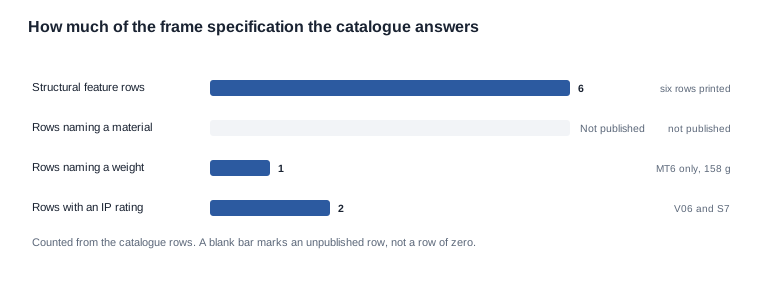
A frame material is the specification row that decides whether a programme can be changed later, and it is also the row our catalogue does not publish. Across all twenty-eight models in the range, not one names the material a frame, a temple or a surface is made from. What our documentation does publish is structure — a detachable inner frame on the V06 and the S7, detachable temples on the G07, flexible temples on the V03 Pro, a slim temple on the YK12 — and structure tells a buyer more about changeability than a material name would.
That gap is the reason this page is worth a buyer's attention. A material trade name cannot be compared between two suppliers, cannot be verified, and cannot be written into a purchase order as an acceptance criterion. A structural feature can. "The temple is detachable" is a statement you can check on a sample, hold a supplier to, and attach a change cost to. "Premium acetate" is a phrase you can neither check nor price.
The single weight figure in the range belongs in the same conversation. We publish 158 g for the MT6 glasses unit — the glasses themselves, including the 265 mAh battery and the camera, and excluding the 1200 mAh foldable charging case. Every other model in the range publishes no weight at all. A range where one model in twenty-eight has a weight is a range where the material conversation cannot be settled by reading the catalogue, and where the questions to ask a supplier are the whole job.
Smart glasses frame materials: what the catalogue omits
Start with the uncomfortable part, because it shapes every other decision. Material specifications are commercially sensitive, they vary by supplier, and a catalogue that lists them would be committing to a bill of materials it changes routinely. So the row is empty in our documentation, and it is empty in most of the category.
The consequence for a buyer is not that the material cannot be obtained. It is that the material has to be specified as a requirement rather than selected from a menu. That is a different piece of work and it has a different sequence. Where you would normally compare two products on a published attribute, here you write the attribute down first — the performance you need from the frame, the tolerance you need on the finish, the parts you will never change, and the parts you expect to change — and then you ask each supplier whether they can meet it and what it costs.
The first requirement to write down is a performance expectation rather than a material. Something like a flex and torsion requirement, a hinge cycle expectation, a scratch and coating resistance expectation, a skin-contact and sweat exposure expectation, or a drop expectation for the product in its packaging. Each of these is testable, each of them can be compared between quotations, and each of them narrows the material decision without naming it. A requirement expressed as a performance is also much harder for a supplier to answer with a substitute that only looks equivalent.
The second requirement is a statement about where the product is used, because the same material behaves differently in a warehouse, on a shop floor, in a vehicle and outdoors. Ingress protection is the published part of that picture, and it is narrow: the V06 and the S7 are the only two models in the range that carry an IP54 rating, which covers protection against dust and against splashing water but not immersion. No other model in the catalogue makes an ingress claim, and a buyer who needs one should treat the model selection as a decision in itself rather than a certification to be added afterwards.
The third requirement is the one most programmes discover too late: which parts of the build are allowed to move. A frame is not one part. There is a front, two temples, hinges, a bridge, a lens or lens mount, and in several of our designs a detachable inner element. Each of them carries a different tooling consequence, and a buyer who has not classified them will find out that a change they considered minor is a re-tool.

What the catalogue does publish, and how to read a structural feature
Six rows in the catalogue print a structural feature, and each of them carries a different commercial implication. Reading them correctly is the difference between a specification and a brochure line.
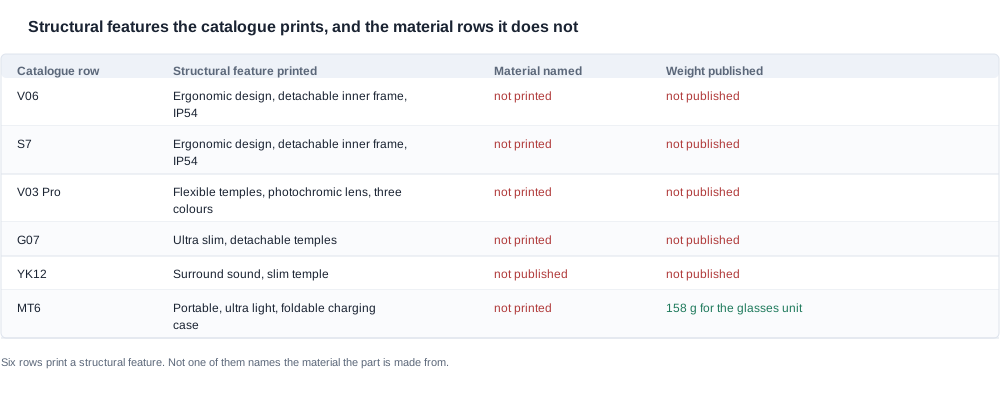
The V06 and the S7 carry a detachable inner frame. Both also carry an IP54 rating, and the S7 is the 13 MP member of the pair while the V06 is 8 MP. The commercial meaning of a detachable inner element is separability: the part that takes the most abrasion and the most handling can be replaced without replacing the whole product, which changes the spare-parts conversation, the hygiene conversation and the service model. A buyer reading this row should be asking whether the detachable element is separately orderable, what it costs on its own, and what its minimum is. Those are the questions the row does not answer.
The V03 Pro carries flexible temples, a photochromic lens configuration and three colour options. Flexible temples are a changeability feature: they absorb a stress that would otherwise break a rigid temple, and they imply a specific hinge and a specific temple geometry, which means a temple change on this platform is not an interchangeable swap. The three published colours on this row are a configuration dimension, not a cosmetic one, because a colour is a separate minimum in almost every quotation.
The G07 is described as ultra slim with detachable temples. This is the clearest case in the range of a structure that shortens the bill of materials and lengthens its service life, because a detachable temple can be replaced instead of the whole product. The G07 also publishes two 55 mAh cells and a rated runtime of about six hours, and it is one of the two models in the 55 mAh pair where the runtime is the shorter of the two tiers rather than the longer.
The YK12 is described with a surround sound feature and a slim temple. The YK12 publishes two 55 mAh cells and a rated runtime of about six hours, magnetic charging and Bluetooth V5.4, and its temple is described as slim rather than as detachable. A slim temple and a detachable temple are different changes with different costs, and the difference is visible in the row.
The MT6 is described as portable, ultra light, with a foldable charging case. This is the one model in the range where the published structural description and a published weight sit on the same row, which makes it the only model where a buyer can reason about weight at all from published data.
The YKC02 is described with a surround sound feature and a long battery life, and it publishes two 70 mAh cells with a rated runtime of about eight hours and Bluetooth V5.4. A long battery life stated as a catalogue description rather than as a figure is a reminder that even in the rows that do publish numbers, some of the marketing language is not a specification.
The reading rule that comes out of all six is simple. A structural feature tells you what can be changed, what can be replaced, and what the product must survive. A material name tells you almost nothing you can verify. For a buyer, the first is a specification and the second is decoration.
The 158 gram figure, and why one weight in a range of twenty-eight is not enough
The MT6 row is the only row in the catalogue that publishes a weight, and it is worth being precise about what it covers. The catalogue publishes 158 g for the MT6 glasses unit, and the row also states a 265 mAh cell, an 8 MP camera and a 1200 mAh foldable charging case. The 158 g figure is the glasses themselves, including the battery and the camera, and it excludes the foldable charging case. No bare frame weight is published for any model in the range, because a bare frame is not what the customer receives.
That distinction matters more than it might appear. A unit weight that includes the battery and the camera is a weak indicator of how the frame itself feels, because the battery and the camera module are close to a fixed cost in the total and a heavier frame would not show up proportionally in the number. Two products can publish the same unit weight and feel completely different, because one of them carries a heavier frame and a lighter electronics package. So the 158 g figure is useful for a buyer doing a rough comparison between complete products, and it is not a substitute for a frame specification.
There is a second reason the single weight does not settle the material question. Weight is one property, and material is a bundle. A buyer who wants a frame that resists a specific chemical, or that can be polished to a specific gloss, or that will not discolour in a particular climate, or that will survive a particular drop onto a particular surface, needs a specification for that property. The weight tells them nothing about it, and no catalogue in this category prints a material grade, a finish standard or a coating durability figure for a consumer device.
The practical answer for a buyer is therefore a two-step request. Ask for the unit weight of each candidate configuration, including exactly what the figure covers, and then ask for the frame material as a specification with a performance expectation attached. Ask for the coating or surface treatment as a separate line, because a surface treatment is usually applied after the frame is made and can be changed without a re-tool, which is a commercially significant difference. And ask how the material is specified in the purchase order, because a supplier who can write the material into the order is a supplier who has a control on it, and a supplier who cannot is relying on a general practice.
The same applies to the detachable elements. If a programme uses the V06 or the S7, the buyer should ask what the detachable inner frame is made from separately, whether it is orderable on its own, and whether its specification can be changed without affecting the rest of the product. The row tells you the element exists. Everything else about it is a question with an answer.

Specifying a frame material so a factory can quote it
The specification work is a sequence, and it is worth doing in this order because each step depends on the one before it. The output is a requirement document that a supplier can price, which is a different document from a product description.

Name the performance you need, not the trade name. A trade name cannot be compared and cannot be tested. A performance expectation can be tested and can be compared, and it leaves the supplier free to propose a material that meets it — which is where a second source comes from. This is also the step that protects a buyer who later wants to change supplier, because a requirement written in performance terms can be re-quoted anywhere.
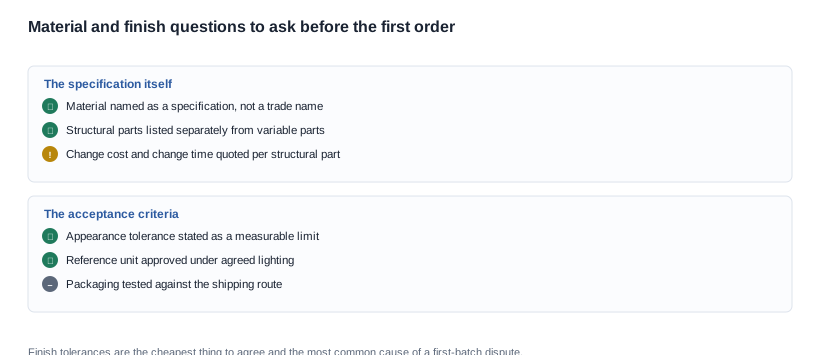
Ask which parts of the build are structural and which are variable. The answer determines the cost of every future change. A structural part carries the tooling, and a change to it is a development with a cost and a lead time attached. A variable part is a materials and artwork change. The question to ask is not "what is the material" but "what would it cost and how long would it take to change this specific part".
Ask for the change cost and the change time for each structural part, in writing. This is the number that is always missing from a quotation and always needed later. A buyer who has the figure can decide whether a request is worth making. A buyer without it either makes the request anyway and pays for the surprise, or declines to make it and loses the option.
Agree the appearance tolerance before production, in a form that can be judged. A tolerance expressed as a physical reference unit approved under agreed lighting is workable. A tolerance expressed as a colour reference on a screen is not, and it produces a dispute about every unit in the first batch. The tolerance has to cover the variation between units in a batch and the variation between batches, and it has to state how it is judged — against the reference unit, under what light, by whom.
Put the structural list, the performance requirements and the tolerance into the purchase order. A requirement that lives in an email is a preference. A requirement that lives in the order is an acceptance criterion, and a lot that fails it is a lot you can refuse.
The red flags in a material specification are unremarkable. A trade name with no performance expectation behind it. A structural list that is really a colour list. A tolerance that is set after the first batch has been produced. A change cost described as "a matter of weeks" for a part that carries tooling. Each of them is cheap to close at the quotation stage.
The tolerance, the tooling and the change route that cost money
Materials and tooling are the clearest example of a non-recurring cost that is routinely misdescribed in a quotation. Tooling is a one-off charge, usually amortised across the programme, and the useful questions are over what volume it is spread and what happens to it if the programme is discontinued. A change to a structural part re-opens that amortisation. A colour or finish change does not, because no new tool is cut. Artwork and finish are smaller one-offs and they are cheap compared with tooling, but they take calendar time — a packaging artwork round is a week, and a mould is a lead time measured in weeks rather than days.
The decision tree in this section is the one a buyer can apply to any request that arrives after the programme has launched. A request that changes a temple profile is a new mould. A request that changes a temple tip is a material and tooling change of a much smaller kind. A request that changes a colour or a finish is a materials and artwork change. A request that changes an engraving is an artwork change. Each of those has a different cost and a different schedule consequence, and in a well-run programme all four are pre-agreed so that the request can be answered with a number instead of a negotiation.
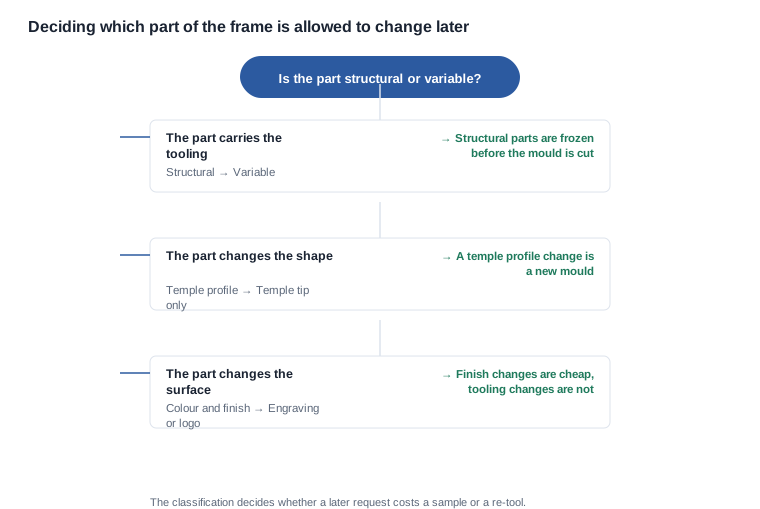
The clauses worth having in the agreement are the structural parts list with the material specification attached, the tooling ownership and the amortisation schedule, the appearance tolerance with its reference unit and the lighting condition, the packaging specification tied to the shipping route, and a change route for each structural part with a stated cost and a stated schedule consequence. The last one is the clause that is always missing, and it is the one that matters most, because a requirement change made after approval is exactly the moment when a buyer most needs a number and a supplier least wants to give one.
The packaging question belongs in the same section because it is a material decision in disguise. Packaging selected for the shelf appearance rather than for the shipping route produces transit damage, and transit damage produces returns that get attributed to the product rather than to the packaging. Specify the packaging against the route, confirm the drop and vibration conditions it is rated for, and record who approved it. The cost of a damaged unit is higher than the cost of a better box, and the cost of discovering it is a returns rate rather than a complaint.
The total-cost framing is what makes this section land with a finance reviewer. The total cost of a frame programme is the unit price plus the tooling amortisation plus the artwork and finish one-offs plus the returns reserve plus the cost of the documentation route. The trade-offs between those are settled in the quotation, not after it, and which one to negotiate hardest depends on where the programme is weak. A programme that is certain to change its temples should negotiate the amortisation; a programme with a high-value channel should negotiate the tolerance.
The frame questions we can answer, and the ones that need a supplier
The short answer: we publish the rows we hold and mark the rest as open, and we would rather show you an empty material row than a plausible one.
What our published data does settle is the structural feature on six rows: the detachable inner frame on the V06 and the S7, the flexible temples and the photochromic lens configuration on the V03 Pro, the ultra slim and detachable temples on the G07, the slim temple on the YK12, the foldable charging case on the MT6 and the long battery life on the YKC02. It settles the colour options where they are published — three on the V03 Pro, four on the V06 — and the ingress rating on the two models that carry one, both at IP54.
It settles one weight in the whole range: 158 g for the MT6 glasses unit, including the 265 mAh battery and the camera, and excluding the 1200 mAh foldable charging case. No model in the range publishes a bare frame weight, and we will not estimate one, and we will not describe the 158 g figure as a frame weight, because it is a whole-unit figure and describing it as anything smaller would be a false statement in a document a buyer relies on.
What we do not publish, and will not estimate, is the frame material, the temple material, the hinge material, the surface treatment or its durability, the coating specification, the material of the detachable inner frame on the V06 and the S7, the material of the detachable temples on the G07, and the material of the lens mount. For those rows the honest answer is that they belong to the supplier's own technical documentation, and a buyer who needs them should ask for them in writing against a named configuration, with a performance expectation attached rather than a trade name.
We also make no efficacy claim applying to vision, health or eye protection for any product in this range, in any market, and we would rather say that before a programme is scoped than after a listing is written.
If you send us the models, the configurations, the quantities and the target market, we will tell you which structural features our documentation records, which rows are open on each model, and which parts of the material and tolerance question you will have to establish with the supplier on your own units. The selection guide is how to choose frame materials, the field-level list is frame materials key specifications, and the supplier-side checks are in frame materials supplier verification. The background sits under materials and ergonomics and sport smart glasses, and the prescription-lens question is covered in how to wear them with prescription lenses.
Related reading
- Choosing between frame options — how to choose frame materials
- The construction questions behind the frame — frame materials key specifications
- What to ask a supplier — frame materials supplier verification
- materials and ergonomics
- sport smart glasses
- how to wear them with prescription lenses
Send the configuration, the quantity and the market, and we will say which parts of the frame specification are settled and which are yours.


