

Smart glasses frame materials: a housing, not eyewear
How a smart glasses frame is made has a surprisingly short answer and a long list of consequences, because in this product the frame does two jobs at once that pull in opposite directions. It has to carry a cell, a protection circuit, a control board, on some platforms a camera module, a speaker and a microphone; and it has to resemble eyewear and sit on a human head for hours. The electronics need a thick, rigid, thermally conductive volume. The appearance needs a thin, light, curved, moulded object with a controlled surface finish. Every stage of the build is a negotiation between those two requirements.
This matters to a buyer because smart glasses frame materials smart glasses how it works is not a manufacturing explainer for its own sake. It is the logic that decides which decisions you can still make at the quotation stage and which ones have already been made for you by the time the first sample arrives. The two common mistakes are to treat the frame as a cosmetic part that engineering finishes later, and to treat the electronics as fixed when in fact the cell configuration is one of the inputs that sets the frame geometry.
The published data in our range gives a useful starting set, and it is worth stating plainly what it does and does not contain. The unit weight is published for one model in the entire catalogue: the MT6, at 158 g for the glasses unit including the 265 mAh cell and the camera, and excluding the foldable charging case, whose 1200 mAh capacity is published while its own weight is not. The material itself is not published for any model in the range. The colour options are three for the V03 Pro and four for the V06. The camera tier's cell configurations run from 220 mAh to 290 mAh, the audio tier uses dual cells at 55 or 90 mAh per side and a single 100 mAh cell, the sport tier uses a dual 70 mAh cell, a single 115 mAh cell and a single 100 mAh cell, the IP54 catalogue markings are on the V06 and the S7 in the camera tier, and the children's models run at 40 mAh and 70 mAh. Charge time is published for all twenty-eight models, twenty-six of them at two hours or less and two at about one hour.


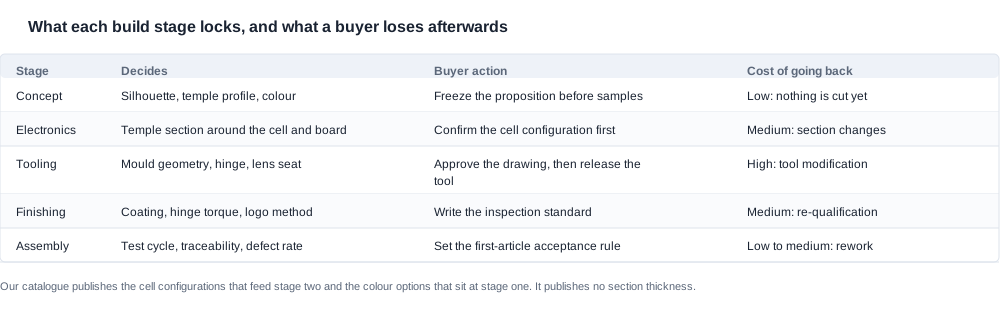
Four build stages and what each one commits you to
The build runs in four stages, and the useful thing about naming them is that each one closes options permanently. A change made at stage one is a discussion. The same change made at stage three is a tool modification, and the same change made at stage four is a concession on price or a line in the contract.
Stage one: the concept and the form
The concept stage settles the silhouette, the material family, the colour, the temple profile and the nose bridge. At this point the product is a piece of eyewear with a proposition, and the published colour options in our range sit here, because colour is a finish decision inside a material and a form. The V03 Pro listing three colours and the V06 listing four are the only finish-related rows we hold for any model.
What a buyer can still do at this stage is almost everything: choose the family, choose the number of colourways, choose whether the product carries a camera and where the bay sits, and decide whether a folding case belongs in the programme. The MT6 in our range is the model where the case is part of the product rather than an accessory, and a folding case is a published structural feature on it.
Stage two: electronics integration
This is where a smart glasses frame stops being an optical frame. The temple has to house a cell, a protection circuit, a control board, a camera module where fitted, a speaker and a microphone. The published cell configurations in our range are the inputs to this stage, and the output is a section thickness. The list runs 40 mAh for the A05 and the A06, 70 mAh for the A07 and for each side of the YKC02, 90 mAh per side for the K01 and the K02, 55 mAh per side for the G07 and the LC-105-1, and the YK12 and the LC-105-2, a single 100 mAh for the D11, the D12 and the ZH12, 115 mAh for the D17, 200 mAh for the bone conduction entry, 220 mAh for the V03 Pro and the V03, and the MT5, 260 mAh for the KY06 and the S7, and the V06, 265 mAh for the MT6, and 290 mAh for the CY03 and the L1 Pro, and the L2 Utral and the CY05.
That list is not an aside. A larger cell occupies more bay, the bay sets the section, the section sets both the mass and the flex behaviour, and the flex behaviour is what eventually decides whether the joint cracks. The ordering rule is therefore simple and worth defending in a programme: the cell configuration is decided before the frame section, and the frame section is decided before the appearance review.
Stage three: tooling
The frame and temple moulds, the lens tooling, the case tooling where a case is part of the product, and the fixtures for the inspection plan. This is the stage where the drawing has to be frozen, and the freezing is the expensive part rather than the steel. A tool cut against a drawing that the factory then proves unachievable as drawn is a tool modification, and a tool modification moves the launch date in a way that no amount of factory capacity can recover.
The tooling requirements are set out in more detail on the tooling page, and the cost drivers are covered on the cost factors page.
Stage four: finishing and assembly
The surface finish, the hinge assembly, the logo application, and the assembly of the electronics into the frame. The logo options — in-mould marking, pad printing, laser engraving and debossing — are four different tooling and finishing answers, and they are chosen here rather than at the artwork stage, which is why an artwork change at the last minute can carry a tooling cost.
The four things that make a smart glasses frame different from an optical frame
The temple is a housing, not a strut. In an optical frame the temple is a cantilever. In a smart glasses frame it is a housing with a cantilever attached, and the two requirements fight: a thicker section carries the electronics and the mass, and a thinner section resembles eyewear. This is the single reason that optical-industry dimensions and weights do not transfer to this category, and it is why a buyer comparing a smart glasses frame to an optical frame on the same numbers is comparing two different objects.
The weight is structural. A heavier frame needs a stronger section, and a stronger section is a heavier frame. Our range publishes one weight figure, the MT6 glasses unit at 158 g, and not published for the rest, which means the section thickness cannot be derived from any published data and has to be requested against the specific configuration.
The front may carry a camera, which changes the bridge. A camera module in the bridge or at the front of the temple means the front section is no longer only holding a lens, and it changes the usable field of view because the frame occludes part of the scene. The field of view is not published for the camera tier in our range, and it is one of the rows that most often decides whether a camera product is usable for a given channel.
The charging interface is an opening. A magnetic contact in a temple is a deliberate opening in the enclosure, and it interacts with the ingress position. The V06 and the S7 carry an IP54 catalogue marking with no test report number published, and the seal question belongs to the design stage rather than to the test stage, because the seal geometry is fixed when the tool is cut.
The frame as an antenna environment and an acoustic enclosure
Two of the four differences above have consequences that a buyer rarely sees in a quotation, because they belong to disciplines that sit outside the mechanical drawing.
The antenna environment is the first. The radio in this category is in the temple, and the frame surrounds it. A resin front, a metal temple and a different hinge arrangement do not behave the same way radiatively, even when every component on the bill of materials is unchanged. That means a material or geometry change late in the programme is a radio question, not only a mechanical one, and it needs a radio assessment rather than an assumption that the change is harmless. It also means the Bluetooth version published on the audio models — V5.3 on the K01 and the K02, V5.4 on the D11 and the LC-105-1, the G07 and the D12, and the LC-105-2 and the YK12 — is a statement about the radio generation and not about the radio behaviour in a given frame. The sport models publish V5.4 as well, on the YKC02, the D17 and the ZH12, and the same reading applies to them.
The acoustic enclosure is the second. The speaker sits in the temple and the sound radiates through and around the temple section. A rigid section of a given mass and a compliant section of the same mass are different enclosures, and the difference is audible. This is why the material, the section and the sound quality are connected in a way that a buyer cannot verify from any published row: we publish no material, no frequency response and no driver figure for any model, so the connection cannot be made from the documentation at all. A brand that connects a material to a sound claim is making a claim it cannot evidence, and that is exactly the kind a reviewer tests by playing the same track through two products.
Both points land in the same place at the programme level. The frame is a structural part of a radio product, and a change to it triggers a review rather than a purchase decision.
The four questions to ask at the tooling gate
The tooling gate is where the specification becomes physical, and it is the last point at which the answers are cheap.
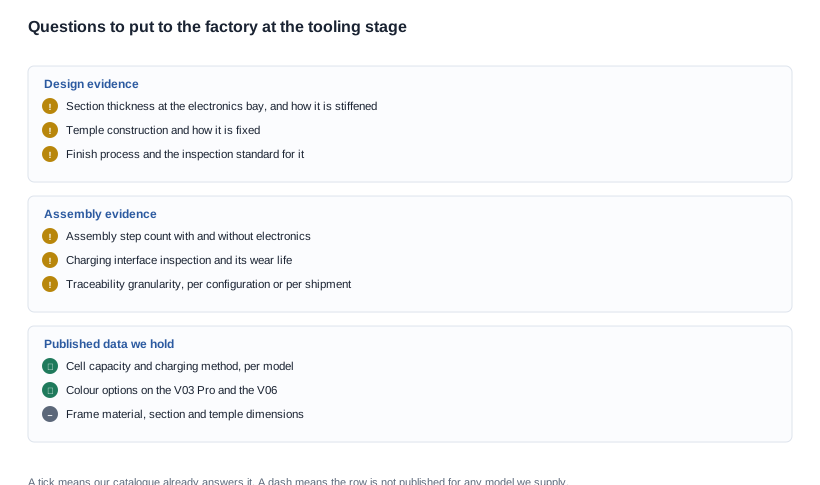
- What is the section thickness of the temple at the electronics bay, and how is it stiffened? A supplier who answers this has designed a frame rather than a housing. If the answer includes a rib, a boss or an insert, the request is being taken seriously.
- What is the frame weight in grams for the exact configuration? In our range, one model answers this and not published covers the rest. Ask for the scope of the measurement alongside the number, because a glasses-unit figure and a unit-with-case figure are not comparable and are sometimes quoted interchangeably.
- Is the temple user-replaceable, and how is it fixed? Riveted, screwed or bonded, and whether it can be swapped at a distributor. This question decides whether a service model exists at all, and it is cheap to ask before the tool is cut and expensive to answer afterwards.
- What is the finish process, and what is the inspection standard for it? Because the finish determines what quality control actually looks at, and a gloss inspection under a defined viewing condition is a stricter inspection than a colour-match inspection under a booth light.

The four questions to ask at the assembly gate
The assembly gate is where the unit price becomes a cost, and where a lot either passes or becomes a claim.
- What is the assembly step count with and without the electronics, and what does each added step add to the test cycle? The test cycle is where the cost hides, and it is the number that determines the delivered cost per unit on a large order.
- What is the first-article cosmetic acceptance standard, and who signs it? This tells you whether the supplier has a defined finish standard or an opinion, and it tells you where a cosmetic rejection will be argued.
- How is the charging interface inspected, and what is the wear life? An interface that fails intermittently in a customer's hand is a support cost that arrives long after the launch, and it is invisible to a one-off sample inspection.
- What is the traceability granularity? Whether a batch identifier is per configuration or per shipment determines how a claim is worked two years later. For a category where the material rows are unpublished, traceability is the only mechanism that ties a returned unit back to a production lot and therefore to a specification.
What the inspection plan has to cover before a lot is accepted
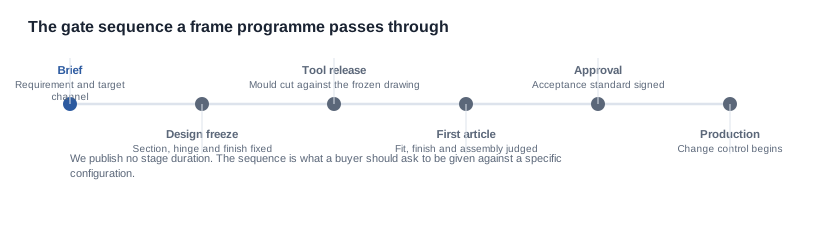
The inspection plan is where the frame specification either becomes enforceable or stays decorative. It is written at the tooling stage, because the fixtures that measure the frame are cut with the tool, and it is the document that a quality control dispute is actually settled against.
Five groups of check belong in it, and each one traces back to a row the buyer asked for.
- Dimensional checks on the section and the bay. Section thickness at the electronics bay, temple length, and the hinge boss geometry. These are the rows that decide whether the bay can actually accept the cell, the board and the camera module, and they are the checks that catch a moulding that was not achievable as drawn.
- Joint checks. Hinge torque at a stated count, and the presence and form of a steel insert where the joint is a torque joint. A torque check without a cycle count is a measurement of one moment rather than of the joint.
- Finish checks against a defined reference. A physical reference unit, a stated viewing condition, and an agreed tolerance. A finish judged against a photograph is a finish judged against somebody's memory.
- Interface checks. The charging contact, its insertion and removal cycle, and its condition at the end of that cycle. The magnetic interface and the Type-C interface fail differently and are inspected differently.
- Traceability capture. The batch identifier, the configuration, and the association between the unit and the production lot. Without this, a material question two years later cannot be answered even if the material was ever characterised.
A sixth group is worth adding deliberately: a retained unit. Keep one unit from every accepted lot as the physical reference for the next delivery. In a category where the material rows are unpublished, a retained unit is often the only baseline a buyer will ever have.
What to ask a factory before you order, in one page
There is a shortlist of questions that, asked together, will tell a buyer more about a frame programme than any sample evaluation. These are the questions to ask at the first quotation, and they are ordered by what they unblock.
- What material and grade will be used for the front and for the temple, and where were those figures verified? This separates a characterised product from a copied datasheet.
- What is the section thickness at the electronics bay, and what is the frame weight in grams for the configuration I am ordering? Two numbers, one of which you will not find anywhere else.
- What does the hinge consist of, and what cycle count has it been tested to? The joint is where this category fails most often.
- Which acceptance criteria will be applied at first article, and who signs them? The criteria decide what quality control looks at; without them a lot is approved by opinion.
- What has to be re-run if the frame changes after this point? This is the question that tells you where the change-control boundary sits in the programme.
- What is the minimum order quantity, the lead time and the price tier for each volume break? These three answers only become real once the material and the section are fixed, and asking them together prevents a comparison between a programme price and a unit price.
- What is the total cost of the frame relative to the whole product? A frame that adds ten per cent to the unit cost but requires a new tool, a new declaration and a re-test can cost more than one that adds thirty per cent and changes nothing else.
The trade-offs between these answers are programme trade-offs, not product trade-offs, and the ones that cannot be negotiated — certification cost and certification time, tooling — should be identified early rather than discovered at the second quotation.
Where our own documentation stops, and what we will do about it
The boundary we hold: we publish the unit weight where we hold it — 158 g for the MT6 glasses unit, excluding the foldable charging case — and not published for the rest, and we will not fill a material, section or dimension row with values from the optical industry, because the terms transfer and the values do not. A buyer who receives "typical" for a temple section has received nothing, and the gap will surface at the first article rather than at the quotation.
What we will do is explain the manufacturing logic, tell you which published rows are available for a given model, and be direct about the questions that have to be asked of the design team rather than answered from a catalogue.
| Row our catalogue publishes | Scope | What it lets a buyer fix | What it does not settle |
|---|---|---|---|
| Battery capacity | Every model in the catalogue | The bay volume the temple has to accept | Runtime, which depends on the workload |
| Charge time | Every model, twenty-six at two hours or less and two at about one hour | An upper bound on replenishment | The starting state, the temperature, the charger |
| Charging method | Per model, magnetic or Type-C | The cable, the cradle and the packaging geometry | Contact condition and thermal behaviour |
| Colour options | Three on the V03 Pro, four on the V06 | The number of combinations to fund and stock | The material or finish behind the colour |
| Structural features | Flexible temples on the V03 Pro, ultra-thin and detachable temples on the G07, a foldable case on the MT6 | What the assembly must achieve and how service works | Cycle life, release mechanism, failure behaviour |
| IP54 marking | The V06 and the S7 only | That the catalogue states an ingress position | A method, a report number, or the effect of a material change |
| Unit weight | The MT6 glasses unit only, 158 g, excluding the foldable case | One comparison point on one model | Frame weight elsewhere, and the balance on this one |
One practical consequence of a thin material file shows up at quotation rather than at specification. Because frame material drives the tooling decision, and because tooling drives both the unit economics and the lead time, we publish no unit price, no minimum order quantity and no production schedule on this site. Those three answers only mean something once the material and section are fixed, and fixing them is a conversation rather than a catalogue search. A buyer who asks us for a unit price before the section is fixed will be given a number with no basis, and a number with no basis is worse than no number at all because it will be used in a comparison.
The route that works is to send the configuration and the target weight, and to receive in return the list of gates the configuration has to pass and the list of rows that have to be closed before the first article. Send us the configuration and the target weight and we will tell you what the frame has to achieve.
Related reading
- Materials and ergonomics
- Frame materials for beginners
- Frame materials cost factors
- Standard OEM tooling requirements
Send the configuration and the target weight and we will tell you what the frame has to achieve.


