
Durability is the word in this category that most often ends up as an adjective rather than a criterion, and the reason is straightforward: nothing in our documentation allows it to be anything else. For the A05, the A06 and the A07 there is no drop result, no impact figure, no ingress rating, no lens material, no hinge data, no frame material and no frame weight published. A catalogue sheet that used the word durable in a product description would be making a claim, and our catalogue does not do that. Which leaves a channel with a commercial need and no evidence, and the only honest route between those two things is to build the evidence.
That is what this article is about, and it is a procurement subject rather than a product subject. A durability claim obliges a seller to something: to stand behind the unit after it has been dropped, to answer when a parent says the lens is scratched, to say what happens to a unit that fails. A channel that has not built a test has none of those answers, and it will find them out from customers one at a time, at whatever price the returns data eventually sets. A channel that has built a test has a criterion, a record and a remedy, and can defend all three.
The scope is deliberately narrow. This is about how durability is expressed in a purchase file and how an acceptance test is specified and judged. The daily handling routine that a household follows sits in a separate piece, and the compliance framework for the product sits in another; repeating either here would blur the three.
The health boundary applies as everywhere else. None of these three models carries a vision, health or eyesight claim, and none is presented as a medical device, and the boundary position note sets that out. The child product compliance page covers the framework the buyer's own compliance party works from.
Kids smart glasses durability for children: an acceptance test, not a catalogue adjective
The first question for a buyer is what the durability work is actually for, because the answer determines everything else about it. There are three defensible purposes and they lead to three different tests.
A claim the channel intends to make. A listing that says the unit survives being knocked about is a claim that will be tested by a customer, and the test that supports it has to be a test the channel has specified and can point to. The severity of the test follows the claim: a broad claim needs a broad protocol.
A requirement a retailer has set. A school or a large retailer will often have its own acceptance condition, frequently expressed as a number of drops from a stated height onto a stated surface. In this case the protocol is largely given, and the buyer's work is to make sure the units being offered are the units being tested, and to record the result properly enough to satisfy the retailer later.
A return rate the channel wants to reduce. This is the most common commercial reason and the least specific, and it is the one most often handled badly, because it tends to produce a single informal test on a single unit at the factory. A return-rate programme needs a sample, a protocol and a record, because without them nobody can tell whether a change in the failure pattern means the product improved or the test changed.
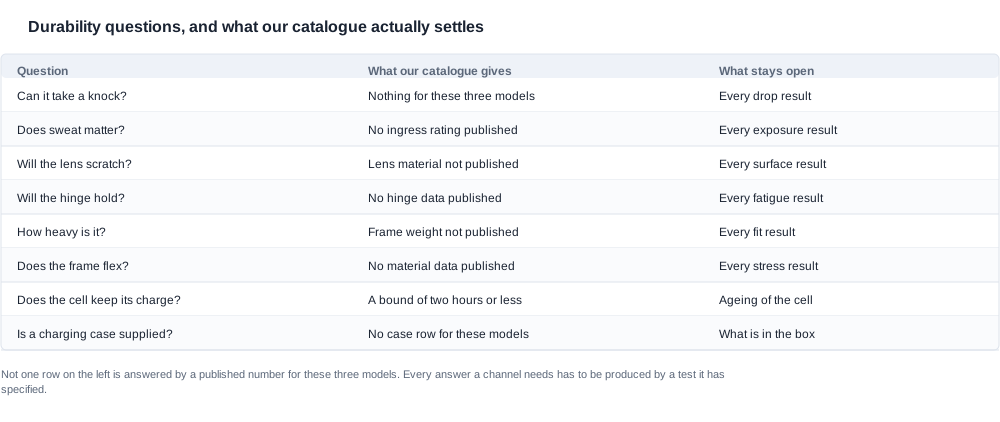
Read the table as a work list rather than a specification. Every row on the left is a question a buyer eventually has to answer, and not one of them is answered by a published figure for these three models. That is not a criticism of the catalogue; it is the reason the test has to be bought and specified rather than looked up.
The four questions to settle before commissioning anything
- Which claim or requirement is the test for? Without this, a protocol cannot be written, because the severity of a drop and the pass condition both follow from what the result is going to be used for.
- What is the pass condition? A unit is either outside the stated limit, in which case the result is a pass regardless of how it looks, or inside it, in which case it is a fail. Anything in between is a protocol that was not finished.
- How many units, drawn how? A single unit proves nothing. The units should come from the batch being ordered, so that the result describes the goods rather than a pre-production sample.
- What happens to a unit that fails? The remedy has to be decided before the test, and it has to be written into the order, or the result is a piece of information rather than an obligation.
The red flags a buyer should watch for in a supplier's durability offer
A supplier that offers "we drop-test every unit" has described a procedure without a protocol, and the missing elements are exactly the ones that carry the meaning. Which height. Which orientation. Which surface. How many. What is checked afterwards. And what the pass condition is.
The second red flag is a result presented without units. A figure without a unit cannot be compared with another figure, and a percentage without a denominator is not a result. The third is a result for a different model, or for a model with a similar name. The fourth is a result described in terms of the product category rather than the ordered designation.

The drop protocol that has to be written before it is run

A drop protocol is a short document, and there is no reason for it to be long. It needs to fix the following, in writing, before the first unit is handled.
The height, and the surface. Both are part of the result rather than the setup. A unit dropped from a padded position onto a hard surface and a unit dropped from a hard position onto a padded surface are different tests with the same name.
The orientation. A unit dropped flat, one dropped on a corner and one dropped on an edge are three different tests. A protocol that does not state the orientation is a protocol that will be reported as a single result regardless of what happened, and the reader will take it as the average case.
The number of drops and the sequence. Whether a unit is dropped once, dropped three times on the same edge, or dropped three times on three different edges, changes what the result means. The sequence matters in particular, because damage from a first drop can change the behaviour of a second.
The functional check after the sequence. Whether the unit still charges, still pairs, and still performs its published function, and which of those are checked, is the part of the test that actually matters to a channel. A unit that survives a drop and no longer charges is a failure, and a protocol that only looks at the shell will report it as a pass.
The recording rule. Every unit is recorded, including the ones that pass, and including the units that are examined and found undamaged. A record that contains only failures cannot be compared with a later record, and a test that reports a single best result out of a sample is not a test at all.
Why the protocol has to be written first
The commercial reason for writing the protocol before the test is not procedural neatness. A protocol written after a failure is a description of what happened, and the party that writes it after a failure has an interest in the outcome. A buyer who accepts a protocol drafted after the first failure cannot tell a criterion from a justification, and the difference shows up later in the argument about who pays for the units that did not survive.
There is a second reason, which is more practical. The protocol defines the remedy, because the remedy follows from the pass condition, and the pass condition is only meaningful if it was fixed in advance. Writing the protocol first means that a failure is a fact that triggers a clause, rather than a negotiation.
The A07 buyer review checklist covers the review items that sit alongside this one, and the school requirements piece covers the version of the same question that a school purchaser asks.

Sweat, water and the ingress question none of the three can answer today
The second limb of durability in a children's product is exposure to liquid, and here the published position is not merely thin, it is empty for these three models. The catalogue publishes an ingress rating for the V06 and the S7 and for nothing else. The A05, the A06 and the A07 carry none, and there is no published material describing how they behave when a child sweats on them, when they are left in a bag during a downpour, or when they are rinsed under a tap.
That absence is what makes this the easiest part of the article to get wrong. A channel that has read about a rating elsewhere in the range can easily carry an assumption across, and a listing that mentions a splash or a sweat story creates an obligation nobody has measured.
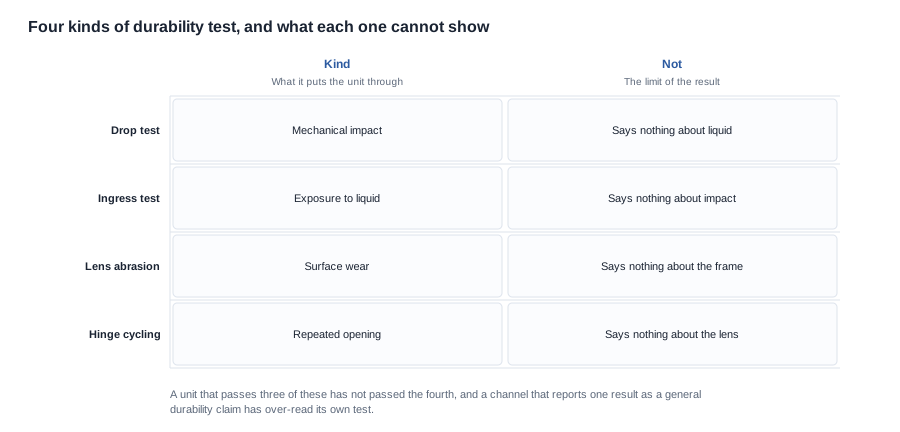
The matrix above makes the point that matters commercially: exposure and impact are separate exercises. A unit can pass a mechanical test and still be undemonstrated in liquid, and a unit can be shown to tolerate liquid while showing nothing about knocks. A channel that runs one of the four tests and reports it as a general durability position has over-read its own evidence, and the copy that results is usually broader than the test.
What a channel should do instead of claiming
- Make no liquid-related statement for these three models until a report exists. Not a soft statement, not a careful one, none.
- Write the routine instruction instead of the claim. A printed instruction that the unit is taken off before an activity session is defensible on the basis of the published position, because it follows from the absence of a rating rather than from any assertion about failure.
- If a liquid demonstration is commercially necessary, commission it properly. That means a stated severity, a stated duration, a stated surface and orientation, a stated number of units, a functional check afterwards, and a report that names the ordered designation and the date.
The questions to ask about the liquid position
- Is there any exposure testing for these three models, and if so does the report name the designation?
- If a rating is to be claimed, which method and which severity, and who issues the report?
- Does the supplier's own guidance for activity sessions agree with the routine a channel intends to print?
- What changes to the unit, in the supplier's view, would invalidate such a report?
The last question is the one that belongs in the purchase order as a notification obligation, because a liquid-related claim is only as durable as the components it was measured on.

Lens, hinge and temple checks that decide what the unit is worth second-hand
The third limb is the wear and tear that decides what happens to a unit after a term of use, and it is the limb with the clearest commercial logic for a channel, because a unit that still looks and works as new at the end of a school year is a unit that can be resold, re-listed or discounted without a loss.
The lens. Our catalogue publishes no lens material for these three models, which means an abrasion test has to be defined rather than inherited: what is used as the abrading medium, how many cycles, under what load, and what is inspected afterwards. Without a lens material, a scratch result is not comparable between suppliers, and a "scratch-resistant" statement has no document behind it.
The hinge. A hinge in a children's product is a fatigue item rather than a strength item, because the failure mode is repeated opening and closing rather than a single event. The useful test is a cycle count with the number of cycles stated and a check of the temple alignment afterwards, and the useful record is a photograph of the alignment, because alignment is what a reviewer will actually argue about.
The temples and the nose bridge. These carry the fit, and the fit is what decides whether a child keeps the unit on. A bent temple is a return, and a temple that has been adjusted is a unit whose geometry no longer matches the measurement on the file. The frame weight and geometry are not published for these three, so a channel cannot calculate the tolerance either, and the practical answer is to record the condition of the temples at the start of a term and compare.
The cell. The charge time is bounded at two hours or less, and we publish no ageing data for the fitted cell, so a channel cannot state how the bound moves over a year of use. A channel that wants to describe the second year of a product's life needs a cell measurement over time rather than a catalogue figure.
How these checks reach the purchase file
A durability programme written as four separate exercises produces four results that cannot be added together, and a channel that reports them as one number has produced a claim it cannot defend. The alternative is to keep them separate in the file and to state, for each, the claim it supports. A lens abrasion result supports a statement about the lens surface. A hinge cycle result supports a statement about the hinge. Neither supports a general durability statement, and the general statement is the one a listing usually wants.
The durability criteria that belong in a purchase order
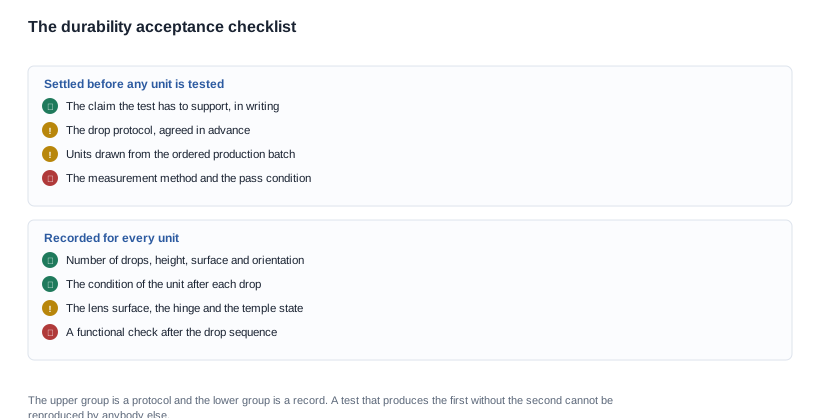
The checklist has two halves for a reason. The upper half is a protocol, and it belongs before the test; the lower half is a record, and it belongs in the file afterwards. A test that produces the first without the second cannot be reproduced, and a test that produces the second without the first cannot be compared.
Five clauses earn their place in the order, and each of them exists because a channel has otherwise been left arguing.
- The acceptance criteria, stated in full, as a pass condition per unit and a fail condition per unit, attached to the order rather than described in a covering letter.
- The sampling rule, so that the units tested are drawn from the ordered batch, in a stated quantity, and the result is a statement about the goods.
- The remedy, decided in advance, covering the units that fail, the units that are destroyed in testing, and the cost of re-testing a replacement batch.
- A notification obligation before any change to a safety-relevant component, the lens material, the frame material, the cell or the detection defaults, since any of those can invalidate a result.
- The record handover, so that the test report and the underlying data are delivered with the order and stay in the channel's file for the period the product is on sale.
A sixth clause is worth considering where a channel is buying repeatedly: whether a re-test is triggered by a change of production batch, and who pays for it. Without that clause, a result obtained on one batch is quietly extended across every later batch, and nobody notices until a return pattern changes.
A worked sequence
The scenario is constructed to show how the pieces are sequenced rather than to describe a customer.
A distributor has a children's line on order and has been asked by a retailer to state a drop condition before the first delivery is accepted. The distributor's first step is to establish the claim the test is for, and to discover that it is the retailer's condition rather than a channel claim. That single answer changes the protocol entirely: the severity is given, and the distributor's work is to make sure the result describes the ordered goods.
The protocol is written and agreed, the units are drawn from the batch, and the test is run. Three units fail. Because the pass condition was fixed in advance, the result is a fact rather than an argument, and the remedy in the order takes effect. The distributor also asks, in the same exchange, what the supplier's own position is on liquid exposure for these models, and the answer establishes that no rating exists and none can be claimed, so the channel's printed instruction stands and no liquid wording goes onto the carton.
In the second term the distributor adds two further exercises rather than one: a hinge cycle count and a lens abrasion, each with its own pass condition and its own record. It becomes clear that a single general durability figure was never available, and that the channel's position is three separate statements rather than one broad one.
The outcome is a file that answers a retailer's question without a test being repeated, and a carton that makes no claim the file cannot support. The decisive decisions were fixing the claim before the protocol, taking the units from the ordered batch, and keeping the separate exercises separate in the copy.
What our documentation can and cannot contribute to this decision
It contributes the specification against which a unit can be judged as functional: the published specification for each of the three models, which is set out in the electrical rows piece. Those are the rows a functional check after a drop sequence is written against, and a channel that has them can define "still works" precisely.
It contributes nothing on the mechanical side, and we will not estimate it. No drop result, no exposure result, no lens material, no hinge figure, no frame material, no frame weight and no age band is published for these three models, and a channel that needs any of them has to commission the test and hold the report. The models are at kids smart glasses.
Give us the claim you intend to make, the retailer condition you have been given, and the batch the order will run against, and we will write the acceptance criteria in the form they can be tested against and put them into a purchase order clause.


