

Verifying a frame material is unusually hard to do remotely, because the material is not what a buyer is buying and the thing that actually determines whether the product works is a property of the frame that a material certificate does not describe. A supplier can be entirely honest, produce a real frame, and still fail you on the specific thing you needed — and the evidence of that failure is physical.
The published position in our range makes the difficulty concrete. The frame material is not published for the range as a whole. The complete-unit weight is published for one model in the entire catalogue — 158 g for the MT6, which is the glasses unit including the 265 mAh cell and the camera and excluding the foldable 1200 mAh charging case — and Not published for the rest. Frame dimensions, temple length and temple curve are Not published for every model. The certifications shown across the range are ten patent certificates on the export-certification page — eight appearance-design patents and two utility-model patents — with no CE, FCC or RoHS marking named, no per-model certificate numbers published, and the certification position for the children's models not published to us.
So smart glasses frame materials smart glasses supplier verification is a question about what to verify, in what order, and with what physical evidence — and this article is organised around that order rather than around a list of attributes.
Smart glasses frame materials: four verification tiers and what each costs
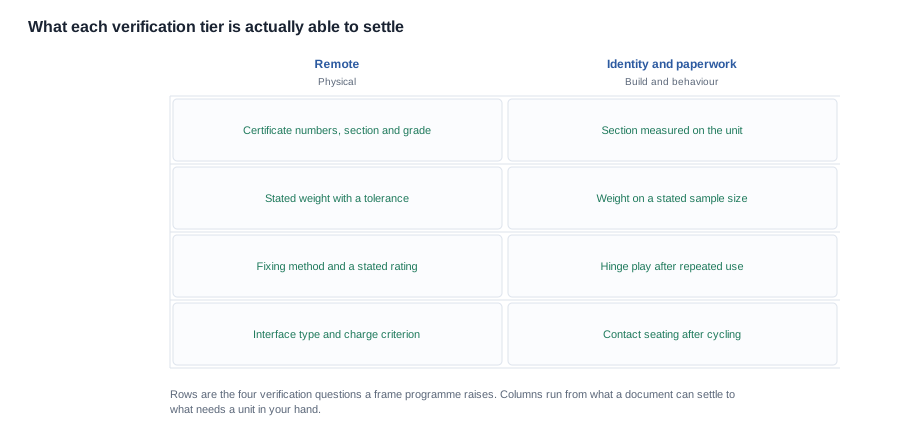
Verification in this category is not a single activity. It is four tiers, each more expensive than the last and each able to settle things the one below it cannot.
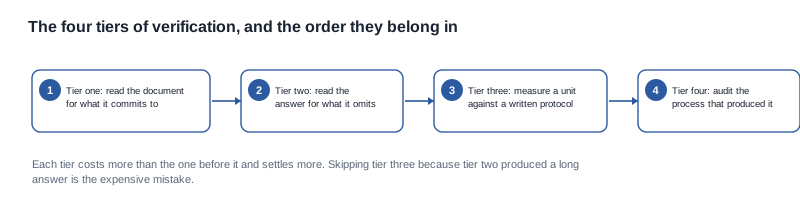
Tier one is the document. Read the supplier's specification sheet for what it commits to rather than for what it describes. A populated row is a commitment; an empty row is a decision that has been transferred to you. This tier costs an hour and settles a surprising amount, because most suppliers document their engineering honestly even when their marketing is loose.
Tier two is the answer. Ask the questions and read the answers for what they omit. A weight offered as a range, a certificate offered at family level, a material offered as a family name — each of those is a true answer to a narrower question than the one you asked, and the omission is the finding.
Tier three is the unit. Measure a physical sample against a protocol you wrote before the sample arrived. This is the first tier that can settle a dimensional or a behavioural question, and it is the tier where most remote verification programmes stop short.
Tier four is the process. Audit the operation that produced the unit, either on site or through a third party. This is the only tier that can tell you whether the inspection regime exists at all, as opposed to whether one inspector inspected one lot correctly.
The discipline that makes the tiers work is spending the cheapest tier that can retire the risk. A risk that is purely documentary — a certificate that might not cover your model — is closed at tier one, and commissioning an audit to settle it is a waste of the programme's budget. A risk that is a process weakness cannot be closed at tier three no matter how many units you measure, because a consistent process produces consistent samples.
Choosing the tier your risk actually needs
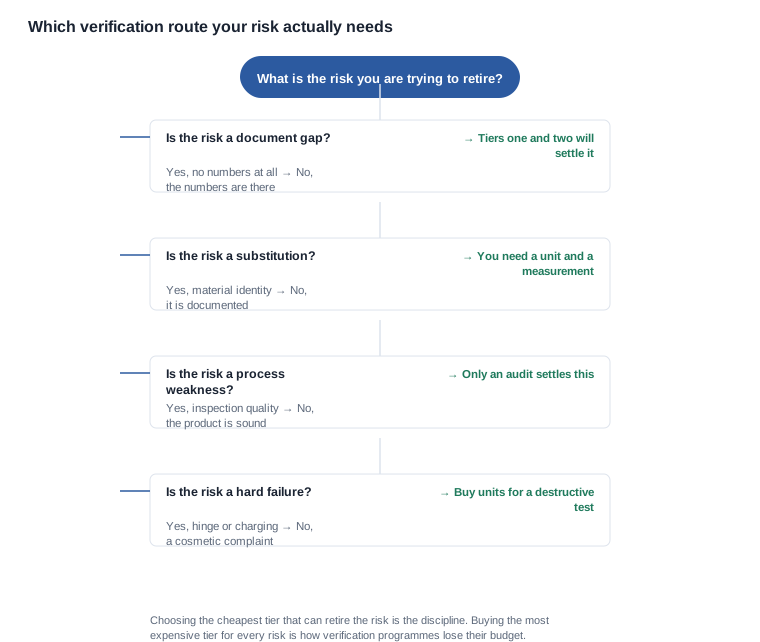
The four questions in that decision tree are worth asking before any verification spend is approved, because each one retires a different class of risk. A document gap is closed by tiers one and two. A substitution risk — the risk that the resin in the unit is not the resin in the paperwork — is only closed by a unit, because a document cannot be inspected. A process weakness is only closed by an audit. And a hard-failure risk, where the question is whether a hinge or a charging contact survives, has no documentary answer at all: it has to be settled with units bought for the purpose and tested to destruction.

The four things to verify remotely, before a sample
Four items can be settled from the desk, and they are the four that most often turn out to be missing rather than to be wrong.
1. The material and the core construction. Whether the temple is a solid moulding or an acetate temple with a wrapped metal core. This is a design question with a structural answer, and it determines what the temple can carry. Ask for a drawing or a section rather than a description, because a description is where the family name comes from.
2. The finish process and the inspection standard. Matte, gloss or soft-touch, and what quality control actually inspects for that finish. A gloss inspection is a stricter inspection than a matte one, and a supplier who has a defined standard for each finish has a process rather than an opinion. Ask which instruments are used and against what physical reference, because the reference is what makes the standard usable.
3. The weight, in grams, for the exact configuration. Ask per model, in writing, including the battery configuration. In our range this figure is available for one model and Not published for the rest, so it is a data request rather than a courtesy. Specify that the answer must state the sample size and the spread, because a weight without a spread is a single measurement.
4. The RoHS and REACH position, against the actual bill of materials. Not the material's certificate but the product's declaration, because a material certificate does not cover what was assembled. A declaration that has not been updated after a component change is not evidence of anything, and the date on the declaration is the thing to check.
Three answers that deserve a second question
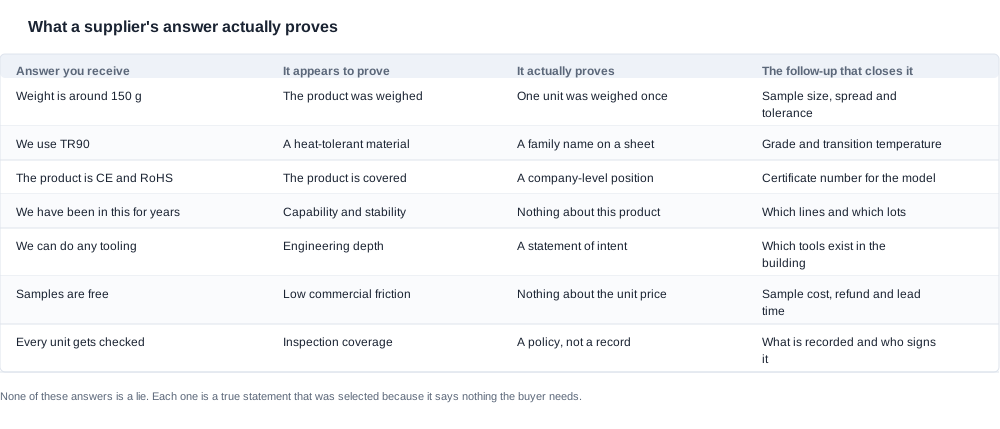
A weight offered as a range. "Around one hundred and fifty to one hundred and sixty grams" across a range of models usually means one configuration was measured and generalised. The second question — how many units, and what was the spread — converts a marketing number into a capability statement, and the spread is often the more useful half.
A certification offered without model coverage. "We have CE" is not a position; the model list on the document is. In our range the export-certification page carries ten patent certificates, eight of them appearance-design patents and two utility-model patents, and names no CE, FCC or RoHS marking, no per-model certificate numbers are published, and the children's models have no published certification position at all. A family-level statement is not coverage for a branded configuration, and that distinction is what stops a marketplace rejection or a customs query later.
A material certificate offered as the product's evidence. The two documents are different and cover different things. The material certificate covers the resin. The product's declaration covers the assembly, including the plating, the adhesives and the skin-contact components. Asking for both is not pedantry; it is the only way to close the chemical-restriction question, because those obligations reach coatings and plating rather than the base polymer alone.
The four things only a sample can establish
Four items cannot be settled from any document, and the honest position is that they cannot be settled remotely at all.
1. The sizing across a size range. Temple length, temple curve and the width at the temples. The published data in our range cannot help — every one of those is Not published for every model. Sizing drives returns more than any other variable, and it is the one that can only be tested on people.
2. The temple's stiffness under a load. A temple carrying a battery and a board behaves differently under a torque load than an optical temple does, and a flex test on a sample tells you more than a material name ever will. The test is cheap; the write-up is what makes it usable, and the failure criterion has to be defined before the first reading.
3. The hinge play after repeated use. This is the wear point, and the one that produces returns a year after purchase, which means it will not appear in any acceptance test you run at the factory gate. Write the cycle count and the pass mark into the order before the first lot ships, and the tier-three work becomes tier-four evidence.
4. The charging interface's condition after a cycle. Relevant in the sport tier, where the catalogue carries an IP54 marking on the V06 and the S7 with no test report number published, and where the interface is an opening in the frame. The contact alignment after a stated number of mating cycles is a measurement, not an opinion, and it is one of the few frame questions that predicts a field failure directly.
Why sizing cannot be verified from any document
It is worth being explicit about this, because it is the row buyers most often assume a factory will have. No factory publishes accurate sizing for you, because the person who would measure it is your customer. The published data can tell you what the front looks like; it cannot tell you how it sits on a face, how it behaves across the fourth dimension of the head population, or how it behaves after the temple has been flexed ten thousand times.
The consequence for a sourcing decision is that sizing has to be a sample-and-wear activity with several head shapes, and it has to be specified by the buyer rather than inherited. The unit weight row is the same shape of problem: in our range it exists for one model only, the MT6 at 158 g for the glasses unit including the cell and excluding the case, so for every other configuration it is a request to be answered rather than a figure to be compared.
What a verification result tells you about the supplier, not the product
The value of the tier-three and tier-four work is not only about the unit in your hand. It is that a measured result tells you something about the operation that produced it, and that something transfers to the next order.
A supplier that supplies a section thickness for a named cell configuration is a supplier that designs frames. A supplier that supplies only a material family is a supplier that buys housings and adapts them, which is a perfectly good business model and is not a criticism — but it means the frame is not the source of any strength figure and the buyer should not treat it as one. A supplier that can produce a pull-force rating at the hinge has done the work on the joint, which is the joint that generates the warranty claim.
The questions that separate a frame maker from a housing maker
Four questions do most of this work, and all four have a structural answer rather than a descriptive one.
What is the section thickness of the temple at the electronics bay, and how is it stiffened? A supplier who answers this has designed a frame rather than a housing.
How is the temple fixed to the front, and is it user-replaceable? Riveted, screwed or bonded, and whether the assembly can be swapped at a distributor. This is a service and returns question, and on a bonded design it determines the difference between replacing a part and replacing a product.
What is the first-article cosmetic acceptance standard, and who signs it? This tells you whether the supplier has a defined finish standard or an opinion, and it tells you what to ask to receive when a lot is rejected.
Where is the tooling held, and who owns it? A tool held at the supplier with a recorded shot count is an asset. A tool without either is a rumour. The tooling requirements are set out in more detail on the tooling page, and the factory audit page covers what to look at when you are standing in front of the operation.

The price of verification, and who carries the risk of a failed cycle
Verification has a price, and the price is usually not the sample. It is the freight, the duty, the customs handling, the people-hours, and the calendar time in which the programme is waiting.
The sample charge and its refund terms. A supplier who offers free samples is usually offering them against an order, and the terms are worth reading: whether the sample cost is credited, whether the freight is credited, and whether there is a minimum order attached to the credit. These three lines decide whether verification is a cheap front end to a programme or a real line item.
The sample lead time. Samples that take six weeks are a programme risk, because the verification work cannot start until they arrive. Ask for the date the units will be built, not the date they will ship, and note that the same supplier's production lead time will usually be longer than the sample lead time, not shorter.
The cost of a destructive test. A hinge pull test and an interface cycle test consume units. Asking for the cost and the willingness to do them before the quotation is easier than asking afterwards.
Who pays for the re-run. If a verification result fails and the programme has to restart, the schedule cost dwarfs the unit cost. A clause that covers the re-run changes the supplier's incentive to answer tier-two questions honestly, which is the cheapest way to improve the quality of the answers you get.
The negotiation on this is not about the individual prices. It is about how many verification cycles the programme funds and who carries the risk of the first one failing. A supplier who agrees to carry the re-run is telling you something about how they expect the verification to go.
A worked scenario for a brand shortlisting three frame suppliers
The worked example below is hypothetical and is here to show how a supplier would be checked, not to report a client.
Assume a brand sourcing camera glasses for a sports channel, with a first launch window that cannot move, and three candidate factories. The brand's own team has no published frame specification to compare against, so the shortlist is built on verification rather than on datasheets.
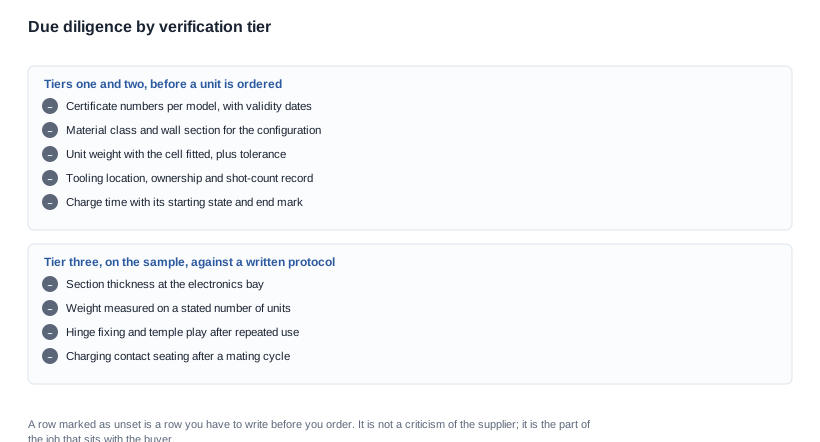
The first pass is tier one and tier two, and it costs a day. The brand sends the same request to all three suppliers, asking for the certificate numbers per model with validity dates, the material class and wall section for the exact configuration, the unit weight with the cell fitted plus a tolerance and a sample size, the tooling location and shot-count record, and the charge time with its starting state and its termination criterion. The uniformity of the request is the point: three suppliers answering the same five questions is comparable, and three suppliers answering five different questions is not.
The second pass reads the answers for what they omit. One supplier answers all five with numbers. One answers three and explains at length why the other two do not apply. One answers with a brochure. The third is eliminated at this stage, which is the outcome the brand wanted: it cost a day rather than a sample, a freight booking and a month.
The third pass buys one unit from each of the two remaining suppliers. The protocol is written before the units arrive and covers the section thickness at the electronics bay, the weight on a stated number of units, the hinge fixing and the temple play after a stated number of cycles, and the charging contact seating after a stated number of mating cycles. The supplier that supplied a section thickness for the exact cell configuration is the one the brand expects to place the order with, because that answer predicted the other three.
The fourth pass settles the commercial terms. The brand asks for the sample cost, the freight terms and the lead time, and it asks which of the three will carry the cost of a re-run if the first lot fails a criterion. It then writes the criteria into the purchase order, attaches the verification protocol, and puts the certificate numbers per model into the order as well, because an answer on a specification sheet is still a description.
By the end, the brand has not chosen a frame material. It has chosen a supplier on the basis of what that supplier could prove, and it has a written acceptance file that would survive a dispute eighteen months later.
What we can and cannot verify remotely
We publish the unit weight where we hold it — 158 g for the MT6 glasses unit including the 265 mAh cell and excluding the foldable 1200 mAh charging case — and Not published for the rest, and we will not fill a material, dimension or finish row with values from the optical industry, because a smart glasses frame is not an optical frame and the values do not transfer.
We will also say plainly what we cannot verify remotely either: sizing, temple stiffness under load, hinge play and the charging interface's behaviour after cycling. Those need a sample and a wear test, and we will not describe a material as though it settled them.
If you tell us the model and the configuration, we will tell you which of these items we can answer from what we hold and which need a physical unit. The wider frame material question sits under materials and ergonomics, and the cost side of the same decision is covered in frame materials cost factors.
The risk to retire first, and the tier that retires it
Send us the model, the configuration and the risk you are trying to retire, and we will tell you which tier of verification can settle it and which items we can answer from what we hold. If you want a starting template for the supplier request, say so and we will send the five questions in the form we would use.
Related reading
- Materials and ergonomics
- Frame materials for beginners
- Frame materials cost factors
- Factory audit and what to look for
Send the model and the configuration and we will tell you which items we can answer from what we hold.


