

Smart glasses frame materials: five questions buyers ask
Material is the specification this catalogue says least about, and the one that decides the most. Our catalogue publishes a rated runtime, a cell configuration, a charge time, a charging method and, for two models, an ingress marking — and it publishes no frame material for any model, no surface treatment, no hinge specification, no impact rating and no alloy or polymer designation. That is not an oversight in the sense of a missed field; it is the boundary of what a catalogue page can carry, and a buyer who needs material data has to obtain it as a declaration from the supplier, in writing, before the order.
The five questions buyers ask about material are, in the order they are usually asked: what is it made of, how heavy is it, how long does it last, what does it look like, and can you make it in our colour. The order in which those questions should be answered is different, and the difference is where a procurement decision is usually lost. Material first, because it drives the tooling and the cost and it cannot be changed late. Then the mechanical specification, because the hinge and the temple joint decide the warranty line. Then the environmental behaviour, because it decides the market. Then the weight, because it is a consequence of the first two rather than an independent variable. The colour question is last, because a colour requirement that arrives before the material decision is a tooling commitment made in the dark.
The reason this row matters commercially is that material is where a product's cost, its lead time, its warranty exposure and its market access all meet. A material change moves the tooling cost, the minimum order quantity, the certification position for skin-contact and substance restrictions, the radio behaviour, the ingress rating and the image the brand has to sell. A buyer who treats material as a cosmetic field has misunderstood where the commercial risk in a glasses product actually sits.
The mechanism behind our approach is on the materials and ergonomics technology page. If you want the questions rather than the analysis, the material questions to ask a supplier article is the condensed list, the material limitations article covers where these approaches reach their limits, and the material glossary defines the vocabulary used here.
The five questions, in the order we would answer them
- What is each part made of? Not the product, but the parts: front, temple, bridge, hinge, nose pad, temple tip. A single material name for a product is a description of the front and nothing else.
- What is the mechanical specification of the joint? The hinge and the temple joint decide the warranty line, and a cycle rating for that joint is a number a buyer can hold a supplier to.
- What is the environmental behaviour? The ingress marking, the UV and salt exposure results, and the surface treatment, because these decide the market and the service life.
- What does the assembly weigh? With the cell and the camera in it, and with an explicit statement of what is included, because the one weight our catalogue publishes is easy to misread.
- Which colours are available from the base material, and which need new tooling? This is the question that decides the minimum order quantity and the first-order cost.
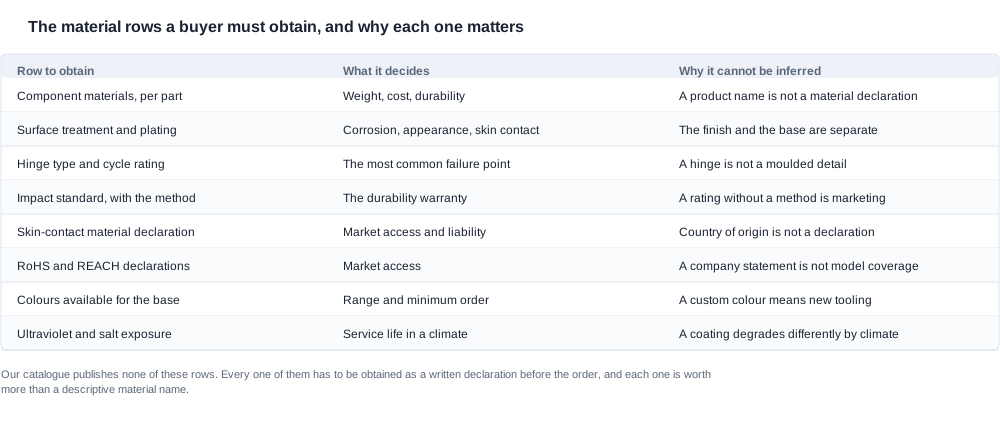
The table above is the complete list of material rows worth obtaining, with the reason each one is worth the effort. Rows three and four on that list are the ones that get skipped, and they are the two that decide whether a product works in the market the buyer is actually targeting.

What a frame material commits a supplier to
A frame is not one material. It is a set of materials, each doing a different job, each with its own specification, its own tooling and its own failure mode. The buyer who asks "what is it made of" is asking about the front and learning nothing about the hinge, and the hinge is where the warranty claim comes from.
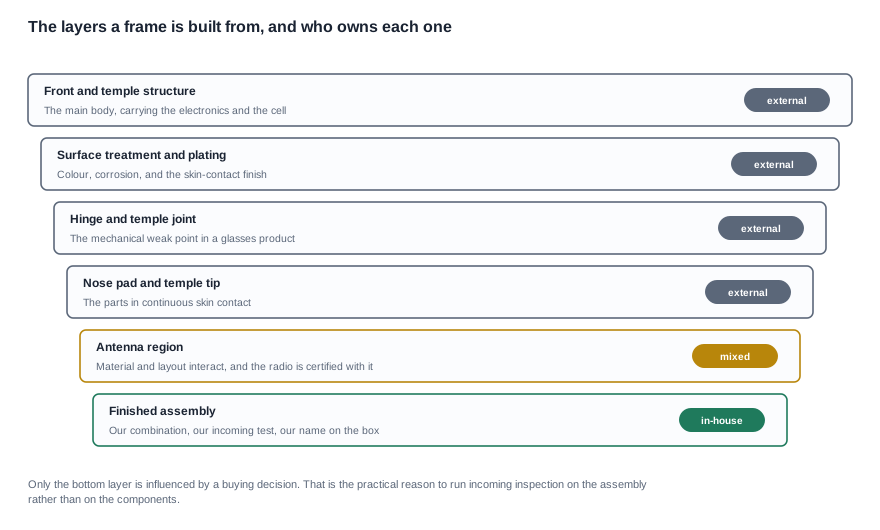
The layering above is worth reading as a commercial map rather than an engineering one. The structural parts and the finish belong to the supplier, and their specifications arrive in the technical file rather than in the sales conversation. The antenna region is the interesting one, because the radio and the structure are not independent: a metal front, a metal temple and a plastic front with a metal temple produce different radio behaviour, and a change to the material can change the certification position of a product that was already documented. That coupling is not obvious to a buyer, and it is the reason a material change late in a programme is a documentation event and not a production event.
The final layer is the one the buyer owns. The finished assembly — the combination, the tolerance, the joint, the state of the product in the box — is where the brand's name sits, and it is the only layer that a buying decision can actually influence. This is the practical reason to run incoming inspection on the assembly rather than on the individual components: a component that conforms to its own specification can still be assembled into a product that does not meet the requirement.
The temple matters more than the front
The front of a glasses product carries the electronics, the cell, the camera and the branding, so it gets the attention. The temple carries the hinge, the antenna region, the battery, the control, and the entire mechanical load, and it is where the product fails. In our catalogue, two of the audio models publish a distinctive temple: G07 is described with a slim and detachable temple, and YK12 with a surround-sound slim temple. Both details are mechanical, and both of them change what a buyer has to specify and what a supplier has to test.
A detachable temple is the clearest example of a material decision with a testing consequence. A joint that can be separated is a joint that can be assembled in more than one way, and the radio and the acoustics are affected by whether it is fully seated. The supplier has to test the product in the configuration that ships, and the buyer has to write that configuration into the order rather than assume it. A slim temple reduces mass, which changes the balance and the load on the hinge, which changes the hinge cycle rating that the product can honestly claim. Neither of these is visible in a product photograph.
There is a second consequence of the temple that is purely commercial: the number of distinct parts in the assembly. A product with a removable temple, a replaceable tip, a separate hinge cover and a set of nose pads has more part numbers, more incoming inspection points, more spare-part decisions and a larger accessory conversation. A buyer who is comparing two quotes on unit price alone is comparing the easiest number in the set, and the difference in assembly complexity shows up in the quality cost later.
The weight question, and the 158 g exception
The weight question is the one buyers ask most often, and it is the one where the catalogue can mislead even a careful reader, so the position has to be stated precisely. The catalogue publishes one weight in this product range, and it belongs to a single model: the MT6 glasses body is 158 g, including its 265 mAh cell and its camera, and excluding the 1200 mAh folding charging case. The catalogue publishes no bare frame weight for any model, and it publishes no weight for the case itself. A buyer who records "158 g frame weight" has recorded a false specification, and the product will fail an incoming inspection against it.
That single number is also the clearest illustration of why a product weight is a poor proxy for a frame weight. The MT6 body carries a camera, a cell, a charging circuit and the structure that holds them, so its body weight says very little about how heavy the frame itself is, and nothing at all about how heavy a different model's frame would be with a different set of contents. Comparing two products on body weight compares two bundles rather than two frames.
The right question to ask a supplier is the weight of the specific model, broken into what is included: the frame structure alone, the electronics, the cell, and any case as a separate line. A buyer who needs a frame weight for a design or ergonomic assessment, rather than a total for a shipping calculation, needs it stated as a frame figure and needs the supplier to say that it is one. Most suppliers will give the bundle figure readily and the frame figure reluctantly, because the bundle figure is the one that is certain.
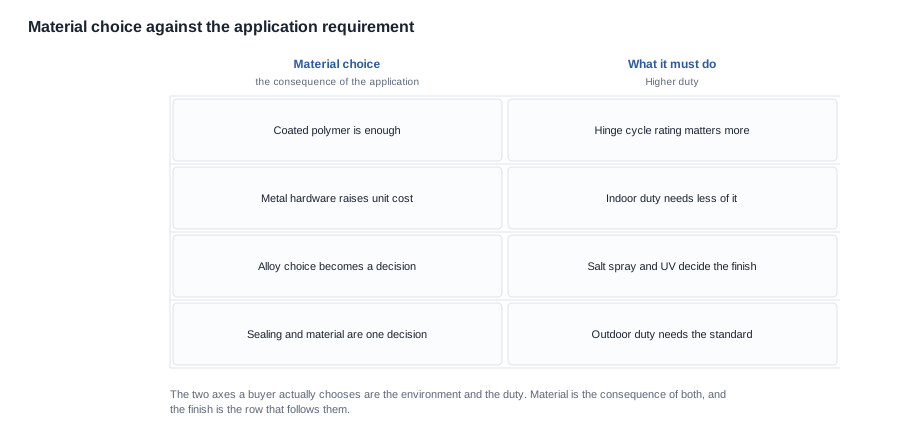

Getting a material claim onto paper before the order
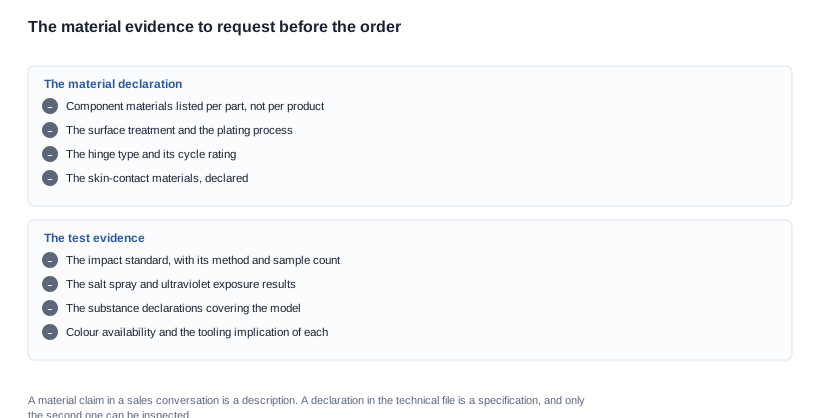
The material conversation usually starts as a description and has to be converted into a declaration, because a description cannot be inspected and a declaration can. The conversion takes five steps, and none of them requires a laboratory.
Step one: get the per-part material list, not a product name. The front, the temple, the bridge, the hinge, the nose pad, the temple tip, the hinge cover and any internal structural part. If the supplier answers with a brand or a trade name, ask for the base material as well, because a brand name conceals the specification and a base material does not.
Step two: get the surface treatment separately from the base. Coating, plating, anodising, painting and passivation are different processes with different durability and different skin-contact consequences, and a colour name says nothing about which one was used. This is also the row that determines whether a corrosion claim can be made at all.
Step three: get the mechanical specification. The hinge cycle rating with the number of cycles and the failure criterion, the impact or drop standard with its method and its sample count, and the tolerance on any joint that is designed to come apart. A rating without a method is a marketing claim, and a cycle count without a failure criterion is a number that cannot settle a warranty claim.
Step four: get the market documentation as a model-specific declaration. The substance restrictions — the RoHS and REACH declarations, the skin-contact material declaration, and where the market requires it, the nickel-release position on the parts that touch skin. The important distinction is that a company-level statement about the factory's capability is not coverage for the configuration being ordered, and a buyer who treats a general capability statement as model coverage will discover the gap at a market-access check.
Step five: get the tooling implication of every colour and every material variant. Custom colours in a non-stock base material mean new tooling or a minimum that is higher than the programme supports. The supplier should be asked which combinations exist in stock, which need tooling, and what the minimum is for each.
A material review you can run on the sample
A sample unit can settle a surprising amount of the material question without a laboratory, and it is worth running the same review on every candidate model so the comparison is fair. Five checks, in order.
First, the joint test. Work the hinge and any removable temple through their full travel and then a number of times beyond what a customer would do, and note any movement, play or noise. This is not a cycle rating, but it is the fastest way to see which of two candidates has the weaker joint.
Second, the surface test. Look at the finish on the parts that are handled most — the temple tips, the hinge area, the areas nearest the skin — for wear marks, colour transfer or coating damage. If a supplier has a batch of units that have been in circulation, that is more informative than a new one.
Third, the weight test. Weigh the unit as it ships, and ask the supplier in writing what the figure includes. If the answer differs from the catalogue row for a model that has a published weight, that difference is worth resolving before the order rather than after the first shipment.
Fourth, the markings and surfaces test. Check that the markings on the product, the packaging and the technical file agree, and check the parts that a customer handles for any finish that is inconsistent between units. Inconsistent finish between units is usually a process window issue, and it is the first thing a channel notices.
Fifth, the materials document test. Take the material declaration and physically check that the part names on it correspond to parts that exist on the unit. A declaration that lists a temple and a bridge for a product with a removable temple and a fixed bridge is a document that was copied, and the copy will not survive a customer's question about a broken part.

The material failures that appear after the first shipment
Four material-related failures recur, and each one is a specification failure rather than a material failure.
The hinge is the warranty line and nobody specified it. The symptom is a return pattern concentrated in one model, with a description that mentions the joint or the temple. The root cause is that the hinge was treated as a moulding detail rather than as a specified component with a cycle rating. The prevention is to obtain the rating with its failure criterion and to put it in the order, so that a claim can be assessed rather than argued.
The colour batch drifts. The symptom is a visible inconsistency between units in one delivery, noticed by the channel before the customer does. The root cause is a tolerance on the finish that was never agreed. The prevention is to agree a reference unit and a tolerance band before the first shipment, and to record the reference in the purchase order so that a later shipment can be assessed against it.
The product fails outdoors and passes indoors. The symptom is failures concentrated in one market, one climate or one season. The root cause is that the environmental exposure was never specified and the sample was only ever tested indoors. The prevention is to require the exposure results for the target climate — salt spray for coastal markets, ultraviolet exposure for high-sunlight markets — and to match the test standard to the environment the product will actually be in.
The documentation does not cover the variant. The symptom is a market-access query or a rejected consignment, usually in a market the buyer did not think about. The root cause is that a company-level material or substance statement was treated as coverage for the specific configuration. The prevention is to obtain the model-specific declaration for the exact configuration and to add a re-issue obligation for any material, finish or colour change.
The questions the supplier cannot answer from a data sheet
There is a short list of material questions that a data sheet will not answer, and a buyer who expects one to is going to be disappointed. The weight of a specific model, broken down, is one of them. The frame-only weight is another. The life of the finish under a stated exposure, and the interval at which the supplier expects it to be re-applied, is a third — a supplier can usually state a warranty period and will rarely state the underlying data. Whether a given colour is in stock in a given material, and what the minimum is for a non-stock combination, is a fourth. And the acoustic or radio effect of a material change is a fifth, because it is a question about the assembled product rather than about the material.
The productive response to an unanswerable question is to convert it into a condition. A weight that cannot be broken down becomes a total weight on the order, stated with what is included. A finish durability question that has no data becomes a warranty period with a stated exposure. A colour question becomes a list of stock combinations with their minimums, and a non-stock combination is either accepted with its tooling cost or excluded from the first order. The pattern is the same one that runs through the rest of this article: a criterion, a method and a pass rule, written before the goods are made.
How material decisions and tooling cost interact
The commercial structure of a material decision has three layers, and the middle one is where the money is. The variable layer is the unit price, which moves with the material choice and the finish, but usually by less than buyers expect, because in a product with electronics the frame is a modest share of the cost. The setup layer is where the decision actually lands: the tooling for a front, the tooling for a temple, the separate tooling for a non-stock colour, the additional first-article work, and the revalidation of the assembly that a material change forces. The recurring layer is the accessory and spare-part line, because a colour or material change multiplies the part numbers that a channel has to hold.
A buyer comparing two material proposals should work through a short checklist before comparing any prices: which per-part declaration covers the configuration, which rows are model-specific rather than company-level, which colours exist in stock, which tooling each variant needs, and which market documentation covers the exact finish. How to compare two quotations in this category is therefore a matter of reading the declarations side by side rather than the unit prices, and a shortlist built against those criteria is comparable between suppliers; a shortlist built on a descriptive material name is not. The trade-offs the buyer is actually making are explicit at that point — the cost of a stronger hinge against the cost of a tighter tolerance, the cost of a sealed finish against the cost of a soft-touch coating, the cost of tooling on a non-stock colour against the cost of carrying four part numbers instead of one. And the red flags are short: a weight quoted without saying what is included, a cycle rating with no failure criterion, and a substance declaration that names the factory rather than the model.
Before you order, a material due-diligence pass is short enough to do in an afternoon: read the per-part declarations line by line, mark the rows where the supplier answered with a description rather than a figure, and treat every one of those rows as an open item in the order rather than as a gap to be closed later. The total cost of the programme then includes the qualification work for those rows, and a buyer who has counted that work holds a comparable total cost rather than a comparable unit price.
Four terms are worth asking for explicitly. The first is a per-part material declaration attached to the purchase order, so that a substitution in a later production run is a breach rather than an operational detail. The second is a stated tooling scope — which parts carry tooling, what the amortisation volume is, and what happens to the tooling if the programme is discontinued — because a buyer who pays for tooling on a part that turns out to be a stock part has paid for an option nobody exercised. The third is the colour and material combination list with the minimum order quantity for each, because that list is what determines whether a first order can be split into a testable quantity and a production quantity. The fourth is a change-control obligation that names the material, the finish and the colour as configuration items, since a change to any of them invalidates the material declaration and the market documentation.
One cost is fixed in a way that is worth naming early. The material and substance documentation — the RoHS and REACH coverage, the skin-contact declaration, and the radio conformity work for a product with a radio, which runs through the Radio Equipment Directive (EU) 2014/53/EU — is a per-configuration exercise with a laboratory and a documentation queue attached to it. Its cost and its duration are properties of the test house rather than of the order size. The useful question is not whether a supplier can make them cheaper, but whether the declarations cover the exact configuration, the exact finish and the exact markets the buyer is shipping into.
A material walk-through for a private-label buyer
This worked case is hypothetical, and it is written to show the order of the decisions rather than to report a client outcome. Assume a brand buyer opening a private-label line for a distribution channel, with a target of four colourways in the first year, an order that has to clear a market-access review, and a channel that will hold inventory of the product rather than reorder weekly.
Step one: the material rows are requested before any colour is chosen. The buyer asks for the per-part material list, the surface treatment, the hinge cycle rating with its failure criterion, the impact standard with its method, and the model-specific substance declaration. The answer establishes what is stock and what is not, and it does so before the buyer's colour preference has been communicated to anyone.
Step two: the shortlist is cut on the rows that carry cost or risk. Two candidates are eliminated on the material declaration, because their hinge is a moulded detail with no cycle rating and their substance documentation is a company-level statement. One candidate is eliminated because its only weather-appropriate configuration carries a per-colour minimum the programme cannot support in year one.
Step three: the sample is reviewed on the joint, the finish, the markings and the documents. The hinge test identifies a candidate with play that the other does not have. The markings test finds that the product, the packaging and the file do not agree on the model designation, which is corrected before the order rather than after the first shipment.
Step four: the colour and tooling scope is fixed. The buyer commits to the stock combinations, takes the tooling cost on the one part that needs it, and asks for the amortisation volume and the discontinuation position in writing. The first order is split into a testable quantity and a production quantity, with the split matched to the minimum for each combination.
Step five: the order carries the criteria. The material declaration, the cycle rating with its failure criterion, the weight with what is included, the reference unit and the finish tolerance, the change-control obligation covering material, finish and colour, and the model-specific market documentation.
The walk-through did not produce a material recommendation. It produced a declared specification and a cost structure the buyer can plan against, which is the only version of "the right material" that survives a customs check and a warranty claim.
What we publish about materials, and what we do not
We publish no frame material for any model, no surface treatment, no hinge specification, no impact rating and no alloy or polymer designation, because we do not hold verified declarations for them and a material name we cannot back with a document is a description rather than a specification. We do publish the one weight in this range, and we state it narrowly: the MT6 glasses body at 158 g, including its 265 mAh cell and its camera, excluding the 1200 mAh folding charging case. We publish no bare frame weight for any model, and we would rather say that than let a buyer infer one from a figure that means something else.
We also publish the ingress marking for the two models that carry one, V06 and S7 at IP54, and we would point out that an ingress marking is a statement about a sealed assembly rather than about a material in isolation. A material on its own does not produce a rating.
What we will do on request is walk through the published rows for the models under consideration, confirm which configurations exist, and state plainly where a material requirement in the brief is one we cannot answer from the catalogue. If the requirement is specific, the productive next step is to write it as a per-part declaration with a method and a pass criterion, and to put it to a supplier who is willing to be measured against it. That is how a material becomes a specification rather than a description, and the materials and ergonomics page is where the position behind these questions is set out.


