

Smart glasses frame materials: the limits, stated plainly
The limitations of a smart glasses frame are not a list of defects, and treating them as a list is what leads a buyer to the wrong conclusion — that a product with a thin specification is a risky product. The more accurate description is that the parts of the frame a buyer cannot see are the parts a buyer cannot inspect, and that an entire class of failures therefore has to be handled by the process rather than by the test.
The thinness is worth stating in full, because the thinness is the actual subject of this article. Material is not published as a range-level fact. Weight is published for a single model in the catalogue, the MT6, at 158 g for the glasses unit including the 265 mAh cell and the camera and excluding the foldable charging case; the charging case holds 1200 mAh and its own weight is not published, and no model in the range publishes a bare frame weight. The frame dimensions, the temple length and the temple curve are not published for any model. Colour runs to three options on the V03 Pro and four on the V06. The V06 and the S7 carry an IP54 catalogue marking with no test report number behind it. No drop, impact or vibration figure is published for any model.
What the catalogue does publish is the electrical side: cell capacity, charge time, charging method, and Bluetooth version where the model has one. Cell capacity runs from 40 mAh on the A05 and the A06 up to 290 mAh on the L2 Utral and the L1 Pro, and the CY03 and the CY05, with dual-cell configurations at 55, 70 and 90 mAh per side. Those figures set the bay volume, the bay volume sets the section, and the section sets the mass — which is why the material question cannot be separated from the electronics question, and why a limitation that appears as a missing row is really a missing consequence.
So smart glasses frame materials smart glasses limitations and drawbacks is an inventory of what a buyer is accepting, which of the parts can be closed before the order, and which of them have to be priced instead.
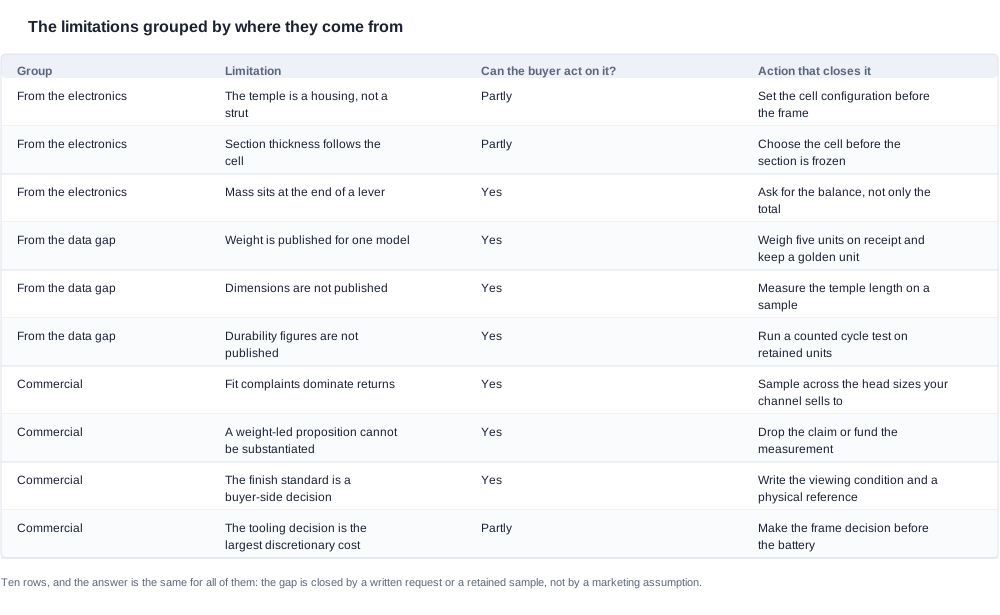
Five limitations the electronics create
1. The temple is a housing. In an optical frame the temple carries nothing. Here it carries a cell, a protection circuit, a board, sometimes a camera module and a speaker, and the section that carries them is thicker. The consequence is that an optical frame's sizing and its mass do not transfer, and any comparison drawn from optical-industry data is a comparison of two different objects.
2. The section thickness is set by the cell. The published cell configurations are the input to the geometry, and a bigger cell is a thicker temple. The mass follows the thickness, and the published position in our range is that the mass is not published for every model except one. A buyer cannot derive the section from the published data, and the section is what determines whether the joint can carry the load.
3. The mass distribution is uneven. A camera module at the front of a temple is a mass concentration at the end of a lever, and it changes the retention and the load on the head over a long session. This is a distribution problem rather than a total-weight problem, and the published figure on our one published model is a total, not a distribution.
4. The frame is heavier than an optical frame of the same geometry, and the difference is not describable from any published row. A buyer quoting an optical frame's mass as the reference point for a smart glasses frame is quoting a comparison that cannot be substantiated.
5. The temple's flex is a new variable. An optical temple can flex; a temple carrying a board and a cell flexes differently, and the flex changes the acoustic chamber as well as the geometry. This is also the mechanism behind the seasonal movement and the crooked-temple complaints that recur in this category, and it is a mechanism rather than a defect.
Five limitations the data gap creates
6. You cannot compare frames on weight. One published figure in the whole catalogue, for one model, with a scope that has to be read carefully.
7. You cannot compare frames on dimensions. Not published for any model, which means the size range, the temple length and the temple curve all have to be established by measurement.
8. You cannot verify the material. Not published range-wide, for the frame, the temple or the lens. A buyer who needs a material declaration has to request it against a specific configuration.
9. You cannot predict the size range. It is a sampling exercise and it will remain one; the sizing guide sets out why, and the honest version of the answer is that no supplier in this category publishes a distribution of head sizes for its own channel.
10. You cannot predict the durability. No drop, impact or vibration figure is published for any model, and the unit weight that would affect impact behaviour is published for one.
A framework for deciding which limitations are decisive for you
A limitation list of fifteen items is only useful if it can be reduced to the two or three that actually decide a programme. Three questions do that reduction, and they are worth asking in this order because each one eliminates a group.
Does the limitation touch a row you are going to write into the purchase order? If it does, it is a specification item and it belongs in the acceptance criteria. If it does not, it is a context item and it belongs in the risk note. Mixing the two is what produces a specification that is twenty pages long and says nothing enforceable.
Who pays for it when it goes wrong? The matrix above answers this for each limitation, and the answer determines the action. Where the buyer pays, the action is a specification and a measurement. Where both parties pay, the action is a gate and a sign-off. Where nobody pays in the short term, the action is an acceptance and a price adjustment.
Does it change before the launch? Some limitations close themselves if a decision is made early: the tooling decision, the cell configuration, the number of colourways, the finish standard. These are worth front-loading because their cost rises sharply with time, while the limitations that cannot be closed at all — the fact that the category does not publish mechanical data — are constant and can be priced once.
That last point is worth a sentence on its own, because it is the one most often skipped. A limitation that will not go away should be priced into the commercial model once, explicitly, and then it stops being a source of anxiety. The category does not publish mechanical specifications; you have accepted that; the unit economics carry a line for it; and the programme proceeds. The alternative — carrying it as an open risk through every review — costs more than the line item and buys nothing.
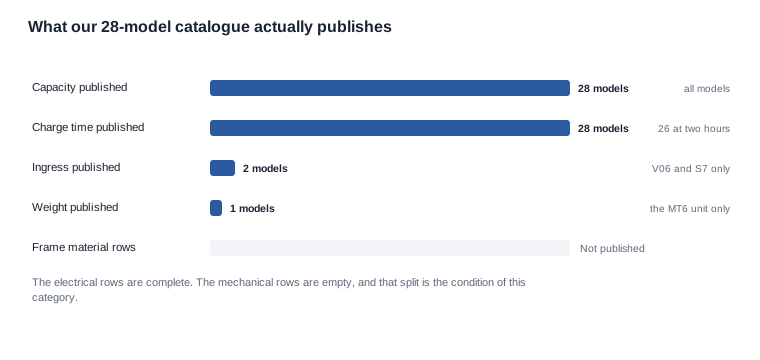
Why the split in that chart is the whole story
The chart above compares how many of the twenty-eight models in our catalogue publish each kind of row. The electrical rows are complete: every model publishes a battery capacity, and every model publishes a charge time, twenty-six of them at two hours or less and two at about one hour. The mechanical rows are close to empty: two models carry an ingress marking, one model publishes a weight, and no model publishes a frame material.
That split is not a complaint about our own catalogue. It is the shape of the category, and it is the same shape in every supplier's catalogue for the same reason: the mechanical specification is a factory document that gets consumed at the point of manufacture and rarely travels with the product. A buyer who assumes the split is our weakness will assume the next supplier's catalogue is complete, and will make the same mistake with the same result.
The commercial consequence is straightforward. Any comparison a buyer makes in this category has to be built on the electrical rows, which are comparable, and completed by measurement on the mechanical rows, which are not. That is more work than a category with a published mechanical datasheet, and it is the work.

Five limitations that are commercial rather than technical
11. Sizing complaints dominate the returns. And the frame data needed to prevent them is exactly the data that is missing. Each individual return is a legitimate sizing complaint rather than a fault, so the aggregate never appears in a defect report and never triggers a corrective action.
12. A mass-led product proposition cannot be substantiated. If the proposition is "the lightest thing on the market", the published position in our range cannot support it for any model except one, and the one model it can support is a camera model with a foldable case.
13. The cosmetic variance is the most common first-article rejection, because the finish standard is a buyer-side decision and is often not written down. The inspection can only measure against an agreed reference, and where the reference is a photograph, the dispute is about memory.
14. The tooling decision is a frame decision, and it is the largest discretionary cost in the programme. It is also the decision with the longest tail, because the tool amortisation and the changeability of the design are both fixed at the moment it is taken.
15. A service proposition needs a replaceable temple, which is a design decision taken at the frame stage and not a spare-parts decision. Our range publishes a detachable temple and ultra-thin temple options on the G07 and flexible temples on the V03 Pro, and publishes no cycle life, release mechanism or failure behaviour for any of them.
Putting a price on the limitation you cannot remove
Two of these limitations cannot be closed at all: the category does not publish mechanical specifications, and the size range cannot be predicted from a datasheet. Both still have to be priced, and the way to price them is to convert them into channel and logistics costs rather than to hope they stay small.
For the sizing limitation, the cost lands in three places and can be estimated from the buyer's own records even when the frame data is missing. The first is the reverse logistics and handling cost per return. The second is the loss of margin on the unit, whether the unit is restocked, discounted or written off. The third, and usually the largest, is the channel cost of a return rate that crosses a threshold, because most marketplaces and retailers operate on a tiered penalty structure rather than a flat one. A buyer who knows the channel's threshold can decide whether the frame specification is worth paying for on the basis of a number that is already in their own accounts.
For the unpublished-mechanical-data limitation, the cost lands in the design phase rather than in the returns phase. It is the cost of writing the specification, the sample protocol and the acceptance criteria yourself, and of re-establishing them for every new configuration. That is a fixed programme cost rather than a variable one, which means it should be amortised across the programme rather than charged to each order. Programmes that re-do this work for every colourway are paying a fixed cost repeatedly, and that is one of the easier savings available in this category.
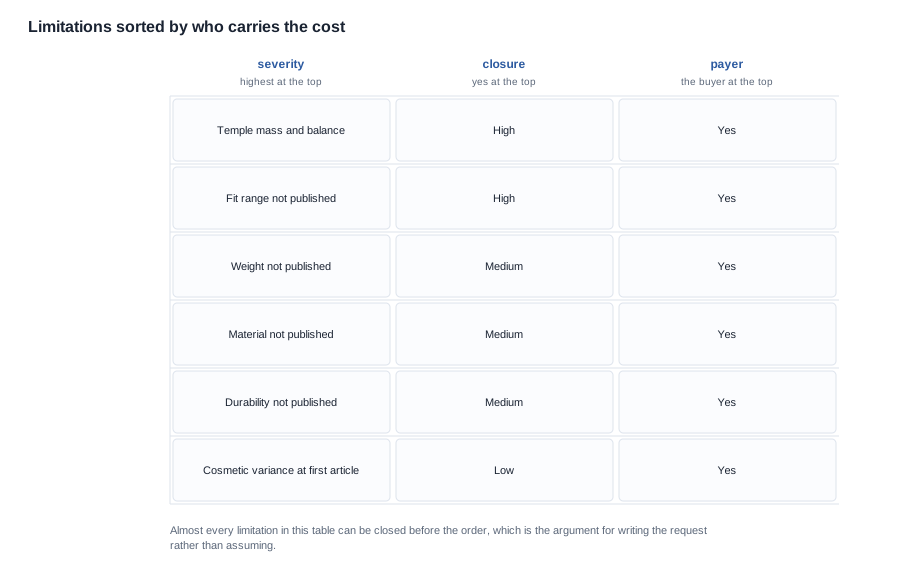

What a buyer can close before the order
Four of the fifteen limitations above are structural and cannot be bought away. The rest can be closed, and the useful discipline is to close them in cost order.
1. Request the numbers in writing, per model. The frame weight, the dimensions, the temple length, the section thickness at the electronics bay, the material grade and the hinge construction. Our published position is that these are not published for nearly every model, so this is a data request rather than a catalogue search, and the request itself is the deliverable.
2. Write the acceptance criteria before the first article, including the finish standard with a viewing condition and a physical reference unit. This is the cheapest single action on this list and it prevents the most common rejection at the most expensive gate.
3. Sample across a size range, because the size range is not a specification question and never will be in this category. A few people with the head sizes your channel sells to will tell you more than any published dimension would.
4. Treat the tooling decision as a frame decision, and make it before the battery, because the battery is what changes the frame. This is the one limitation on the list where the order of decisions, rather than the quality of a request, determines the outcome.
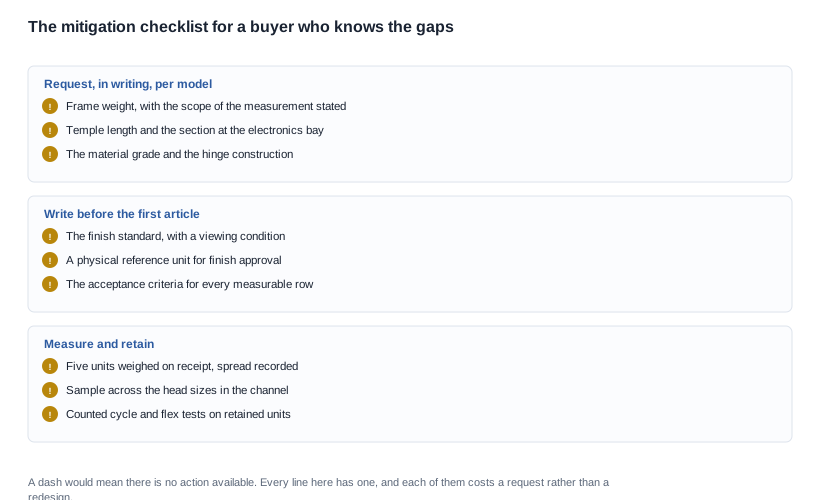
What closes each limitation, and what it costs
| Limitation | Closed by | Cost to close | Can be closed before the order? |
|---|---|---|---|
| Weight not published | Weighing five units on receipt | One scale and an hour | Yes |
| Dimensions not published | Measuring the temple length on a sample | One calliper | Yes |
| Material not published | A written request against a configuration | One email | Yes |
| Durability not published | A counted cycle and flex test on retained units | A fixture and a week | Yes |
| Size range unpredictable | Sampling across your channel's head sizes | A small panel | Yes |
| Cosmetic variance at first article | A written finish standard with a physical reference | One reference unit | Yes |
| Uneven mass distribution | Asking for the balance, not only the total | One email, but the answer may be refused | Partly |
| Seasonal movement in acetate | Specifying the grade and assembly conditions | A specification clause | Yes |
| Heavier than an optical frame | Accepting it and not claiming otherwise | Nothing | Not applicable |
| Tooling as the largest discretionary cost | Making the frame decision before the battery | A design decision | Yes, if taken early |
The row that matters commercially is the second from the bottom. An uneven mass distribution is a property of the product, and a supplier that has not characterised the balance will not produce a number for it on request. The mitigation there is not a measurement but a specification clause that fixes where the camera module sits and what the retention requirement is, so that the property is designed rather than inherited.
A shortlist of questions that surfaces the limitations fastest
A buyer does not need the full fifteen-item inventory in order to find the ones that matter for a particular programme. Five questions, asked against the quotation rather than against the catalogue, will expose most of them in a single email exchange.
- What is the frame material and grade for the front and for the temple, and what is the wall gauge at the electronics bay? Two of the fifteen limitations are structural and cannot be bought away, and this question tests for them first.
- What is the unit weight in grams for this exact configuration, and what does the figure include? A supplier that has to think about the scope has probably not weighed the units.
- What is the temple length and the size range, and how were they established? The answer distinguishes a measured range from a design intent.
- What cycle testing has been done on the hinge, and against what failure criterion? This is the limitation that becomes a warranty line.
- Which rows were verified on production tooling, and which on a sample? The answer tells you which of the remaining limitations are worth spending money on and which are simply open.
The trade-offs between these five questions and the time they consume are real, and the answer depends on where the programme sits. Early in a programme, all five are worth asking, because the answers change the design. Late in a programme, the first and the fifth are still worth asking, because the answers change what you can accept, and the middle three have probably already been settled by events.
What has to be accepted, and what our own catalogue holds
Four things have to be accepted, and stating them is more useful than softening them. The mass and the dimensions will stay unpublished in this category for some time, because the manufacturers do not publish them either. The size range will remain a sampling exercise. The durability will be established by the buyer's own testing rather than by a published figure. And the honest way to buy in this category is to specify the numbers you need rather than to assume they are on a sheet.
Thin published data is a condition of this category rather than a fault in one product, and the honest description of it is more useful than a padded one. Our position is that we publish the unit weight where we hold it — 158 g for the MT6 glasses unit, including the cell and the camera and excluding the foldable charging case — and not published for the rest, and that we will not fill a material, a dimension or a finish row with values from the optical industry, because the terms transfer and the values do not. A limitation a buyer can state is one a buyer can price; a limitation hidden behind a borrowed number is one that surfaces in the field instead of on the datasheet.
We will also be direct that this is a category condition rather than a failing of any one supplier, and that a buyer who knows which rows are missing can act on it. A buyer who assumes a thin specification is a weak product has drawn the wrong conclusion, and will usually draw it again on the next supplier.
If you tell us the models and the use case, we will say which of these limitations are decisive for you and which you can let go. The size question is set out in materials and ergonomics, the cost consequences are covered under frame materials cost factors, and the broader procurement sequence is in the frame materials procurement checklist.
Related reading
- Materials and ergonomics
- Frame materials for beginners
- Frame materials cost factors
- Frame materials procurement checklist
Tell us the models and the use case and we will say which limitations are decisive.


