

Frame material vocabulary comes from the optical industry, and most of its terms describe a world where a frame carries a lens and nothing else. In a smart glasses product the frame carries a cell, a control board, sometimes a camera module and a speaker, and the terms have to be re-read with that in mind.
That re-reading is the point of a glossary here, because most of these words will be used in a conversation with a supplier and most buyers will hear them in their optical meaning.
Our published position for the range is that the unit weight is published for one model only — the MT6 glasses unit at 158 g including its 265mAh cell and its camera, excluding the foldable charging case, whose capacity is 1200mAh and whose weight is not published. The weight of a bare frame is not published for any model. The frame dimensions, the temple length and the temple curve are not published for any model. The material itself is not published for the range as a whole. The catalogue's export certification page carries images rather than text, states no certification position in words, and has no per-model rows behind it, so no model-level claim can be read from it.
So smart glasses frame materials smart glasses glossary is a set of definitions, each written to point at the question it should raise rather than at the definition itself.
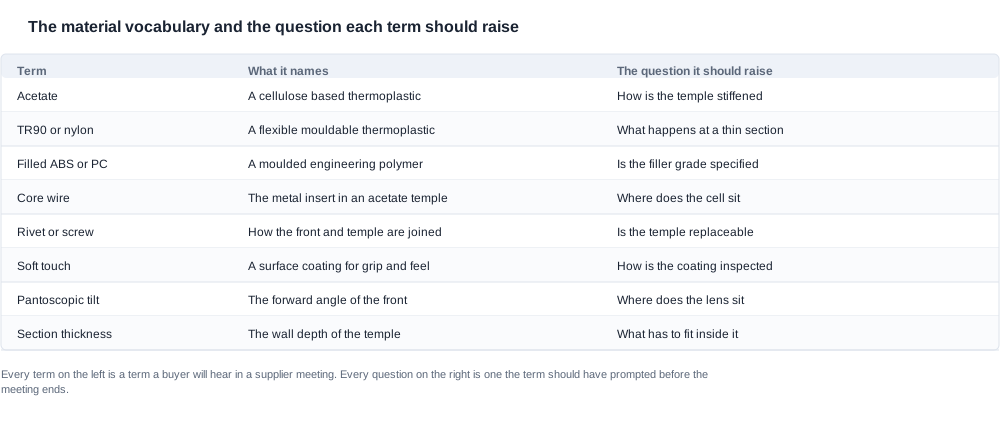
Smart glasses frame materials: vocabulary terms and questions
Acetate. A cellulose-based thermoplastic, the traditional optical frame material, selected for its finish quality and its ability to be polished. In this category the constraint is thin sections and the mass of carrying electronics, and the vocabulary term that matters is the section thickness. The question to ask is how the temple is stiffened, because an unstiffened acetate temple carrying a cell is a temple that will move.
TR90, or a nylon-based thermoplastic. A flexible, light, tough material that takes complex moulded shapes, which is why it appears in sport and cycling products where the temple has to carry a lot in a small volume. The trade is that it is harder to finish to a high gloss and it is more visible at thin sections. The question to ask is what happens at a thin section under a hard knock.
Injection-moulded ABS and PC, and the glass-filled variants. Common in electronics housings. In a frame they appear where the shape complexity is high and the cosmetic requirement is lower, and the glass-filled grades are used where section stiffness matters. The question to ask is whether the filler grade is specified or whether it is a supplier default, because the two behave differently at the same thickness.
Metal frames, and the partial-frame construction. A metal front with a plastic or metal temple, or a wire temple. The material term that matters is the temple construction, because in this category the temple is the structural member carrying the electronics.
Carbon-reinforced composites. Used where the stiffness-to-mass ratio is the priority. The vocabulary that matters is the reinforcement direction, because a composite's performance depends on fibre orientation and a frame's load path is not through the front.
Three terms that get used in two different senses
Three words in this vocabulary are used in one sense by an optical supplier and in another sense by an electronics supplier, and the gap between the two senses is where most of the confusion in a first meeting happens.
"Flexible". In optics it describes a temple that can be bent to suit a head shape, and the desirable quality is a gentle give. In a smart glasses product the same word describes a temple that will not crack when the product is dropped or sat on. The first is an ergonomic property; the second is a survivability property. They often pull in opposite directions — a very flexible material is forgiving of a design error, which means a badly designed temple stays in service instead of failing visibly, and a failure that never happens is a failure you never learn about. The question to ask is what flexible means in this build: bendable by the customer, or bendable without breaking.
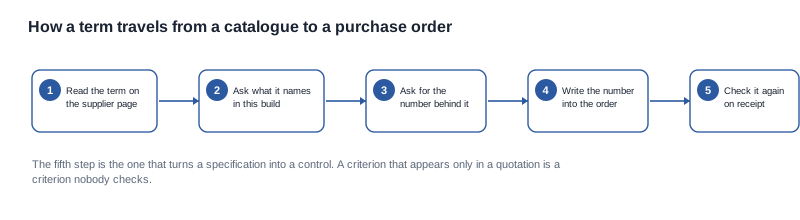
"Lightweight". In optics it is a marketing word with a loose convention behind it. In this category it is a mass, and a mass is meaningless without the configuration it describes. A unit with two cells in the temple is a different mass from a unit with one. Ask for the figure in grams with the build named, and treat a number quoted without one as a category description rather than a specification.
"Premium". It appears in a material phrase in almost every frame quotation and it names nothing that can be ordered, inspected or re-supplied. If a buyer cannot turn "premium acetate" into a grade, a supplier and a finish process, then the phrase is doing marketing work and nothing else. The question that replaces it is simple: which grade of which polymer, from which supplier, with which finish process — and a supplier who cannot answer all four is quoting a position rather than a specification.
The general rule behind all three is worth stating, because it is the reason this article is written the way it is. A term that cannot be turned into a number, a configuration or a named process is not a specification term, and the moment it is used as one the file stops describing the product.

The structural and dimensional vocabulary
Temple length. The distance from the hinge to the end of the temple, usually expressed in millimetres. In the optical world this is a sizing dimension. In a smart glasses product it is also a length of battery housing, and the two constraints pull against each other.
Temple curve, or the temple's bend. The bend that follows the side of the head. In this category the curve determines the acoustic chamber, the coupling of the speaker to the ear and the stability of the seating, so it is an audio and an ergonomic variable, not only an ergonomic one.
The bridge. The piece joining the two lenses. In an optical frame it carries almost nothing. In a smart glasses product it may carry a camera or a sensor, and the published position in our range is that the camera tier's field of view, which would determine what the frame occludes, is not published.
The front, or the eyewire. The part that holds the lens. In this category it also defines the field of view's usable area, so its width and height are camera variables rather than only optical ones.
Hinge. The joint between the front and the temple. In this category it is a service item and a stress concentration, and the terms that matter are the number of barrels and whether it is serviceable. The question to ask is whether a temple can be replaced at all.
End piece, and the bend point. Where the temple transitions from straight to curved. In a smart glasses product the bend point is often where the charging interface or the microphone sits, and it is the area where a rigid insert meets a flexible one.
Section thickness. The wall depth of the temple. This is the term that connects the whole vocabulary together: it is set by what has to go inside the temple, it is the constraint the material has to satisfy, and it is the number a material decision is actually made against.
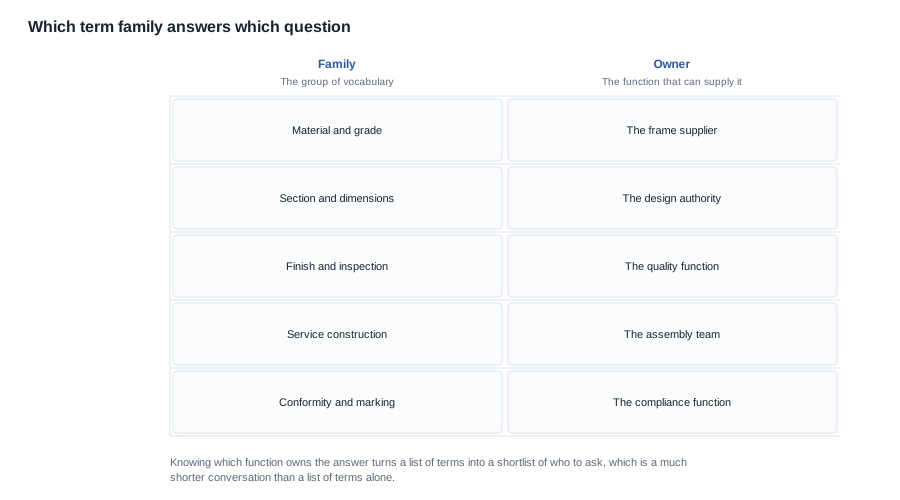
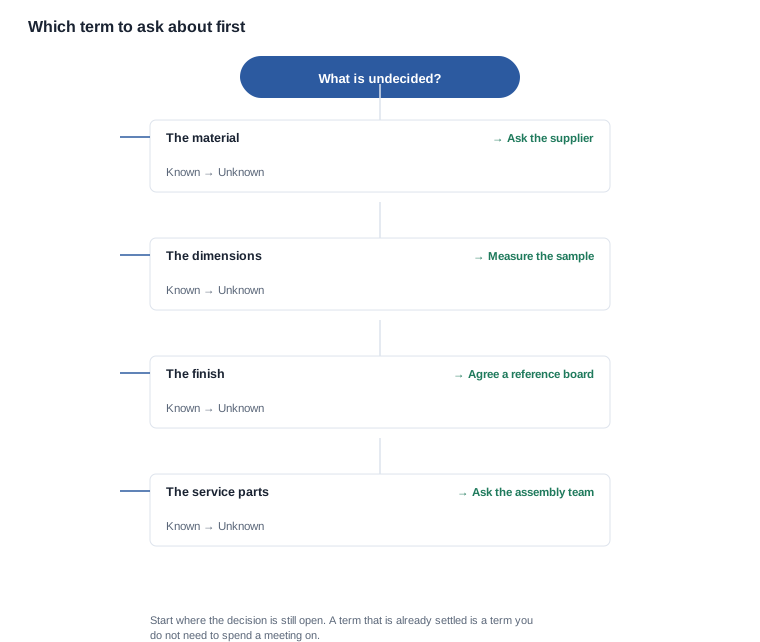
The matrix above is the practical use of a glossary. Each family of terms belongs to a different function, and knowing which one owns the answer turns a list of vocabulary into a shortlist of who to ask — which is a much shorter conversation than the vocabulary alone.
The dimensions worth asking for, and the ones that are decoration
Not every dimension in a frame specification carries weight, and separating them saves time in a first meeting.
The four worth asking for are the temple length, the temple spread, the front width and the lens aperture. Each of them is a decision variable: the temple length is where the cell goes and where the ear sits, the spread determines whether the product coexists with an existing pair of glasses, the front width decides the field of view the camera actually gets, and the lens aperture decides whether a prescription lens can be mounted at all. None of the four is published for any model in our range, and each one is measurable on a sample in minutes.
The dimensions that are decoration are the ones that describe the silhouette rather than the structure. Overall frame length as a single number, the visible curve of the front, the profile of the temple tip. These describe the silhouette, and they matter for a brand's visual identity, but they do not constrain the engineering and they do not decide whether the product works. A quotation full of them and empty of the four above is a quotation describing a shape rather than a product.
The one dimension that is always decisive and always missing is the section thickness at the electronics bay. It is set by the cell configuration and it is the constraint that the material has to satisfy, so a specification that omits it while stating a material has skipped the step in which the two are reconciled. Our published cell configurations run from 40mAh single cells in the children's models through 55mAh×2, 70mAh×2 and 90mAh×2 dual arrangements to single cells at 100mAh, 115mAh, 200mAh, 220mAh, 260mAh, 265mAh and 290mAh, and each of those implies a different bay.

The finish and assembly vocabulary
Core wire. The metal insert in an acetate temple that gives it strength and holds its shape. In a smart glasses product with electronics in the temple, the core wire's geometry constrains where the cell can sit, and this is a term worth asking about specifically.
Rivets and screws. How the front, the temple and the end piece are joined. A riveted joint on a plastic temple is serviceable in a way that a glued joint is not, and the term a buyer should use is whether the temple is user-replaceable. Our range publishes a detachable temple on the G07, a slim temple on the YK12 and flexible temples on the V03 Pro, and publishes no temple description for the rest.
Surface finishing: gloss, matte, soft-touch. The cosmetic terms. In this category they determine what quality control actually inspects, because a gloss surface shows tool marks and a matte surface hides them. The published colour options in our range — three on the V03 Pro and four on the V06 — are decisions of this kind within an existing material, not new materials.
In-mould marking, pad printing, laser engraving, and debossing. How a logo gets onto the frame. These are four different tooling and finishing answers with different unit costs, different appearances and different durability characteristics, and the choice interacts with the surface finish in ways that are only visible on a sample.
Detachable inner frame. A sport-platform feature in which an inner frame comes out of the outer frame. In our range the V06 and the S7 publish one, and they are also the only two models in the range carrying a published ingress marking — IP54 — which is published as a catalogue marking with no third-party test report number behind it. A removable part in a sealed product is a joint in the enclosure, and it is part of the configuration the marking is about.
Four assembly terms that decide what the after-sales budget contains
The assembly vocabulary is small, and four terms in it decide whether a service event costs you a part or costs you a unit. These are worth getting right before the programme is designed rather than after it is launched.
The fixing method. Riveted, screwed or bonded. A bonded joint is the cheapest to make and the most expensive to undo, and in a product where the temple is the service item it converts every temple failure into a whole-unit replacement. A screwed or riveted joint is more expensive at assembly and far cheaper at service. The cost difference between the two is invisible in the unit price and enormous in the returns data.
Whether the part is interchangeable. Not merely whether it can be removed, but whether one spare covers a range. A temple that fits three models is one spare-parts line; a temple that fits one model is one spare-parts line per model, per colourway, per market. Our range publishes a detachable temple on the G07, and a programme built around a detachable temple inherits that cost model, so the interchangeability question has to be asked at the quotation stage.
Whether the removal changes the geometry. A temple that comes off and goes back on has to return to the same position, and in a sealed product it also has to restore the seal. Where the seal is part of the marked configuration, the removal has to be part of the documented procedure — which is a documentation cost, not a mechanical one, and it is much cheaper to plan than to retrofit.
Whether the replacement carries the same conformity position. A replacement part is part of the enclosure, and an enclosure change is a product change in most frameworks. The question to ask a supplier is specific: does attaching a spare part move the product outside the configuration the documentation covers? If the supplier cannot answer, the answer is in the after-sales budget.
What these four terms cost, and where they land
The four terms above decide a single commercial line: the cost of a service event. That line is rarely in a quotation and it is one of the largest recurring costs in this category.
The arithmetic is simple. Multiply the expected failure rate of the service item by the cost of the response — a spare part and a return to service, or a whole unit and a refund — and you have the annual cost of that design decision. A supplier who can tell you how the joint is fixed, whether a spare covers a range and what the part does to the conformity position has given you the three inputs to that calculation.
What to ask is therefore not "can the temple be replaced" but the three questions underneath it. And the trade-off, once priced, is worth making explicitly: a bonded joint is a lower unit price and a higher service cost, and a brand that has not done that arithmetic will discover the difference in the warranty line rather than in the quotation.

The six terms to add to a supplier evaluation form
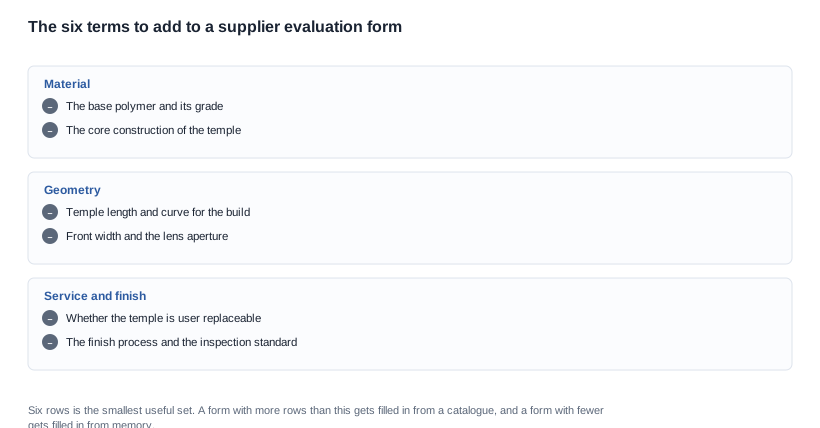
One: the frame material and the core construction. Whether the temple is a solid moulding or a wrapped core. This is the term that decides the mass and the section, and therefore the two things that dominate every scenario in this category.
Two: the temple length and curve for the exact configuration. The seating, and the acoustic chamber. This is the term that decides whether the speaker reaches the ear.
Three: the front width and height, and the lens aperture. The camera's usable field of view depends on it, and so does the prescription question.
Four: whether the temple is user-replaceable and how it is fixed. Riveted, screwed or bonded. This decides whether a service event is a spare-parts line or a returns line, and the answer changes the after-sales budget more than any material decision does.
Five: the finish process and the inspection standard for it. Because a gloss inspection is a different inspection, and the inspection is where the first-article rejections come from.
Six: the frame mass in grams for the exact configuration. The published position in our range is that this is available for one model, the MT6 glasses unit at 158 g including the cell and the camera and excluding the foldable case, and not published for the rest.
Six rows is the smallest useful set. A form with more rows than this gets filled in from a catalogue, and a form with fewer gets filled in from memory. The criteria that make those six worth asking are simple: the answer must name the configuration, and the answer must be a number or a stated design decision rather than a description.
The terms transfer and the values do not
The boundary we hold: we publish the frame mass where we hold it and not published for the rest, and we will not fill a material, dimension or finish row with values from the optical industry, because the terms transfer and the values do not.
The reasoning is worth stating once, because it is the rule that governs every number in this category. An optical frame carries a lens. A smart glasses frame carries a cell, a board, sometimes a camera module and a speaker. A temple length taken from an optical catalogue is a number that describes a different product, and it will be held against you the first time a customer returns a frame because of it. The vocabulary is transferable because the vocabulary describes shapes and processes; the values are not, because the values describe products with entirely different contents.
We will also say plainly that these terms describe a product whose parameters are, in our published data, mostly unstated. The vocabulary is the part we can give you; the numbers have to come from a sample or from the design team.
The trade-offs of working that way are real, and it is worth naming them. A buyer who asks for every row will get a slower programme and a defensible file. A buyer who fills the rows from the optical industry will get a faster programme and a file that cannot be defended. The red flags to watch for in a supplier's answers are the ones we have set out here — a term used without a configuration, a number without a method, and a family-level document presented as a per-model one.
If you tell us the product requirement and the target mass, we will tell you which of these terms are decisive for your programme, and we will point at the rows that are still empty. The orientation is under frame materials for beginners, the assessment procedure is under frame assessment from a sample, the colour decisions are under standard OEM colour options, and the wider material context is under materials and ergonomics.
Related reading
- Materials and ergonomics
- Frame materials for beginners
- Bluetooth audio glasses comfort and fit
- Standard OEM colour options
Send the product requirement and the target mass and we will tell you which of these terms are decisive.


