

Smart glasses frame materials: the brand rides on it, not the electronics
Why the frame carries the brand rather than the compliance risk
The frame is the only part of a smart-glasses product that a customer touches before they turn it on, and it is the only part that carries your brand where it is most visible. That makes the material decision a brand decision rather than a sourcing decision, even though it is quoted and timed like a sourcing one. Three things follow. First, a material trade name is not a specification, and comparing our supplier's material name against another supplier's material name produces a false equivalence that is usually discovered at the first article inspection. Second, the frame is where the cell, the hinge and the temple electronics have to fit, so the section of the frame is set by the cell capacity and not by the design. Third, most of the frame data a buyer would want to compare on is not published in our catalogue, and a buyer who assumes it is will build a programme on a figure that no supplier can defend. Ask for the material as a specification with a performance expectation attached, ask for the weight of the product as configured, and ask which parts of the frame are structural before you ask anything about price.
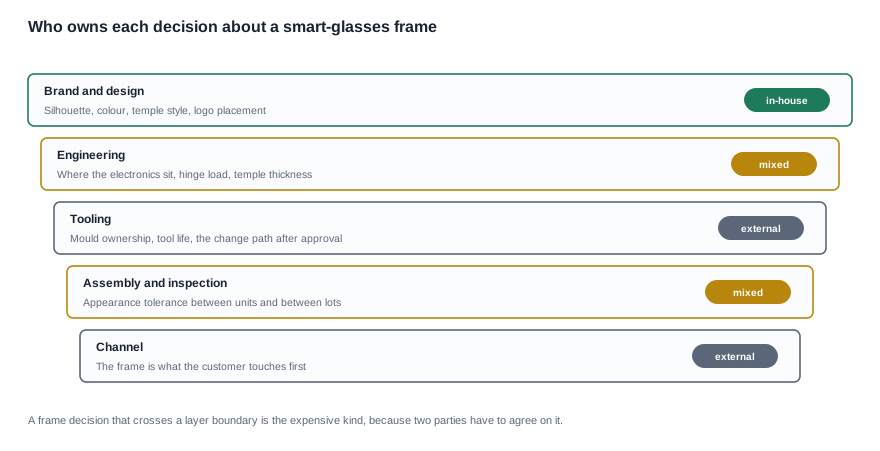
The three situations that bring a frame question to a buyer
The reader is a brand-side product owner, a design lead who has been handed a sourcing task, or a channel buyer taking on a frame programme that a previous supplier used to build. Three situations bring these people to the same question.
The first is a quotation comparison where the unit prices are close and the buyer has run out of obvious differentiators. Frame material is usually the next line of enquiry, because it sounds like a specification and is easy to write on a comparison sheet. The second is a new product opening, where a design has been approved and the factory has to build tooling around it, and someone realises that nobody wrote down what the frame is actually made of. The third is a re-sourcing or a range extension, where the buyer has to place a new colour or a new temple variant next to an existing SKU and needs to know whether that is an artwork change or a tooling change.
What the buyer is afraid of in all three cases is the same set of things: a mould ordered against a specification that changes in month two, a first production lot where the colour of unit forty does not match unit one, a transit damage rate that gets attributed to the product rather than to the packaging, and a weight figure that turns out to be the wrong number because it came from a different model in the same family.
The reader's position in the supply chain decides which of these they can actually control. A brand owner controls the artwork, the configuration and the tolerance, and therefore controls all three. A channel buyer who buys finished units controls none of them and has to put the tolerance and the material expectation into the purchase order as acceptance criteria. A distributor who holds several brands has to solve the packaging problem across every brand it carries, which is usually where the transit damage actually originates.

The frame data our catalogue publishes, and the rows it does not
Our catalogue publishes more about the cell than about the frame, and a buyer who has worked through the electrical rows can be surprised by that. It is worth setting out precisely what exists so the open rows can be requested rather than assumed.
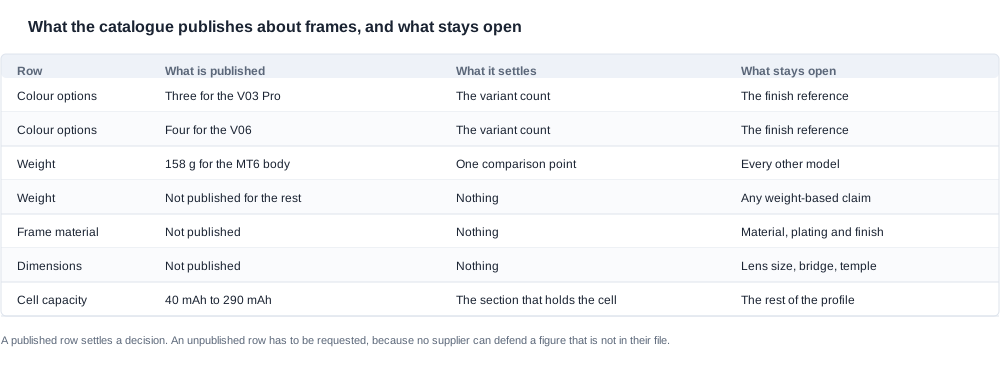
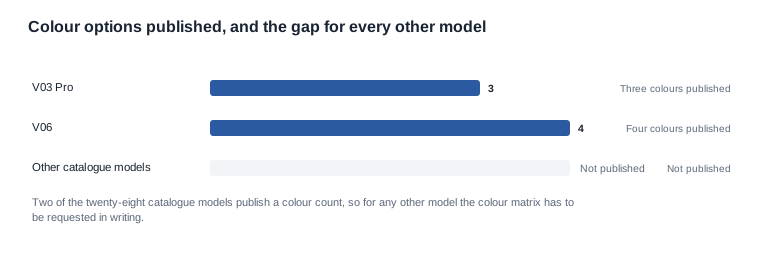
Colour is published for two models only. The V03 Pro is listed in three colour options and the V06 in four, which tells a brand owner how many variants it is signing up for on those two SKUs and tells them nothing at all about the other twenty-six. Weight is published for exactly one model: the MT6 glasses body is 158 g, which includes the 265 mAh cell and the camera and does not include the 1200 mAh folding case. The case weight is not published, and no other model in the range has a published weight. Frame material, plating, finish, lens size, bridge, temple length and temple curve are not published for any model.
The cell capacities are published for every model, and they matter more to a frame buyer than it first appears. They run from 40 mAh on the A05 and A06 children's models up to 290 mAh on the L1 Pro, the L2 Utral and the CY05, and the CY03, with dual-cell arrangements on the audio models. The cell is the thickest single element in a smart-glasses temple, so the cell capacity sets the minimum section of the frame, and the section is what a design drawing is actually built around. A brand that specifies a slender temple profile in month one and a 290 mAh cell in month three has a conflict on its hands, and the conflict does not resolve politely.
The two geometry features that the catalogue does publish are more useful than they appear. The V03 Pro is listed with flexible temples. The V06 and the S7 are listed with a removable inner frame and an ergonomic design. The G07 is listed with an extra-slim and removable temple, and the YK12 with a slim temple and surround sound. Each of those is a statement about how the product is held on the head rather than about the electronics inside it, and each of them has consequences for the frame material, the hinge design and the tolerance regime, because a removable inner frame is a second interface that has to be specified.
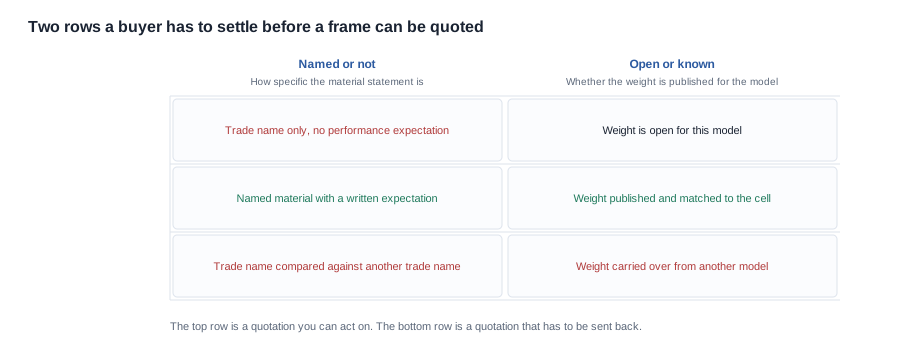
The pattern across the range is worth stating as a rule rather than as a list. The catalogue publishes the electrical rows because those are the rows the factory controls and the rows a buyer orders against. The frame rows are published only where they are already fixed by the industrial design. Where a brand wants a frame row to be fixed for it, the mechanism is a specification and a sample, not a catalogue lookup.
One warning applies to all of the above, and it is the warning that catches most buyers in this category: the published rows are not directly comparable between suppliers, because a weight quoted without stating whether the cell is included is a different measurement from one that states it, and a section quoted without stating the cell capacity behind it is not a section at all. Before you compare a published 158 g against a supplier's figure, check whether their number includes the cell, the camera and the case, because the only way to be sure is to ask.
Nine questions that turn a material name into a frame specification
The point of a question list here is not to be thorough for its own sake. It is to convert a name into something a factory can build, an inspector can judge and a contract can enforce. The nine below are ordered so that the answers to the early ones make the later ones answerable.
- What is the frame made of, stated as a specification rather than a trade name, and what performance expectation does that material have to meet?
- Which parts of the frame are structural, meaning they carry the mould and cannot change without new tooling, and which are variable?
- What is the total weight of the product as it ships, including the cell, the camera and any case, and what is the weight of the frame alone?
- What cell capacity is the frame built around, and what temple section does that capacity require?
- What is the hinge type, what load is it rated for, and what is the failure mode when it fails?
- What is the tolerance for colour and finish between units and between production lots, expressed with a named measurement method and a reference unit?
- Which surface treatments are applied, and what is the requirement on coating adhesion, sweat resistance and skin contact for the materials that touch the face?
- What packaging protects the product on the shipping route you intend to use, and what drop and vibration conditions is it specified against?
- What does a change to the frame material, the temple shape or the finish cost, how long does it take, and who owns the original tooling?
Questions three and four are the pair that most often exposes a mismatch. A factory that quotes a light frame and a 290 mAh cell has to have solved the section problem somewhere, and the solution is usually a wider temple than the brand's design drawing showed. Asking for both numbers in the same email surfaces that in week one rather than at first article.
Question six is where a lot of programmes avoid the hard part. "Colour as per approved sample" is not a tolerance, because it has no method and no reference unit, and it turns every unit in a lot into a possible dispute. A tolerance expressed with a named colour-difference method, a stated illuminant and a signed reference unit is judgeable by a quality control inspector in a factory in a different country, which is the only kind of tolerance that is worth having. The change control procedure is worth reading at this point, because a tolerance agreed after production has started is a tolerance that has already been missed.
Question seven is the one that carries the material compliance obligation rather than the mechanical one. RoHS covers the electronic assembly, and REACH is the framework most buyers will expect a supplier to answer on for materials that touch the skin. The honest position is that a material name answers neither, and a supplier who cannot say which substances their material declaration covers is telling you that the declaration is not theirs.
Question nine belongs in the enquiry rather than in the negotiation, because the tooling amortisation schedule is much easier to agree at the start of a programme than in month four. The standard OEM tooling requirements page sets out the usual ownership and amortisation questions, and the answer in each case depends on what the factory is willing to carry for the programme.

How a frame answer becomes a signed, judgeable specification
Frame verification is the part of the process that most buyers leave to the sample photograph, and that is precisely the part that cannot be delegated to a photograph. The sequence below is designed so that each step produces something the next step can be checked against.
Step one: get the parts list with materials on it, and treat a trade name as an open row. The purpose of this step is not comparison, it is to find out which specification is fixed, which is negotiable and which has to come from the supplier's own file. A parts list that names only "frame" tells you nothing about the mould, the hinge or the temple, and a mould that has not been specified cannot be quoted accurately.
Step two: agree the appearance tolerance in a form that a third party can judge. A physical reference unit approved under an agreed lighting condition, with a colour-difference limit expressed by a named method, is workable. A colour reference on a screen is not, and it will produce a dispute about every unit in the first batch. Record the reference unit, its unit identifier, the lighting condition and the measurement method in the same document, and make the reference unit a controlled item in the quality control plan rather than something kept in a sample bag.
Step three: check the frame against the cell configuration, and check the cell against the frame. Ask for the cell capacity in the quoted configuration, then ask what temple section that capacity requires, then ask for the weight of the assembled product. If the three numbers do not sit together, the programme is quoting a frame and a cell from different configurations, and the assembly step will be where that is discovered.
Step four: verify the material against the declaration rather than against the name. Ask for the material declaration for the frame and for any material that touches the face, and check that it covers the substances you need covered. Where a supplier offers a test report instead, note the date and the standard, and check whether the report is for the exact material in your configuration or for a similar one. A report for a similar material is the single most common documentation gap in this category, and it is invisible until a regulator or a marketplace asks.
Step five: test the sample against the tolerance, not against the impression. Put the physical reference unit next to the sample, under the agreed lighting, and judge them as a pair. Then put two units from the same lot next to each other, because a tolerance that only compares a lot against a reference can pass while the lot itself drifts. The frame materials supplier verification procedure sets out the wider document set, and the how frame materials work page covers the mechanics behind the choices.
Step six: write the frame specification into the purchase order and into the quality control plan. The material specification, the structural parts list, the weight of the assembled product, the appearance tolerance with its method and reference unit, the packaging specification tied to the shipping route, and the change route for each structural part. The last of these is the one that is almost always missing: a requirement change made after approval should have a defined cost and a defined schedule consequence, and both belong in the document rather than in a negotiation that starts when the change is needed.

Where frame programmes fail once the first shipment has landed
The mould was ordered before the temple shape was settled. A structural change was treated as a small variation and landed on the tooling budget at the worst possible moment. The control is to freeze the structural parts at quotation stage and to price the change path for each of them separately, so that a temple shape change is a known cost rather than a surprise. A programme that discovers this at the point where the mould is ordered has lost weeks that could have been spent on the design.
The shade difference that became a claim. No appearance tolerance existed, so every unit was compared with the unit before it, and the accumulation of small differences produced a batch dispute. The control is a tolerance with a method and a reference unit, agreed before the first production lot and issued to the factory as a controlled document.
The packaging that protected the shelf and not the route. Transit damage produced returns that were attributed to the product, because the damage arrived before the customer ever saw it. The control is to specify the packaging against the shipping route and the drop and vibration conditions of that route, and to record who approved it. The frame materials cost factors page is where the packaging and logistics lines usually sit inside a landed cost model, which is why they belong in the first conversation rather than the last.
The material name that produced a false equivalence. Two suppliers were compared on material names, one of which was a polymer and one of which was a metal, and the conclusion was that they were equivalent. The control is to compare performance expectations, not names, and to accept that a material that is not specified cannot be compared at all.
The weight that turned out to be a different measurement. A quoted weight excluded the cell, and the assembled product was heavier than the channel had planned for, which changed the shipping plan and the packaging drop rating. The control is to ask for the weight of the product as it ships, and to state in the specification what is included. On the single published figure in our range, the MT6 body is 158 g including the 265 mAh cell and the camera and excluding the 1200 mAh folding case, and the case weight is not published.
The inner frame that was never in the tolerance regime. A removable inner frame, a flexible temple or a slim temple was treated as a styling option, and the parts that move were never included in the appearance tolerance or in the change-control list. The control is to name every moving or removable part in the quality control plan, because a part that can move is a part that will vary.
The cost of a frame change, and the rows we publish and withhold
The cost of a frame is mostly not in the frame. It is in the tooling, the finish, the artwork, the packaging and the approval time, and the buyer who is comparing two quotations on unit price is comparing the smallest part of the total. The materials and ergonomics page covers what the frame is doing structurally; this section is about what changes when you change it.
What moves in a negotiation is worth naming precisely. Tooling is a one-off cost that the factory may amortise across the programme, and the useful questions are over what volume it is amortised and who owns the mould if the programme is discontinued. The number of colourways and the number of structural variants are negotiable, and per-variant minimums move when you commit to a variant count rather than a unit count. The artwork round count is negotiable and each round is a week, and one extra round added at the start is cheaper than a fourth one added at the end. Packaging is negotiable against a stated route. The tolerance regime is negotiable in its method, but not in its existence, because a tolerance that does not exist cannot be improved later.
What does not move is equally worth naming. The section of the frame is set by the cell capacity and the hinge design, and it does not move for a price. A material change is a tooling change, and the cost and lead time of that change are facts about the mould rather than about the negotiation. Certification and conformity costs are fixed per product family and sit in a queue at the test laboratory, and pressing on them produces a longer schedule rather than a shorter one. The dimensions of a frame, once the tooling is cut, are not a commercial variable at all.
The documents worth collecting before the deposit are: the parts list with materials, the structural parts list, the material declaration for the frame and for anything that touches the face, the weight of the assembled product with what is included stated, the tolerance method and the reference unit, the packaging specification against the shipping route, the tooling ownership and amortisation schedule, and the change route for each structural part.
The clauses worth writing into the purchase order are: the structural parts list with the material specification attached, the weight of the product as configured, the appearance tolerance with its method, illuminant and reference unit, a clause requiring notice before any change of material, plating, finish or temple geometry, a clause requiring the documentation pack to be reissued for such a change, and a warranty set against the tolerance and the packaging specification rather than against a general statement of quality.
On our own side, the boundary is deliberate. We publish the cell capacities, the charge interfaces, the colour counts where the industrial design has fixed them, and the one weight we hold, which is 158 g for the MT6 body including the cell and the camera and excluding the 1200 mAh folding case. We do not publish frame material, frame dimensions, temple length, temple curve, plating, finish, hinge rating, the weight of the charging case, or the weight of any model other than the MT6. We would rather say that plainly than quote a typical figure from the optical industry, because the terms transfer and the values do not, and because a buyer who builds a packaging plan on a borrowed weight discovers the problem at the freight stage.
Before you order, the frame checklist is short: get the parts list with materials on it, settle which parts are structural, fix the tolerance method and the reference unit, and price the change path for each structural part before you accept the drawing. How to compare two frame quotations is to lay them out in the same order before any number is compared at all, because the trade-off between a cheaper frame and a cheaper tolerance is invisible until the rows sit side by side. The red flags worth naming are the material name with no performance expectation, the weight that does not state what it includes, and the tolerance that has no method and no reference unit. Those three are the usual pitfalls in a frame sourcing process, and which model you end up with is usually decided by which of them you refused to accept at quotation stage.
The practical consequence is that a frame programme with us starts with a configuration and a tolerance, not with a catalogue row. Send the models, the quantities, the target markets, your material expectations and the shipping routes you intend to use, and we will tell you which configurations exist, which frame rows are open on our published data, and exactly what has to be requested to close them. If the answer to "what is this frame made of" is not in our published material, we will say so rather than invent it, and we will tell you what to put in the order to get the answer you need. For sizing, the sizing guide explains the measurements that determine the geometry before any of this is quoted.
Related reading


