

This is a reasoning walkthrough, not a customer story. No client is described, no order is claimed, and no commercial figure below belongs to anyone. The scenario is hypothetical and the point of walking it through is the order of the reasoning: a buyer with two quotations, a hard retail date, and a specification that had been written in the wrong order. The variable that decided the outcome was not the factory and not the product. It was which stage had been named as binding before the date was agreed.
The reader is a brand-side procurement manager or a channel buyer who has a real date to hit and a supplier to choose between. The fear underneath the question is specific: a launch window that does not reopen, a second order that lands after the season it was meant to serve, and a channel that stops restocking once it has been disappointed once.
Smart glasses lead time: a worked case, not a customer story
Here is the situation being modelled. A channel buyer is opening a camera glasses programme to be sold into two European markets, with a first order in the low thousands of units and a retail rollout date that cannot move. Two camera models are on the shortlist. The buyer has a schedule from each supplier, expressed in weeks, and the two schedules differ by three weeks. The buyer's question is which model to take.
Nothing here is claimed about a real order. The quantity, the markets and the date are assumptions set in order to reason against published catalogue rows, and the reasoning is the transferable part.
The buyer's first move is the one that almost every buyer makes and almost every buyer regrets: they compare the two models on battery capacity. Both shortlisted models are published at 290 mAh. Both are published with a charge time of two hours or less, both with a rated use band of approximately 7 h, and both carry a charging case — so on the three numbers a buyer is most likely to have in front of them, the two models are identical.
They are not identical, and the difference is worth about a week of schedule and a permanent line in the buyer's operating cost.

Step one: the configuration that was never really a configuration
The buyer's specification at this stage reads, in full: "the L1 Pro, 13 MP, with the standard case, black, for EU and UK retail, packed for shelf." It reads like a specification. It is not one, and the reason it is not one is that four separate decisions are compressed into a sentence, and each of them changes what has to be built.
The case capacity is not specified. The L1 Pro is published with a 1400 mAh case, so that one is settled by the catalogue. But the alternative on the shortlist, the L2 Utral, is published with a 290 mAh cell and a case available at 900 mAh or 1400 mAh, and "the standard case" does not say which one. A case is a separate purchased item with its own position in the bill of materials, and choosing between two capacities is a decision about what ships in the carton — which is a decision about the packaging artwork, which is an approval step, which is a stage in the schedule.
The colour is not specified. The L1 Pro's colour options are not the point here; the point is that "black" on a sentence and "black" in a quotation are different things if the catalogue publishes three options for one model and four for another, because the number of artworks is a function of the option count, not of the sentence.
The market route is not specified. Two European markets means two conformity routes, and in Europe the governing instrument for a radio-equipped product is the Radio Equipment Directive (EU) 2014/53/EU. Whether the second market is covered by the first market's file is a question with a document behind it, and the answer changes the schedule.
The configuration string is not fixed. And this is the point at which the buyer's specification quietly stops being a specification: nothing in it identifies the build, so the quotation that comes back is a quotation against whatever the supplier assumed, and two suppliers will assume differently.
The fix is unglamorous. Write the string in full — model, pixel tier, case configuration, colourway, packaging configuration, destination markets — and require that every quotation is issued against that string. In the scenario, doing this takes the buyer's specification from one sentence to five lines, and it converts the next two weeks of supplier correspondence into a single comparable pair of answers.
Step two: two models with the same capacity and a different week
With the configuration written, the buyer can do what the capacity comparison prevented: compare the two models on the rows that actually differ. Three of them do.
The charging interface. The L2 Utral publishes a Type-C charging interface. The L1 Pro does not publish a charging method or interface at all — the catalogue gives its pixels, its 290 mAh cell, its charge time, its rated use band and its 1400 mAh case, and stops there. Both are camera models in the eleven-model camera range, so the buyer cannot infer the L1 Pro's charging method from the range. This is the row that turned a three-week schedule difference into a permanent operating cost, and it was invisible while the buyer was comparing capacity.
The case choice. The L2 Utral's case is selectable between 900 mAh and 1400 mAh. The L1 Pro's is 1400 mAh. A buyer who plans to run the retail units as an eight-hour-a-day device, sold as a standalone unit rather than paired with a dock, has a reason to want the smaller case that the L2 Utral offers — and a reason to want it for packaging reasons that appear four weeks before the goods are built.
The radio specification. Neither camera model publishes a Bluetooth version, so this row does not separate the two. It matters for a different reason, and the scenario makes it matter: the buyer intends to run an incoming acceptance test on the first shipment, and neither model's file supports writing that test in advance. That is a programme-level cost rather than a model-level one, and it is worth naming because it is the kind of thing that is cheaper to solve once.
The rating that separates models with an identical capacity. The scenario also contains a trap the buyer nearly fell into, and it is worth recording because the catalogue contains four models published at 100 mAh: an AR model rated at approximately 8 h and charged magnetically, a D11 rated at approximately 7 h and charged over Type-C, a D12 also rated at approximately 7 h over Type-C, and a ZH12 rated at approximately 8 h over Type-C. Identical capacity, different runtime, different charging interface. A buyer who selects on capacity alone cannot tell which is which, and the difference in the scenario's terms is an hour of use per charge across a range of units in a channel that will notice it.
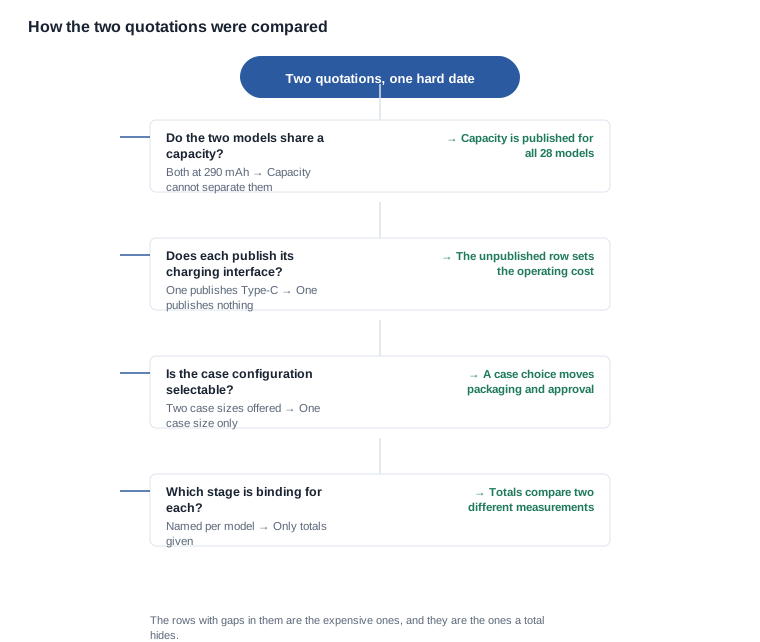
The lesson from step two is narrow and worth stating plainly: the numbers that read like the specification are often the least discriminating numbers on the sheet. Capacity is published for all twenty-eight models, which is exactly what makes it useless as a discriminator. The rows that separate two shortlisted models are the ones with gaps in them.
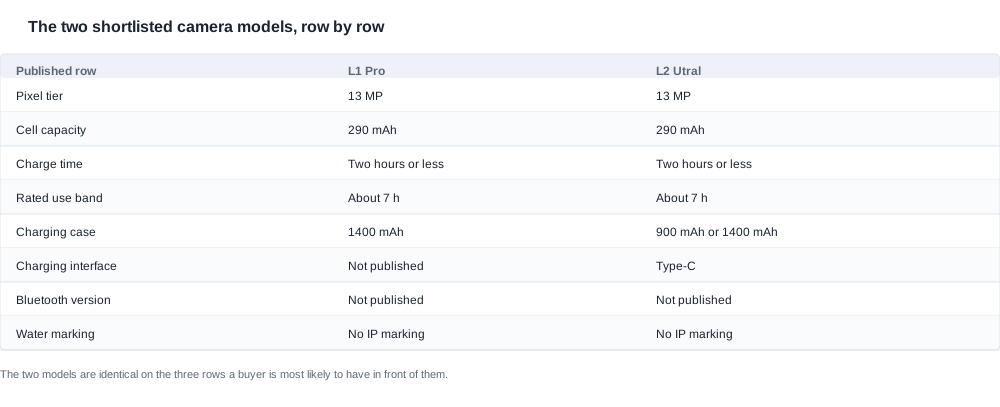
The table above is the comparison the scenario ends up making, and it is worth reading against the version the buyer started with. The first three rows are the rows the buyer had already compared and found identical. The rows that actually decide the case are the two below them: a charging interface that is published on one model and absent on the other, and a case configuration that is fixed on one model and selectable on the other. Both of those rows change the buyer's operating cost, and neither of them is about the cell.

Step three: the open row that appeared at the packaging stage
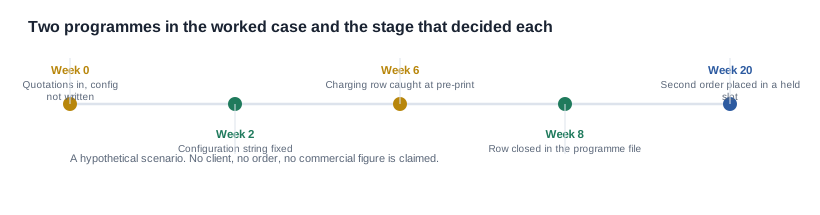
The scenario's schedule is now written and agreed, and for the first six weeks nothing goes wrong. The failure arrives in the packaging stage, and it arrives in a way that is instructive because nobody made a mistake.
The retail packaging for the two markets is designed by the buyer. The design includes a printed line explaining how the device charges and how long it takes. The buyer's copywriter, working from the buyer's own system, has written "magnetic charging" — because that is what the other eleven models they had reviewed do, and because the supplier's quotation described the device as charging magnetically without a model reference.
The L1 Pro's catalogue row does not publish a charging method. The buyer's design now asserts something about a model for which the published data says nothing. The supplier's pre-print check catches it, because a good supplier checks artwork against the specification string, and the specification string is the thing the buyer finally wrote down. Two weeks of artwork time are lost and the print date moves.
This is the moment the scenario turns, because the buyer's reaction defines the next order. There are three available reactions, and the wrong one is the most natural.
The wrong reaction is to treat it as a supplier problem. The supplier caught it, which is a point in the supplier's favour, and treating the catch as an accusation teaches the supplier that reporting a problem is a cost to them. Suppliers who have been punished for reporting a discrepancy stop reporting them, and the next discrepancy is found by the channel instead.
The second reaction, better but still incomplete, is to fix the copy. Correct the line, get the print date back, and treat the episode as a one-off. The episode was not a one-off. It was the first appearance of a row that the buyer's own collateral now depends on, and the collateral for a two-market retail programme is a living document that will be reprinted.
The right reaction is to close the row for the programme, not for the artwork. Ask the supplier, in writing, what the charging method is for the selected model. Get the answer into the configuration file. Change the artwork template so that the charging line is generated from the configuration rather than typed into the artwork. The answer might be magnetic; it might be Type-C; it might be something the buyer has not encountered. The point is that the buyer's collateral will never again assert a charging method that the buyer's own file has not confirmed.
That is the transferable part of the case, and it generalises past this category. The first time an artwork, a data sheet, a listing or a manual states a fact the buyer's own specification did not contain, the correct response is to find where else that fact has been typed by hand. A buyer's printed collateral is a set of assertions about the supplier's product, made by people who did not read the specification string, and the specification string is the only artefact in the process that was written by the person who had the data.

Step four: the schedule that survived the reorder
The scenario continues into a second order, and the second order is where most of the value of the first-order discipline shows up. Three things have changed by then, and all three were consequences of decisions taken during the first cycle.
The configuration string carries over. The second order is quoted against the same string, with the same case configuration and the same colourway. There is no re-specification round, and therefore no new artwork, and therefore no new approval stage. A buyer who has done this once has saved the four weeks that the pre-print correction cost in the scenario — and has saved them without negotiating anything.
The open rows have a small number of left, and they are known. The charging method is closed. The radio version is still open, because the catalogue does not publish it for the camera range, but the buyer has a written answer from the supplier and therefore a test that can be written. That is the difference between an unknown and a known unknown, and it shows up in the schedule as float rather than as a surprise.
The slot is quoted against a programme rather than a date. In the scenario the buyer offers a later ship date in exchange for a confirmed position in the following production window. The factory accepts, because a held slot costs them less than a released one, and the buyer's second order lands earlier than the first one did even though it was placed later. Nothing about the factory got faster. The buyer's position in the queue did, because the buyer traded something the factory valued for something the buyer valued.
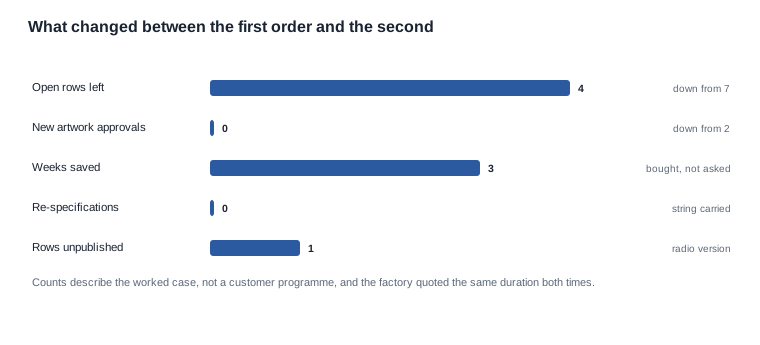
The comparison above is the one the scenario supports and the one a buyer can act on: the second order's schedule was shorter than the first's, and the factory's quoted duration for the second order was the same as for the first. The gain came from the buyer's side of the ledger — fewer open rows, fewer re-specifications, and a slot that was bought rather than requested.
There is a fourth change in the scenario that is easy to miss because it is not about the schedule at all. The buyer's own collateral — the packaging copy, the retailer listing, the product data feed the channel pulls from — is now generated from the configuration file rather than typed by hand. That was a decision taken in week eight, when the charging line was corrected, and it is what stops the episode from recurring in a form nobody would recognise. A second-order programme is cheaper than a first-order programme for exactly the kinds of reason that are not on a schedule: a template that pulls its facts from a file does not need to be re-checked, and a buyer who has been burned by a typed fact once tends to audit the template rather than the supplier.
What the case settles, and what it does not
Three conclusions, each of which is the sort of thing that is obvious afterwards and expensive to learn beforehand.
A schedule is settled by its binding stage, not by its total. In the scenario, the three-week difference between the two quotations was not a difference in build speed. It was a difference in which stage was binding for each of the two configurations, and it only became visible once the configurations were written down. A buyer who had compared the two quotations before writing the configuration string was comparing two totals that were not measuring the same thing.
The rows with gaps in them are the expensive ones. A published row can be quoted in a meeting, emailed to a colleague and cited in an artwork template. An unpublished row has to be asked for, has to be written down, and has to be carried through every downstream document by hand. The charging method for the L1 Pro is unpublished; that single gap is the most expensive line in the scenario, and it was invisible for six weeks.
The order that reads as a specification is often not one. The scenario's specification was one sentence and carried four decisions. It survived a first order only because a pre-print check caught it, which is luck rather than process. A specification that names the model, the pixel tier, the case configuration, the colourway, the packaging configuration and the destination markets is a specification in the sense the schedule needs.
What the case does not settle is the number. We do not publish a nominal lead time, monthly output, line count or a minimum order quantity, and a worked case without a number in it is not an oversight — it is the point. The catalogue publishes the configuration surface, the electrical rows, the charging method where it is stated, the case configuration where it is stated, the pixel tiers and the colour options, and it publishes the two models carrying an IP54 marking. The durations that can be quoted from those rows are the charge time and the rated use band, and both of them describe a unit rather than a production schedule. The lead time section sets out what the published rows support.
It is worth saying what the case would have looked like with a different opening question, because the opening question is the transferable part. Had the buyer asked "which of these two models can you build fastest?" the answer would have been a comparison of two totals, and the totals would have been measured from different starting points, and the charging interface would have stayed invisible until the artwork stage. Had the buyer asked "which of these two models has the fewest rows our own collateral will have to assert?", the answer would have been the L2 Utral on a 13 MP tier with a published Type-C interface — and the case would not have needed the pre-print incident at all. The question is not "how fast" and it is not "how cheap". It is "how many of our downstream documents have to carry a fact that nobody has confirmed".
What we will do is answer the open rows in writing for the models a programme actually selects. Send us the models, the quantities, the configuration for each and the destination markets, and we will tell you which rows the published data already closes, which ones we will close for you, and which ones are yours to close with your own suppliers.
Related reading
- A guide for first-time buyers — the order of operations
- The buyer's twelve conditions — the list this case walks through
- Mistakes that add weeks — the avoidable ones
- A stage-by-stage comparison — who owns each stage


