

Most schedule surprises are agreed before anybody worries about them. The date is signed, the deposit is paid, and four weeks later it turns out that nobody knew who was approving the artwork. This checklist exists to close that gap in about twenty minutes, in the last window before the money moves, when fixing a discrepancy still costs a phone call rather than a new production slot.
The reader is a brand-side buyer, a channel buyer or an importer with a signed quotation and a scheduled payment. The situation is always the same: the commercial terms are agreed, the date is on the order acknowledgement, and there is a small window in which the buyer can still ask the awkward questions without anyone feeling that the deal is being reopened. The fear is not a bad supplier. It is a payment made against a date that was never attached to a plan, and a buyer who realises in week five that the plan was never written down.
Smart glasses lead time: a twenty-minute check before the deposit
The reason this check sits after the signature rather than before it is worth stating, because the ordering looks backwards to a buyer who has not been caught by a schedule that moved.
A date agreed before the configuration is fixed is a date agreed against an assumption. Both parties believe they are describing the same order, and the belief is not unreasonable — it is simply unverified. The first quotation in a category always contains this mismatch, and it usually survives until something physical forces the two descriptions into the open. The earliest that can happen is the sample, the artwork, the packaging or the pre-print check, and all four of those are downstream of the deposit.
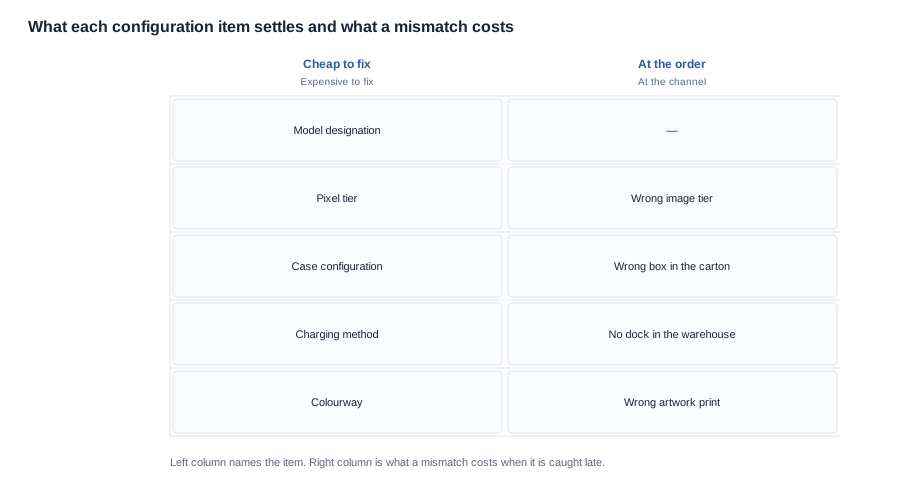
There is a second reason the check runs late, and it is about price rather than about dates. Once a configuration is fixed, most of the cost of changing it is gone, and a buyer who discovers the mismatch before the configuration is frozen can usually correct it at no cost at all. A buyer who discovers it after the artwork is in pre-print is looking at a re-print and a new artwork approval cycle, and both of those sit on the critical path. The cost of the check is twenty minutes; the cost of skipping it is a week of artwork and a re-print, and it arrives in the one week of the programme where a week is least affordable.
A deposit, on the other hand, is a one-way door in the commercial sense. Once it is paid, the factory's plan is committed, the buyer's own approval processes lose their optionality, and a change to the configuration stops being a conversation and becomes a new quotation with a new price. Everything that is still unverified at that point gets carried into production and discovered later, when the cost of a change is a change.
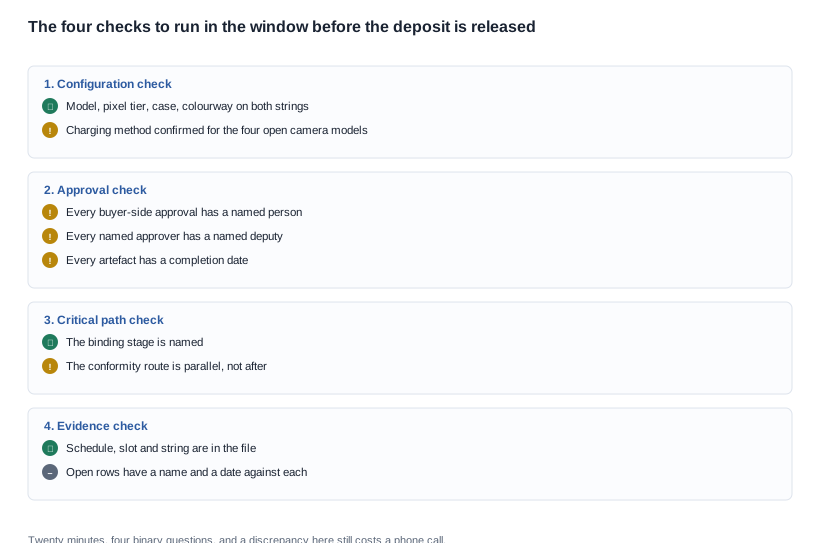
So the check runs in the gap, and the gap is short. The check itself is four questions, each of them binary, each of them answerable by a document that already exists or by a person who can be asked one question. Twenty minutes is generous.
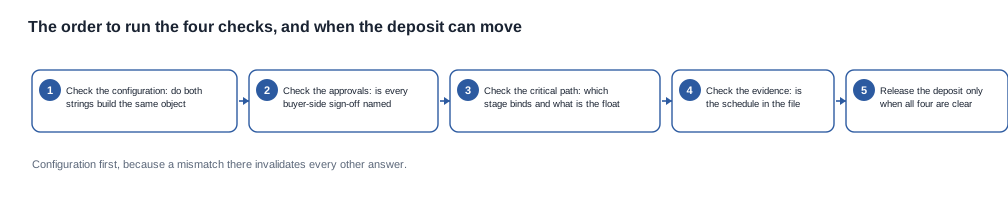
The order matters more than it looks. The configuration check comes first because a mismatch there invalidates the answers to everything else — if the two sides are not building the same object, then the approval route, the critical path and the schedule all describe different things. The approval check comes second because it is the one most likely to fail, and failing it is cheap today and expensive in six weeks. The critical path check comes third because it tells you what the date is actually made of. The evidence check comes last because it is the most mechanical and the least likely to change anything once the first three are clear.

The configuration check: is the string the same on both sides
The configuration check is a single comparison: the string on the buyer's purchase order against the string in the supplier's order acknowledgement, word for word. It takes two minutes and it is the check that finds the most expensive class of discrepancy, because a configuration mismatch does not announce itself — it surfaces at inspection, or at a market declaration, or in the channel.
What has to be in that string, for a camera model, is more than the model name. In this catalogue the surface is wide enough that a model name is a poor identifier, and the four items below are the ones that most often differ silently.
The pixel tier. Eleven of the twenty-eight models carry a camera, and they split into eight published at 8 MP and three at 13 MP. The three are the S7 and the L1 Pro, and the L2 Utral, and all three are otherwise distinct products. A quotation that says "camera model" has not selected anything, and a buyer's own purchase order that says "camera model" has not selected anything either.
The case configuration. This is the row that catches people, because the case is not always a choice but it is often invisible in a model name. The L2 Utral is published with a 290 mAh cell and a case available at 900 mAh or 1400 mAh. The CY03 and the CY05, and the L1 Pro carry a 1400 mAh case. The MT6 carries a 1200 mAh folding case. The KY06 and the MT5 have a case whose capacity is not published. The V03 Pro has no case at all. "With the standard case" resolves to a different object on each of those, and in the case of the V03 Pro it resolves to nothing.
The charging method. Twenty-four of the twenty-eight models publish one — magnetic or Type-C — and four camera models publish none: the MT6 and the L1 Pro, and the CY03 and the CY05. If the selected model is one of those four, the string cannot be complete until the supplier has confirmed the method in writing. This is a five-minute question to the supplier and a permanent line in the buyer's file.
The colourway. Three options on the V03 Pro, four on the V06, one on the MT6. Small, but it is the difference between one artwork and four, and an artwork is a week.
The test at the end of this check is simple and it is the one that actually matters: could a third party, reading the two strings, build the same object twice? If yes, the configuration is settled. If the answer is "probably", the discrepancy is still in the order, and a deposit is about to be paid against it.
The approval check: who is allowed to stop the build
The approval check asks three questions about the buyer's own side, and all three are the buyer's to answer without asking the supplier anything. That is why this is the check most likely to fail and cheapest to fix.
Question one: is every buyer-side approval assigned to a named person? Not a department, not a role, not "the brand team". A name. The reason is specific: an approval that belongs to a group has no deadline, because nobody in the group is individually accountable for it, and a group approval that has already been through two rounds of comments will go through a third.
Question two: is there a deputy for each named approver? Single points of failure in an approval route are the most common cause of a slipped date, and they are invisible in a plan because the plan assumes the person is available. A deputy costs nothing to nominate and removes an entire category of delay.
Question three: is there a date by which each approval must be complete? Not a date for the project — a date per artefact, with the artefact named. Retail packaging, carton artwork, the market-specific label, the listing copy, the data feed. The dates are buyer commitments, and putting them in the order is what gives a missed date an owner and a consequence on both sides.
There is a fourth question that is worth asking at this point even though it is not an approval: can the artwork still change? If the artwork is already in pre-print when the deposit is released, then the configuration freeze has effectively already happened, and any later change to the configuration is a re-print. Buyers who release a deposit with artwork in pre-print have, without meaning to, moved their own start point forward and taken away the supplier's room to batch the build.

The critical path check: what is actually on it
The critical path check asks the supplier two questions and the buyer one. The supplier's two are: which stage is binding, and what is the float on each of the others. The buyer's one is: which of my own commitments sits on that path.
The check exists because a schedule presented as a list of stages with dates does not tell you which stage can move and which cannot. A buyer who has this and a buyer who does not have this will have the same conversation and reach opposite conclusions about what to negotiate.
Two of the answers are worth a moment's attention, because they are where the published catalogue data helps most.
Is the binding stage a build stage or a document stage? If the binding stage is the production slot, the conversation is about capacity and priority. If it is artwork approval or a market label, the conversation is about the buyer's own process, and no amount of factory efficiency will fix it. A buyer who has not asked will often assume the second while the supplier is planning around the first, and the two will discover their disagreement in the middle of the build.
Does the plan assume the conformity route runs in parallel? For a radio-equipped product, the market-access route is a separate journey from the build, and in Europe it runs through the Radio Equipment Directive (EU) 2014/53/EU. A route that starts after the build is on the critical path whether or not anyone has written it down. The question that settles it is not "how long does certification take" but "when does the file open".
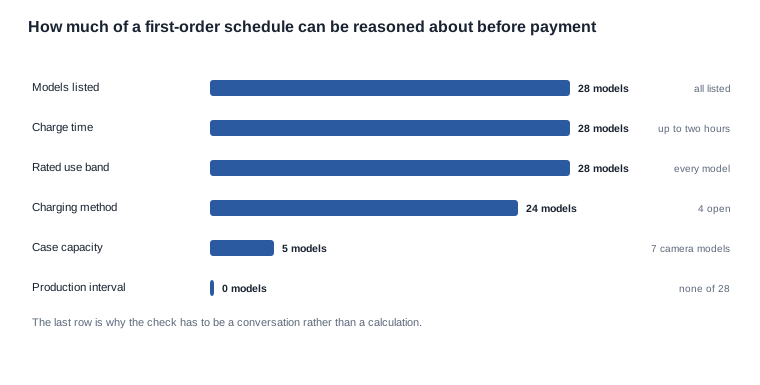
The bar chart above is a summary of how much of a first-order schedule can be reasoned about from published data before any money moves. The charge time and the rated use band are published for all twenty-eight models and are stable, so they are usable as fixed points. The charging method and the case capacity are published for most models and need a written answer for the remainder. The production interval itself is not published for any model, which is why the check has to be a conversation rather than a calculation.

The evidence check: is the schedule in the file or in someone's memory
The evidence check is the last one and it is the most mechanical: for each of the three or four claims the buyer's plan depends on, establish where the claim is recorded.
For the schedule itself, the record should be a written plan, referenced by the order acknowledgement, with a date against it. A schedule that exists only in an email thread, or worse only in the supplier's head, is a schedule that a new person in the supplier's commercial team cannot honour and will not know has been promised.
For the slot, the record should be a written confirmation naming the configuration, the start date and the deadline for placing the order. This is the single most common place where a buyer's plan and a factory's plan diverge, because a slot discussed verbally is understood by the buyer as held and by the factory as discussed.
For the configuration, the record should be the string, in both places, identical.
For the open rows — and there will be some — the record should be a list with a name against each unanswered question and a date by which it must be answered. For the four camera models whose charging method is not published, and for the radio specification that no camera model publishes, that list is the mechanism that keeps a second order from reopening the same questions.
The evidence check is where the twenty minutes go, because it is the only one of the four that produces a file rather than an answer. A buyer who answers the first three checks well and skips the fourth will still be relying on somebody's memory, and the first time the supplier's commercial team changes, the memory will be a different person's.
Two habits make this check cheap rather than tedious, and both are worth adopting before the first order rather than after the second.
Keep one file per order, and put the four records in it. A purchase order, the supplier's acknowledgement, the written schedule and the configuration string, in one place, named consistently. The cost of this is a folder and a naming convention. The benefit is that the second order starts with a reference instead of a reconstruction, and that the open-row list has somewhere to live from the first order onwards.
Log the answers to the checks, not just the outcome. A line saying "charging method: Type-C, confirmed in writing on the date of the order, source: supplier written answer" is a record. A line saying "charging method confirmed" is a note, and the difference between them is the difference between a file that can be handed to a colleague and a file that has to be re-derived. The category of data that most often has to be re-derived is exactly the data with a gap in it, which is why the four camera models whose charging method is not published should be logged with more care than the twenty-four that publish it.
What to do when one of the four checks fails
A checklist is only useful if it says what to do when an answer comes back wrong, so here is the failure handling for each check, in the order of how expensive each failure is to leave unresolved.
If the configuration check fails, stop. Do not release the deposit. A configuration mismatch is not a discrepancy to be reconciled later; it is a different order at a different price, and a deposit against the wrong configuration buys the buyer a unit that cannot be sold into the market it was bought for. The recovery is a corrected purchase order and a corrected acknowledgement, and it costs a day.
If the approval check fails, the deposit can usually still be released, because the fix is entirely inside the buyer's organisation. Name the approvers, name the deputies, set the dates, and put them in the order. What must not happen is releasing the deposit and fixing the approvals later, because the whole point of the check is that the approvals are a buyer commitment and the commitment has to exist before the factory's clock starts.
If the critical path check fails, the deposit can usually still be released, but the buyer's own plan has to be rebuilt. The finding here is about the buyer's expectations rather than about the order, and the remedy is to work the schedule backwards from the date that cannot move, mark the float on each stage, and identify which single stage has the least. If that stage is on the buyer's side, the buyer has just learned something worth a great deal, and it cost twenty minutes to learn it.
If the evidence check fails, hold the payment but not the order. The remedy is a documentation request, not a renegotiation: a written plan, a written slot confirmation, a configuration string on both sides, and a named list of the rows still open. Ask for all four in one message, because the answers have to be consistent with each other and the cheapest way to find out that they are not is to ask for them together.
The general principle behind the four failure routes is worth stating, because it is the principle and not the four answers that transfers to the next order. A discrepancy found before the deposit is a document problem. A discrepancy found after the deposit is a production problem. The first costs an hour; the second costs a slot, a re-print and a week. Nothing in this checklist requires a supplier to be more efficient, more responsive or more careful than a reasonable supplier already is. It only requires the buyer to compare two documents that already exist, and to ask four questions that a competent supplier will have already answered internally. The buyer is not asking for a favour. The buyer is asking to see the plan that the order is already built on.
What we will do on our side is close the open rows in writing for the models a programme actually selects. Send us the models, the quantities, the configuration and the destination markets, and we will tell you which rows the published data already closes — the charge time, the rated use band, the pixel tier, the colour options, the charging method where it is stated, the case configuration where it is stated, and the IP54 marking on the two models that carry it — and which ones we will answer for you directly. What we do not publish is a production lead time, a monthly output figure, a line count or a minimum order quantity, because a number that does not hold for a specific build is the number a launch window gets built on and then fails. The lead time section sets out what the published rows support.
Related reading
- A checklist for your first order — where the clock starts
- The buyer's twelve conditions — what to settle before the date
- Red flags in a supplier's schedule — what to watch for
- Negotiating the schedule — the three branches


