

Buyers ask for a single number and receive a range, and the range is often mistaken for evasion. It is not. The width of a quoted range in this category is produced by four variables, three of which sit on the buyer's side of the table, and once you know which four they are most of the spread resolves into a plan with named owners. The residual manufacturing time that remains is the most predictable part of the whole exercise — and it is also the smallest part.
This matters because the instinct on receiving a range is to ask for a narrower one, and narrowing a range by asking harder does not work. A range narrows when the variables behind it are closed, not when the supplier is pressed for a firmer number. Which is why the practical questions to ask are about configuration, quantity, approval latency and market scope rather than about the number itself.
Smart glasses lead time: why the answer comes back as a range
The buyer who asked for one number, and why one number was the wrong request
The request usually comes from a scheduling problem rather than a curiosity. Somebody in the business has committed to a date — a trade show, a retailer onboarding window, a season launch — and the purchasing team has been asked to confirm it. The natural instinct is to ask for a number, because a number is what can be put in a plan.
The problem is that the interval a buyer wants to plan against is not a property of the factory. It is a property of a combination: a configuration, a quantity, a set of approvals and a destination. Change any one of them and the interval changes. Asking for a single figure without naming those four things is asking for an average of several different orders, and an average of orders is a number that will be correct for none of them.
This is also why a range is frequently wider than the physical variation it appears to describe. A supplier who quotes a range is often absorbing schedule risk that sits outside their own control — the transit, the clearance, the customer's own approval behaviour — and folding that risk into the range is honest even though it is unhelpful. The midpoint of such a range is not a planning number, because the midpoint of a risk-absorbing interval describes an order that never happened.
The way to get a usable answer is therefore to narrow the question rather than the range: name the configuration, the quantity, the destination and the approval path, and then ask what the interval becomes under those four conditions. A supplier who can answer that has a plan. A supplier who returns the same range has given you a price of certainty rather than a schedule.
There are two kinds of range, and telling them apart saves a lot of wasted negotiation. The first is a structural range, produced by the four variables below, and it narrows when they are closed. The second is a risk range, produced by a supplier padding an interval to cover exposure they cannot price — the transit they do not control, the clearance they have not seen, the customer's own delays. A risk range is not dishonest; it is a different product, and it cannot be narrowed by asking about its causes, because its causes are not in the supplier's hands.
The practical way to separate them is the re-dating test described further down, and it is worth running it before accepting a range into a plan, because the two types need opposite responses. A structural range responds to a buyer who closes variables, and closing them is mostly free. A risk range responds to a buyer who attaches a consequence, because the moment the interval costs somebody something, it becomes worth contracting rather than forecasting.

The four variables that produce the spread
Configuration is the first variable, and in this catalogue it is unusually easy to get wrong because the range is genuinely broad. It spans audio units with two cells at 55 mAh each, single-cell models at 40, 70, 100 and 115 mAh, and camera platforms at 220, 260, 265 and 290 mAh. It spans two camera resolution tiers, with eight models publishing 8 MP and three publishing 13 MP, and a 13 MP module has a longer integration and calibration path than an 8 MP one. It spans magnetic charging on seventeen designs, Type C on seven, and four camera models — the L1 Pro, the CY05 and the MT6, and the CY03 — where the charging method is not published at all and therefore has to be established before the configuration can be considered closed.
It also spans the option count, and the option count is what multiplies the production items. The V03 Pro publishes three colourways, so it is three production items before anything else is added. The V06 publishes four. The L2 Utral publishes two charging case options at 900 mAh and 1400 mAh, and because the carton is sized by the case, that is two items and two different cartons. The MT6 publishes a 1200 mAh folding case, which is a different assembly again.
Quantity is the second variable, because the setup and the changeover amortise across a run. A short run pays the full setup for a small number of units, and a long run pays it for a large number. This is the variable where the buyer has the most direct influence, and where the most straightforward commercial mistake is made: increasing the quantity to reach a price band without checking how many production items the increase creates.
The arithmetic of that mistake is straightforward enough to run before any order is placed. If a programme has three colourways of one model, it has three production items and three setups whatever the total quantity is, and the setup cost per unit falls with volume while the setup count stays fixed. Doubling the quantity in that arrangement halves the amortised setup but does not change the number of changeovers, and the saving is smaller than a buyer who was quoted a single-setup price expects. The same applies to the case option: a L2 Utral ordered across both 900 mAh and 1400 mAh cases is two production items and two different cartons, and the carton change is a separate packaging line that does not appear anywhere in the unit price.
Approval latency is the third variable, and it is the one most often left out of the published range because it sits on the buyer's side and is therefore invisible to the supplier's own measurement. It is also, in practice, the variable that most often decides whether a launch date is met, because it is at the front of the chain and because it is the only one of the four that the buyer can change unilaterally.
Market scope is the fourth. Certification work for a new destination market is additive and it is not manufacturing time, so it widens the range without appearing anywhere in the factory's own figures. The euro radio requirement sits under the Radio Equipment Directive (EU) 2014/53/EU and the electromagnetic compatibility requirement under a separate directive, and the battery transport documentation is a third stream. Three separate workstreams, each with its own owner and its own duration, and none of them inside the factory.
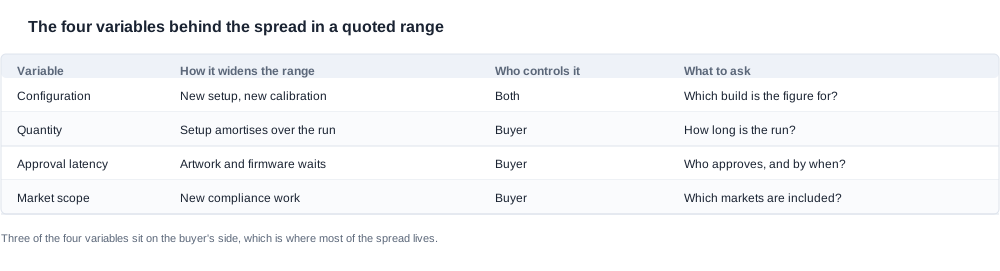
| Variable | How it widens the range | Which side controls it | The question that closes it |
|---|---|---|---|
| Configuration | New setup, new calibration, new carton | Both | Which build is the figure for? |
| Quantity | Setup amortises over the run length | Buyer | What is the run, and how many setups? |
| Approval latency | Artwork and firmware waits at the front | Buyer | Who approves, by when, and with a deputy? |
| Market scope | New compliance work per destination | Buyer | Which markets and language packs are in? |
Three of the four are on the buyer's side, and that is the most useful fact on this page. It means most of the width of a quoted range is not a factory variable at all, and a buyer who closes those three will find that the range contracts without anybody having to move.
Approval latency, and why it is the only one fully in your control
The most common source of delay in this category is not production and not compliance. It is an approval that sits unanswered, and it is almost always a structurally avoidable condition rather than a person being slow.
The typical pattern is a print proof sent on the second day and returned on the ninth, because the person who had to approve it was travelling and nobody had been told that a substitute was needed. Six days have gone, the material booking is waiting, and nothing in the factory was ever at fault.
Fixing it costs nothing and takes one line in the purchase order. Name one approver and one deputy. Agree a response window, in working days, on the two approvals that sit at the front of the chain — the artwork revision and the firmware acceptance. State that silence after the window constitutes approval. And record the two names in the schedule so that the consequence of an unanswered approval is visible in the plan rather than discovered in it.
The reason this works commercially, rather than merely organisationally, is that a factory with a defined approval window can hold a slot against it. A factory without one re-queues the order behind whoever answered first, and the re-queue is invisible from the outside — the order has not slipped on the schedule, it has simply moved to a later position in a queue that nobody told you about. Buyers who have never seen this happen often assume the factory is at fault, which makes the relationship harder and the problem harder to fix.
There is a second-order effect worth knowing. Buyers who write a response window into the order tend to get narrower ranges from that supplier, because the supplier can now model the approval stage instead of absorbing it. The range narrows as a side effect of the clause, which is a useful data point if you are evaluating a supplier's scheduling maturity: a supplier who cannot quote against a known approval window is telling you that their schedule does not have one.

The re-dating test that identifies the variable that matters
Every quoted range hides a question: which of the four variables is actually producing the width? There is a cheap way to find out, and it is worth running on any range before the range is accepted into a plan.
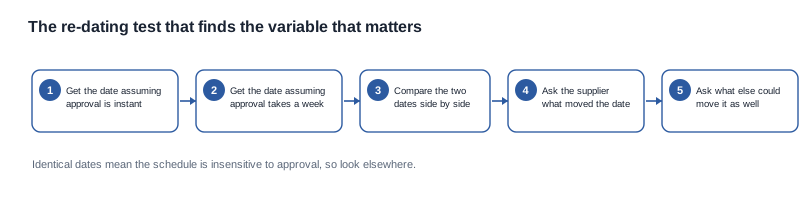
Ask the supplier to re-date the order twice under two different approval assumptions. The first pass assumes the artwork and firmware approvals come back on the day they are requested. The second pass assumes each of them takes a week.
If the two resulting dates are the same, the schedule is not sensitive to approval, which means approval is not what is producing the spread and you should ask what is. It is often the material booking, and it is sometimes the quantity — a run short enough that the setup has to be repeated. Either way, you have found the variable and it is a real one.
If the two dates differ by roughly the approval allowance, then approval is on the critical path and it is the variable worth managing, because it is the one where a small change in the buyer's behaviour produces a large change in the outcome.
There is a second reason to run the test, which is diagnostic rather than planning-oriented. A supplier who cannot re-date the plan under two assumptions has not built a plan, and their range is a summary of experience rather than a schedule. That is not a disqualification — plenty of smaller operations work that way — but it does mean the range should be treated as a risk allowance rather than as a description, and the plan should carry contingency rather than the midpoint.
The same logic applies to the other three variables. Ask the supplier to re-date under a different configuration and a different quantity, and a supplier who returns the same number each time has told you the number was not a function of any of them.

What a usable commitment looks like instead of a range
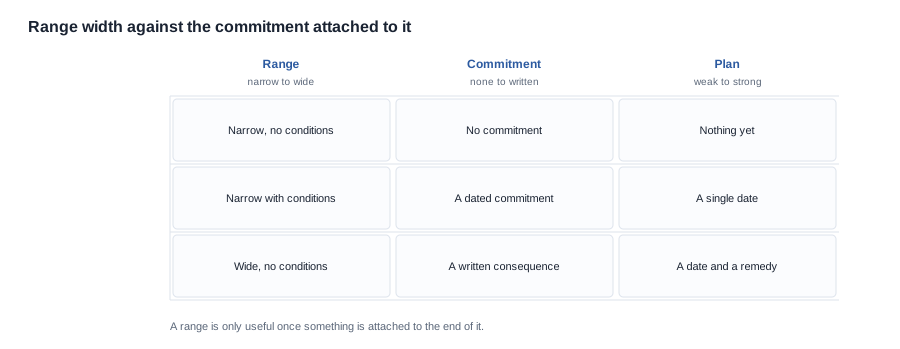
A range becomes usable when something is attached to the end of it. The commitment that works is narrower than a range and stronger than a number, and it has three parts: a configuration, a quantity, and a date range with a named consequence if the date moves.
That is a smaller ask than a guarantee, and it is much smaller than a midpoint. The consequence does not have to be a penalty; it can be a re-sequenced shipment, a partial dispatch, a revised launch date, or a written notice. What it has to be is something that happens, because the entire difference between a range and a commitment is that a range describes a distribution while a commitment attaches an obligation to the breach.
The same table can be read in the other direction, from the commitment backwards. A quote that carries a configuration, a stage structure and a consequence is a document that can be compared against another supplier's. A quote that carries only a range, however tight the range is, cannot be compared with anything, because there is no second thing to compare it to.
There is one more trap in the range itself, and it is the most common. A range quoted for a first order is a range that has absorbed first-order effects — the document route opening, the first article, the artwork approval running long because nobody was watching it. A range quoted for a repeat order on a proven configuration is a different range, often materially narrower, because most of the opening work has already been done. Buyers who compare a first-order range against a repeat-order range conclude that one supplier is faster than another when the real difference is the position in the programme. The sample policy article covers why sample work runs ahead of the order and what that does to the first-order range.
The decision a range actually forces is narrower than it looks. A buyer is not choosing between the ends of the interval; they are deciding whether the interval fits inside a launch plan, and if it does not, whether the plan moves or the order changes. That is a question about the total cost of the programme rather than about the schedule, because a late order does not only cost the delay. It costs the storage on the stock that arrived out of season, the marketing spend on a launch that happened without the product, and the discount that moves the leftover. A range that only accounts for the factory is the wrong range to plan against, and the widest variable in the whole exercise is usually the one nobody puts on the page.
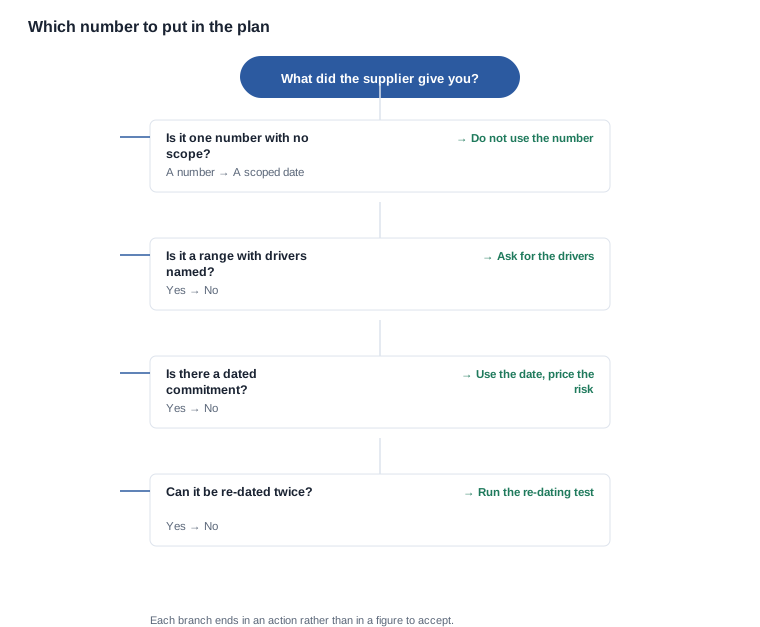
The criteria worth applying before you accept any quoted range are therefore short. It names a configuration. It names a quantity. It distinguishes a first order from a repeat. It identifies which of the four variables is producing the width. And it carries a consequence if the date moves. A range that passes all five is usable, however wide it looks on the page.
What Cynrin publishes about duration, and what it will not put in writing
We do not publish a standard lead time or a stage-by-stage duration, and the reason is worth stating precisely rather than as a policy. A duration without a configuration, a quantity and a date range has no denominator, and the not-published position applies to every stage duration we hold until a specific order gives them one. A number printed on a web page would be a number without a denominator, and a buyer who plans against it is planning against our uncertainty rather than against our capacity.
What we will do is give a date range for your quantity and configuration before the deposit is due, tell you which of the four variables is producing the width in your case, and tell you plainly if any part of it sits on your side of the approval line. We will also re-date the plan under two approval assumptions if that is the question you need answered, because it is the fastest way to find out whether the approval is the constraint.
What we will not do is quote a midpoint as though it were a commitment, and we will not hold a production slot against a purchase order that has no named approver on the buyer's side. That last one is not a negotiating position. A slot held against an order with no defined approval is a slot taken from somebody who does have one, and in a category where capacity is not published, that is a decision we are not willing to make on a buyer's behalf.
The practical questions to put in front of a supplier are collected in the lead time checklist, and the longer set of what to ask before ordering is in the questions to ask about lead time. The wider commercial structure sits under the lead time pillar.
Related reading
- Lead time checklist — what to confirm before you pay
- What to ask before ordering — the longer question set
- Sample policy effect on lead time — why first orders run longer
- Procurement pillar — the commercial structure
Send the configuration, the quantity and the market, and we will tell you which of the four variables is producing the width in your case and what we can commit to.


