

Six questions, asked before the deposit rather than during week three. None of them is difficult, and a supplier that answers all six clearly is telling you something important about how the order will run.
The reason these six and not others is that a quoted lead time is a summary of a plan, and the six questions are the ones that decompose the summary. Two suppliers can quote the same number for the same configuration and only one of them be right, because one quotation's chain contains a documentation wait that has already been started and the other's contains a documentation wait that starts after the deposit. Both totals are identical. One of them will be four weeks late against a date that was accepted.
So the questions are not about negotiating a shorter number. They are about finding out which link in the chain is actually binding, and what happens to your date when something on your side moves.

Smart glasses lead time: the six questions, and who has to answer
-
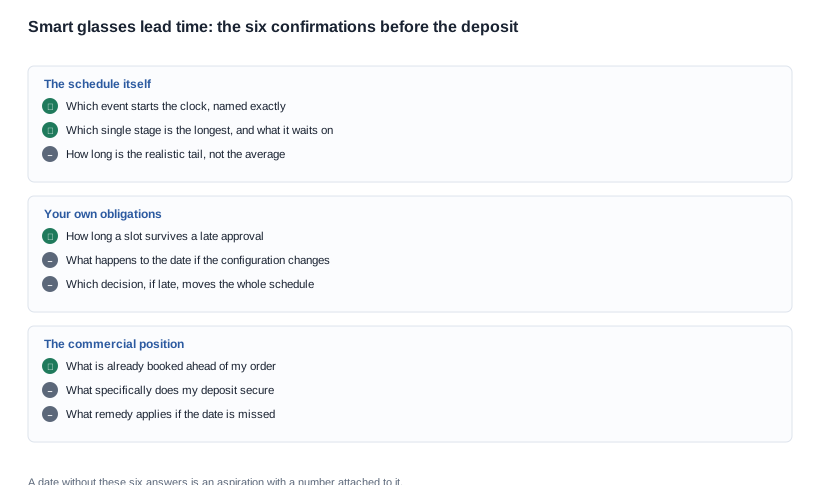
Which event starts the clock? Ask for the event by name, not for a date. A factory quoting from deposit and a factory quoting from artwork approval give the same number and mean different things, and the trigger decides whether a delay in sending artwork is a delay you caused.
-
Which stage is on the critical path? One stage name, not a list. Then ask what that stage is waiting on, because a stage waiting on a purchased component has a different risk profile from one waiting on an internal queue.
-
What happens if I approve late? Ask how long the booking survives a delay on your side. "We will try to hold it" is not an answer; "five working days" is, because it can be planned around.
-
What is already booked ahead of my order? This tells you how much of the quoted capacity is genuinely available rather than available in principle, and which orders the delay would land on.
-
What specifically does my deposit secure? A slot in a schedule, or the early weeks of production. The distinction matters when the factory re-sequences a month and the buyer's date moves.
-
What remedy applies if the date is missed? Ask it as a scenario rather than as a general question, and learn the answer in week one rather than in week six.
A supplier that answers all six clearly is telling you something about how the order will run. A supplier that answers three of them in specific terms and three in general terms has told you which parts of the schedule are fixed and which are decided later.
Why the starting event decides more than the total
The reason to insist on the event rather than on a date is that the event is a fact about the process and the date is a fact about one instance of it. A supplier that quotes from the deposit has a trigger that is entirely inside its own control, which is convenient for the supplier and risky for the buyer, because the deposit is exactly the moment at which the buyer's own approvals are usually outstanding. A supplier that quotes from artwork approval has chosen a trigger that acknowledges the buyer has work to do.
Neither is wrong. What is wrong is a quotation whose trigger is not written down, because then every dispute about the date becomes a dispute about what was agreed, and the supplier's account of the trigger is the one that survives.
There is one further reason to name the event rather than to accept a generic one, and it is specific to this category. The published charge time in this range is two hours or less across twenty-six of the twenty-eight configurations, with the D17 and the ZH12 at about an hour, and the published run times are given as bands rather than as single figures. Neither figure carries a measurement condition, so the buyer's own test has to supply one. A schedule that says the date runs from artwork approval implicitly accepts that the artwork approval is a gate the buyer controls; a schedule that runs from the deposit does not.

What is on the critical path?
Ask for one stage name, not a list. A factory that can name the longest stage is a factory that has decomposed its own schedule.
Then ask what that stage is waiting on. A stage waiting on a component has a different risk profile from one waiting on an internal queue, and the difference determines whether you can do anything about a slip.
A chain of seven links is the useful frame for this, and it is worth having in mind because it shows where the buyer actually has leverage. The links are configuration freeze, material readiness, artwork and packaging, the documentation route, the production run, test and pack, and consolidation and customs. Two of the seven belong to the buyer alone — the configuration freeze and the documentation route — because both are triggered by decisions the buyer has not yet made. The rest can be shortened, but only by a decision, an amount of money, or a trade-off the buyer has to accept.
The link that is most often misunderstood is material readiness. In this category the constraint is frequently a purchased component rather than the assembly line, and the cell is the obvious candidate because the published configurations use several cell capacities: 220 mAh, 260 mAh, 265 mAh and 290 mAh across the camera models, and a charging case adds a second cell type at 900 mAh, 1200 mAh or 1400 mAh. A factory quoting line capacity while a cell supplier sets the real limit has described the wrong bottleneck, and a buyer who does not ask which part constrains the output will plan against a schedule that was never going to hold.
What happens if I approve late?
Ask specifically whether the booking survives a delay on your side and for how long. "We will try to hold it" is not an answer; "five working days" is.
This is worth knowing in advance because the answer is often generous on the first order and shorter on the fourth, when the factory has more customers and less reason to hold a slot for an approval that may never arrive.
The most useful form of the answer names a number. "We hold the slot for five working days after the proof is sent" is a commitment you can manage around; "we try to accommodate" is a sentiment. And the sentiment version has a specific failure mode: when the deadline passes, the slot is released to whoever asks next, and the buyer discovers this from a delivery date rather than from a notice.
This is the question that matters most for the buyer whose own cycle is the slow one. A brand going to a trade show six weeks after the order is placed is not unusual, and the supplier who holds a slot indefinitely for a customer who may yet approve is holding inventory that the slot could otherwise be used for.

And the two commercial questions
What is already booked ahead of your order, and what specifically does your deposit secure? The first tells you how much of the quoted capacity is genuinely available, and the second tells you whether the early weeks are protected if the order changes.
The first question is worth putting in a sharper form. Ask which other orders occupy the window your order is scheduled into, and ask how long each of them has been scheduled. A window containing one long-running order and several fresh ones is a window where a delay lands on you; a window containing only long-running orders is one where a delay rolls forward.
The second question distinguishes two things that are often conflated. A deposit secures a slot in a schedule. A deposit does not necessarily secure the slot against the factory re-sequencing its own month in order to fill it with a larger order, because re-sequencing is a factory decision and a slot is not a contractual right unless the re-sequencing is prohibited. The lead time checklist covers the confirmations in full, and the lead time documents article is the document-level version.
The last commercial question is what happens if the date moves. A supplier without a written remedy term is not necessarily unreliable, but you should learn that now rather than in week six, and the answer is more useful if you ask it as a question about a specific scenario rather than as a general one.
One question sits above the other five. Ask whether the supplier would give the same date to a customer they have worked with for three years. If the answer is that a longer-standing customer would be treated differently, you have learned something that no amount of further detail would have told you — and it is better to learn it now.
The reader, and the three situations behind the six questions
The reader is a buyer working for the brand, a channel buyer or an importer. The situations are three. A retailer has committed to an on-sale date and the quoted schedule does not fit the window. Two suppliers have quoted different lead times for the same configuration and the buyer cannot tell which to believe. Or a repeat order has been promised a date that the previous order did not achieve, and somebody is asking whether it can be faster this time.
The third situation is the one that most often turns out to be a misreading. The repeat order usually has fewer links in its chain than the first order — the material set exists, the documentation route exists, the artwork is approved — so a supplier quoting the same number on the repeat is quoting the first order's chain again. The question to ask is which link is supposed to have disappeared, and the answer is usually a specific one that nobody had looked at.
Why two quotations for the same configuration disagree
Three mechanisms explain almost every case where two quotations carry the same total and different realities, and knowing which one is operating saves a buyer from comparing the wrong thing.
Different starting points. One supplier runs the clock from the deposit, the other from artwork approval. The second quote looks worse and may be better, because it is counting a wait the first quotation excludes entirely.
Different scope. The quotations are for different products. A configuration that includes a charging case carries a packaging and an assembly wait that a configuration without a case does not. Four colourways on the V06 are four material sets; one colourway is one. The L2 Utral publishes two case options, at 900 mAh and 1400 mAh, and each is a separate material set with its own procurement chain behind it.
Different documentation positions. One supplier has already filed the route for this destination and model, and the other has not started. The same certification work takes a different amount of time depending on whether the technical file exists, and the buyer cannot see that from the total alone. The way to separate the two is to ask which route is open for which model, because a route that is open for the audio range tells you nothing about the camera range.
A fourth mechanism is worth naming because it is not a difference in schedule at all: one supplier quotes a firm date and the other quotes a window. A window is not a schedule. It is a statement that the date will be decided later, and the later decision is made by the party with the most flexibility, which is never the buyer with a retailer's date in the diary.
The two waits you can remove on your own
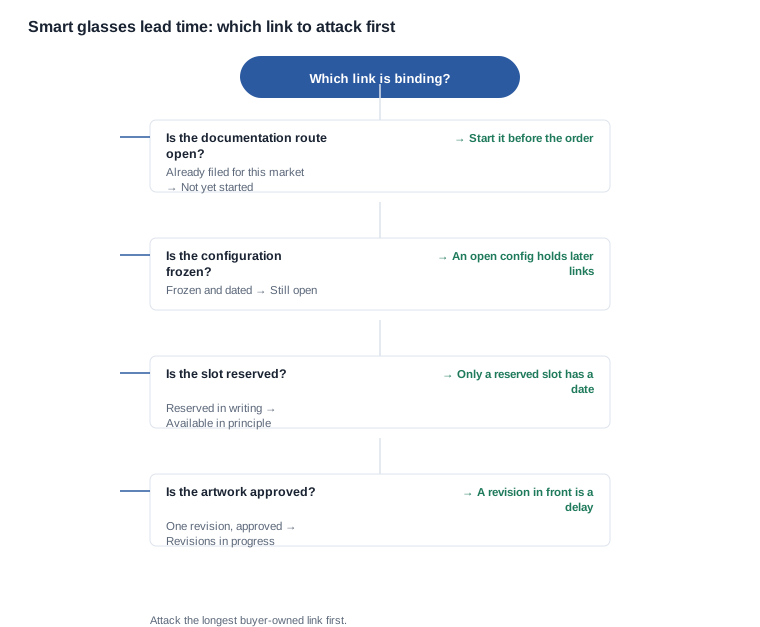
The decision diagram above puts the four links a buyer can influence against what the answer reveals, and two of them are removable at no cost at all.
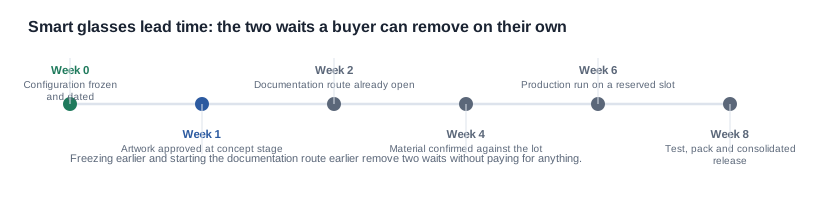
The configuration freeze. Freeze earlier, and make it a dated event with a named owner. A freeze that is "when the buyer is ready" is not a freeze. What goes into it: the model code, the colourway, the case option, the packaging and artwork version, and the destination market. Everything downstream is waiting on this link, and a link that is waited on by six others is the one worth removing.
The documentation route. The market route is frequently the binding link and frequently the longest tail, and it starts the moment the destination and the claims are known — which is before the order. Starting it early costs nothing and compresses the whole chain. The certification lead time article covers why the route behaves this way, and the certification documentation requirements article is the field-level list of what has to exist.
Two more links can be shortened for money rather than for free, and both need to be quoted as separate lines rather than buried in the unit price.
An expedited slot. The price of a shorter production date is a premium, and it is a purchase rather than a reduction. It is worth taking when the cost of the delay is a fixed, visible penalty — a retailer markdown, a launch window that closes — and not worth taking when the cost of the delay is uncertain. Against a margin model that comparison is usually close, so it should be made explicitly rather than absorbed.
A dedicated documentation route. Where the market route is the binding link, a supplier who has already started it for this configuration can deliver the documentation faster than one starting from zero. This is not a premium on the goods; it is a decision to order into a route that is already open.
Both purchases have a counterpart risk worth stating. An expedited slot bought without a written milestone schedule gives the buyer a date and no visibility, and a date with no visibility is a date that will be defended rather than met.

Where a quoted date is quietly undone
The freeze that was not really frozen. The configuration freeze is agreed in the order and then ignored, because the artwork revision, the case decision and the market confirmation all arrive after it. Each of them reopens the chain. Prevention: name each of them inside the freeze, and make the freeze date the trigger for the artwork work rather than its output. The test is simple — if a change to the case option is still possible after the freeze date, the freeze was a sentence rather than an event.
The configuration that was added later. A fourth colourway, a second case option or a different lens option added in week three is not a small addition. It is a new material set with a new procurement chain behind it, and it usually lands behind the slot that was booked for the original build. This is the most common way a schedule agreed at eight weeks becomes a schedule that ships at eleven.
The documentation that was scheduled after the despatch. The document set is treated as an output of the production run rather than as an input to it. The goods are ready and the file is not, and the release stops.
The test that was cut to make the date. The schedule was met and the returns reserve was not budgeted. The cost of a shortened schedule bought this way does not appear in the programme; it appears in the warranty claims eighteen months later. Ask which stage was compressed, because a factory that will say which test was cut has a test plan, and one that will not is telling you the schedule was met by a decision nobody recorded.
The date that was agreed before anyone asked which link was binding. A supplier who names the documentation route and a buyer who assumed it was the production line have already saved a week of argument. A supplier who says the schedule depends on the season and a buyer who accepts that has saved nothing at all, because nothing was asked. The failure is symmetrical and it is expensive: the buyer who never asked cannot later complain that the answer was wrong.
The signs that a schedule has been shortened in the wrong place are simple: the date holds and the first shipment does not match the approved sample; the date holds and the documentation is incomplete; the date holds and the returns reserve does not. The lead time common mistakes article covers the same ground as a working list.
The commitments we will make on a schedule, and the ones we will not
We will answer all six in writing before the deposit, including which stage is on your side and what it waits for, and we will state the starting event for the schedule by name.
Our stage durations and standard lead time are not published in our documentation because they vary with configuration and quantity — what we will give you is a schedule for your specific order rather than a figure that applies to nobody in particular.
We will also tell you when our answer is that something is outside our control, because a supplier who claims every stage is fixed is either unusually well run or not telling you where the risk sits. The published configuration options are what make a schedule specific rather than general, and they are worth reading before a date is accepted: the V06 publishes four colourways, the V03 Pro three, the L2 Utral ships with either a 900 mAh or a 1400 mAh case, charging cases appear at 1400 mAh and at 1200 mAh in the foldable case on the MT6, and the published charge time is two hours or less across twenty-six of the twenty-eight configurations, with the D17 and the ZH12 at about an hour.
The lead time section covers the sequence in full, and the production capacity article is where the decision to buy a slot is framed.
The window that the first quotation does not fit
Read the steps below as a constructed case rather than a client project. A brand-side procurement manager needs a camera model with a charging case on a fixed retailer on-sale date. The first quotation is a single number, and it does not fit the window. The second quotation offers a shorter number and asks for a larger deposit, which is the combination that most often turns out to be a slot premium rather than a shorter chain.
Before accepting either, the buyer decomposes both into the seven links, and the first two links answer most of it. The first quotation has the documentation route starting after the deposit, and it has the artwork at two revisions. The second has the documentation route already open for the destination but the same artwork position, and its shorter number comes entirely from a slot premium rather than from a shorter chain. The larger deposit is the tell: money is being asked for a position in a queue, not for a shorter process.
The decision then follows from the decomposition rather than from the totals. The artwork wait is removed by approving one print proof at concept stage, with the print area sized against the carton for the case configuration already chosen. The documentation route is started before the deposit, so it is no longer inside the chain. The configuration freeze is dated, and the colourway count is cut from two to one for the first run, with the second colourway added at reorder. What remains is material readiness, production, test and consolidation — the three links the buyer cannot remove. Every saving here is free, and each one is a decision rather than a purchase.
The result is a schedule that fits the window without buying speed, and the slot premium in the second quotation is dropped because the chain is shorter once the two buyer-owned waits are out of it. The commercial decision at the end is not which date to accept; it is which configuration to launch with and when to add the second colourway. That is a decision the buyer controls, and it is worth more than the week that the negotiation appeared to be about. The saving also carries forward, because the reorder for the second colourway inherits an open documentation route and an approved print proof.
The same arithmetic works in reverse for a repeat order, and it is worth doing it once. The second order for the same configuration usually has fewer links than the first, because the material set exists, the documentation route exists and the artwork is approved. A supplier quoting the same number on the repeat order is quoting the first order's chain again, and the buyer should ask which link is supposed to have disappeared. Asking it is also a useful check on the first quotation, because a supplier who cannot decompose the repeat schedule is unlikely to have decomposed the original one either.
Tell us the configuration, the quantity, the destination market and the date you are working back from, and we will tell you which link we would attack first.


