

Buyers consistently underestimate the calendar impact of a sample, because they count the time to receive it and not the time that follows. The unit arrives in week two; the decision it was meant to inform arrives in week six; the bulk order is placed then, and everything downstream of that order is already late.
The reason is that most of the elapsed time in a sample stage is not spent making anything. It is spent moving a unit around an organisation, agreeing what would count as a pass, and coming back with a decision. A smart glasses sample policy therefore affects lead time mostly through the buyer's own process, and only secondarily through the factory.
Smart glasses sample policy: where the weeks are actually spent
The conclusion first. Plan the sample stage backwards from the date the stock has to be in the destination market, and treat the sample window as the gap between that date and the date the production order has to be placed. Most buyers plan forwards from the day they send the request, which is why the sample stage arrives as a surprise in a schedule that was otherwise built on production lead times.
Two levers shorten the window, and both are buyer-side. Agreeing the acceptance criteria before the unit ships removes a revision round, which is the single largest source of delay in this category. And running the evaluation as one concentrated session, with the answers returned the same day, removes the waiting time between the unit arriving and the decision being made.
Two situations change the arithmetic completely. A buyer whose configuration is new to the supplier has a build step in the middle, and the build step sits in front of a line that is running real orders. A buyer whose configuration already exists in production can sometimes run the sample and the bulk order in parallel, which removes the stage from the critical path entirely.
Who this is written for, and what the deadline is
The reader is a brand-side procurement lead, a channel buyer or an importer, and the deadline is the one that makes this urgent.
That deadline usually comes from outside the buying organisation. A distributor has committed a listing date, a retailer has put the product in a plan, a trade show has a fixed slot, or a marketing campaign has a launch date that was set before anyone thought about a sample. In all four cases the date was agreed by people who were not counting the sample stage, and the sample stage is the thing that has to be absorbed.
What the reader needs is a method for finding out how much room there actually is, and a list of the things that can be done inside that room. This article sets out both, and the typical range article covers what a sample stage costs in weeks.

The five stages, and who controls each one

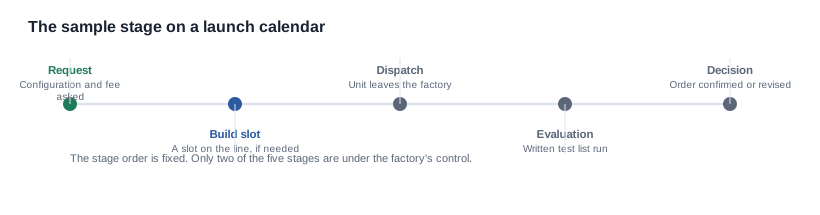
The five stages are the same for every sample programme, and the useful fact about them is that only two of them are under the factory's control.
Stage one is the request. The configuration is named, the questions are listed, the terms are asked for. This stage sits entirely with the buyer, and it is the stage where the programme is either specified or not specified. A request that names a model code, a colour where colour is published, a charging interface and a case configuration, and that lists the questions the unit has to answer, is a request that can be turned around quickly. A request that says "we would like to evaluate one of your AI camera glasses" takes longer to interpret, produces a quotation for a model the buyer did not name, and still does not settle anything.
Stage two is the build or the pick. If the configuration already exists, the unit comes from stock. If it is new, there is a build, and a build needs a slot on a line that is running real orders. This is the one stage where the factory's own workload matters, and it is the stage that the catalogue's published rows help to predict: seventeen models are published with magnetic charging and seven with Type-C, and the four camera models whose interface is not published at all, which are the CY03 and the L1 Pro, and the MT6 and the CY05, are the four where a build rather than a pick is most likely.
Stage three is the despatch and the transit. The unit leaves, it crosses a border, and it may be held for a query because it contains a lithium cell. This stage is mostly outside both parties' control, which is why the transport documentation is worth checking before despatch rather than after a consignment stalls.
Stage four is the evaluation. The unit is opened, the written list is run, the photographs are taken and the gap list is written. This stage is entirely with the buyer, and it is the stage that expands when the criteria were not agreed in advance, because the session turns into a discussion and the discussion has to be scheduled.
Stage five is the decision. The results are reviewed, the order is placed, or the questions are sent back. This stage is also with the buyer, and it is the stage that decides whether the programme produced a result or a revision.
The arithmetic that surprises buyers is that stages one, four and five are buyer-side, and in a well-run programme they are the three longest. That is not an argument against sampling. It is an argument for planning the stage as an internal project rather than as a delivery someone else is going to send.
The stage that nobody plans for
Between stage three and stage four there is a stage that does not appear on any list of sample stages, and it is the one that most often breaks a launch schedule. The unit has arrived and it is sitting somewhere, and the people who are going to run the evaluation have not been told that it has arrived.
It happens in three ways. The unit is signed for by whoever was in the building, and the evaluator is in another office, or another city, or another company. The unit is opened and handled before anyone has read the acceptance criteria, and the impression it creates competes with the criteria. Or the unit is put on a desk and stays there until a colleague is in the office, which on a Friday can be three days.
None of these is a supplier's fault and none of them is visible in any quotation. They are all eliminated by one instruction, and the instruction is worth writing into the order: the unit is to be held unopened, the evaluator is to be notified on arrival, and the evaluation session is to be scheduled in advance with a named participant.
The same logic applies at the other end of the stage. The results of the evaluation are a document, and a document that arrives on a Friday afternoon and is read on the following Monday has cost two days that nobody budgeted. Where the decision can be made by a named person against a written acceptance rule, it can be made on the day, and the whole stage collapses from a week to an afternoon.
This is the least glamorous part of a sample programme and the part that most often decides whether a launch date is met.
Revisions, and the mechanism that multiplies the calendar
One revision round is ordinary. Two is common. Three usually means the criteria were never written down.
The mechanism is the same every time, and it has two parts. The first is the substance: a change to the artwork, the packaging, the colour or the firmware, each of which has its own approval path and its own set of stakeholders. The second is the approval path itself, and this is the part that is usually underestimated. The first approval involves the person who wrote the brief. The second involves the person who owns the brand. The third involves whoever signs off on the artwork, and by then the stakeholders are different from the ones who approved the first version.
A revision round therefore does not cost one week. It costs the time of the approval path plus the time of a new build or a new despatch plus the time of a new evaluation session, and each of those three has been underestimated separately in most programmes that have run long.
The mitigation is to scope the first sample properly. A sample taken with a considered specification and a considered acceptance test usually needs no revision. A sample taken to have something to hold usually needs two. The cost of the difference is not a fee; it is a second build slot, a second shipment of a lithium cell across a border, a second evaluation session and a second approval path with a different group of stakeholders.
The published rows make the scoping work concrete. The colour options are published for a small number of models, three on the V03 Pro and four on the V06, so a decision about colour is a decision that can be made before the first sample rather than after it. The charging interface is published for twenty-four of the twenty-eight models, so a buyer in most of the range can specify the interface without asking. The charge time is published for all twenty-eight models, at two hours or less on twenty-six of them and about one hour on the D17 and the ZH12, so the test instruction sheet can be written from the catalogue rather than asked for. Each of these is a revision round that never has to happen.
What a sample policy does to the schedule
Two policy details alter the calendar materially, and both are decided at the request stage.
The first is whether the sample fee is refundable against a bulk order. It affects whether a buyer is willing to commit early, which in turn affects whether a booking can be held. The second is whether the sample counts against the order minimum, because it decides whether a cautious trial order is even possible at a low volume. Ask both questions at the point of requesting the sample, because the answers are easier to settle before the fee is paid than afterwards.
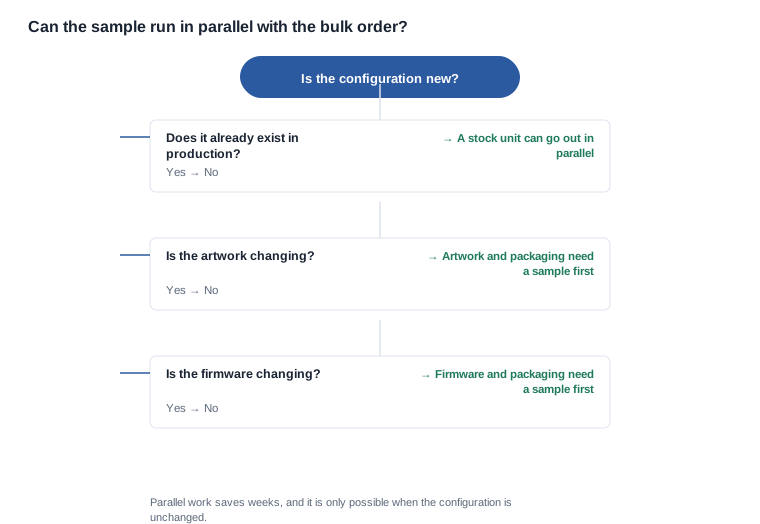
A third question is worth asking in the same message: whether the sample stage can run in parallel with the bulk order rather than before it. It can occasionally, when the configuration is unchanged from something already in production, and that single answer is worth several weeks in a launch schedule. The decision chart above sets out the three conditions, and the pattern is consistent: parallel work is possible when nothing about the configuration is changing.
The opposite is worth stating too. Where the artwork, the packaging or the firmware is changing, the sample is not a formality and it cannot be skipped, because it is the only point at which the new combination is visible as a whole. A buyer who has three changes in flight has three reasons to need a sample and no way to compress it into a parallel exercise.

What shortens the calendar, and what lengthens it
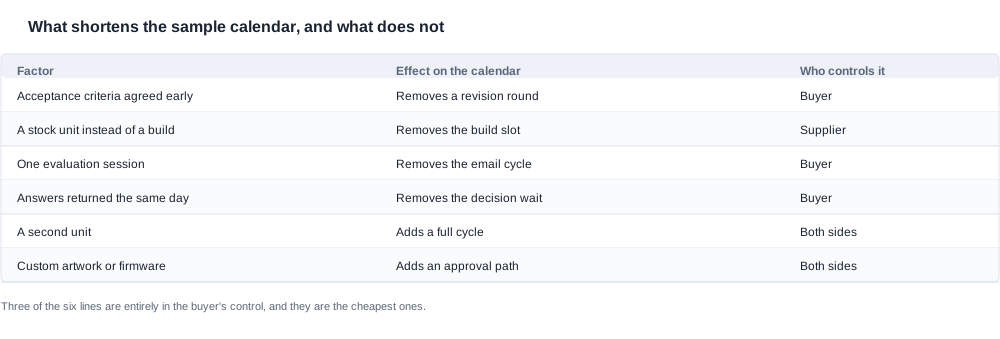
Three of the six lines in that table are entirely in the buyer's control, and they are the cheapest ones. Agreeing the acceptance criteria early removes a revision round. Running one evaluation session removes the email cycle. Returning the answers and the photographs the same day removes the decision wait. None of the three costs anything but discipline, and together they are the difference between a two-week stage and a five-week stage in most programmes.
The three lines that are not in the buyer's control are worth understanding rather than resenting. A build slot is a slot, and it is taken from real orders. A second unit is a second unit, and it means a second cycle. Custom artwork or firmware means an approval path, and the path has stakeholders who are not the same people as the ones who approved the brief.
There is a fourth line that is neither the buyer's nor the supplier's, and it is the one that surprises people most. It is the time between a decision being made and the decision being acted on. A buyer who receives the results of an evaluation and then takes a week to convene the people who can approve the order has added a week that appears in no quote and no policy, and it is the one that is easiest to remove.
Planning backwards from the date
The method is straightforward and it is worth doing before the request rather than after it. Start with the date the stock has to be in the destination market. Subtract the production weeks and the freight weeks already agreed with the supplier. What remains is the sample and approval window, and that window is the only one the buyer controls.
Then work forward inside that window. Put a day against the request, a day against the build slot, a day against the despatch and the transit, a day against the evaluation session and a day against the decision, and see whether the total fits. In most programmes the answer is that it fits comfortably, and that the buyer who believed the sample stage added months was counting from the wrong starting point.
The calculation also reveals when the sample conversation has already started too late, which is the more useful finding. If the remaining window is shorter than the stages need, the options are to run the sample in parallel, to reduce the scope to the decisions that actually block the date, or to move the date. Those are three real options, and they are only visible if the calculation is done before the request goes out rather than after the unit arrives.
A worked backwards schedule
Here is the method applied to a hypothetical scenario, written to show the working rather than to describe a project.
A channel buyer has a commitment to have stock in a European distribution centre by a fixed date, and a production lead time that has been agreed at a number of weeks plus a freight allowance. The buyer subtracts both from the required date and is left with a window for the sample and the approval of the order. That window is then filled stage by stage, with the buyer's own stages scheduled against named people rather than left open.
The first thing the calculation exposes is that the window is comfortable for a stock unit and tight for a configured one, because the configured case adds an artwork approval that has its own stakeholders. The second thing it exposes is that the sample can be run in parallel with the production order, because the configuration already exists in production and nothing about the artwork is changing. The third thing is that the decision stage has to be given an owner and a day, because it is the stage that has slipped in every previous programme.
The fourth thing the calculation exposes is the actual deadline for the request, which is earlier than anyone had assumed, because the buyer had counted the request and the decision as one step. A buyer who does this exercise once will do it automatically in future, and the conversation with the supplier will start from a stage estimate rather than from a hope.
The exercise also changes what the buyer asks for. A buyer who has calculated the window does not ask for a "sample and a price", because that request has no shape and the supplier has to infer one. The buyer asks for the stage estimate for a named configuration, and asks whether the sample and the bulk order can run in parallel, and asks what the supplier needs from the buyer in order to protect the date. All three are narrower questions than the one they would otherwise have asked, and they are the questions a factory can answer in a single reply.
What we will state about timing, and what we will not
Our sample fees, refund terms and lead times are not published in our documentation, because they depend on the configuration and on whether the sample is built or drawn from stock. What we will state is the stage estimate for a specific sample request before anything is paid, broken into the same five stages described above, so that a buyer can place it in a launch schedule rather than guess at it.
We will also tell a buyer what we think a given configuration will need, including whether we would expect a revision round, which is more useful than an optimistic estimate that produces a second cycle. And we will say plainly when a request cannot be compressed, because a buyer who has been told that a stage cannot be shortened will plan around it, while a buyer who has been given an optimistic date will discover the truth at the worst possible moment.
We will not hold a production slot against a sample request, because a slot held against an undecided evaluation is a slot nobody is using, and because holding it costs a real order its place on the line. We will not quote a sample dispatch window as if it were a production lead time, because the two measure different things and conflating them is the single most common way a launch date ends up wrong.
The samples section covers the commercial side, and the glossary covers the terms that surround this vocabulary, including the difference between a sample dispatch window and a production lead time. The production lead time article sets out the weeks on the other side of the sample stage.
Related reading
- Glossary — the terms buyers confuse
- Typical range — what a sample stage costs in weeks
- Lead time typical range — production weeks


