

A smart glasses lead time quoted as a single number is the least useful thing a supplier can tell you, because it hides the only thing that matters: which clock is running and who controls it. Six constraints decide the date, and only one of them is usually inside the factory's control. The others sit with your artwork team, your firmware reviewer, a component supplier you have never met, a certification body, and a booking calendar. Six documents turn that claim into a schedule you can put in a plan, and they are the difference between a delivery date and a date somebody hopes for. This guide names the six clocks, sets out the document that belongs to each one, and explains the part of the schedule nobody quotes — the bench time, which in this category is published and is longer than most buyers expect.
Smart glasses lead time: the six clocks that decide the date
The buying task behind a lead time request
The reader is a procurement manager at the brand, a channel buyer or an importer who has a date they cannot move and a supplier who has quoted a number against it. The buying situation is more common than it should be: a launch date fixed by a trade fair, a retail season, a contract with a distributor, or a marketing commitment made before the product existed. The buyer needs the date defended, not merely promised.
The instinct is to ask for a shorter number, and that is the wrong instinct. A supplier who quotes 35 days when 55 days is realistic has not helped anybody; it has moved the discovery of the shortfall to the point where the shortfall cannot be fixed. The useful question is not how long the lead time is but which of the six constraints is the binding one for this configuration, and what evidence the supplier holds that the other five will not move.
There is a second reason to want the breakdown rather than the number. A lead time is a forecast of a future sequence, and forecasts are only as good as the assumptions underneath them. The assumptions are the bought-in component dates, the artwork approval, the firmware sign-off, the certification evidence and the inspection window. Get them in writing at the quotation stage and you can re-plan when one of them moves; get only the total and you find out which assumption broke when the consignment misses the booking.
The fear underneath all of this is the version most experienced buyers have already seen. A supplier gives a date that looked comfortable, the artwork was late by a week, the component arrived late by three, nobody told the buyer because each delay was individually small, and the shipment landed six weeks after the plan with a launch date already in the past.
Why a single number is the least useful thing a supplier can tell you
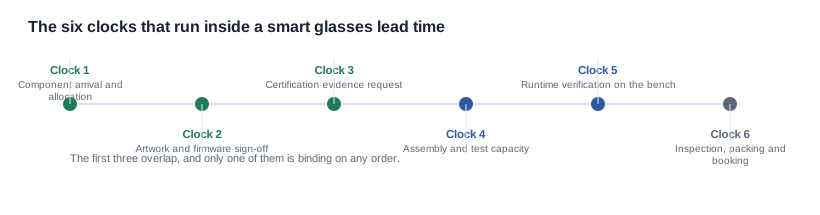
The six constraints do not all behave the same way, and the difference between them decides how a buyer should manage the date.
Two are almost entirely under the buyer's control and are therefore almost always the buyer's own fault. Artwork approval waits on the buyer's own design cycle, and firmware sign-off waits on the buyer's own review. A buyer who asks a supplier to compress a lead time without first fixing the artwork freeze date is asking for something nobody can deliver.
Two are outside both parties' control. Component arrival depends on sub-suppliers the factory does not own, and a certification or test evidence request depends on a laboratory's queue. These are the ones that produce the large, unpredictable slips, and the ones a buyer should interrogate hardest because they are where the due diligence value is.
One is inside the factory's control and is the one usually quoted. Assembly and test capacity is the constraint suppliers are most comfortable discussing, because it is the one they can claim to own, and because it is frequently not the binding one at all.
And the sixth is the one nobody quotes: the inspection, packing and booking window at the end. It is short, it is predictable, and it is where a missed cut-off turns a late shipment into a very late shipment. Because the booking calendar moves in fixed steps rather than continuously, a delay of two days can cost a week, which makes this the constraint with the worst ratio of small cause to large effect.

The six documents that turn a lead time claim into a schedule
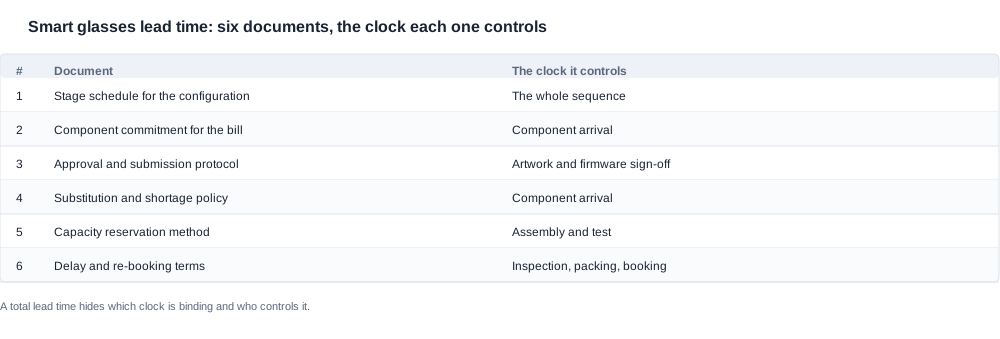
The six lead time documents, and what each clock needs
| # | Document | The clock it controls | The question it must answer |
|---|---|---|---|
| 1 | Stage schedule for your configuration | The whole sequence | Which stage is the binding one right now |
| 2 | Component commitment for your bill of materials | Component arrival | Which bought-in part arrives last, and from where |
| 3 | Approval and submission protocol | Artwork and firmware sign-off | What must you submit, by when, and what late submission costs |
| 4 | Substitution and shortage policy | Component arrival | What happens when a part is unavailable |
| 5 | Capacity reservation method | Assembly and test | How reserved capacity becomes a committed date |
| 6 | Delay, recovery and re-booking terms | Inspection, packing and booking | What is owed when a date is missed |
What each clock actually waits on
The stage schedule is the umbrella document, and it is the one to ask for first because it tells you which of the other five is binding. A supplier who sends only a total has either not worked it out or has decided not to share it, and the difference matters, because a supplier who can identify the binding constraint is a supplier who manages it.
The component commitment is where the schedule usually breaks. The useful version names each bought-in part for your configuration, the supplier's own committed date for it, and whether that part is shared with other customers. Shared parts are the ones that move without warning, because a common cell or a common sensor that arrives early for somebody else arrives late for you, and the factory has no way to prefer you on that part without cost.
The approval and submission protocol is the document that protects the buyer, because the artwork and firmware clocks are buyer-side and the buyer usually owns the delay without knowing it. What it must contain is what has to be submitted, in what format, to which named person, by which date, how many rounds of revision are included, what a late submission costs in calendar time, and whether the clock restarts.
The substitution and shortage policy answers the question that the component commitment cannot: what happens when the date in the commitment is simply wrong. The distinction that matters is between a substitution the supplier must notify you of before shipping and one you discover at the customer's warehouse, and between a change that requires re-approval and one that does not.
The capacity reservation method is often a surprise, because "reserved capacity" sounds like a courtesy. What it means in practice is how much line time is held for you, how long the hold lasts, what happens when it expires, and what converts a reservation into a committed date. A supplier who reserves capacity for a month and confirms dates for two weeks is telling you something about how firm the date is.
The delay and re-booking terms are what convert a missed date from a negotiation into a process. Who absorbs the cost of a missed booking cut-off, what notice the supplier gives, what happens to the payment milestones, and whether a cancelled production slot is charged.
Where the hidden hours are: test windows and packing
The runtime band is a test duration
The part of the schedule that buyers consistently underestimate is the bench time, and in this category it is published rather than estimated. Every camera model in our range carries a rated use, and verifying a unit against that published band is a test that runs for the length of the band itself.
That changes the arithmetic at the end of the line. A model published at about seven hours — the MT6 and the L1 Pro, the L2 Utral and the CY03, and the CY05 — needs a runtime check that occupies a unit for most of a working day. The KY06 and the MT5 are published at six to eight hours, and the S7 and the V06, and the V03 Pro and the V03 at five to eight hours, which in practice means an overnight test rather than a shift. A buyer who assumes a functional check fits inside a shift is planning a schedule that cannot hold.
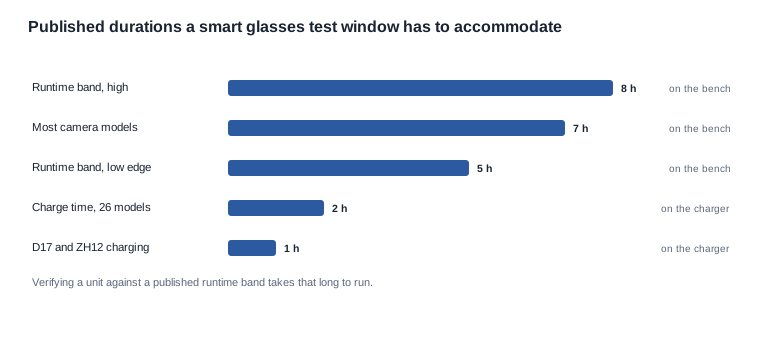
The practical consequences are three. The inspection window scales with how many units have to be runtime-verified, so a batch of five hundred units and a batch of five thousand do not differ by a factor of a thousand in test time. The last unit in a batch finishes testing hours after the first, which is a scheduling fact rather than a staffing fact. And a batch that mixes a five-to-eight-hour model with a seven-hour model needs two test protocols running at once, which is a reason to group models by runtime band in the production plan.
The charging arrangements that change the bench
The charging method is published for twenty-four of the twenty-eight models — magnetic on seventeen, Type C on seven — and is not published at all for four camera models, the CY03 and the MT6, and the CY05 and the L1 Pro. That gap matters here for the same reason it matters everywhere else in a procurement file: a test station for a magnetically charged model is a charging dock, and a test station for a Type C model is a cable, and the four models with no published method cannot have their bench planned until the supplier states it.
The charging case changes it again. A 1400 mAh case is published on the CY05 and the L1 Pro, and the L2 Utral and the CY03 is published with either a 900 mAh or a 1400 mAh case, and the MT6 with a 1200 mAh folding case. If the order specifies a case, then a case-to-unit matching check is part of the test, and if it does not specify a case, the unit may arrive with one anyway. A case that arrives on a unit that was not ordered for one is a packaging problem discovered at inspection, which is exactly the kind of thing that turns a working schedule into a late one.
The charge time itself is published for all twenty-eight models — up to two hours on twenty-six of them and about one hour on the D17 and the ZH12 — so the charging test is a defined step rather than an open one. That is worth having in the protocol, because a charging test written as "confirm it charges" takes as long as the technician's patience, while one written against the published charge time takes two hours and produces a number.

Building the schedule backwards from the date that matters
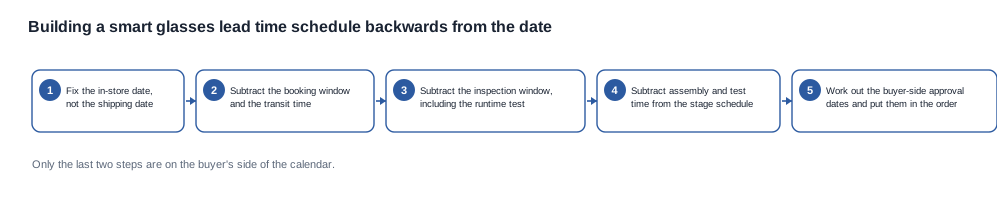
The five-step backward schedule
- Fix the date that cannot move. Not the shipping date but the in-store date, and then the week before it, because arriving in a warehouse is not arriving in a shop.
- Subtract the booking window and the transit. Both are longer than first-time buyers expect, and the booking step is discrete — there is a cut-off and the next one is a cycle away.
- Subtract the inspection and packing window, including the runtime test window for the models in the batch, because that window is published and it scales with the batch.
- Subtract the factory's assembly and test time, using the schedule document rather than a total, so that you can see which stage is binding and how much float is left.
- Then, and only then, work out what the buyer has to deliver — artwork, firmware sign-off, artwork proofs, approvals — and the date each of those is due. Those dates belong in the purchase order, because they are the only two clocks the buyer controls.
The milestone record you keep for each stage
Six fields per milestone, and the schedule stops being a claim and starts being a plan. The milestone and its owner, which is usually not the person you emailed. The date it was due, the date it was met, and the variance in days. The dependency it was waiting on, so that a delay can be attributed rather than absorbed. The consequence of a miss, agreed in advance, which is what stops a slip becoming a negotiation. And the float, because the milestones with float are the ones that can absorb a surprise and the ones that cannot.
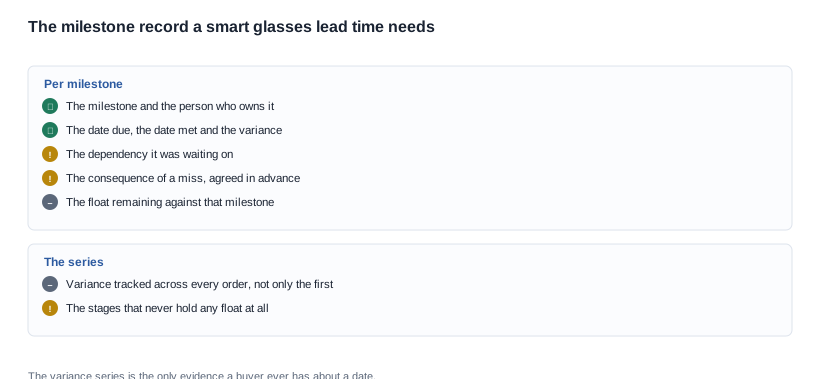
The record is worth keeping across the programme rather than for the first order, because the variance series is the only evidence a buyer will ever have about whether a date can be trusted. A supplier whose dates hold is worth a great deal more than a supplier whose dates are optimistic.

Where lead time commitments fail
Four failures
The artwork that was approved in a hurry. Approving artwork in a week to save a week has a way of producing a reprint. The lead time did not shorten; it moved, and it moved into a step with a much worse ratio.
The component that was shared. The date in the commitment was accurate for the factory's other customer and wrong for yours, because the part was allocated elsewhere. The symptom is a slip discovered without notice, and the control is to ask which parts are shared and how allocation is decided.
The test window nobody scheduled. The runtime verification was written as a check rather than as a timed test, so the batch sat on the bench for days. The symptom is a schedule that was comfortable and then was not, at the very last stage.
The cut-off that was missed. Everything else went well and the consignment missed the booking window, so a two-day slip became a week. This is the failure with the worst ratio of small cause to large effect, and it is the one that a milestone record with a named owner prevents.
The commercial terms around a committed date
What moves is the flexibility around the date, not the date itself. A supplier who will hold a reserved capacity slot for a stated number of days, who will confirm or release it by a stated cut-off, and who will re-book automatically on a documented delay, has given the buyer something real. What does not move is the time the work genuinely takes, and a contract term that pretends otherwise will be renegotiated in the middle of the programme, which is the worst possible time.
The trade-offs worth making are specific. Tighter approval deadlines on the buyer side in exchange for a firm date. A capacity hold with a clear release rule in exchange for a lower price. A documented delay process in exchange for an agreed recovery. And a late-approval clause, because most buyers are quietly paying for their own late artwork through the supplier's insurance of the schedule, and naming it is cheaper than absorbing it.
The total cost of a date that slips is rarely the delay itself. It is the air freight, the demurrage, the missing launch window, the channel who took the space, and the cost of the next order being placed on a schedule nobody trusts any more. Those costs belong in the conversation about whether a date can be committed at all.
A lead time schedule worked through, and what we will commit to
A lead time schedule reasoned through
Read the scenario below as a constructed argument rather than as a report from a client engagement. No customer, order or engagement is described; the model, the quantity, the destination and the date are assumed so that the reasoning can be followed from the first request to the signed schedule.
A channel buyer has a camera model and an audio model to ship for a retail season, with the in-store date fixed. The camera model is one of the eleven camera models in the range and the audio model is one of the eight. The buyer has a total lead time from the supplier and no breakdown.
Step one is the stage schedule request, scoped to the two models and the destination. The supplier returns a stage-by-stage plan with dates, and the binding constraint is immediately visible: it is the component arrival for a shared part, not the assembly line the buyer had assumed. That reorders the buyer's own planning, because it moves the artwork approval earlier rather than later, since the artwork clock is the one the buyer controls and it needs to finish before the sub-supplier's date rather than before the factory's.
Step two is the component commitment, which names the shared part and shows the allocation rule. The buyer now knows which single date to watch, and can ask for a fortnightly update on that part rather than a general status request.
Step three is the test window, which the buyer had not considered. The camera model's published runtime band means the runtime verification occupies a unit for most of a working day, so the inspection window is sized against the batch rather than the shift. The audio model is a different product with a different test protocol, and the two are grouped in the production plan so the bench is not asked to run both conventions at once.
Step four is the backward schedule from the in-store date, which produces the two buyer-side deadlines — artwork approval and firmware sign-off — that go into the purchase order as conditions rather than as hopes. The booking cut-off appears as a hard line on the plan, because it is the one step that moves in discrete jumps.
Step five is the milestone record, with an owner, a variance and a float against each stage, and the buyer discovers in the first run which stage has no float at all.
What we will state and what we will not
It is worth being precise: we will give a lead time as a breakdown rather than a total, with the stage, the owner and the dependency for each step, and we will say which constraint is binding for the configuration you have asked about. That is more useful than a single number, because it tells you what to manage and what to ask about weekly.
What we will not publish is a standard lead time for the range, and we will not quote a date we cannot decompose into stages. We do not publish production capacity, minimum order quantities or defect rates, and the same reasoning applies to dates: a figure that is not traceable to a stage schedule is a number nobody is bound by, and it becomes a dispute rather than a commitment.
We will also be explicit about the parts that sit outside our own control. A component commitment depends on a sub-supplier's date, and we can commit to our own receipt of it rather than to its production. Where that distinction matters, we will say which one we are offering.
A schedule breakdown
Send the models, the quantities, the destination and the date that cannot move, and we will tell you which of the six clocks is binding for that configuration, which parts of the schedule come from published rows and which come from a sub-supplier's commitment, and what you would have to deliver on your side for the date to hold. If you have a date you have been given, send it with the breakdown you were also given and we will tell you where the two disagree.
Related reading
Send the models, the quantities, the destination and the fixed date, and we will show you which parts of a smart glasses lead time can be decomposed into stages and which are one supplier's assumption.


