

Microphone buying mistakes are expensive because the failure appears after launch, in a channel you cannot reach, and because the product itself was probably fine. The mistakes are also consistent across suppliers — they come from the shape of the category rather than from any particular company, and a factory that has never heard of any of these six mistakes is not unusual.
So smart glasses microphone quality smart glasses buying mistakes to avoid is largely a list of things that resemble diligence and are not. Six of them, what each one actually costs, and what to do instead — because the useful version of this article is not a list of things to stop doing but a set of procedures that produce the same confidence at a lower cost.
Smart glasses microphone quality: six mistakes that look like diligence
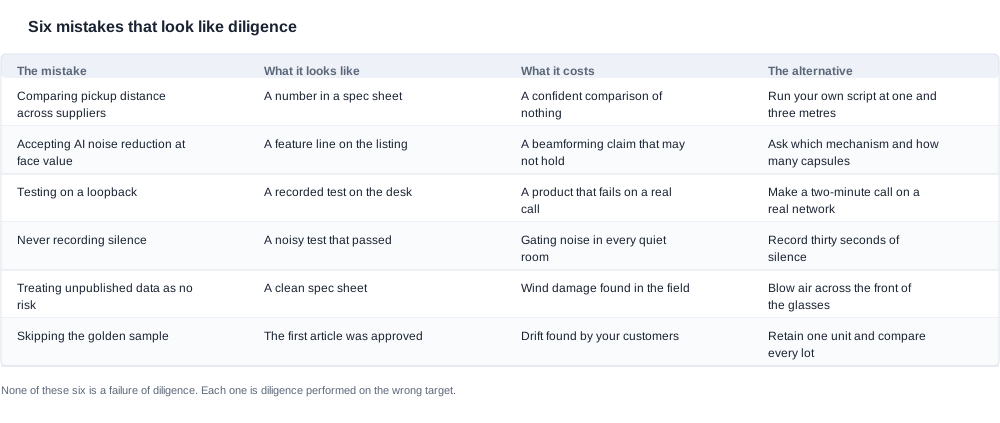
None of these six is a failure of diligence. Each one is diligence performed on the wrong target: a comparison where a measurement was needed, a test in an environment that does not exist, or an absence of data read as an absence of risk.
Why these mistakes are so common
There is a structural reason. The category has no published specification to work from — no capsule count, no pickup pattern, no sensitivity, no frequency response, no pickup distance, no cancellation depth and no microphone model is published for any model in our range. When there is no specification, a buyer substitutes the nearest available thing, and the nearest available things are the published rows of the product: the open-ear acoustic structure, the directional audio, the intelligent noise reduction, the Bluetooth version, the cell capacity and the runtime.
None of those rows describes microphone quality. They describe the product. Reading them as a microphone evaluation is what produces the six mistakes below, and it happens to almost everyone who buys in this category for the first time.
Mistakes one and two: comparing what cannot be compared
Mistake one: comparing pickup distance across suppliers. This is the most common and the most damaging, because it produces a confident comparison built on nothing.
A pickup distance quoted without an input reference level — how loud the source was, and at what distance — is not a measurement. Two suppliers quoting "five metres" may be describing completely different test conditions, and the number that survives into a product page is usually copied rather than measured. We publish no pickup distance for any model, and the alternative is straightforward: compare on your own test. Play a fixed passage at one metre and three, record from where the head would be. One metre passes on almost anything. Three is where differences appear.
Mistake two: accepting "AI noise reduction" at face value. The phrase names no mechanism, and there are two quite different mechanisms it might refer to.
Beamforming uses two or more capsules in a defined geometry to favour one direction — a hardware approach with specific placement requirements, and it is genuinely effective against a competing speaker. Single-capsule processing is software, works by attenuating everything outside a target, and has inherent limits that no amount of processing removes. The two are sold with the same phrase, and the difference in performance against a competing speaker is large.
Ask which one the product uses and how many capsules contribute. A supplier who cannot say has not examined the design, which is a finding about the design rather than about the supplier's honesty.
The capsule count is the one number worth chasing
Of all the missing rows, the capsule count is the one that changes how you evaluate everything else, and it is also the one that a supplier can answer without any laboratory.
A single capsule with processing and a two-capsule array with beamforming are described with the same phrase on a listing, and they are different products with different behaviour against a competing speaker. The array needs a defined geometry to work: the capsules have to be placed and spaced in a way that produces directional rejection, and a two-capsule array with poor placement performs worse against off-axis noise than a well-tuned single capsule. So the count alone is not sufficient — the geometry matters too — but the count tells you whether you are dealing with a hardware design or a software one, and that determines which of the other questions are worth asking.
It also tells you what to expect from wind. A capsule mounted in an open temple has no seal in any configuration, but an array gives the processing chain more to work with, and that is why the wind test in this article is run on the specific unit rather than inferred from the specification.
The measurement conditions that make a pickup distance meaningless
Four conditions have to be stated for any pickup figure to be comparable with anything, and a quote with three of them is still unusable.
The source level. The same distance produces completely different results at a whisper and at a raised voice, and a supplier who does not state it is quoting the easiest version of the test.
The distance and the orientation. One metre directly in front is not one metre to the side. Off-axis behaviour is exactly what a directional pickup is supposed to be good at, so the angle is the number that matters and it is the one that gets left out.
The acoustic environment. A quiet room and a street are different measurements and different numbers, and quoting the quiet-room result for a product sold for outdoor use is how a comparison becomes a trap.
The pass criterion. "Five metres" means nothing without the criterion: at what intelligibility score, or against what reference, was five metres deemed a pass? A measurement without a criterion is a claim, and a claim without a criterion cannot be repeated by anyone else, including you.
This is the general form of the mistake. A figure quoted without its conditions is not a weak fact; it is not a fact at all, and it should be deleted from the comparison rather than carried into it.
Mistakes three and four: testing the wrong thing
Mistake three: testing on a loopback. A loopback test plays audio back locally. It skips codec behaviour, packet loss and any processing that only engages on a network path — which is precisely where a wearable fails and a phone does not.
The test that costs nothing and finds this: make an actual two-minute call on a real network, speaking at conversational distance. If the product is fine locally and poor on a call, the problem is end-to-end rather than the microphone, and replacing the microphone would have been a waste of a unit and a week.
Where the loopback test goes wrong, and what it is actually testing
A loopback test is not a bad test; it is a test of a different system. Playback through the same device exercises the audio path in the cleanest possible conditions: no codec, no packet loss, no jitter, no handover and no network-dependent processing.
That cleanliness is exactly why it cannot settle the question a buyer is asking. The failure that matters in this category happens on a network path, where a codec applies its own filtering, where a packet is lost and retransmitted, and where any processing that only engages on a call is active. A loopback result tells you the microphone capsule, the analogue path and the local playback chain are working. It tells you nothing about whether a call will be intelligible, and that is the only question anyone buying a call-enabled product is actually asking.
The practical version is worth stating plainly: a two-minute call on a real network, at conversational distance, in the environment the product is sold for, recorded on both ends if you can. It costs two minutes and it is the test that has replaced every other test in this category more often than any other single procedure.
The second reason loopback misleads is subtler. Because the conditions are clean, a loopback test tends to be passed by products that are marginal in the field, so it selects for the wrong supplier: it rewards a unit whose local path is well built and ignores the product that behaves well under load. Two suppliers can both pass loopback and differ completely on a real call, and the loopback comparison between them tells you nothing.
Mistake four: never recording silence. Thirty seconds of silence on a table exposes gating and pumping from aggressive noise reduction — the signature of a processing chain doing too much. It is most audible in quiet conditions, in a quiet office or a car at night, which is exactly where nobody tests.
This is a failure mode you cannot hear in a noisy environment, and your customers will hear it every time they take the glasses off to take a call in a quiet room. It is also the cheapest of the six to catch, because it costs thirty seconds and a recorder.

The thirty seconds of silence that find more than an hour of noise
The reason silence is worth recording is that noise masks everything, and masking is what a noise-reduction chain is built for. In a noisy environment the chain is doing exactly what it was designed to do, so the test cannot distinguish a good chain from a bad one. In silence, the chain has nothing to work on, and whatever it does in the absence of a target becomes audible.
There are three things a silence recording tells you that no other test does. It shows whether the gain is being opened up in the absence of speech, which is where a pumping artefact comes from. It shows whether there is a residual hiss floor, which is what a poorly set noise gate produces when it closes too far. And it shows whether the chain changes state audibly, which is the difference between a processing chain that is aggressive in a controlled way and one that is aggressive in an unpredictable way.
The protocol is trivial: put the unit on a table in a quiet room, record thirty seconds, listen with headphones rather than speakers, and repeat with the unit worn. Two recordings, one minute, and it is the highest-yield minute in the entire microphone test programme.
Mistakes five and six: treating absence as safety
Mistake five: treating unpublished data as no risk. Our catalogue publishes nothing about microphones, and a buyer concluding "no data, therefore no problem" is making an inference the data does not support.
Wind rejection is the specific case. A temple-mounted microphone sits directly in airflow, and wind noise is low-frequency, which is the range basic filters handle worst. Software reduces it; it cannot remove it, because the acoustic information is contaminated before the microphone receives it.
If your product will be used outdoors, test with air blown across the front of the glasses. It is a gating test rather than a refinement, and it is the one test in this category that an empty specification sheet can never substitute for.
Mistake six: skipping the golden sample. Retain one approved unit, record the baseline, and compare every subsequent delivery against it.
Microphone performance drifts between production lots more often than specification sheets suggest, usually because a component supplier changed and nobody on the project noticed. Without a retained reference you cannot detect the drift, and your channel discovers it through complaints.
What a retained unit is actually worth
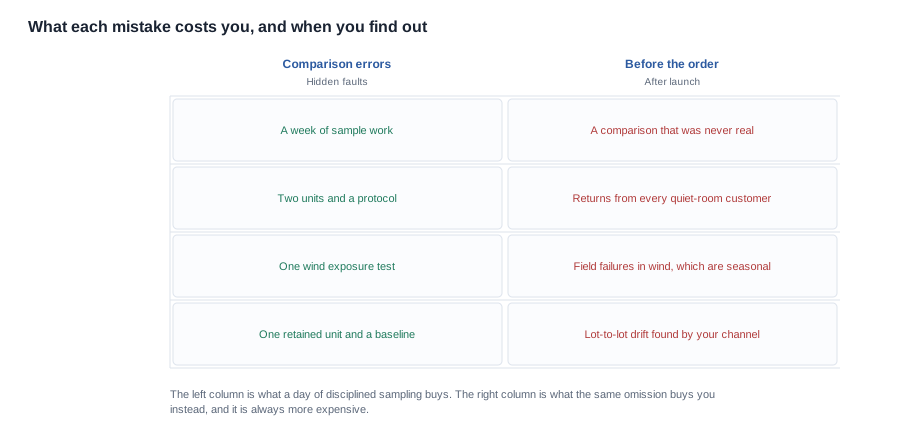
The golden sample is the cheapest insurance in this category and the one most often declined, usually because the retention unit is treated as lost value: a unit that has shipped and therefore cost money.
It is worth pricing properly. One unit, retained. Against it: a baseline recording of the scripted test in a defined environment, a photograph of the finish and the temple, and the configuration reference. That is the whole asset, and it costs one unit and half a day.
Against that, put the failure it prevents. Lot-to-lot drift is invisible to a customer until it is audible to them, and when it is audible it arrives as a cluster of complaints in one channel at once, with no way to identify which lot caused it. A retained reference converts that from an investigation into a comparison. It also changes the conversation with the supplier: instead of describing a complaint, you can send the recording from the good lot and the recording from the bad one, which is a much shorter conversation and usually a much shorter one.
The gate to pass before a microphone order is placed
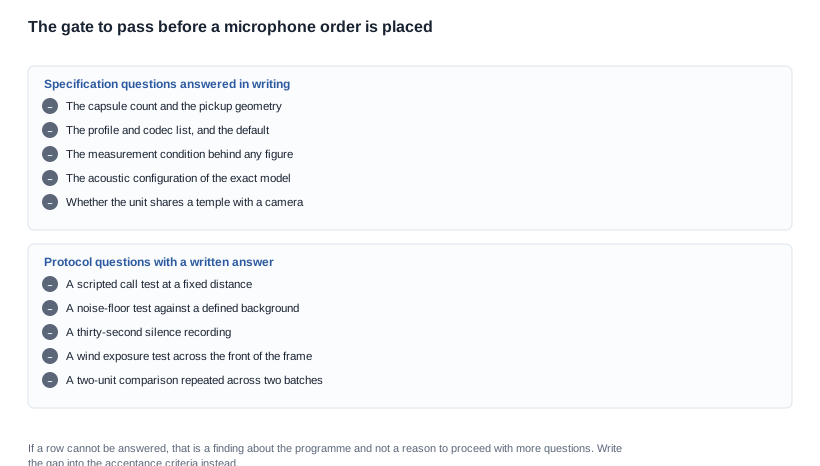
If a row on that gate cannot be answered, that is a finding about the programme and not a reason to proceed with more questions. Write the gap into the acceptance criteria instead. A row that is answered "not published" with a sample measurement attached to it is closed; a row that is answered "not published" and then ignored is how the six mistakes in this article happen.
Two rows on that gate are worth calling out. The capsule count and the pickup geometry is the row that decides whether a feature line about noise reduction means anything, and it is answerable by any supplier who has examined their own design. The two-unit comparison repeated across two batches is the row that answers the consistency question, and it is the only way to detect the drift that the golden sample later measures.
How to choose between two suppliers when the evidence disagrees
Most shortlists in this category do not end in a clean verdict, and the temptation is to fall back on the unit price. There is a better way to close it.
Write the three criteria before you look at the results. Not the whole checklist — the three that matter for your programme. For a call product sold indoors, they are probably the scripted call result, the silence recording and the capsule count. Deciding which three matter before the data arrives is what stops a strong result on one row from carrying a weak result on another.
Weight each criterion by the cost of being wrong. A criterion whose failure is a copy problem is worth less than one whose failure is a defect claim. Ask of each criterion: if this one goes the wrong way, what does it cost? The answer sets the weight, and the weighting is what makes the trade-offs explicit.
Treat the missing rows as evidence, not as a neutral tie. A supplier who answered every row is a supplier you can contract with. A supplier who answered three of five has an unknown on the other two, and the unknowns are not symmetric between suppliers — they are the reason the programme is risky.
Use the red flags to decide between equals, not to eliminate. If two suppliers score the same on your three criteria, the tie-breakers are the red flags: a weight offered as a range, a certificate at family level, a specimen that arrives with a different temple from the one you asked for. Each of those tells you what will happen when something goes wrong later.
Negotiate on the total cost of the unknown, not on the unit price. The unit price of a microphone programme is a small number beside one replacement run, one rejected listing or one channel that stops restocking.
Run the due diligence before you order, not after the first complaint. The checklist is cheaper than the returns pile, and the shortlist is the right place to spend it. These are the pitfalls worth avoiding in this category, and they are all avoidable at this stage for the cost of a few days.
The order of the gate, and why it matters
The gate is listed in two blocks because the two blocks are different in kind, and the sequence between them is what keeps the programme cheap.
The first block is answered in writing and costs days. If a row there cannot be answered, the programme is not ready for a sample lot, because the sample would be measuring a product whose design you do not understand. A supplier who answers "we have advanced noise reduction" to a request for the capsule count and geometry has told you that the sample programme will have to do the work of a design review.
The second block is answered with units and costs a week. The silence recording goes first because it is the cheapest and because a failure there invalidates the other results — if the processing chain pumps, every scripted comparison you run afterwards is contaminated by the pumping. Then the wind exposure, because it is the only test that no document can replace. Then the scripted call on a real network, because it is the end-to-end confirmation. And the two-unit comparison across two batches last, because it is the one that costs the most units and the one you would rather not repeat.
A programme that follows that order spends its budget on the failures that are hardest to detect later, and it does so before the order rather than after the launch.
A worked scenario for a brand that caught three of these at once
What follows is hypothetical, and it shows the order of the mistakes rather than an engagement we worked on.
Assume a brand that launched a call-enabled glasses line and, three months in, receives a cluster of complaints from a single channel: customers reporting that the person on the other end cannot hear them in a car. The brand has a specification sheet for the product, an approved first article, and a test record showing that calls worked on the bench.
Step one: it checks whether the complaint matches a published expectation. The listing says nothing about vehicle use, and the product's proposition is indoor calls. That does not make the complaints wrong, but it changes the question from "why is the product broken" to "what did the copy fail to say".
Step two: it runs the silence test on a unit from the affected channel's lot. The recording shows gain pumping in quiet conditions — audible, regular, and consistent. That points at the noise-reduction chain rather than at the capsule, and it is a finding that a loopback test would never have produced because it happens in the absence of any signal.
Step three: it tests a second unit from a different lot. The behaviour is identical, so this is not lot drift, and the golden sample would not have caught it. It is a product behaviour.
Step four: it runs the wind test. Air across the front of the frame produces a level of degradation consistent with the complaints. The mechanism is now understood: an open-ear capsule in a temple, in moving air, with a processing chain that was tuned for indoor conditions.
Step five: it changes the remedy rather than the product. The units are not defective. The remedy is a support script that explains the vehicle case, a narrowed proposition in the listing, and a note to the supplier about whether the processing profile can be tuned. No units are replaced, and the return rate falls because the expectation and the product now match.
Step six: it adds the missing rows to its own gate. Silence recording, wind exposure, two units across two lots, capsule count and geometry. Four rows, all of which would have taken less than a day, and all of which would have caught this before launch.
The brand spent a day on the diagnosis and avoided a replacement programme. That is the whole return on a disciplined microphone test programme, and it is available to anybody who chooses to take it.
What we will and will not do with your samples
Stated plainly: the only microphone figure worth buying is one you produced on your own units against a fixed protocol. We will not publish a microphone specification we do not hold, and we will not quote an improvement figure we have not measured.
If you send samples we will run the same protocol with you and report what we hear, including where the result is worse than you expected. That last part matters more than it sounds: a supplier who only ever confirms what you hoped for is not giving you a measurement, and you cannot build an acceptance criterion on it.
See noise control and microphone pickup for the underlying treatment, and how to test before ordering for the protocol itself. The published configuration rows are in microphone quality key specifications, and the supplier-side checks are in microphone supplier verification.
Whether the fault is a defect or a described limit
Send us a sample and tell us the environment the product is sold into, and we will run the protocol with you and report what we hear — including the cases where the answer is a limitation rather than a defect. If your programme has already shipped and the complaint queue is growing, send three failing units and one working unit instead, and we will tell you which cause the pattern matches.
Related reading
- noise control and microphone pickup
- microphone procurement checklist
- microphone quality questions and answers
Send samples and we will run the same protocol and report what we hear.


