

A microphone checklist is one of the few places in this category where a buyer's own procedure beats any supplier's datasheet, because no supplier publishes a microphone specification for these products. We hold no pickup distance, no frequency response, no capsule type, no microphone count, no described noise-suppression implementation and no leakage figure for any model in the range.
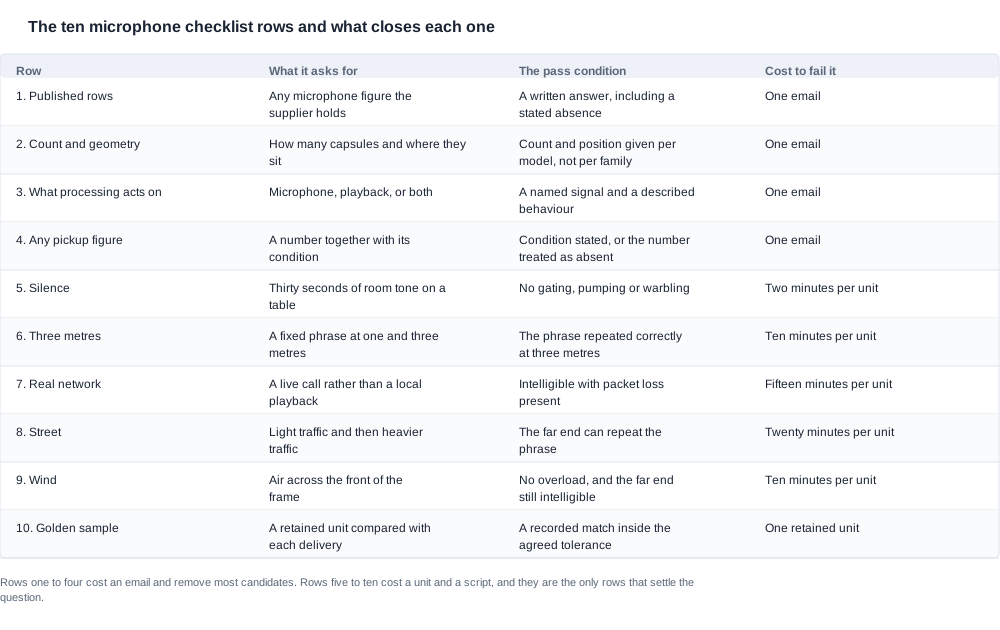
That makes smart glasses microphone quality smart glasses checklist for procurement teams less a comparison task and more a procedure. The ten rows below are ordered so that the rows which remove a supplier cheaply come first and the rows that need physical units come last. The order is the checklist's real content: a candidate removed on paper costs one email, and a candidate removed on a unit costs a week, a freight booking and a protocol.
Smart glasses microphone quality: a checklist ordered by cost of failure
The buying task behind the checklist
The reader is a brand-side buyer, a channel buyer or a sourcing manager who has two or three candidate suppliers and no way to rank them on the one parameter that matters. The situation is ordinary: the quotations are within fifteen per cent of each other, the technology descriptions are nearly identical, and every supplier has said the right words about noise reduction. The decision that has to be made is which candidates are still worth a sample, and the task behind it is to make that removal cheap and defensible.
The commercial risk being managed here is specific. A microphone that fails does not fail as a warranty claim; it fails as a support stream and a review, and it fails late. The buyer who shortlists two candidates and tests only the cheaper one has made a decision by accident. The checklist exists to turn an accidental decision into a documented one, with the removals recorded in the order they happened.
The other reason a checklist beats a specification in this category is that a checklist survives a change of supplier. A specification is a set of numbers that only mean something alongside the conditions and the test method behind them. A checklist is a set of rows, each with a pass condition, and a row stays valid when the candidate changes.
The three kinds of row, and why mixing them causes trouble
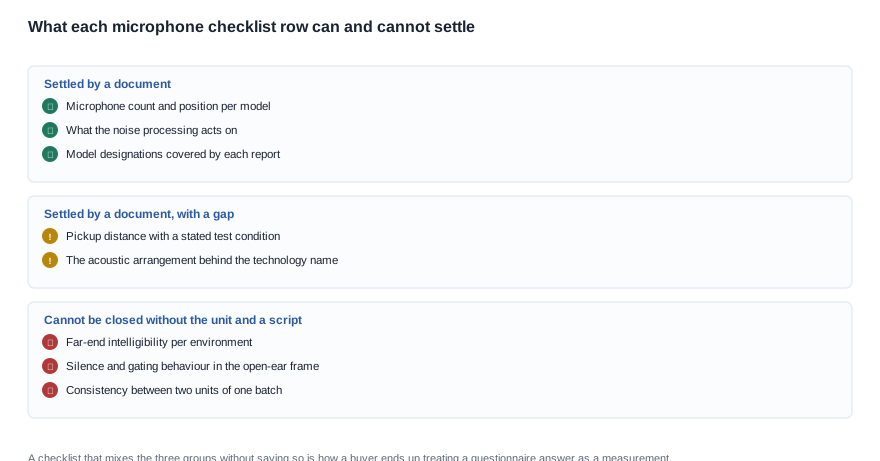
Every row on a microphone checklist falls into one of three groups, and the groups have different costs and different failure consequences.
The first group is settled by a document. The microphone count, the position of the capsules, the model designations covered by each report, the cell configuration, the charging method — these are written down somewhere, and the only cost of establishing them is a request. A row in this group that comes back empty is a supplier problem, and the cheapest possible outcome of the row is a written statement of absence.
The second group is settled by a document with a gap in it. A pickup distance quoted without a test condition, a technology name with no implementation behind it, a chamber description that names the feature but not the geometry. These rows can be closed, but only by pushing back once, and the answer that closes them is a condition, not a number.
The third group cannot be closed by any questionnaire at all. Far-end intelligibility in a given environment, the silence behaviour in an open-ear frame, the consistency between two units of the same batch — these need a unit, a script and a judge, and no amount of documentation substitutes for them.
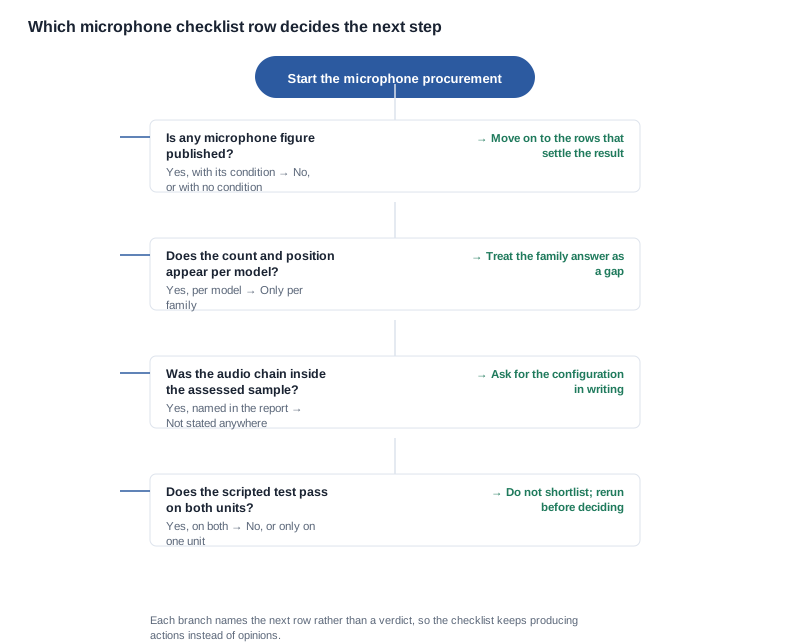
A checklist that mixes the three groups without saying so is exactly how a buyer ends up treating a questionnaire answer as a measurement. The chart below is the grouping, and it is worth reading before the rows themselves, because it determines which rows are allowed to end a shortlist.
The five checklist rows that need no sample at all
Rows one to four, and the answer that closes each one
Row one asks whether a microphone specification is published. The answer is a paragraph describing the microphone as high-sensitivity with no figure, and that answer is itself the result: it establishes that any comparison the buyer has seen was marketing copy. The pass condition is a written answer, including a written statement of absence, because a stated absence is a fact you can file and an unstated absence is a gap you have to keep chasing.
Row two asks how many microphones there are and where they are positioned. This separates a product designed for calls from a product designed for a demonstration. A single capsule on the temple will hear the person; two capsules in a stated geometry may do something more. The pass condition is a count and a position per model, not per family, because a family-level answer leaves the question open for every specific model in the range.
Row three asks what the noise processing acts on. "AI noise reduction" is not a specification; it is a label. Either a named algorithm performs a named function on a named signal, or the claim is positioning language. The pass condition is the signal and the behaviour, and the question that separates the two answers is what happens when two people speak at once, because that is where a directional implementation either shows an advantage or does not.
Row four asks for any pickup figure the supplier holds, together with its test condition. This is the row where numbers get invented, in one direction or the other: a supplier offers a figure with no condition, or a buyer offers one in the request form and the supplier answers with a number that cannot be compared to anything. The pass condition is deliberately narrow — a figure with a stated condition passes, and a figure without one is recorded as absent rather than as a low score.
Why these four rows come first
Because they are the only rows where a failure is free. A candidate that cannot state a microphone count per model, cannot say what its processing acts on, and quotes a pickup figure with no condition is telling the buyer that the acoustic side of the product is not documented. That is disqualifying on its own, and it costs one message to establish.
The order also protects the budget further down. Samples are expensive in a way that is easy to underestimate: the unit cost is the smallest part, while the freight, the customs handling, the time waiting for a shipment, the time spent running a protocol and the delay before a shortlist can be scored are the larger parts. Four rows of questions reduce the number of shipments, and each shipment avoided pays for the questionnaire several times over.
The rows also decide what a sample can and cannot tell you. If row two came back as a per-family answer, then a sample of one model tells you about that model and nothing about the rest of the range, and a test programme on one sample is a test of the programme rather than of the category.
The checklist rows that need a unit, a script and a judge
Rows five to nine, run identically on every unit
These five rows are run on every sample, in the same room, with the same script, and the recordings are kept. The value is not the first result; it is the comparison between units and between deliveries, and the comparison is only possible if the protocol is identical each time.
Row five is silence. Thirty seconds of room tone on a table, on every unit. This exposes gating and pumping from aggressive noise reduction, and it is audible in a noisy environment only by its absence, so it is invisible unless you go searching for it.
Row six is three metres. A news bulletin played from a speaker, at one metre and then at three. One metre passes on almost anything; three is where sensitivity differences appear, and three metres is roughly the distance in a real call when the other party is not holding a phone.
Row seven is a real network. An actual call, not a local playback between two devices on a desk. Loopback tests skip the codec and the packet loss entirely, and those are exactly the conditions under which a microphone on a frame fails and a phone does not.
Row eight is the street. Light traffic, then heavier. The question is whether the person on the other end is intelligible, not whether the recording is free of hiss; a recording can be free of hiss and still unintelligible.
Row nine is wind. Air across the front of the frame. A temple-mounted capsule sits directly in the airflow, and this is the standard failure mode for open-ear frames. If the product will be used outdoors, this is a gating row rather than an optional one, because no firmware change recovers a signal that was contaminated before it reached the transducer.

Row ten, the one that pays for the rest
Keep the recording from the approved unit and compare every subsequent delivery against it. Microphone performance drifts between lots far more often than a specification sheet suggests, usually because a component changed and nobody on the project noticed, and the retained unit is the only way to see the drift.
Row ten is also the row that connects the checklist to the business. A golden sample turns the incoming inspection from a judgement into a comparison, which means a delivery that has drifted can be refused at goods-in rather than discovered by a customer. It is the difference between a quality problem and a commercial one, and it is the row that most directly protects the return rate of a call-led line.
The practical point about keeping rows five to nine is that the raw recordings are what you keep, not the conclusions. A conclusion written after the result is a summary of what you already believed, and a recording is evidence that somebody else can re-judge. The script and the conditions are kept with them, because a recording without its conditions cannot be compared with the next one.
Turning a failed checklist row into a decision rather than an argument
The triage for a row that does not pass
A failed row produces one of four outcomes, and the outcome is decided by which kind of row it is rather than by how badly it failed.
A document row that comes back empty is a supplier gap. The decision is whether to escalate, request a written statement of absence, or drop the candidate. Escalation is only worth it when the candidate has something else you want, because the supplier has just told you the acoustic side is undocumented, and that fact does not change with a second email.
A document row that comes back with a condition missing is a supplier answer, and the decision is whether the condition can be supplied. Usually it can, in one line. Where it cannot, the correct action is to record the row as absent and continue, not to score it as a partial pass, because a partial pass is a number that will be re-read later as a number.
A scripted row that fails on one unit and passes on the other is a process variance finding, and it is the most valuable row result in the whole checklist. It tells you that the product is not a single product, which no document would have told you. The decision is to rerun on more units before drawing any conclusion, and to treat the variance as a supplier notification rather than a defect claim, because the mechanism is usually unknown at that point.
A scripted row that fails on every unit is a scoping result, not a defect result. The unit may be entirely correct for a different environment, and the failure may only be telling you that this unit is the wrong unit for this channel. The decision is to check the environment against the use case before raising anything, because a defect claim on a product that was never going to serve that environment costs the relationship and the schedule and buys nothing.
The evidence that closes a row for good
Every row on a checklist should have a named closing artefact, agreed before the row is run, so that the row cannot be closed by opinion. Rows one to four close on a written answer in the supplier's own document. Rows five to nine close on a recording with its conditions attached. Row ten closes on a comparison against a retained unit with a stated tolerance.
The tolerance question is the one that gets skipped and it is the one that matters most at volume. "The same as the golden sample" is not a tolerance, because two units that match exactly is not a realistic expectation and a standard with no tolerance has no failure condition. A tolerance has to be set in whatever unit the row produces, it has to be set before the first production delivery arrives, and it has to be applied by the same rule every time.
The same logic applies to the rows that produce a written answer. A written answer without a named owner and a date is an open item, and the difference between an open item and a closed row is the difference between a question that is still being asked and a question that has been quietly dropped.
The microphone checklist rows that belong in the purchase order
What to attach, and what to leave out
Six rows belong in the purchase order, and they are not the six rows a buyer is most tempted to attach. What belongs is the evidence, the conditions and the change rule.
- The microphone count and position, per model designation, attached to the order.
- The processing description, with the signal it acts on, attached to the order.
- The far-end capture requirement, so that the result can be re-checked rather than argued about.
- The intelligibility result per environment, with its conditions, the unit count and the batch it was taken from.
- The incoming inspection criteria, written as the same protocol applied to each delivery, with the tolerance stated.
- A notice obligation before any change to the chamber, the port positions, the seal or the capsule, with the record voided and a re-run required after a change.
What leaves out is any call quality, noise cancelling or intelligibility claim that has not been measured on a unit, and any figure quoted without its condition. Leaving those out is not modesty; it is the protection that makes the rest of the agreement enforceable, because a claim in a listing that the file cannot support is a claim the supplier cannot be held to and the buyer has to absorb.
The commercial lines that go with the checklist are the ones the checklist makes negotiable. Because the rows have a known closing artefact, the buyer can ask for the production units to be used in the protocol rather than engineering samples, ask for the raw recordings to be supplied, ask for the inspection to apply to every delivery rather than the first, ask for the first run to be split against a staged payment, and ask for a share of the units to be taken at a pilot tier. Each of those is a number that moves, and each is worth more than the unit price difference between two candidates that both failed row one.
How the ten rows become a shortlist score
A checklist that produces a yes or a no on each row still leaves the buyer with a shortlist and no way to rank it, which is where a lot of microphone programmes stop. The fix is to score the rows by what they cost to be wrong about, and to score the categories rather than the individual rows.
Three categories work. The first is disqualifying: a candidate that cannot state a microphone count per model, or that quotes a pickup figure with no condition, or that fails a scripted row on every unit. A candidate in this category is removed, and the removal is recorded with the row that caused it, because the record is what a later stakeholder will ask for.
The second is differentiating: a candidate that passes every row but passes some of them less well than another candidate. This is where the comparison actually happens, and the two candidates usually differ in a way that is obvious once the rows are scored. One may be strong in the quiet-room and noise rows and weak in the wind row, the other the reverse, and the scoring forces the buyer to say which environment is the one that matters.
The third is confirming: a candidate that passes everything and needs no further work. It is worth naming these explicitly, because a differentiating candidate and a disqualifying candidate appear identical on a summary sheet if the rows have not been sorted into categories, and a buyer who treats both as "pass" ends up shortlisting a product that should never have reached the sample stage.
Two rules keep the scoring honest. The categories have to be assigned before the first result is seen, or the buyer will find a reason to move a row into the category that suits the candidate they prefer. And a row that could not be run has to be scored as absent rather than as a partial pass, because a partial pass is a number that gets re-read later as a number.
The result is a shortlist with an order, an order with a reason, and a set of rows that will be re-run at incoming inspection. That is a more valuable artefact than a ranking, because it survives the next quotation.
What a microphone checklist cannot close for you
Where the checklist runs out
It is worth being precise: the only microphone figure worth buying is one you produced on your own units against a fixed protocol, and a supplier who quotes a pickup distance without a test condition has given you a marketing number. We will not publish a microphone specification we do not hold, and we will not estimate one.
The checklist closes what can be closed by measurement and by documentation. It does not close three things, and it is better to say so before the programme starts than after.
It does not close the acoustic design. No row in the ten tells you whether the chamber geometry behind the technology name is the right geometry for your environment, because that is a design property and not a test property. The checklist tells you whether the delivered units behave; it does not tell you whether they were built to behave.
It does not close the regulatory boundary. Where a feature amplifies sound, the classification question in the destination market is a legal question with a long lead time, and no row in any checklist resolves it. That question belongs with the legal function, and it belongs with them early.
It does not close the data path. A row can confirm that the microphone is present and that a call works; it cannot describe what is collected, where it is processed or how it is retained, and those are questions for the party that owns the firmware.
If you send samples we will run these same ten rows with you and report what we hear, including where the result is worse than you expected. The design questions behind these rows are covered on noise control and microphone pickup, the rows themselves are explained in how to read a microphone datasheet, the misreadings are in smart glasses microphone quality common mistakes, the procedure sits at how to measure smart glasses microphone quality, and the sample-handling side is at what to check when samples arrive.
Related reading
- noise control and microphone pickup
- how to test microphone quality before ordering
- what to check when samples arrive
Send samples and we will run the same ten rows with you and report what we hear.


