

Six mistakes account for most of the disappointment buyers report about voice in this category, and only one of them is a hardware problem. Smart glasses microphone quality smart glasses common mistakes are mostly decisions taken before a sample exists, which is convenient, because a decision taken early is the cheap one to change and an expensive one to change late. The four rows that cost the most are also the four that cost nothing to avoid: a message, a second unit, a written condition and a triage step.
The pattern across all six is the same. In each case the buyer has a number, a name or a single observation where a measurement belongs, and the substitution is invisible until a customer makes it visible. That is why the mistakes below are written as symptom, root cause and prevention rather than as warnings, because a warning tells you not to do something and a diagnosis tells you what to do instead.
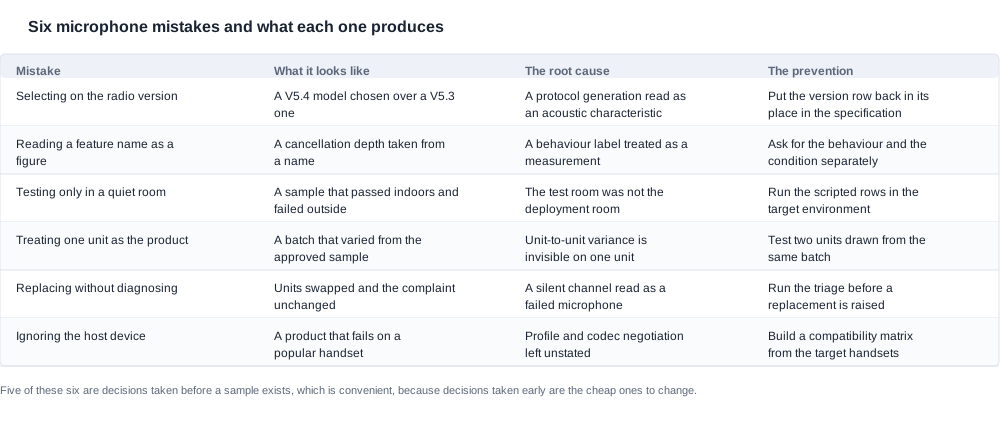
Smart glasses microphone quality: six mistakes that cost buyers the most
Where the money actually goes wrong
The commercial damage of a microphone mistake is unusual in shape. It is not paid at the moment of the mistake; it is paid over the following two quarters, in three different currencies, and none of them arrives labelled as a microphone problem.
The first currency is returns. A customer whose calls sound bad does not necessarily return the product, because the product does many other things. What happens instead is that they stop using the voice feature, which is worse for a voice-led line than a return because nothing surfaces it. The second currency is support time, and a support conversation about a call that cannot be heard is one of the most expensive conversations a channel can have, because it cannot be closed by a script. The third currency is review content: a product with a microphone complaint on it loses the listing position that the microphone was supposed to protect, and the review text is usually uninformative, which means the next customer arrives with the same expectation and the same result.
Against that, the cost of the six mistakes is small. A second unit is one unit. A written condition is one line in an email. A triage step is a phone call. A second reading is an afternoon. This asymmetry — trivial cost at the front, compounding cost at the back — is the reason these mistakes are worth a checklist of their own, and the reason the total cost of a voice programme is set by a handful of cheap decisions rather than by the quotation.
The reader is a brand-side buyer or a product manager who has already inherited a programme, or who is about to sign a purchase order for a call-led line, and who wants to know where the money usually goes. The task is to separate the decisions that are worth revisiting from the ones that are settled, and the six below are the ones that are usually not revisited in time. The due diligence on a voice-led line is mostly spent on the wrong rows, and the red flags in this category are visible long before the first delivery.
The order the mistakes appear in
The six are not in order of severity. They are in order of how often they occur, and the order matters because the early ones are the ones that make the later ones invisible.
Selecting on the radio version is first because it is the only mistake in the list that is made before any conversation with a supplier at all, and it is therefore the hardest one to catch in a later review. It happens at the shortlist stage, when a buyer has two specifications that are otherwise identical and needs a tie-breaker, and the radio version is the only technical row that is published on every model. That makes it an attractive tie-breaker and a useless one.
Reading a feature name as a measurement is second because it happens at the quotation stage, and because once a number has been extracted from a name it is very hard to un-extract. A buyer who has written "noise cancelling" into a comparison table is comparing names.
Testing in the wrong room is third, and it is the first mistake that costs real time.
Trusting a single unit is fourth, and it is the mistake most often defended on the grounds that the sample passed.
Replacing without diagnosing is fifth, and it is the only one that appears in the field rather than in the programme.
Ignoring the host device is sixth, and it is the one that survives the quotation entirely because it involves a third party the buyer does not control.
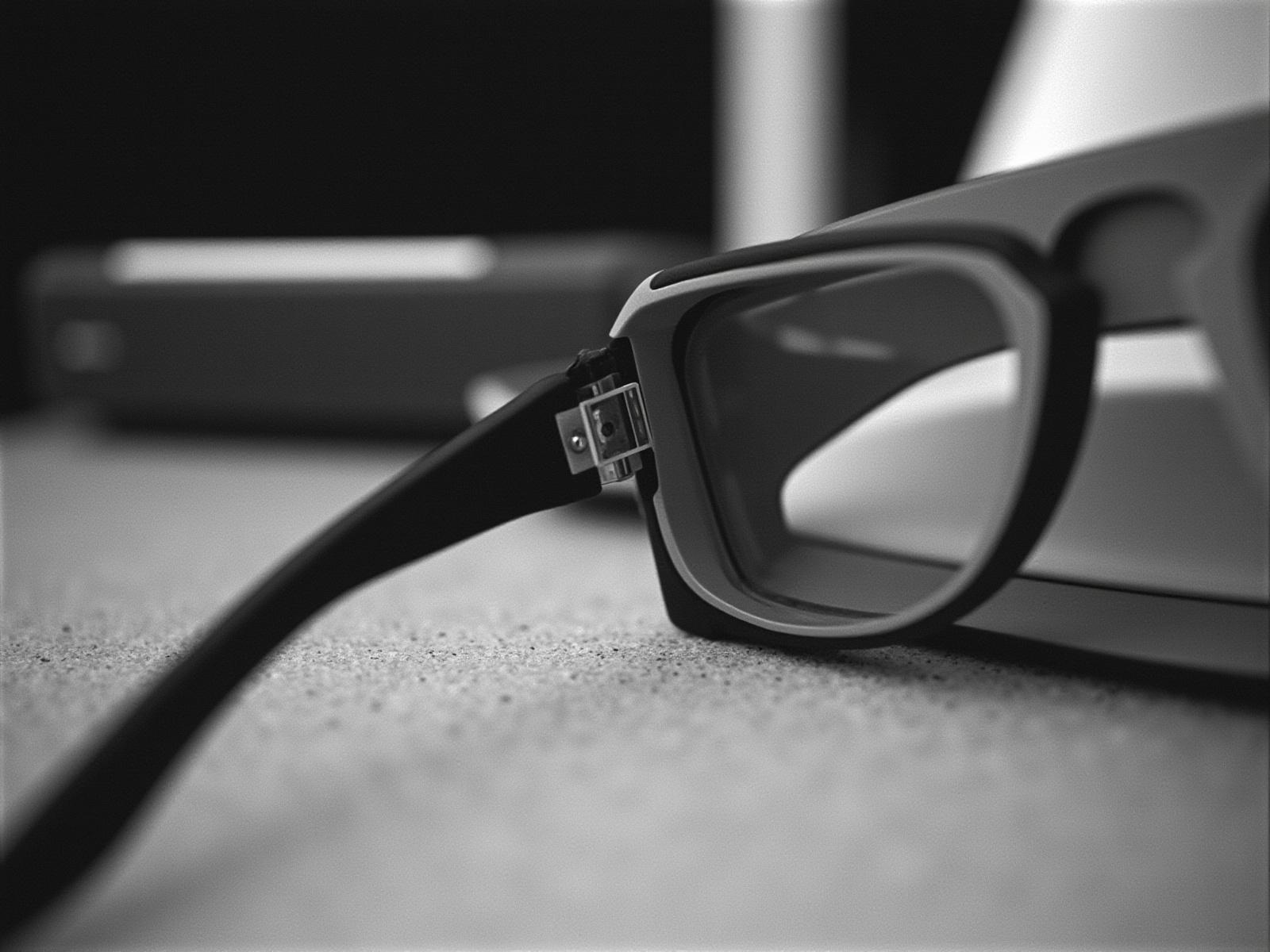
Reading a feature name as a measurement
The version string is not a quality row
Selecting on the Bluetooth version has no immediate acoustic effect whatsoever, and that is precisely why it is so common. The radio generation affects power consumption and codec availability; it does not determine what a microphone captures. A V5.4 product with a poor pickup chain still sounds poor on a call, and a V5.3 product with a good one still sounds good.
Our range carries both generations across different models, with V5.3 on the K01 and the K02 and V5.4 on the LC-105-1 and the G07, the YK12 and the YKC02, the LC-105-2, the D12 and the D11. Because we publish no microphone figure at all, the version string is frequently the only technical figure a buyer can put in a comparison table, and a figure that is easy to put in a table gets treated as a meaningful axis. The longer argument about the version row is at smart glasses bluetooth version myths.
The prevention is procedural rather than technical: write the version row into the specification as a connectivity requirement, in the same place as the charging interface and the cell configuration, and remove it from the comparison table. A row that has a stated purpose is not over-read. Before you order, the practical check is whether the version was the reason a candidate was kept or the reason it was dropped; if it was the reason, the shortlist has a hole in it.
"Noise cancelling" is a behaviour, not a depth
"AI noise reduction", "beamforming", "directional audio", "intelligent noise reduction" — these are names, and a name is a claim about a mechanism without a number attached to it. Unless a reduction figure comes with a stated condition, what you have is a label.
The bench figure measured on a steady tone says very little about a street, because the two situations differ in the type of the interfering signal, not only in its level. Our own published material contains no such figure for any model: microphone count, capsule type, pickup pattern, sensitivity, frequency response and pickup distance are all not published for our range, and the descriptions in our documentation name the technique without quantifying it.
The request that separates a mechanism from a label is narrow and it works: ask what the processing does to a voice at conversational distance in a room with a stated background. A supplier with a real implementation can answer. A supplier with a label has to paraphrase the label.
The two questions that force the answer out
Two questions do most of the work, and they are worth sending together because they are cheap.
What happens when two people speak at once? A directional implementation has to do something specific with the second voice, and a label does not.
What does the system do at a distance it was not designed for? A microphone tuned for a desk has a boundary, and a supplier who knows where the boundary is will say so; a supplier with a label will not.
The rows a buyer's comparison table should actually contain are set out in smart glasses microphone quality spec sheet explained, and the vocabulary behind them is at how to read a datasheet. How to verify a supplier's sheet in three passes, and what to ask for at each step, is covered at smart glasses microphone quality spec sheet explained.
Testing in the wrong room, and trusting a single unit
The quiet-room trap
Indoors, almost anything works. Outdoors in moving air, the same product may be unusable, and the artefact is pumping or warbling rather than a complete absence of noise — which is why the failure is so often misattributed. A buyer who hears a distorted recording in a street assumes a broken microphone, and a buyer who hears nothing in a quiet room assumes a working one.
The prevention is to run the test in the place the product will be used, at the level the customer will produce, and to record the far end rather than judging the near end. If your proposition involves calls taken while moving, that test is not optional. Run it on a street in wind above walking pace, at both low and high speech level, on two units, and keep the recordings. The full procedure is at how to measure smart glasses microphone quality.
There is a second version of this mistake, and it is more expensive. The quiet-room result is the one that reaches the listing, because it is the one that is easy to photograph and easy to describe. So a product is specified against a quiet-room bar, is deployed on a street, and returns. No microphone figure would have rescued that, because the specification was written against the wrong bar in the first place.
One unit is not a product
A single unit tells you about a unit. Microphone placement and acoustic sealing vary enough between units that one passing sample tells you very little about a production run, and the variance runs in both directions — a unit that measures better than the run is as misleading as one that measures worse.
The minimum is two units from the same batch, tested identically, before you accept a voice claim. This is the cheapest criteria in the whole category and the one most often skipped. The reason to insist on the same batch rather than two units from the shelf is that batch is the variable you are trying to characterise; two units from different batches test the supplier's inventory management, which is a different question.
If the two units disagree materially, that is a process variance finding rather than a failed test, and it is more useful than a passing sample. It tells you the product is not a single acoustic product, which is something no document in the range would tell you, and it is the point at which a supplier conversation changes character.

The two readings that catch what one reading misses
A single test protocol is a single point of failure. Two additions catch most of what one misses, and neither needs extra equipment.
The first is the silence run: thirty seconds of room tone on a table with nothing happening. Gating and pumping from aggressive noise reduction are audible in this and in nothing else, and they are a design characteristic rather than a fault, so knowing about them early prevents a wrong escalation.
The second is the two-unit comparison above. Where a single unit passes and its batch-mate fails, the two results together point at a process, and the process is the thing worth fixing.

Replacing units before diagnosing, and the triage that decides the cost
Why replacement is the expensive routine mistake
Replacing a unit that the customer reports as silent is the most expensive routine decision in this category, because it is usually wrong. Two causes in particular produce identical complaints and have opposite remedies, and nothing in the complaint tells you which one you have.
Silent in every environment is usually a connection state, a charge state or a dead channel. The remedy is a reset or a charge, and a replacement solves it once and permanently, which means the original unit goes back into stock apparently healthy and the same complaint appears again on the next unit from that batch.
Silent only outdoors is usually masking, not a fault. The remedy is a different product position, a different expectation, or a different channel, and a replacement solves nothing at all, so the same complaint arrives with the next unit.
The triage order is at smart glasses microphone quality advanced considerations, and the sequence below is the same logic arranged as steps.
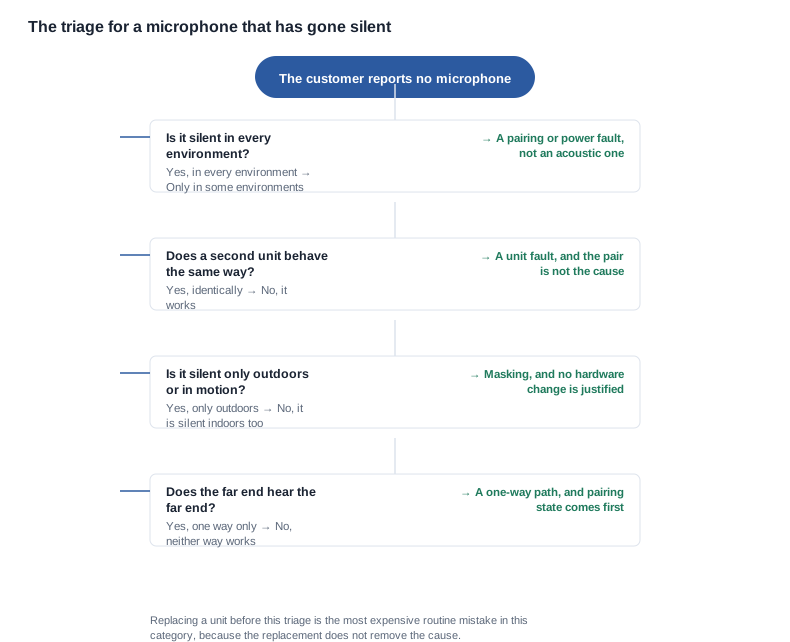
The diagnosis order, and where it stops
Step one is to reproduce the report on a second unit, in the same environment. This single step separates a unit fault from a product characteristic, and it is the step most often skipped because the customer wants a replacement and the process is faster.
Step two is to check the connection state, the charge state and the mute state before anything else. These are free, they take under a minute, and they are responsible for a large share of the reports that arrive as microphone failures.
Step three is to record the far end. A recording of what the other side heard tells you whether the path is one way or two, and a one-way path points at the connection and the profile rather than at the microphone. A two-way failure in every environment points at the unit.
Step four is to test on the host device the customer actually used, because the microphone is only one end of a chain that includes a handset, a profile, a codec and a network.
Step five is to move to the environment, and only now, and only if the unit is silent in every environment. If it is silent only outdoors, there is no fault to replace and the answer belongs in the channel rather than in the warehouse.
Step six is to raise a replacement only after the cause has been named. A replacement raised without a named cause costs a unit, a freight booking, a customer relationship and a support cycle, and it produces no information about the next unit.
The commercial version of this is simple: a warranty replacement rate that is not broken down by diagnosis is not a defect rate, it is a shipping cost, and it hides every real signal in the data. The trade-offs between a looser replacement policy and a tighter one are worth negotiating deliberately, because a loose policy is a quiet agreement to fund the customer's environment rather than to fix the product.
The mistakes that survive the quotation and reach the customer
The listing claim built on a name
The first mistake to survive the quotation is a claim written in the listing from a technology name rather than from a measurement. The symptom is a customer reporting that the product does not do what the page says. The root cause is that a copy line was written from the retail word rather than from the mechanism, and the prevention is the cheapest one in this article: fix the claim wording before the product page is written, and let the copy describe what the mechanism does rather than what the customer hopes for.
The second is a claim that outruns the evidence in the other direction. A product that performs correctly is still returned, because the expectation was set by a different technology. The buyer who has handled a mineral lens carries that expectation into a listing for a powered one, and the returns arrive as a cluster from one channel with a description that does not match the product. The prevention is to state the mechanism in the copy and to set the expectation in the listing, in the packaging and in the support script, consistently.
The host device nobody checked
The third mistake to reach the customer is the compatibility one, and it is the one the buyer has least control over. Some handsets connect and behave well, others connect and behave badly, and the cause is profile and codec negotiation rather than the microphone. The remedy is a compatibility matrix built over the handset models that dominate your market, and the useful property of that matrix is that it doubles as the support script — the two documents are the same document with a different first line.
The matrix should be built on the handsets you actually sell into rather than on the ones that are easy to obtain, and it should be rebuilt when the platform lineup changes, because a handset that negotiates a different profile is a different host device even though the model number is similar.
The product scoped to an environment it cannot serve
The fourth is a microphone that fails at a stated background level and is treated as a defect when it is a scoping error. A product sold into a plant floor that was specified for a quiet office is not a defective product; it is the wrong product, and the cheaper moment to discover that is before the purchase order rather than after the first returns.
This one is worth separating from the others because it is the only mistake in the list where the correct action is to change the product position rather than to change the product.
What a microphone mistake costs once it is in the field
The cost curve, and the stage where it opens
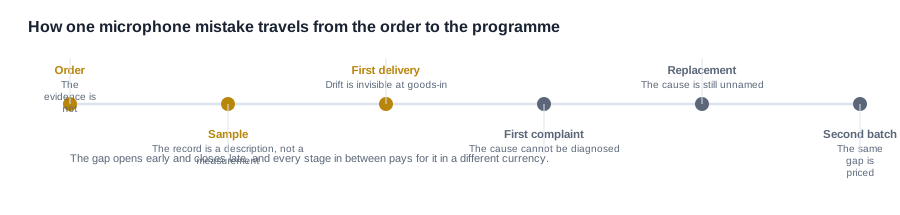
The cost curve of a microphone mistake has a shape that is worth putting in front of a buyer before the purchase order is signed, because every stage of it has a different currency and a different owner.
The gap opens early. At the order stage, the evidence is not collected, and the price that seems attractive on the quotation is a price for a product whose acoustic behaviour is unknown. At the sample stage, the record that exists is a description rather than a measurement, and a description is indistinguishable from a good record until somebody disputes it. At the first delivery, drift between the approved unit and the run is invisible at goods-in, because there is no incoming inspection criterion to check it against.
By the time the first complaint arrives, the cause cannot be diagnosed, because the record that would have diagnosed it was never created. The replacement is raised and the cause is still unnamed, and the second batch repeats the whole sequence with more units at stake.
What we will and will not tell you
Here, we publish no microphone specifications for our range and we will not fill the gap with typical industry values, because every number a buyer derives downstream inherits any guess we make. What we will do is tell you which figures exist as categories, which of them matter most for voice, and what to measure on a sample to get an answer that is yours rather than ours.
We will also tell you plainly when one of these six mistakes is already inside a programme. That is a more useful answer than a blank sheet, because most of these mistakes are made once, early, by someone who did not know they were optional — and the recovery path for each of them is short.
The wider question of what a voice claim can rest on is covered at noise control and microphone pickup, and the procedure behind the tests referenced here is at how to measure smart glasses microphone quality.
Related reading
- Reading a supplier's sheet in three passes: smart glasses microphone quality spec sheet explained.
- What the datasheet rows actually mean: how to read a microphone datasheet.
Send us the two products you are comparing and we will tell you which of these six is most likely producing your result.


