

If smart glasses microphone quality smart glasses for beginners is your first question in this category, the reassuring answer is that almost all of the difficulty is in step one rather than in the hardware. Most people start by hunting for a specification, find that suppliers either do not publish one or publish a feature name, and conclude the topic is too opaque to buy on. It is not. The useful information is not in the datasheet; it is in a twenty-minute test and a one-paragraph decision. This page is written for a buyer who has to make the decision, and it gives the four steps in the order that closes the most per hour.

Smart glasses microphone quality: the first week in a category, in order
What the first buyer is usually doing
A buyer new to this category is usually doing one of three things, and all three start from the same place: a supplier has quoted, and the quote contains a sentence about the microphone that nobody can evaluate.
The first situation is a brand opening a new product line and working out which platform to build on. The second is a channel buyer placing a replenishment order on a product line that already exists and has to decide whether the current platform is still the right one. The third is a product manager who has inherited a programme, has a supplier who is pushing a particular acoustic design, and needs to work out whether that push is justified.
In all three, the instinct is to hunt for a specification, because a specification is what the other side of a negotiation is supposed to produce. In this category it usually does not arrive, and the absence feels like a wall. It is not a wall; it is the category, and the way through it is to stop hunting for a number and start producing one.
The other thing a first buyer has to accept early is that the microphone is rarely the largest commercial risk in the programme, even when it is the most visible open question. The larger risks are usually the acoustic chamber, the conformity file and the delivery drift — and the first step, which is a paragraph, is what tells you which of those you actually have.
Why step one settles most of it
Most of the difficulty a beginner attributes to the microphone is actually a step-one problem. A product specified for a quiet office and then deployed on a street was specified against the wrong bar, and no microphone figure would have rescued it. Writing the use-case sentence first converts an unanswerable specification question into a testable acceptance criterion, and it costs a paragraph.
The sentence has to contain three things, not one. Where the product is used, in a place rather than a category — an office, a vehicle cabin, a plant floor, a street. What the background level is there, even approximately, because "noisy" is not a level. And what counts as good there, in terms the customer would recognise, which is usually "the other person repeats it correctly the first time".
The second thing step one settles is where the diligence goes. If the deployment is a desk, the leakage measurement and the quiet-voice artefact are the two tests worth running and the rest is optional. If the deployment is a street or a vehicle, all of them are worth running and the wind case is the one that decides.
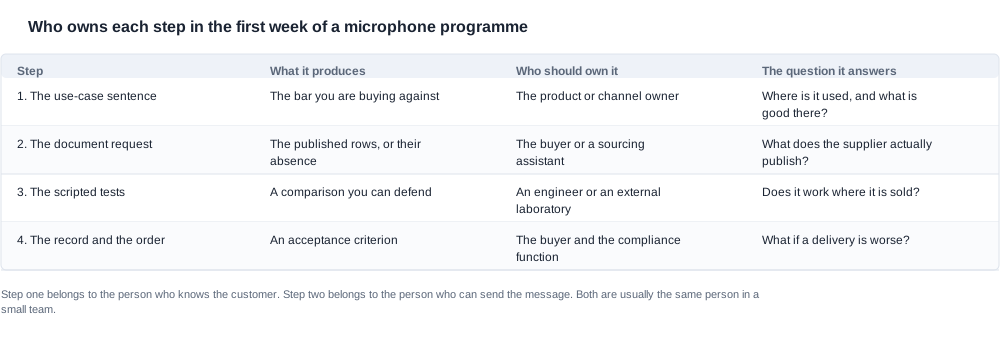
Who owns each step when a beginner is buying for the first time
The four steps and the four owners
One of the reasons a first programme stalls is that nobody owns the steps. The table below assigns them, and the assignments matter more than the sequence.
| Step | What it produces | Who should own it | The question it answers |
|---|---|---|---|
| 1. The use-case sentence | The bar you are buying against | The product or channel owner | Where is it used, and what is good there? |
| 2. The document request | The published rows, or their absence | The buyer or a sourcing assistant | What does the supplier actually publish? |
| 3. The scripted tests | A comparison you can defend | An engineer or an external laboratory | Does it work where it is sold into? |
| 4. The record and the order | An acceptance criterion | The buyer and the compliance function | What happens if a delivery is worse? |
Step one belongs to whoever knows the customer, which in a small team is usually the person who wrote the brief and in a larger one is the product manager. It cannot be delegated to the buyer, because the buyer does not know the environment and cannot ask.
Step two belongs to whoever can send the message, and it is the step most often done badly rather than not done at all. The failure is not leaving it out; it is sending five separate questions over five weeks instead of one message with ten rows, which produces five partial answers instead of one usable one.
Step three belongs to somebody with a bench, and in many companies that is not the buyer. This is the step where a beginner most often needs help, and the two honest options are an internal engineer and an external laboratory. What a beginner must not do is mark it as done on the strength of a supplier's demonstration, because a demonstration is not a measurement and the difference only becomes visible when a customer complains.
Step four belongs to the buyer, and it is the step that turns the work into an asset. Without it, the tests are an afternoon that gets repeated for the next order.
The one thing that has to be written down first
Everything in this article depends on a single paragraph, and it should be written before the first supplier message rather than after it.
The paragraph names the environment, the background level, the bar, and the two conditions that are out of scope. The out-of-scope part is the one that beginners leave out and that causes the most trouble later, because an unbounded environment is an unbounded claim, and a product with an unbounded expectation is a product with an unbounded return rate.
It also names what happens if the requirement is not met. The options are to change the product, to change the environment, to narrow the claim, or to accept the risk knowingly. All four are legitimate; the only illegitimate option is to not decide.
The four beginner questions that answer most of the difficulty
The four questions, and what each one closes
Question one: how many microphones, and where are they positioned on the frame? This is a hardware question with a one-line answer, and it separates a product designed for calls from a product designed for a demonstration. If the supplier cannot state it per model, that is a finding in itself, and it should be recorded as one rather than chased.
Question two: what does the noise processing act on, and what is its documented behaviour on a voice at conversational distance? This is where a feature name either becomes a description of a mechanism or stays a marketing phrase. A named signal and a described behaviour is a specification; "intelligent noise reduction" is a label.
Question three: is any microphone figure published, and if so, under what test condition? A figure with a condition is usable; a figure without one is not a figure and should be recorded as absent rather than carried into a comparison table.
Question four: does the published row set cover the configuration you are buying? The battery, the cell configuration, the charging time, the charging method, the radio version, the rated runtime, the control method and the temple descriptions are published rows for most of the models. The microphone count, the pickup distance, the capsule type, the frequency response, the leakage figure, the processing mode and the temple dimensions are not. Knowing which set a model belongs to tells you which questions to ask.
How to put the four questions into one message
The four questions above are easy to remember and easy to lose, and the usual failure is to send them one at a time over several weeks. One message with the four questions, plus the model designation you are asking about and the configuration you intend to ship, produces a usable answer far more often than the same four questions sent separately.
The message should also say what you are asking the supplier to do with them, which is a line most people leave out. A supplier answering "the microphone count is not published" has answered a question; a supplier answering "the microphone count is not published, and it is not something we can commit to a figure for" has answered a different one, and the second is the answer that closes the row.
Two things belong in the same message, because they are cheap now and expensive later. The first is a request to run your protocol against production units rather than engineering samples, and to supply the raw recordings. The second is a request for the model designation and the configuration list to be written on the quotation, because the artwork, the technical file and the customs description all wait on that line.
Whether to send the rows as a checklist or as prose is a smaller question than it seems. A checklist is easier for a supplier to answer in one pass, and it is easier for you to check the answer against later, which is the point of having one.
What the answers are in our own catalogue
The published position in our range is worth stating precisely, because a beginner will otherwise read a catalogue and assume the silence is an oversight.
We publish no microphone specification for any model: no pickup distance, no frequency response, no signal-to-noise figure, no cancellation depth, no capsule type and no microphone count. We publish the technology descriptions — open-ear acoustic structure, directional audio and intelligent noise reduction — and the electrical rows per model, which include the cell configuration, the charging time, the rated runtime and the charging method. The audio family runs Bluetooth V5.3 on the K01 and the K02 and V5.4 on the D11 and the D12, the YK12 and the G07, and the LC-105-2 and the LC-105-1, with 55mAh × 2 cells on the LC-105, the G07 and the YK12, 90mAh × 2 on the K01 and the K02 and 100mAh on the D11 and the D12. The sport models publish the same rows on Bluetooth V5.4, with 70mAh × 2 on the YKC02, 115mAh on the D17 and 100mAh on the ZH12.
The rows themselves are set out in how to read a microphone datasheet, the misreadings are in smart glasses microphone quality common mistakes, and the procedure behind the tests is at how to measure smart glasses microphone quality.

The mistakes a beginner makes in the first ten days
Six avoidable ones, and what each one costs
Buying on the technology name. The description is identical across the range, so it cannot discriminate, and a buyer who treats it as a differentiator ends up comparing descriptions. Cost: the shortlist is decided on nothing.
Treating a quiet-room result as the result. Almost anything passes in a quiet room, and the quiet-room result is the one that reaches the listing because it is easy to photograph. Cost: the product is specified against the wrong bar.
Asking for a number before asking for the conditions. A supplier who has a number and no condition will give you the number, and it will go into your comparison table and be read as a number. Cost: the comparison is quietly wrong.
Accepting one unit as the product. Unit-to-unit variance in a frame is real, and a single passing unit tells you about that unit. Cost: the first delivery diverges from the approved sample and nobody knows why.
Using the demonstration as the test. A demonstration happens in a quiet room, on a good day, with the person standing still and interested. Cost: the result is unrepeatable, so it cannot be defended.
Writing the result into the specification and nowhere else. A measurement that is not attached to the purchase order and to the incoming inspection criteria is a number that a supplier has no obligation to reproduce. Cost: the programme repeats the whole task on the next order.
The first two are the ones that account for most of the disappointment. The other four are cheap to avoid and are the reason the four steps exist.
A first month, and what it should produce
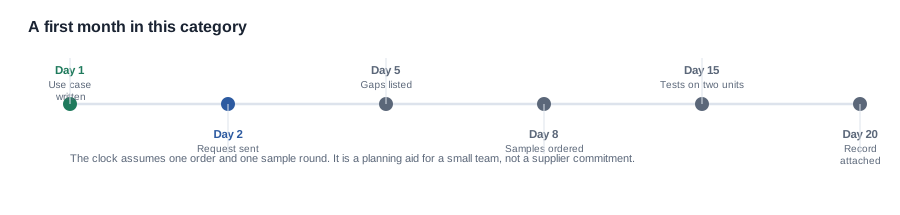
The clock assumes one order and one sample round. It is a planning aid for a small team, not a supplier commitment, and the milestone that matters most is the last one, because a programme that has produced a record by day twenty has something that a programme that has produced a sample does not.
What to do on day one, and what to leave alone
On day one a beginner has one useful hour and a long list of things they could ask about. The discipline that helps most is to spend that hour on the paragraph rather than on the research.
The paragraph is the use case, the background level, the bar, and the out-of-scope conditions. It takes twenty minutes, it can be done without the supplier, and it decides which of the other questions are worth asking. A buyer who has written it can tell within a minute whether a supplier's answer is relevant; a buyer who has not will read every answer carefully and conclude nothing.
Three things are worth leaving alone on day one, and they are the three that beginners find most attractive. The first is the price. Before the configuration is written down, a price is for a product that does not yet exist, and comparing two of them is comparing two sets of assumptions. The second is the certification timeline, which depends on the configuration and the file scope and will change when those are settled. The third is the long list of published rows, which is useful for understanding the range but is not a filter — the published rows are identical across models that behave very differently.
What day one should produce is one paragraph, one message, and a shortlist with a reason attached to each entry. Everything after that is execution, and execution goes much faster when the reasoning is on paper.
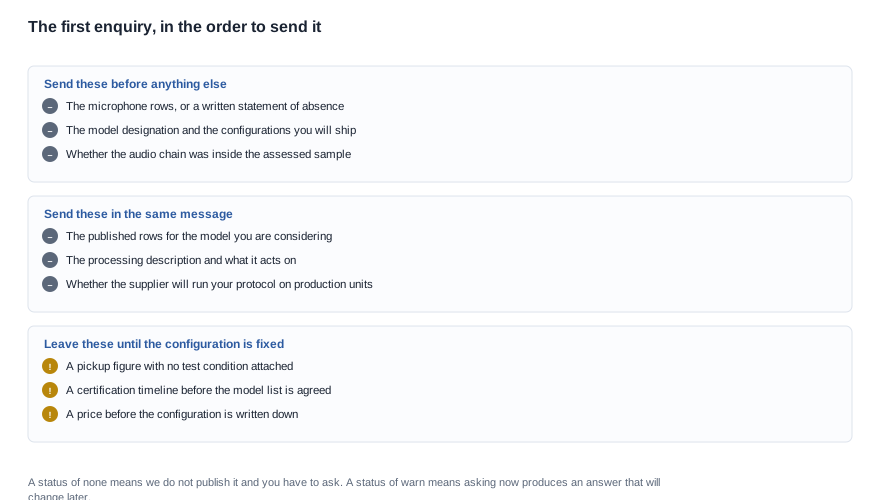
What a beginner should put in the first enquiry and the first purchase order
The enquiry, as one message
One message, with the rows grouped so that the supplier can answer them in one pass. The first group is the rows that are not published at all and therefore have to be requested. The second group is the rows that exist and are worth having in writing. The third group is the rows that should wait until the configuration is fixed, because asking for them now produces an answer that will change.
Two things are worth adding to the message. The first is a request to run your protocol against production units rather than engineering samples, with the raw recordings supplied, which is the clause that makes the later inspection enforceable. The second is a request for the model designation and the configuration list in writing on the quotation, because the artwork, the technical file and the customs description all wait on that one line.
The purchase order, as five clauses
The acceptance criteria. The protocol, its conditions and its sample size, attached to the order, with a lot that fails them being a lot that can be refused.
The inspection clause. The same protocol applied to each delivery, with a stated tolerance and a stated unit count, and a retained unit for the comparison.
The change notification. Notice before any change to the chamber, the port positions, the seal or the capsule, with the result voided and a re-run required.
The claim clause. No call quality, noise cancelling or intelligibility claim beyond the measured result, and the result travels with the listing copy.
The access clause. The right to run the protocol against production units and to receive the raw recordings.
Those five clauses are worth more than a unit price negotiation, because they decide what happens when a delivery is worse than the sample — which is the question that decides the commercial outcome of the whole programme.
The one thing a beginner should ask us first
What to send, and what we will do with it
Concretely, microphone quality in this category is decided by a use case and four steps rather than by a specification, and a buyer who writes the use-case sentence first will spend their diligence in the right place. We will not publish a microphone count, a pickup distance, a capsule type, a frequency response, a leakage figure or a processing mode for a model where the manufacturer has not provided one, and we will not present a feature name as a measurement.
The one thing to ask us first is the use case, because that is the input that produces a useful answer from either side. Send us the environment, the background level, the channel and the two or three models you are holding against each other, and we will tell you which of the four questions each candidate actually has to answer, which rows the catalogue closes for you today, which have to come from the engineering and compliance teams, and which of the use cases you have named are out of scope for this form factor altogether.
That last part is the one that saves the most money. A buyer's own record should say it too, so that the decision outlives the person who made it.
The background position is on noise control and microphone pickup, and the four-step version of this material in plain language is in how to read a microphone datasheet.
Related reading
- The measurement procedure — how to measure smart glasses microphone quality
- The rows and the vocabulary — how to read a microphone datasheet
- The misreadings — smart glasses microphone quality common mistakes
Tell us the use case, the environment and the models you are shortlisting, and we will tell you which questions the documentation closes and which need a sample.


