

Smart glasses microphone quality smart glasses lead time factors has an answer that will be unwelcome to a buyer expecting a sourcing lead time: improving the microphone is not a sourcing exercise, it is a development one. The microphone is not a component you swap and the next week improves; it is a design, a tuning, a test method and a piece of evidence, and each of those has its own lead time.
We publish no microphone count, no signal-to-noise ratio, no pickup distance, no driver size and no frequency response for any model in our range. That absence is the reason this is a development question rather than a specification question — a buyer who knows what they want can source it, and a buyer who does not has to establish it first.
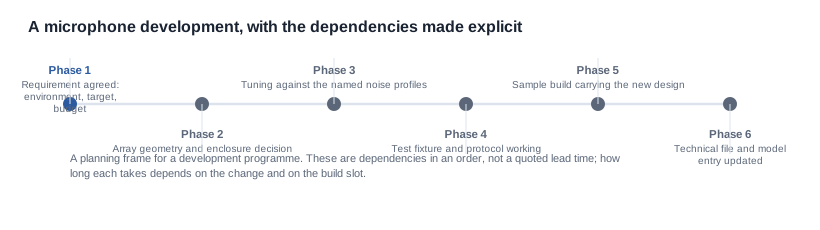
The schedule consequence is worth stating before anything else, because it is the item that determines whether a programme is viable. A microphone improvement has to be scheduled as a development with a sample dependency, not as a sourcing exercise with a delivery date. The three questions to ask a supplier are therefore about the work rather than the part: what is the current array and what would change; what noise profiles would the tuning target, and who defines them; and what the test method is, and can it be repeated on your own units. The third question is the one that most reliably distinguishes a supplier who has tuned a microphone from one who has fitted one.
Smart glasses microphone quality: why a requirement arrives as a schedule
The buying task. The reader here is a sourcing buyer or a product manager who has been given a target that reads like a specification and is not one. The target is usually phrased as a wish — the current model is not performing in a particular environment, a channel is asking for a different product, or a competitor is being quoted a capability that cannot be matched as it stands. The buyer has to convert that wish into a development with a cost and a date, and the conversion is where the schedule is either protected or lost.
What the buyer is afraid of. Three things, in order of cost. The first is a development that cannot be demonstrated, so the improvement cannot be justified to the channel that asked for it and the programme ends with a product nobody asked for. The second is a schedule that slips after the launch date has been committed to a distributor, which turns a development delay into a channel penalty. The third is a compliance tail that appears late, when the enclosure, the model and the file all have to be revisited, and the revisit is the expensive version of the same work.
Where the cost actually sits in this category. The unit price of an audio model is dominated by the hardware and the assembly, and a microphone development does not change the unit price by much at all. The development cost sits in engineering time, in a fixture, in a firmware branch, in a build slot, and in the documentary work that follows a changed design. That is the commercial reason a buyer should treat this as a scoped development with line items rather than as a negotiating round on unit price: the number that moves is the scope of work, and it is quoted separately.
Why two quotations for the same requirement routinely differ by months. One supplier is quoting a firmware and tuning change, and the other is quoting an array change with a new enclosure, a new model and a new file entry. Both are answering the same request, and both are being reasonable, because the request did not say whether the hardware in place can meet the requirement. The row that settles it is a single question — whether the current array and port geometry can meet the target at all — and it is answerable in one meeting before any quotation is requested.
The scheduling consequence. A development with a sample dependency has two critical dates rather than one: the date the work is complete and the date the units that carry it are available. Programmes that manage only the first discover the second in the month the launch is supposed to happen. Programmes that manage both build the sample slot into the same conversation as the engineering scope, and the sample slot is the one thing a factory cannot accelerate by working harder.
The two factors on the critical path
1. The array design. The microphone count and the placement decide the pickup, and a single microphone in a temple and a three-microphone array with one facing forward are different products. This is the only factor on the list that is unambiguously a hardware change, and it is the one with the longest tail: a changed array is a changed enclosure, a changed model and a changed file entry. A build slot, a tooling decision and a conformity entry all wait behind this one, and no amount of parallelism in the tuning work shortens it.
2. The samples. Tuning needs units, and units need a build slot. This is the factor that couples the microphone work to the production schedule, and it is the reason a microphone improvement often lands late: the work is ready and the units are not. The dependency is rarely acknowledged in a quotation because it sits in the factory's plan rather than in the buyer's, and a buyer who has not asked about it discovers it in the week the units were supposed to arrive.
Why these two and not the others. The other five factors are, in the main, work that can be done in parallel with the array decision — tuning, the fixture, the firmware, the assessment and the file update. The array decision determines the target for all of them, so a decision taken late delays everything that depends on it, while a decision taken early lets the rest proceed. The samples are the mirror image: the work is ready but the physical units are not, and no scheduling technique fixes that. A programme that recognises this has two dates to manage rather than seven.
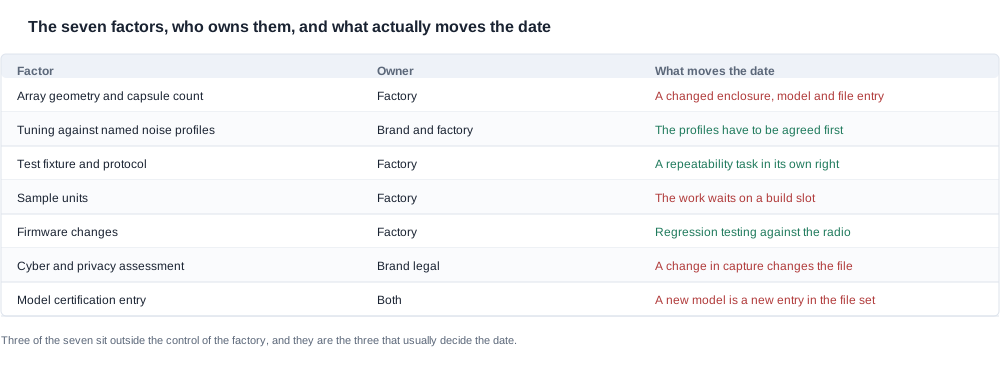
The seven factors, who owns them, and what moves the date. Three of the seven sit outside the factory's control, and they are the three that usually decide the date. The array geometry is the factory's decision but the buyer's money, because it carries a tooling and enclosure implication that has to be approved commercially before it is started. The samples are the factory's schedule but the buyer's dependency, because the sample build competes with the production plan for the same slot. And the compliance and certification entries are jointly owned, because the factory produces the technical file and the brand owns the claim that the file supports.
The three factors that run on the buyer's own clock
3. The tuning against the environment. The noise reduction is tuned against specific noise profiles, and defining those profiles is a decision the brand and the factory have to make together. Traffic, wind, café babble and an office fan are four different problems, and a tuning that handles three of them badly is worse than a simple device, because the customer experiences the bad one. The brand's contribution is the environment description: which of those four the product will be used in, in what proportion, and which one matters most when the product is used in the wrong place. A brand that cannot answer that question hands the tuning to whoever happens to be in the room, and the result is a device tuned for the environment its engineering team works in.
4. The test method and the fixture. To improve a microphone you have to be able to measure it, and a repeatable intelligibility measurement in noise needs a fixture and a defined protocol. Building that is a task in its own right, and it is the task that most often gets skipped — with the result that the tuning is done by ear against a colleague standing in a corridor. The commercial consequence of skipping it is that the improvement cannot be demonstrated, cannot be repeated, and cannot be defended to a channel that asks why this model sounds better than the one it replaced. Building the fixture is often the cheapest item in the whole programme and the one most often deferred, because it produces no visible feature.
5. The firmware. The processing that runs on the captured signal is firmware, and firmware changes carry regression risk against the radio and the assistant behaviour. A tuning change that improves the noise case can degrade the quiet case, and a change that alters the capture behaviour touches the compliance assessment described below. The regression risk is what puts firmware on the buyer's clock rather than the factory's, because the acceptance criteria for the change have to be agreed and the decision to ship it has to be taken by the party that owns the claim.
What the three have in common. They are all questions before they are work. The environment, the method and the acceptance criteria have to be settled before the corresponding engineering can be evaluated, and every one of them sits with the brand. A buyer who commissions the tuning before agreeing the noise profiles buys a tuning; a buyer who agrees the noise profiles first buys an outcome, and the two have very different schedules.

The compliance tail that follows a changed array
6. The compliance evidence. The capture behaviour is part of the privacy and security risk assessment under EN 18031, the cybersecurity requirements that have been applicable within the radio equipment conformity assessment since 1 August 2025. A change to what the microphone captures, or to how it is triggered, is a change to what the assessment has to describe. That is a document update rather than a new test in most cases, but it is a document update that has to be produced by someone, and in a supplier's structure that is a compliance function with its own queue.
7. The certification of the changed model. If the array changed, the model may have changed, and a new model is a new entry in the file set. This is where a seven-week tuning project becomes a three-month one. The specific mechanism is worth spelling out for a buyer, because it is the one that surprises people. The declaration of conformity names models. A private-label configuration that is not on that list is not covered by it, and covering it means extending the file, which means a schedule item rather than an administrative one.
The three questions to put about the tail. Whether the proposed change alters the capture behaviour, and therefore the cyber assessment. Whether it changes the model designation, and therefore the declaration and the model list. And whether it changes the enclosure, the port or the interface, and therefore whether any other marking on the product still applies. These three answers determine the size of the tail, and they are cheap to obtain at the start of a development and expensive to obtain at the end of it.
The commercial framing. The tail is a fixed cost per configuration and a queue at the laboratory or the certification body, so it is not something that scales down with order size and is not something that a larger order buys a faster position in. What the buyer can negotiate is the number of configurations committed in the first year, the artwork round count, the per-market label scope, and the trigger that causes a file extension. Each of those is a decision the brand makes, and each one is cheaper before the change than after it.
Sequencing the work so the first sample carries the new design
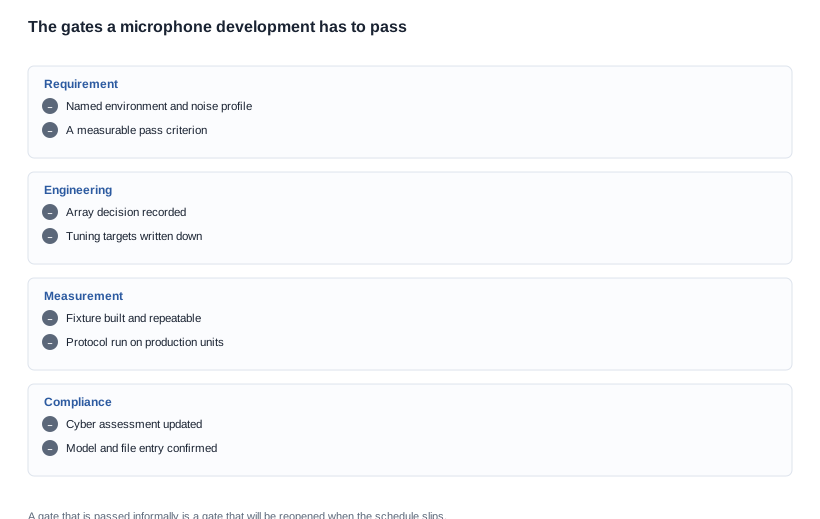
The order of operations is where most of the schedule is won or lost, and the rule is that each gate has to be passed before the next one is started rather than in parallel with it.
Gate one, the requirement. A named environment, a named noise profile, a measurable pass criterion and a budget ceiling for the development. A programme that skips this gate does not have a development; it has a request, and the request will be answered with a quotation for work whose scope is undefined.
Gate two, the engineering decision. Whether the requirement can be met with the hardware already in place. If it can, the tail is a firmware and tuning exercise. If it cannot, the enclosure, the model and the file are all in scope, and the buyer should see that cost before it is committed rather than after.
Gate three, the measurement. The fixture built, the protocol written, the pass criterion fixed in advance. This gate is where most programmes quietly fail, because the fixture is a piece of work with no customer-visible output and it is the easiest item to defer to the end of the quarter, at which point the tuning has been done by ear and cannot be demonstrated.
Gate four, the sample build. The units that carry the new design, scheduled in the same conversation as the engineering work rather than afterwards. A build slot requested after the engineering is complete is a request for the next available slot; a build slot reserved at the same time is a position in the plan.
Gate five, the compliance update. The cyber assessment, the declaration and the model list, updated for the configuration that is actually shipping.
The re-sequencing that saves the most. Moving gate three ahead of gate four, and gate one ahead of both, is worth more than any compression of the tuning itself. The measurement is what turns the work into a result, and the result is what makes the compliance update defensible. A development that reaches the compliance stage without a measurement has to re-open the engineering if the assessment asks for evidence.
A worked sequence, stated as a hypothetical
This is a worked case rather than a customer case. The choice sequence appears here.
Assume a brand-side buyer who is re-launching a Bluetooth audio model in a market where the returns notes frequently say that the other party cannot hear the caller. The brand has already decided to change the listing wording and to run a protocol, and it now has to decide whether to commission a hardware development or to accept the product as it is. The binding constraint is a distributor launch date that has already been announced, so the question is not whether to improve the microphone but what can be improved without moving that date.
The scoping question first. The buyer asks whether the current array and port geometry can meet the target at all. The answer is that a single capsule on the temple cannot separate the speaker from the room, so a whole-room complaint has a structural cause. That answer is uncomfortable, because it removes the firmware-only option, and it is also the most valuable answer in the project, because it was obtained in one meeting rather than after a tuning cycle.
The environment question second. The brand describes where the product is used, and the answer is a vehicle rather than an office, with traffic and airflow across the frame. That description converts the requirement from a general "better voice" into a moving-source noise case, which is a different tuning target from a stationary one and which also changes the acceptance criterion from intelligibility in a quiet room to intelligibility in a specified outdoor condition.
The measurement question third. The brand asks whether the supplier can run a protocol on production units and can repeat it on the buyer's own units. The answer is yes, and the fixture exists, which means the measurement is not a development item and the protocol can be run on the current product before anything is changed. That single fact is what makes the launch date survivable, because it produces evidence about the current product while the decision about the new one is still open.
The commercial structure last. With the array decision open, the brand asks for the development to be quoted as separate line items — array and enclosure, tuning, fixture and protocol, firmware and regression, compliance update — so that the enclosure line can be removed if the budget is cut. It also negotiates the build slot for the sample into the same order as the engineering scope, because the slot is the one item that cannot be accelerated later. The resulting schedule has the launch date protected by a narrower claim and a documented protocol, and the development running behind it on a date that is visible to both parties.
The decisive decisions were all made before anything was built, and none of them was about the algorithm.
What we can scope in advance, and what we will not commit to
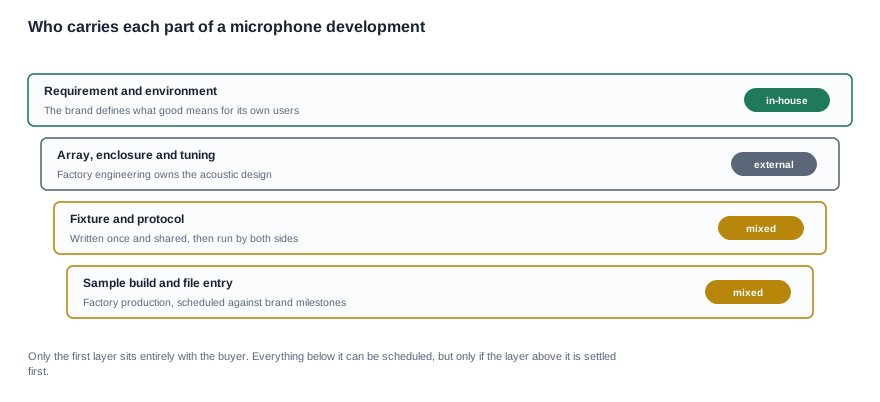
Only the first layer of a microphone development sits entirely with the buyer. Everything below it can be scheduled, but only if the layer above it is settled first, and that is the whole argument for putting the requirement in writing before the quotation is asked for.
Here, we publish the acoustic methods our catalogue states and we publish the empty rows next to them, and we will not quote a microphone count, a signal-to-noise ratio or a pickup distance that we have not measured. We will not present intelligent noise reduction as a guarantee of a clean voice in traffic.
What can be scoped in advance. The array configuration, per model, from the published design. The electrical and radio rows, which are published and verifiable: Bluetooth 5.3 on the K01 and the K02 and 5.4 across the D17 and the YK12, the LC-105-1 and the D11, the ZH12 and the YKC02, the D12 and LC-105-2, and the G07; cell configurations from 55 mAh by two up to 115 mAh; charge times of two hours or less with the D17 and the ZH12 at roughly one hour; runtimes of roughly six to eight hours; and magnetic or Type-C charging depending on the model. The compliance file position for a named model designation. And the commercial structure of a development, in the same way as any other: the sample order cost, the quantity bands, the price tier at each band, the tooling position, the payment schedule and the terms on which a configuration change is priced.
What cannot be scoped in advance. A duration, because the length of a development depends on the size of the change, the queue at the laboratory and the availability of a build slot, none of which a quotation can fix. A performance result, because the result depends on the environment the buyer describes and on a criterion the buyer sets. And a certification position for a configuration that does not yet exist, because the file follows the hardware rather than the intention.
What we will commit to. The published configuration for any model we quote. A written statement of which microphone rows are held and which are not, so that a buyer knows whether a question will be answered from a document or from a test. A development scope that names the array, the noise profiles, the fixture, the firmware change and the compliance work as separate line items, so that a buyer can remove any one of them and see what it costs. And an honest estimate of which of the seven factors a given requirement touches, which is the question a buyer actually has.
The method is described under noise control and microphone pickup, the field protocol is in microphone quality real world performance, and the questions to ask a supplier are in the supplier questions for this row. The specification request that precedes all of this is at microphone specifications to request.
Related reading
- The field protocol — microphone quality real world performance
- Why the row matters — why microphone quality matters
- The supplier questions — the supplier questions for this row
Tell us the scenario you need and we will tell you which of the seven factors it touches and which of them have to be settled first.


