

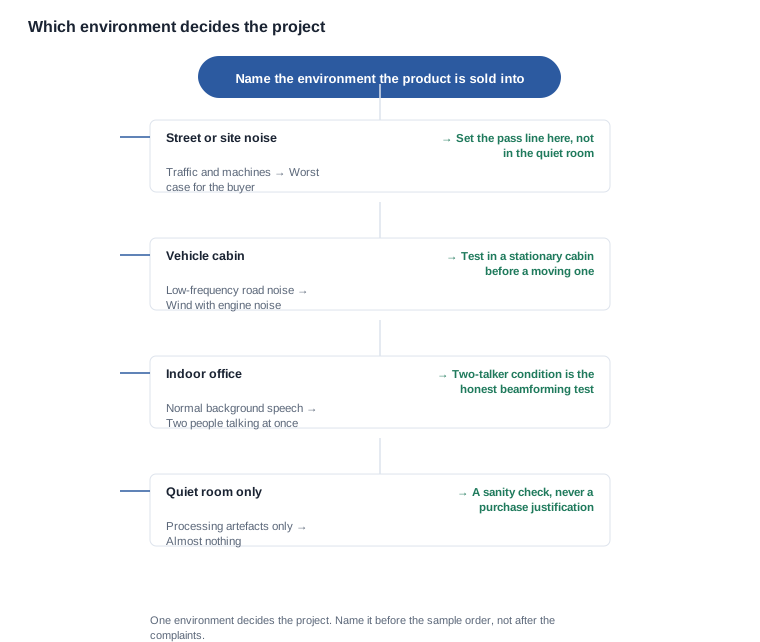
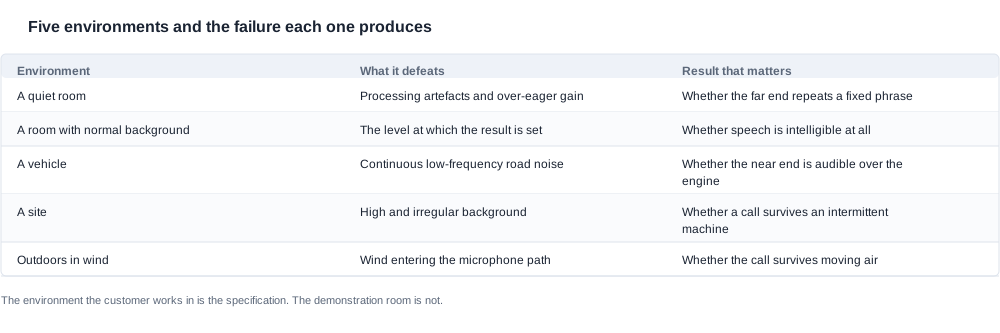
Five environments defeat a wearable microphone in five different ways, and a unit that survives one of them can fail completely in another. The quiet room shows the processing artefacts. The room with an ordinary background shows where the capture level was set. A vehicle shows what continuous low-frequency noise does to the noise handling. A site shows the limit of the geometry. Wind shows what happens when air enters the microphone path. This is why smart glasses microphone quality real world performance is not a specification question. The environment your customer calls from is the specification, and the demonstration room is not.
For a sourcing team the operative rule is short: name the environment before the sample order, write the pass condition for that environment, and run the protocol there. A microphone figure produced somewhere else tells you nothing about the channel you are buying for, and a supplier who is not asked which environment they tested will always present the quiet room.
Smart glasses microphone quality: the calling environment decides the result
The buyer behind this question is a product manager or a sourcing manager who has a channel to serve and a supplier who has demonstrated something impressive. The demonstration is not a lie. The supplier genuinely measured a unit and genuinely got a good result. The problem is that the room in which it was measured is not the room in which the product will be used, and the buyer cannot tell which of the two the result came from because the demonstration carried no environmental condition.
The commercial risk being managed here is not a technical failure in the abstract. It is a launch in which the reviews are about the voice, which in a call-driven product is the feature the customer perceives the product to be. In a voice channel, microphone quality is not one attribute among several. It is the attribute the review is about, and the returns data follows the reviews rather than the specifications.
That is also why the answer to "how good is the microphone" is always the same and always incomplete. There is no published microphone specification for any model in this range: no pickup distance, no signal-to-noise ratio, no frequency response, no microphone count and no third-party acoustic report. The published rows are the technique names — open-ear acoustic structure, directional audio, intelligent noise reduction — and the electrical rows. What the buyer needs in exchange for that thin sheet is a protocol, and the protocol starts with naming the environment.
What the published rows do settle, and what they leave to the bench
The electrical rows do settle something real, and a buyer should use them rather than dismissing the whole sheet. The K01 and the K02 publish 90 mAh per cell across two cells, a rated window of roughly eight hours, magnetic charging and Bluetooth 5.3. The D11 and the D12 publish a single 100 mAh cell, roughly seven hours, Type-C charging and Bluetooth 5.4. The LC-105-1 and the LC-105-2 publish two 55 mAh cells, roughly eight hours and magnetic charging. The G07 and the YK12 publish two 55 mAh cells and a shorter window of roughly six hours, with the G07 noted for a slim and detachable temple and the YK12 for a surround sound slim temple. The YKC02 publishes two 70 mAh cells and roughly eight hours.
Those rows tell you how long the unit can be powered, which matters because a call window is a power budget before it is an acoustic question. They do not tell you whether the far end can make out a phrase in the environment the product is sold into, and no published row in the range will tell you that. That is the boundary of the catalogue, and the reason a field protocol is not optional for a voice product.
Why the same unit behaves differently in two rooms
A microphone on a temple is further from the mouth than a headset microphone, off axis, and moving with every head turn. The room around it adds a background whose level relative to the speech sets the operating point of whatever processing is applied. Where the background is high and irregular, a frame-mounted arrangement reaches a geometric limit that no amount of processing removes, because the signal the processing needs has already been contaminated by the time it arrives.
The second effect is processing. Noise handling is tuned for particular background characteristics, and continuous low-frequency noise — road and engine noise — falls into a band that some stages treat as wind and suppress. The result is a unit that performs worse in a vehicle than in a quiet room, which is precisely the opposite of what a customer expects from a product designed for calls.
This is why a microphone result is a statement about an environment, a device and a network, and never a product property in the abstract.

Why a quiet-room demonstration is the most expensive hour in a sourcing calendar
Consider the total cost of the demonstration hour that precedes every quote in this category. The supplier demonstrates a unit in a treated room with a controlled source. The buyer is impressed. The buyer requests a quotation. The order is placed. The product ships into a channel that turns out to be a vehicle fleet, or a warehouse, or an outdoor site. The first hundred units come back with voice complaints that cannot be reproduced on the buyer's bench, because the buyer's bench is also a quiet room.
The cost of that hour is not the hour. It is the returned stock, the rework of the listing, the customer support load, the re-order at a worse price tier, and the loss of the channel itself. This is the trade-off a sourcing team should evaluate before accepting a demonstration as evidence: a demonstration in the wrong environment is not partial evidence, it is evidence for a product that will not be sold.
There is a second, quieter cost. Buyers who test in the quiet room tend to write acceptance criteria that are meaningless in the field, because the quiet-room result is stable and the field result is not. A criterion written on a stable measurement produces an inspection that passes on the goods and fails in the channel.
The questions that turn a demonstration into a condition
Four questions convert a demonstration into something a buyer can rely on, and they are worth asking before any sample is despatched.
- Which environment produced the result? Not what the technique is called. Which room, which level, which distance, which orientation.
- What was the background level, and how was it produced? A claimed background that was not measured is a description of an intention.
- What was the pass condition, and who wrote it? If the supplier wrote the condition after seeing the result, the condition is not a criterion.
- Was the unit on a head-mounted reference, or on a fixture? A fixture result establishes consistency. A head-mounted result establishes relevance. A buyer who does not ask will usually receive the first and treat it as the second.
The cost of asking these four questions is a short email. The cost of not asking is the field failure described above.
The five environments and the failure each one produces
Each environment defeats a different part of the system, which is why a single test programme cannot cover all five and why a supplier who claims one universal result is describing a room.
| Environment | What it defeats | The result that matters |
|---|---|---|
| A quiet room | Processing artefacts and over-eager gain | Whether the far end repeats a fixed phrase |
| A room with normal background | The level at which the result is set | Whether speech is intelligible at all |
| A vehicle | Continuous low-frequency road noise | Whether the near end is audible over the engine |
| A site | High and irregular background | Whether a call survives an intermittent machine |
| Outdoors in wind | Wind entering the microphone path | Whether the call survives moving air |
The quiet room is a sanity check, never a purchase justification
A quiet room establishes that the capture path works at all. That is a necessary condition and never a sufficient one. It is where processing artefacts are most audible, which makes it useful for one narrow purpose: detecting a unit that pumps, gates or over-gains in silence. It is not where a voice product is judged, and a supplier whose only evidence is a quiet-room result has told you the test was chosen because it is the easiest to pass.
The quiet room should be the first step in any protocol, and it should be used as a gate. If a unit fails here, nothing else needs to be run.
The vehicle case, because it is the one buyers forget
Continuous low-frequency noise is a signal that several noise-handling stages are explicitly tuned to treat as wind, and therefore suppress. The result is a microphone that works in a car less well than in a quiet room, which is the opposite of what a customer expects from a product sold for calls. For a driving or fleet channel, this is the environment that decides the project, and it is an environment a supplier will not have measured unless a buyer asked for it in writing.
The site case, because it is where the scoping decision lives
A high, irregular background is beyond what a frame-mounted arrangement can generally deliver, and the honest answer at a certain level is that the product is not suitable for that use. The procurement decision at that point is not a technical dispute. It is a choice between a different platform, a different environment for the channel, a different claim in the listing, or a different product line. All four are legitimate, and the cheapest is usually to change the claim, because changing the claim costs nothing in tooling and changes everything in returns.
The pitfall here is discovering the limit after the purchase order. A buyer who discovers it during the sample round has changed a specification. A buyer who discovers it in the field has changed a product line.
The wind case, because it is the hardest to obtain
Wind is the only environment in the list where the contaminant enters the acoustic path directly rather than arriving as a background. Software reduces wind noise; it cannot remove it, because by the time the air movement reaches the capsule the acoustic information has already been altered. The interventions that work are mechanical — a windscreen, port geometry, capsule position relative to the airflow — and mechanical interventions are tooling, which makes this the environment where the price difference between two quotations is most likely to be real.
Building a field protocol that survives a dispute with the supplier
A protocol is not a test script. It is a document that defines, before the first reading, what will be measured, under which conditions, against what pass condition, on how many units, and what result constitutes a failure. Its purpose is not to produce a number for the product page. Its purpose is to make the outcome arguable when the outcome is bad.

Step one: fix the room, the distance, the angle and the script
Write these down before the first recording, in a form both parties sign. The script matters more than the microphone: a fixed passage read at a fixed level gives a result that can be compared across units and across deliveries, while a conversation gives a result that can only be compared with itself. The full measurement procedure is set out at how to measure microphone quality.
Step two: record a fixed passage at one metre and at three
One metre separates a working capture path from a broken one and will pass on almost anything. Three metres is roughly conversational distance in a real call and is where sensitivity differences between platforms become visible. Recording both costs a few minutes and turns an impression into a comparison.
Step three: record the same script in the environment the product is sold into
This is the step that gets skipped, and it is the one that decides the project. The background level has to be recorded rather than described. If the environment is a vehicle, the recording is made with the engine running and the unit on a head-mounted reference, not on a bench beside the car.
Step four: run the call on a real network, not a loopback
A loopback test skips codec behaviour, packet loss and any processing that only engages on a network path. Those are common causes of a call that sounds acceptable in testing and is unusable in practice, which means a loopback result tells you nothing about the channel.
Step five: repeat on a second unit from the same batch
The variation between two units of one batch is frequently larger than the variation between two suppliers. A single unit proves a platform can work. Two units of the same batch start to describe the platform. This is also the number that tells a buyer what their incoming inspection should tolerate.
Step six: write the pass condition down before reading the result
A pass condition written after the result is a description of what happened. A pass condition written before it is a criterion, and it is the only version of one that can be enforced in a dispute or in an incoming inspection rejection.
Step seven: keep the recordings and the protocol sheet
Keep the unedited recordings, the protocol sheet, the unit identifiers and the batch references. These are the records that make a claim falsifiable later. The records that must not be kept are the impressions — a note that the result sounded good — because an impression cannot be re-judged by anyone else and cannot be shown to a supplier.
Reading a field result: what it settles and what it leaves open
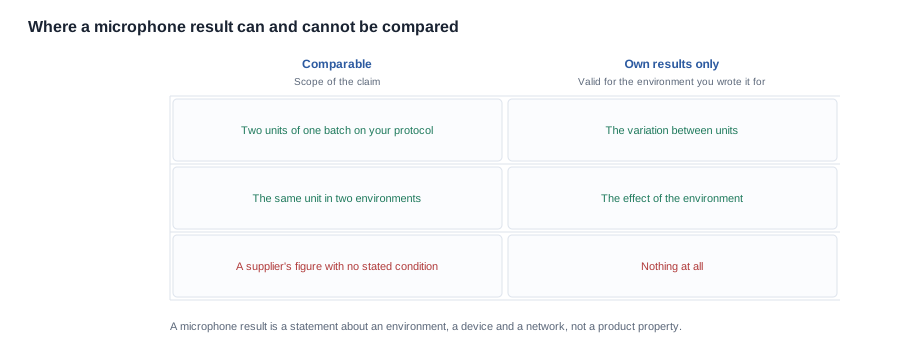
A result is comparable with another result only when the conditions match. This single rule sorts most of the confusion in this category, and it is worth applying before anything else is debated.
A result you produced yourself is valid for the environment you wrote it for. That is the only environment it covers, and the coverage has to be stated in the document that carries the result.
Two units of one batch measured on your protocol tell you the variation between units. That is the number you need to set an incoming inspection tolerance, and it is the number most often missing from a quality file.
The same unit measured in two environments tells you the effect of the environment. That is a design input rather than an acceptance criterion, but it is the number that explains why a vehicle channel behaves differently from an office channel.
A supplier's figure with no stated condition tells you nothing. Not approximately nothing. Nothing, because there is no way to establish whether the condition matches yours.
A pass in the target environment means the product is fit for that environment, and it is worth stating precisely because microphone results are routinely read more widely than their conditions allow. A pass in a quiet room means the capture path works, and nothing more. A failure in the target environment means the scope has to change — a different platform, a different environment, a different listing claim, or a different product line. A difference between two units of the same batch is a manufacturing conversation, and it needs a different remedy from a design change; arguing about both as one issue is how a process fault becomes a hardware order.
The file set that ties a measurement to a model
The signed protocol sheet with its conditions. The model designation table, so that the result is attached to the model being bought rather than to a family. The certificate register at certification checklist. The packaging artwork proof. The agreed incoming inspection criteria carrying the pass lines. The battery transport documentation at battery transport. The clause language at contract terms, and the commercial structure of a first order at pricing. The production-side procedure is at open-ear audio quality control, and the scheduling question that follows a failed protocol is at microphone quality lead time factors.
What can move in this negotiation, and what cannot
The capture path — the capsule count, the placement, and therefore the ceiling in every environment — is fixed before the commercial conversation starts, because it is a property of the design and the tooling. Certification cost and certification lead time are fixed in the same way. Tooling is fixed in amount but amortisable across the first order, and it should be quoted as a separate line rather than buried in the unit price, so that the second order's true economics are visible.
What can move is everything that is a commercial arrangement rather than a physical fact. Whether the supplier will run the protocol against production units rather than engineering samples, and whether they will supply the recordings so the buyer can re-judge them. The minimum order quantity tiers, and whether the microphone test applies to every shipment or only to the first. The quantity of a first order that stays at pilot tier. Colour, temple configuration, logo, lens tint and packaging. Splitting a first run into two deliveries against a staged payment. Those are the levers a buyer actually holds, and the questions to ask about them are the standard ones at procurement pricing.
A worked sourcing decision across two candidate environments
The scenario below is a hypothetical sourcing case rather than a client project, set out to show the order in which the steps actually run.
A brand buyer is opening a first order for an audio platform. The supplier publishes a Bluetooth 5.4 platform with two 55 mAh cells and a rated window of roughly eight hours, magnetic charging, and it offers an open-ear acoustic structure with directional audio and intelligent noise reduction. Two channels are in scope: an indoor operational channel and a fleet channel where the product is used in a moving vehicle.
The first decision is which environment governs. The fleet channel, because a failure there is visible to the end customer in a way an indoor failure usually is not, and because the vehicle case is the one a supplier will not have tested unless it was asked for. The buyer writes that into the request before any sample is despatched, which is the cheapest point at which to make it.
The second decision is the order of the tests. The quiet room first, as a gate, because a unit that fails there does not need the remaining budget spent on it. The office condition second, because it is the channel with volume. The vehicle condition third, because it is the one that decides the listing claim.
The third decision is what the result licenses. If the unit passes the vehicle condition with margin, the listing can describe a voice product for a fleet channel. If it passes the office condition and fails the vehicle condition, the scope changes: the fleet channel either moves to a different platform, or the listing claim is narrowed to the office condition, and the buyer tells the supplier in writing that the vehicle condition was part of the original request. That written record is what makes the narrowing a scoping decision rather than a dispute later.
The fourth decision is the incoming inspection. Two units from the first delivery are tested on the same protocol, and the variation between them sets the tolerance for the second delivery. Without that number, the buyer either rejects good goods or accepts bad ones, and both outcomes are expensive at volume.
The fifth decision is what the listing says. If the fleet channel survives, the listing describes the published configuration and the environment the result was established in. If it does not survive, the listing describes the office condition only. What the listing never does is carry a microphone performance phrase with no condition attached, because a claim that cannot be falsified cannot be enforced and cannot be defended when the first customer complains.
Where we will and will not go on this subject
Our published position is that we publish no microphone specification, because none has been confirmed to us, and we will not quote a typical performance figure for the category or present a processing feature as a measured result. We will also be direct about the limit of that position: a microphone result is a statement about an environment, a device and a network, and a buyer who wants a number that can be printed has to ask for the measurement and accept the conditions that come with it.
What we can do is more specific than a general offer. Give us the environments, the platforms your customers call from, the models being evaluated and the network conditions in play, and we will tell you which of the five environments decides the project, which published rows apply to that configuration, which claims have to come out of the listing before a purchase order is signed, and what the protocol sheet should contain. The background is at noise control and microphone pickup, and the reason the microphone carries so much of the commercial risk in a voice channel is set out at why microphone quality matters.
Send us the environments and the platforms, and we will say which one decides the purchase.
Related reading
- The underlying technology — noise control and microphone pickup
- The measurement procedure — how to measure microphone quality
- The production-side procedure — open-ear audio quality control
- Why it matters commercially — why microphone quality matters
Tell us the environments and the platforms, and we will say which of the five environments decides the purchase.


