

A microphone specification is a claim about an environment, and that is what makes it difficult to buy. Two suppliers can both write an attenuation figure and mean completely different experiments. One measured broadband attenuation in a quiet room, the other measured a low-frequency figure in a simulated traffic environment, and a buyer who compares them side by side is comparing two different measurements of two different arrangements.
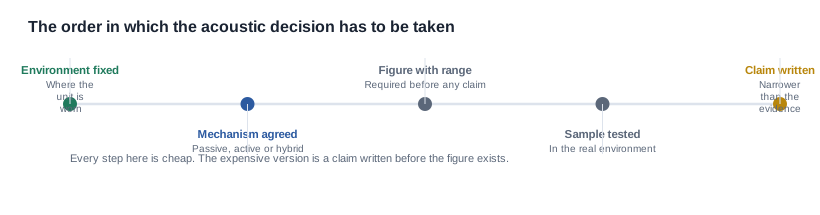
The decision in front of a buyer is therefore not which microphone is better. It is three decisions in a fixed order. Decide the operating environment first, because that determines whether you need a passive arrangement, an active one or a hybrid, and the three cost different amounts and solve different problems. Then decide the claim, because a claim wider than the evidence is a regulatory and commercial exposure that a well-measured product does not cure. Then require the supplier to show the performance figures under that environment rather than in a laboratory, with the conditions attached.
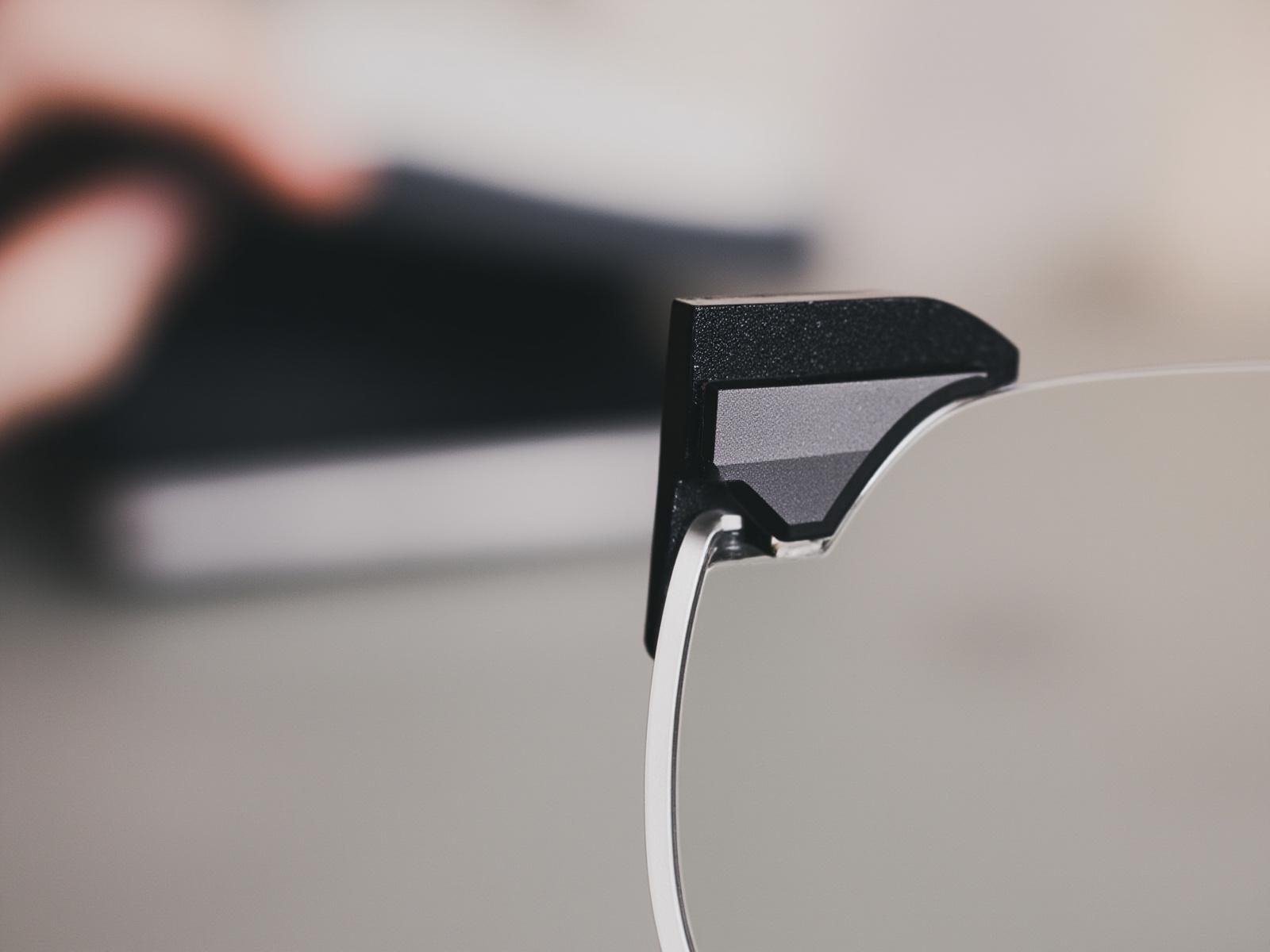
Our own published position explains why this has to be a negotiated specification rather than a published one. The catalogue names audio features at model-row level — a surround sound mode appears on the D17 and the YK12, the D11 and the YKC02, and the ZH12 — and the company profile lists directional audio and intelligent noise reduction among the technologies the operation works in. Neither of those is a measurement. Not one model in the range publishes a microphone count, an attenuation figure, a frequency response, a noise floor, a beamforming description or a third-party acoustic test result. The audio rows in this category are capability descriptions, and a buyer has to convert them into specification.
Smart glasses microphone quality: an undocumented system
The reason acoustic claims in this category fail is that the word covers at least four different arrangements. A passive arrangement uses geometry, porting and damping to keep an unwanted sound out of the microphone path, and it costs nothing in power and nothing in housing. An active arrangement uses microphones to capture the unwanted sound and a processing path to subtract it, and it costs power, processing, a control path, and usually additional microphones. A hybrid arrangement does both. And a per-unit arrangement is different again from an arrangement where the cancellation runs across two units in a case.
Each of those four produces a different attenuation figure, in a different frequency range, under different conditions, and each of them carries a different bill-of-materials consequence. That is why the first question to a supplier cannot be "how much noise cancellation" — it has to be "which arrangement, per unit or across units, and what does it cost in the bill of materials".
The second reason the system matters is that the microphone is one link in a chain and the chain is the product. The chain runs from the acoustic environment, through the microphone and its placement, through the analogue path, through the processing, through the codec and the radio, to the application on the other end. A figure measured at the microphone tells you about one link. A figure that a customer experiences as "the caller could hear me" is a property of the whole chain, and it is not measurable from any single component's datasheet.
The third reason is the control path. A feature that depends on a setting — a mode, a button, a long press, a configuration in a companion application — describes a configuration the customer will not necessarily be in. If the default state defeats the feature, then the published figure describes a state that a customer has to discover and activate, and most of them will not. This is a verification item, not a design detail, and it is where a great deal of the gap between a published figure and a field result comes from.
There is a fourth issue that the catalogue makes concrete. The one product row in our range that prints an amplification figure is the bone-conduction entry, which states an amplification gain of 35 dB, a rated runtime of about seven hours, a 200 mAh cell and Type-C charging. We publish that row as it stands, and we make no hearing-aid claim, no hearing-improvement claim and no medical claim for it in any market, because a product that amplifies sound is not a clinical device and a listing that implies otherwise is a regulatory exposure rather than a marketing decision. A buyer who sells into a market where that distinction is enforced should be told it now, not after the copy is written.
What the catalogue publishes about audio, and at what level
It is worth separating the three levels at which audio information appears in this category, because they are routinely mixed together and a buyer who mixes them will build a claim on the wrong one.
The model-row level is where a feature name sits next to a cell and a runtime. The D11 publishes a surround sound mode and a long-endurance description alongside a 100 mAh cell, a charge time of two hours or less, a rated runtime of about seven hours, Type-C charging and Bluetooth V5.4. The YK12 publishes a surround sound feature and a slim temple alongside two 55 mAh cells, magnetic charging and a rated runtime of about six hours. The YKC02 publishes a surround sound feature and a long battery life description alongside two 70 mAh cells, magnetic charging and a rated runtime of about eight hours. The D17 publishes a surround sound feature, a remote photo control, a 115 mAh cell, Type-C charging, a charge time of about one hour and a rated runtime of about seven hours. The ZH12 publishes a stereo surround sound description and a remote photo control alongside a 100 mAh cell, Type-C charging, a charge time of about one hour and a rated runtime of about eight hours.
That is a useful list for a buyer, because it identifies the five rows in the range where an audio mode is a distinguishing feature rather than a given. It is not an acoustic specification, and it should never be quoted as one.
The company-profile level is where the operation states its capabilities. Our profile lists smart audio technology, low-power solutions and human-machine interaction as areas of work, and names directional audio, intelligent noise reduction and high-definition imaging among the technologies it provides. This tells a buyer that the engineering exists in-house, which is a sourcing fact, and it tells them nothing about any individual model.
The measurement level is where the acoustic numbers would live, and it is empty in our documentation and, as far as we can tell, in most of the category. No model publishes a microphone count. No model publishes an attenuation figure. No model publishes a frequency response or a noise floor. No model publishes a description of the processing. No third-party acoustic measurement is published for any product in the range.
The consequence for a buyer is that the measurement level has to be created, and creating it is a procurement activity rather than a research activity. The questions to ask are the ones set out below, and the answers come from the supplier's own engineering file rather than from a published specification.
There is one more distinction worth holding onto, because it is the one that determines how much a buyer should trust any acoustic number in this category. A measured figure and a specified figure are different things. A specified figure is a target the supplier has committed to and will test against internally. A measured figure is a result from a sample under stated conditions. Both are legitimate, and they are used in different places. A specification is what you put in the purchase order. A measurement is what you put in the listing. Mixing them up is how a product ends up with a number on the page that the order never committed to.
Fixing the operating environment before the mechanism
The mechanism choice is a consequence of the environment, and the environment is a consequence of the channel. This is the step that most programmes skip, and skipping it means every subsequent discussion is a comparison of arrangements the buyer does not need.
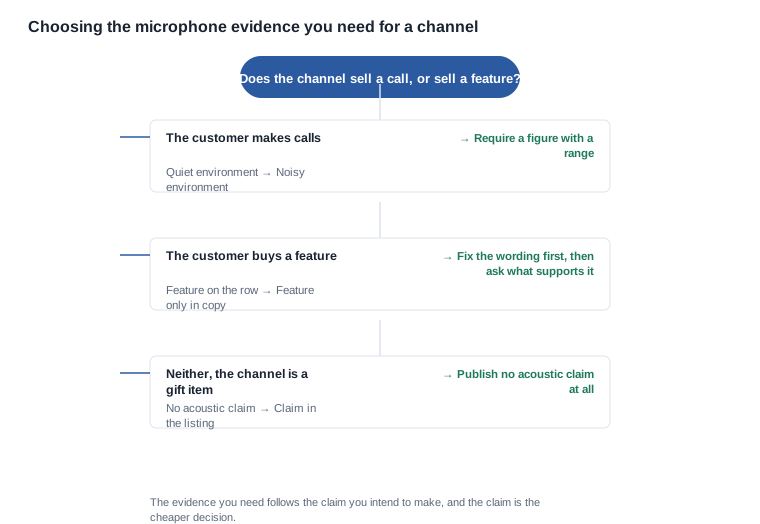
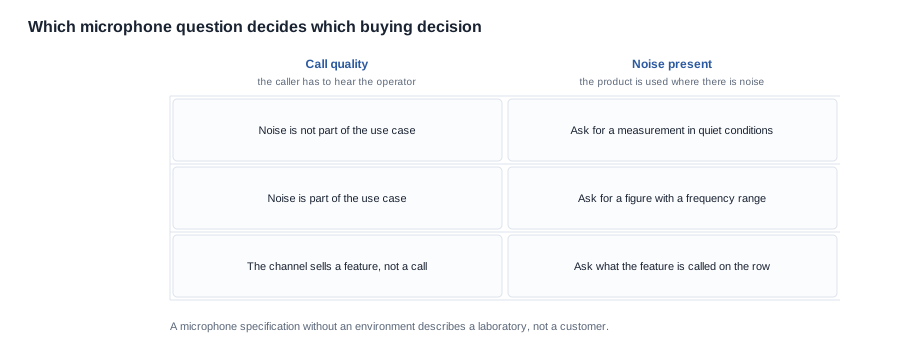
A channel where the product is used in a quiet environment — an office, a desk, a retail counter — does not need an active arrangement at all, and the decision is whether to specify one anyway. The argument for specifying it is a product story that can be tested and a listing that can be differentiated. The argument against is a bill-of-materials cost, a power cost, and a control path that a customer has to activate. A buyer who takes the first argument without the second ends up with a product that carries a feature nobody switches on.
A channel where the product is used in a noisy environment — a workshop, a vehicle, a warehouse, a street — needs the environment described precisely before anything else, because "noisy" is not a specification either. Ambient level, spectral character, whether the noise is steady or intermittent, whether the operator is moving, and whether the call happens in the same room as the noise all change which arrangement works. A steady low-frequency noise and an intermittent broadband one are solved by different means, and the difference in the required attenuation is large.
A channel that sells an audio feature rather than a call has a third set of questions, and they are commercial rather than acoustic. What is the feature called on the row, what does the copy say about it, and what evidence supports that wording. For the models in our range that publish a surround sound description, the feature name is published and the performance is not, which means the wording in the listing has to stay inside what the name implies.
There is a fourth case that is easy to leave out and expensive to discover late: the product is used in an environment where there is no call to make at all. A channel selling video capture has a microphone requirement only in the sense that the microphone must not damage the audio track of the captured video, and the decision to make is whether the microphone is even fitted, and if it is, whether the audio path is characterised at all.
Once the environment is written down, the arrangement question becomes answerable. And once the arrangement is settled, the remaining decision is not acoustic at all: what the arrangement adds to the bill of materials, what it costs in power, what it adds to the housing, and what the default control state is. Those four numbers are what a quotation should contain alongside any acoustic figure, and a quotation that contains the figure without them is a quotation that has hidden a cost.

Turning an acoustic claim into an acceptance criterion
The verification path here is short, and it is the same whether the arrangement is passive or active. The difficulty is not the technique; it is that a buyer has to ask for the conditions before the number, because once a number has been quoted it is very easy to lose the conditions in the transfer from an email to a spreadsheet.

Step one, write the environment down. Not a marketing description of the environment — the actual test environment the sample will be evaluated in, with the noise type, the level, the distance and the motion condition. This document comes before the first reading, because an environment written afterwards is chosen to match the result.
Step two, ask for the arrangement and the mechanism. Passive, active or hybrid, per unit or across units, and what the control path is and what the default state is. This is the step that distinguishes a supplier who has engineered the product from one who has described it.
Step three, ask for the figure with its frequency range and its method. A broadband number and a low-frequency number describe different arrangements, and the difference between them is exactly the range a customer notices. If a supplier cannot state the range, the environment and the method, then the figure is not usable in a specification and should be removed from the comparison table rather than propagated into it.
Step four, test it on your own sample, in your own environment, against a protocol written in advance. For a passive arrangement this is a subjective comparison against a reference unit, which is weaker evidence than a measurement and should be recorded as such. For an active arrangement it is a repeatable test with a known noise source. Either way, the record has to say what was done, because a test that cannot be repeated by a second buyer is not evidence.
Step five, write the figure and the condition into the acceptance criteria. The number belongs in the order with its range, its environment and its method attached. If it is only in an email, it is not binding, and a lot that fails it is a lot you cannot refuse.
The red flags in an acoustic quotation are ordinary. An attenuation figure with no frequency range. A mechanism described as noise cancellation with no indication of whether it is passive, active or hybrid. A feature that depends on a control nobody can find. A quoted figure whose conditions turn out to be a laboratory rather than the channel's environment. Each is cheap to close at the quotation stage and awkward to close once the listing is live.
The commercial cost of a microphone arrangement nobody specified
An acoustic arrangement is a specification dependency, not a free upgrade, and the cost of it belongs in the quotation rather than in a feature list. The bill-of-materials consequence of an active arrangement is real: extra microphones, a driver circuit, a processing path, a control interface and a measurable power draw. Each of those has a unit cost, and each of them has a minimum, because a sub-supplier will not sell a single microphone for a single unit. A programme that mixes variants across a range creates a packaging and labelling problem on top of that, because a variant is a different part number and a different barcode.
The commercial question in this category is therefore less about unit price and more about which configurations are actually orderable, how many of them there are, and what the minimum is for each. That is a question worth asking in the first round of an enquiry, because a supplier who has five microphone variants and one of them is not orderable below two thousand units has told you something about the programme before the price is discussed.
The clauses worth having in the agreement are the arrangement as a named configuration attribute, the figure with its frequency range and its environment, the default control state, the interaction with the primary audio path, and the documentation that has to travel with the product for the destination market. Where a performance claim appears in marketing, the agreement should say which figure may be used, and the sample evaluation should be where the claim is confirmed rather than where it is first noticed.
One clause is worth more than the others in practice, and it is the one about the default control state. If a buyer agrees that the arrangement is active by default, then the published figure describes the state a customer will actually be in, the product does not need an instruction for the feature, and the support script has one fewer branch. If the buyer agrees that the arrangement is off by default, then the figure describes a state the customer has to find, the listing copy has to say so, and the support script has to carry the instruction. Both are legitimate commercial positions. What is not legitimate is leaving it unspecified, which is how a published figure ends up describing a configuration nobody ships.
The total-cost framing helps here, because it is what makes an acoustic decision comparable with the rest of the programme. The total cost of a product is the unit price plus the returns reserve plus the cost of the documentation route, and for a product that makes an acoustic claim the returns reserve is the line that moves, because an acoustic complaint is a complaint a customer describes in terms of a person on a call rather than in terms of a specification.
Where our own audio data stops, and what we will not claim
The short answer: we publish the rows we hold and mark the rest as open, and we would rather show you an empty acoustic row than a plausible value in it.
What our published data does settle is the audio feature description on the five rows that carry one: the YK12 and the D11, the D17 and the YKC02, and the ZH12. Alongside those it settles the cell configuration, the charge time, the rated runtime, the charging method, the Bluetooth version, the temple descriptions on the G07 and the YK12, the remote photo control on the D17 and the ZH12, and the amplification gain figure on the bone-conduction entry.
What we will not do is quote a microphone count, an attenuation figure, a frequency response, a noise floor, a beamforming description or an acoustic test result from a photograph, a brochure, a sub-supplier's general data or a competitor's comparison sheet. We will not fill an acoustic specification gap with a number that cannot be traced to a document, and we will not present a surround sound feature name as though it were a measured performance.
We also make no hearing-aid, hearing-improvement, medical, vision or eye-protection claim for any product in this range, in any market. That includes the bone-conduction entry whose catalogue row publishes an amplification gain. A product that amplifies sound for the person using it is not a clinical device, and we would rather say so before a programme is scoped than after a listing has been written.
What we will do is take a use case, a configuration, an environment and a market, and tell you which parts of the audio position are settled, which are open, and which have to come from the supplier's own engineering file. That is a more useful answer than a number we could not defend.
If you send us the models, the quantities, the environment the product will be used in and the target market, we will tell you which audio rows our documentation answers and which ones you have to establish on your own units. The comparison method is in choosing a platform on microphone claims, the specification traps are in microphone quality red flags, and the testing protocol is in how to test microphone quality. The background sits under noise control and microphone pickup and the range is at bluetooth audio glasses.
Related reading
- The specifications a buyer should not accept without a number — microphone quality red flags
- Comparing two platforms on the same axis — choosing a platform on microphone claims
- Turning a claim into a recorded result — how to test microphone quality
- noise control and microphone pickup
- bluetooth audio glasses
Send the configuration, the quantity, the environment and the market, and we will say which parts of the audio specification are settled and which are yours.


