

Almost every microphone claim in this category is written in the language of a benefit rather than the language of a measurement, and the two are easy to tell apart if you know what to look for. A measurement has a number, a condition and a method. A benefit has an adjective. This article takes the eight claim types we see most often, explains what each is actually asserting, and gives the question that separates the two. The point is not scepticism for its own sake: a claim you cannot defend becomes a refund, and a claim you can defend is an asset in a competitive listing.
The buying task behind a claim audit. The reader is a buyer comparing two or three suppliers whose catalogues all lead with a microphone claim, or a channel buyer reading a listing from a competitor and deciding whether it represents a product the supplier can actually build. The task is to separate the claims that describe a mechanism from the claims that describe a result, and then to decide what to ask for in return. The commercial risk is specific in both cases: a claim that turns out to be unsupported becomes a refund, a marketplace complaint or a return that the channel cannot explain, and the cost of defending a claim after launch is far higher than the cost of removing it before.
Smart glasses microphone quality: eight claim types, and what each one asserts
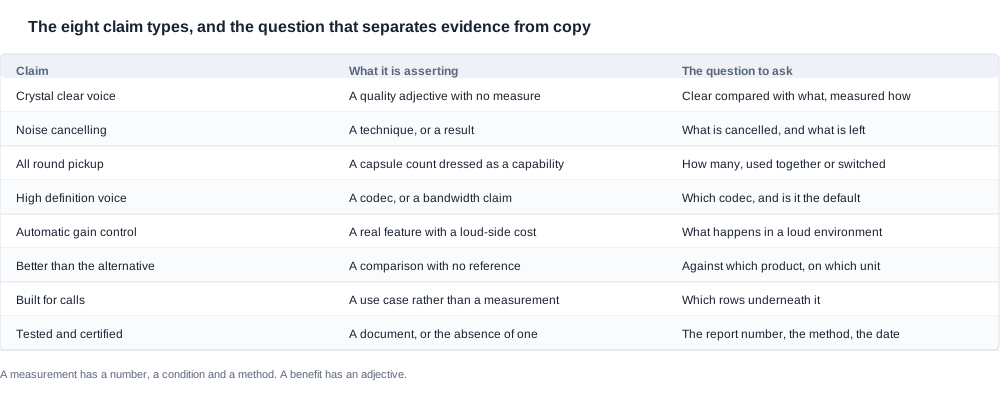
Crystal clear voice. A slogan with no measurement in it. The question that exposes it: clear compared to what, measured how, and at what distance.
Noise cancelling. This one is ambiguous, because it can describe a technique or a result. It can mean an algorithm in the signal path, a beamforming arrangement, or a physical isolation. The question is what is cancelled and what is left, because a claim that says nothing about the residual is not a result.
All round pickup. This is usually a microphone count dressed as a capability. The question is how many microphones there are, and whether they are used together as a beamforming pair or switched between one at a time. The two behave very differently when the wearer turns their head.
High definition voice. Almost always a codec or a bandwidth claim. The question is which codec, and whether it is used by default or only when the far end supports it. A product with a codec in the list and a different one in use is a common disappointment.
Automatic gain control. A real feature and a common source of disappointment at the same time. It keeps the voice level steady as the distance changes, and it does that by amplifying a quiet voice, which in a noisy environment means it amplifies the noise too. The question is what happens in a loud environment.
Better than the alternative. A comparison with no reference, or with a reference that cannot be checked. The question is against which product, on which sample, measured with what script. A fair comparison requires the same test on both units.
Built for calls. A use case rather than a measurement, and the most useful of the claims because it can be traced back to the rows above. The question is which of them it rests on.
Tested and certified. This is either a document or the absence of one. The question is the report number, the standard, the method, the sample size and the date. A phrase like this without a reference is the claim most worth challenging.
Why these eight rather than others. They are the eight that appear on a listing or in a quotation in this category, and each of them resolves to a different kind of answer. Five of them resolve to a documentary answer, which the supplier can produce or decline. Two of them resolve to a description of hardware, which takes one meeting. One of them, the comparison, resolves to a test protocol. Knowing which kind of answer a claim needs is what tells a buyer whether to expect a document, a drawing or a measurement in reply.
The cost asymmetry that makes this worth doing properly. Removing an unsupported claim before the artwork is printed costs an afternoon and a line of copy. Defending it afterwards costs the returns, the reviews, the channel negotiation and the rework of every printed element, and the amount of the claim is not related to the amount of the cost. A claim that is overstated by a small margin is not a small problem; it is a claim that will fail on the customers who push hardest against it, which is a biased sample of the customers most likely to complain. This is why the audit belongs in the sourcing stage rather than in the marketing stage, even though the damage always arrives in marketing.
The two structural questions that sit behind all of them
Is the figure measured on the product or on the component? A microphone datasheet describes a capsule in a test fixture. The number that matters to a buyer is the one from the finished assembly, where the capsule sits in a housing, behind a port, on a moving head, at a distance from the mouth. The transfer between the two is large and it is never in a datasheet.
This is the single most useful question a buyer can ask about a microphone claim, and the reason it is useful is that it separates a claim that is verifiable from one that is merely quoted. A supplier who has measured the assembly will have a method and a set of conditions, and will be able to say so. A supplier quoting a capsule figure will usually present it as a product figure without being asked to distinguish them, which tells the buyer that the claim on the listing was copied from a component document.
Is the test the customer's environment? A quiet room, a prepared phrase and a known-good network produce a result that has almost nothing to do with a warehouse, a street or a call in a car. The claim survives only if the condition travels with it.
Why the two questions are worth more than the eight claim types. A buyer who memorises eight questions will have to remember eight questions, and will apply them unevenly. A buyer who holds two questions — the assembly or the component, and the customer's environment or a laboratory — can generate the specific question for any claim on any listing without a list, including for claims that were not on the list of eight. That is the difference between an audit and a checklist, and it is what makes the audit reusable on a competitor's listing as well as on a supplier's quotation.
The question behind the two. Both of them are variations on the same underlying question, which is whether the claim describes the product the buyer is about to buy, in the condition the buyer's customers will put it in. When a claim survives that question, it is evidence. When it does not, it is a statement about a laboratory, a component, or a different environment than the one that matters.
A sorting method: a number, a condition, a method
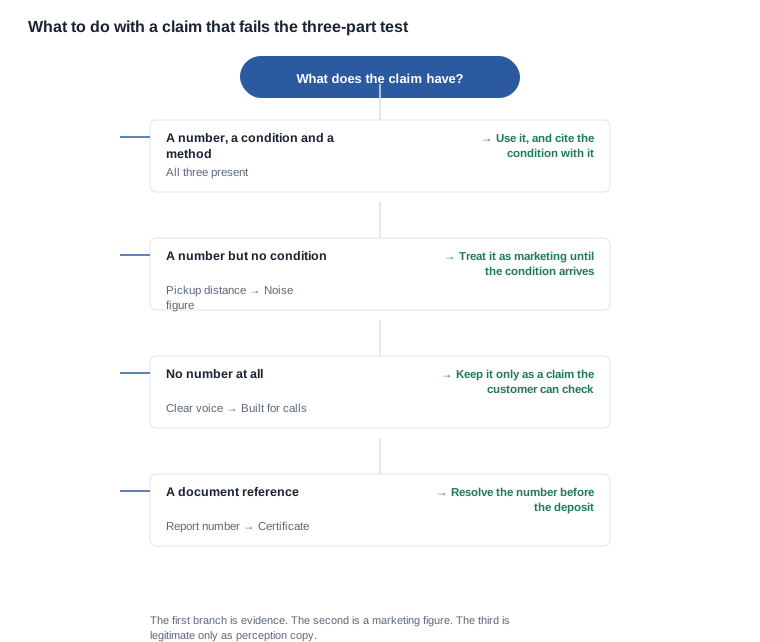
Take any claim and ask three questions in order. Is there a number? Is there a condition? Is there a method? A claim with all three is evidence. A claim with a number and no condition is a marketing figure. A claim with none of them is a slogan, and it belongs in the listing only if it is something the customer can perceive for themselves, which is a legitimate use for it, provided it is not dressed up as a specification.
The distinction matters most in the two places where the customer can check for themselves. Can I hear the person? Is the noise gone? Those are perception questions, and for those a carefully worded qualitative claim is honest and effective, while a number would be a false precision.
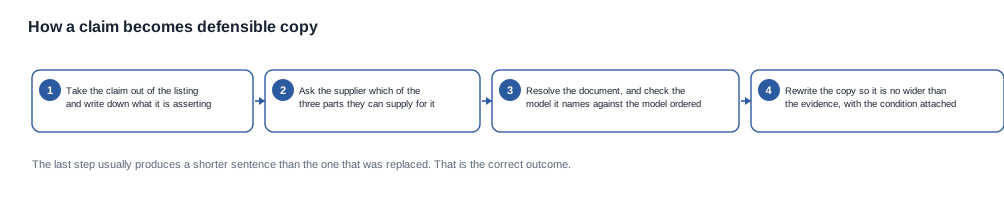
What to do with each result. A claim with a number, a condition and a method can be used, and it should be cited with the condition attached, because a figure without its condition is the thing that causes the next argument. A claim with a number and no condition should be treated as marketing until the condition arrives, and the question to send is what the condition was. A claim with no number can still be used, provided it stays in the perception category and is not turned into a specification by a distributor's copywriter later. And a claim that references a document should be resolved before the deposit, because a reference that does not resolve is the same as no reference at all.
Why the order of the three questions matters. Asking for the method first tends to produce a technical answer about the supplier's own rig, which is not what the buyer needs. Asking for the condition first produces a sentence the buyer can use to design a test, which is immediately actionable. The number, if it exists, is the least important of the three, and it is the one that tends to be quoted back at you by a competitor's sales team.

Auditing a competitor listing as a sourcing input
A competitor's listing is a useful document, and it is useful in a way that is rarely recognised: a claim you cannot substantiate tells you which questions to ask your own supplier, because a claim that is being made widely is usually being made by everyone.
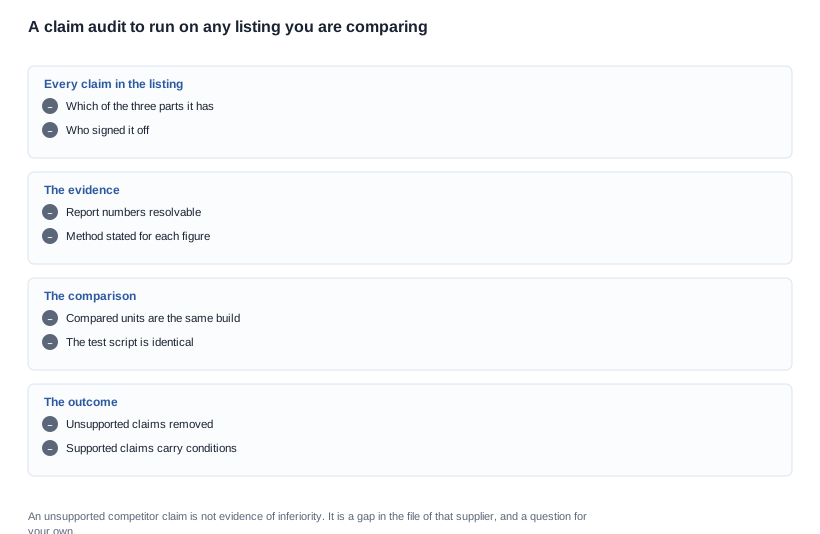
The procedure. Take the listing apart into its individual claims. For each claim, apply the three questions and record the answer. Then, for each claim that produced a number, note the condition and the method if either is present, and if neither is present, mark the claim as unsupported. Then write the question that would resolve it and send that question to your own supplier, without naming the competitor.
Why the question should not name the competitor. A supplier asked to explain a competitor's figure will either decline, because it is not their measurement, or will produce a number of their own to compete with it, which is a number without a condition. A supplier asked for a measurement on the conditions that a third party published will produce a number with a condition, and the result is directly comparable. The second question is better in every case, and it is also the more professional one to ask.
What the audit tells a buyer about the market. A claim type that appears on every listing in the category is a claim type that every supplier can make, and it therefore carries no information about any of them. A claim type that appears on one listing and is absent from the rest is either a genuine differentiator or a mistake, and the two are distinguished by whether the claim can be traced to a document. That is a useful signal to have before the shortlist is made, and it costs an afternoon.
The red flags to watch for in the audit. A number that appears without a unit. A comparison that names a competitor but not a model, or a model but not a configuration. A certification phrase with no reference number. A figure that is precisely stated to one decimal place in a category where nothing is measured. And a claim that describes the result without describing the condition, which is the most common form of the problem and the one that appears in the widest range of listings.
What to do with the result. Two outputs, and the first is more useful than the second. The first is the question list for your own supplier, which is a list of rows to request and a list of conditions to specify. The second is a shortlist adjustment: a supplier whose claim set is entirely unsupported is a supplier whose file is thin, and a buyer who is choosing between suppliers on price will find that the thin file becomes expensive later.
Which claims belong in a listing, and which belong in a specification
The separation is between two audiences, and it is worth making explicitly because the failure mode in this category is usually a specification being written for a customer-facing audience.
Claims that belong in a specification. Anything that will be verified, priced, or used as an acceptance criterion. The capsule count and position. The capture response with its range and tolerance. The self-noise figure with its method. The codec and profile list with the default marked. The leakage figure at a stated distance. These are rows in a table, and they travel with the model designation, the conditions and the date.
Claims that belong in a listing. Anything the customer can perceive for themselves, phrased in the customer's terms. That the device is built for calls. That it sits in an open-ear architecture so the surroundings stay audible. That the audio is tuned for a stated environment. A claim of that kind is honest and effective, and it is also the claim that survives a marketplace review, because a reviewer is checking whether the listing describes the product rather than whether the product has a figure attached.
The two sentences that should never appear in either. A figure with no condition, and a comparison with no reference. Both are the same defect in different clothing, and both are red flags in an audit of a competitor's listing as well as in a review of your own copy.
The commercial negotiation that follows an audit. The documents to request are the same ones a claim requires: the report number with the issuing body, the method and the date for any figure, the model list the report names, and the sample identity. What is negotiable is the number of claim types a supplier is willing to support with a document, the number of models the file covers, the artwork round count, the per-market label scope, and the retention held against the documentation package. What is not negotiable is the cost and the elapsed time of the conformity work itself, and the position of the product on a claim that a regulator would have to review.
The clause that closes the loop. Put the supported claim and its condition into the purchase order, so that the artwork is reviewed against a contractual position rather than against a marketing preference. Then require notice before any change to the capture chain, because a change can invalidate a claim that has already been printed, and a printed claim is the one that costs money.
Where our own catalogue stands on claims
Our catalogue publishes no microphone specification for any model, so none of these claim types are ones we make. The audio family names open-ear acoustic structure, directional audio and smart noise reduction as its key technologies, and those are descriptions of an approach rather than results. We publish no pickup distance, no noise figure, no microphone count, no frequency response, no distortion figure and no third-party report, because the company has not confirmed them.
The practical consequence is that if a buyer is comparing two suppliers, one of whom publishes a microphone report and one of whom does not, the second supplier has not demonstrated inferiority. They have simply not demonstrated anything. The question to put to them is what they can produce on request, and the answer is more useful than a comparison built on one side's marketing.
What we will do with a claim. Send us a microphone claim and we will tell you which of the three parts it has, and which questions would have to be answered to support it. That is a service we can offer because the claim is usually a piece of copy and the three-part test is a short examination, and because the answer tells a buyer where to spend the next half hour of the evaluation.
What we will not do. We will not estimate a pickup distance or a noise figure from typical values, because those are the numbers that end up on a competitor's box and get quoted back at us. We will not repeat intelligent noise reduction as though it were a specification. And we will not rank products on acoustic performance we have not measured, because a ranking is a claim and it would fail the same three-part test that this article applies to everybody else's.
What we can evidence. The published configuration for any model we quote: the audio family names, the Bluetooth versions — 5.3 on the K01 and the K02, 5.4 on the LC-105-1 and the D11, the D12 and LC-105-2, and the YK12 and the G07 — the cell configurations, the charge times, the runtimes and the charging method. The sport models publish the same rows on Bluetooth 5.4, on the YKC02, the D17 and the ZH12. The bone conduction entry publishes a 200 mAh cell, a roughly seven-hour runtime, Type-C charging and an amplification gain of 35 dB, which is an output-stage parameter with a compliance tail rather than a capture claim, and we would rather state that than let it be read as one. The models the claims refer to are at Bluetooth audio glasses, the technique the family is built on is at open-ear audio, and the protocol for checking a claim yourself is at supplier verification.
Related reading
- The technique the family is built on — open-ear audio
- The protocol for checking a claim yourself — supplier verification
- The models the claims refer to — Bluetooth audio glasses range
- The certification side of the same component — microphone quality and certification
Send us a microphone claim and we will tell you which of the three tests it passes and what evidence would be needed to support it.


