

The microphone in a pair of smart glasses is an awkward component, and not because it is difficult to specify. It is awkward because it sits inside three regulatory systems at once. It is an audio component whose quality decides whether a call works. It is a source of radiated emissions and a receiver of interference, which places it inside the radio and electromagnetic compatibility assessment. And it is the first sensor in the device that a person's voice reaches, which places it inside the cyber security and privacy documentation. A buyer who treats the microphone as a specification row will miss two of those three, and the two most often missed are the two that stop a shipment rather than the one that stops a purchase order.
Because no supplier in this category publishes a microphone specification, the practical route is a documented file: what was assessed, what changed afterwards, what the data path does, and which document covers which model. The questions below are the ones that can be closed in writing, and the ones that have to be closed by a compliance team.
Smart glasses microphone quality: why three certification systems apply at once
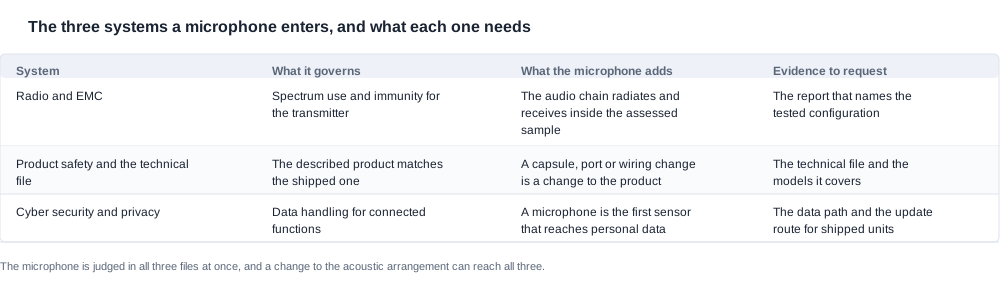
The three files a microphone has to appear in
The radio and electromagnetic compatibility assessment is the first. The Radio Equipment Directive (EU) 2014/53/EU is the directive that governs equipment using the radio spectrum, and the EN 301 489 series is the harmonised standard series used for the electromagnetic compatibility aspects of radio equipment. A microphone and its preamplifier are a small circuit operating next to a radio inside a housing that has a metal temple on one side and a battery on the other. A product that passed the spectrum assessment as configured may behave differently once the audio chain is added, bypassed or re-routed, and the question for a supplier is narrow and answerable: was the audio circuitry inside the sample that was assessed, and is the sample described in the report the product that ships.
The product safety file is the second. The General Product Safety Regulation has applied since 13 December 2024 in the European Union and covers consumer products placed on the market there, including the product safety file, the risk assessment and traceability. The microphone enters this file in an unglamorous but decisive way: the product described in the technical documentation has to be the product that was assessed. A swapped capsule, a moved port position or a rerouted wire inside the temple is a change to the product, and the file has to reflect the configuration that reaches the customer.
The cyber security and privacy documentation is the third, and it is the one that a microphone pulls into scope by existing. A radio that carries a voice function has to describe what it does with the data, and the microphone is the entry point for that data. The EN 18031 series of harmonised standards covers secure communication, encryption, secure storage, user consent and the handling of security vulnerabilities for radio equipment, and from 1 August 2025 the cyber security requirements of the Radio Equipment Directive become a mandatory part of CE marking. That third file is discussed in its own section below, because the questions it raises are different in kind from the first two.
The buying position and what is being defended
The reader here is a brand-side compliance manager, a sourcing manager, or a product owner who has been asked to sign off a product that will cross a border and sit in a retail channel. The concrete problem is that the microphone is invisible in the conformity file in the same way it is invisible in the specification: the file names a model, the model carries a radio, the radio passed. Nothing in that chain tells the reader whether the audio chain was inside the assessed unit, and nothing in it tells the reader what the microphone does with the audio it collects.
Three situations produce the question. The first is a new model in a market that has not been entered before, where there is no precedent document to lean on and everything has to be assembled from the supplier's position. The second is an existing model with a changed acoustic arrangement, which is the case where a supplier's answer and a buyer's assumption diverge most sharply, because the supplier considers it a component swap and the buyer is reading a change to the product description. The third is a voice function added to a platform that was previously certified without one, which is the scenario that drags the microphone into the third file as well as the first two.
What the buyer is defending is the ability to answer a question, usually from a broker, a marketplace reviewer or their own compliance team, without a two-week email exchange. That ability is a document property, not a relationship property, and the questions below are the ones that turn it into one.
The certification questions a supplier has to answer in writing
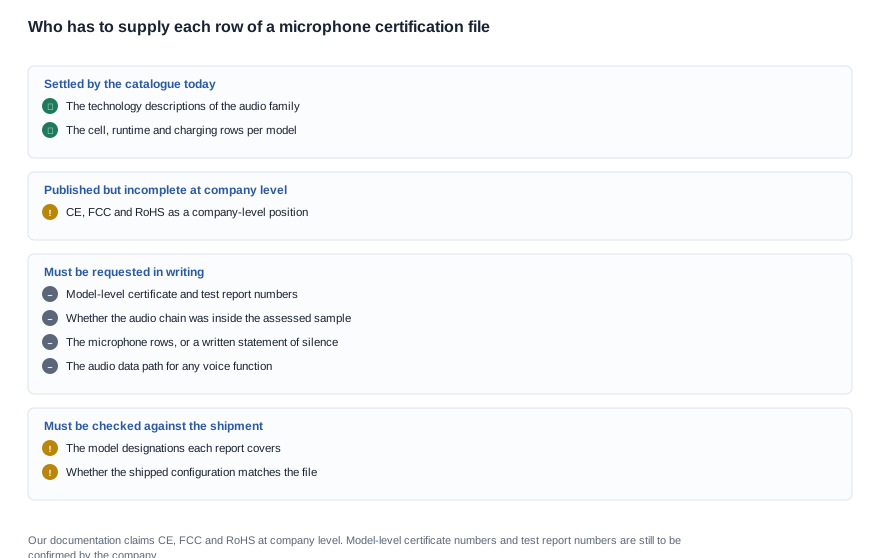
The questions that only a written answer can close
Ten questions, in the order they should be asked, and each one closes a specific file rather than a general doubt.
- Which model designations are named on the assessment report, and does that list include the configuration you will ship?
- Was the audio chain fitted on the sample used for the assessment, and is the assembly described in the report?
- Do the model-level certificate numbers and test report numbers exist, and what are they?
- Does the technical file for the model cover the acoustic arrangement as built, or does it describe a reference configuration?
- What is the microphone count and position for each model, and is that stated per model or per family?
- What does the noise reduction act on, and what is its stated behaviour on a voice at conversational distance?
- Can the microphone be disabled, and what does the device do when it is?
- Where does the captured audio go, and who is the controller of that data?
- How are firmware and app updates delivered to a unit that is already in the field?
- What is the change-control route if the chamber, the capsule or the port positions change?
Questions one to four close the radio, compatibility and product files. Questions five to seven close the acoustic description and the safety assessment. Questions eight to ten close the cyber and privacy file, and they are the three that we can answer least often.
We can state what our documentation says and, more usefully, what it does not say. We cannot supply question three for any model, and we will not answer it with a family-level reference or a document number that does not exist.
Where a soft answer is worse than no answer
The failure mode here is not an evasive supplier. It is a helpful one, giving an answer that is technically true and practically unusable.
"Compliance is handled at company level" is true of our own documentation, and it closes nothing. It shows an export-certification page of ten patent certificates — eight appearance-design patents and two utility-model patents — which says nothing about conformity marking for a model, and the model-level certificate numbers and test report numbers are documents to request in writing rather than rows to read. A broker does not accept a company statement for a shipment.
"We test with the microphone connected" is true, and it closes nothing either, because the question was not whether the microphone was powered. It was whether the sample that carried the assessment mark was the sample that included the audio chain, in the configuration that ships. A supplier who answers in terms of function rather than in terms of configuration has answered a different question.
"Any change will require re-testing" is true and is worse than silence, because it makes the buyer plan for a re-test on every engineering change. The useful answer names the changes that do not require one — a firmware change with no hardware effect, a packaging change, a print change — and the changes that do.
The general rule is the one that should be written into the request: a soft answer should be recorded as an open item with an owner and a date, not as a closed row. A closed row with a soft answer in it is worse than an open row, because the programme believes it has an answer and does not chase the one it does not have.
The microphone as a data device once the radio rules apply
When a microphone becomes a data device
The transition happens the moment a device has a voice function. Until then, the microphone is an audio component with a quality question. After it, the microphone is an input to a data path, and the documentation has to follow the data.
The trigger is worth stating carefully, because it is where buyers go wrong in both directions. A product with a voice assistant captures audio that is processed on the device, on the phone, or on a server, and those three arrangements create completely different documentation obligations. A product that is only a headset captures audio that travels over a radio link to a phone, and the data path is short enough to describe in a sentence. The mistake buyers make is assuming the second case applies to the first.
There is also a structural point in our own range that changes the question. The Bluetooth audio family has no camera module and no AI voice assistant; those two belong to the AI camera glasses family. A buyer who has been told that a particular model has a voice assistant should check which family the model is actually in, because a voice assistant implies a microphone path and a processing path that the plain audio models do not have. A model with a microphone but no voice function has a far shorter data path, and the documentation obligations scale with the path, not with the presence of a microphone.
The questions the privacy and cyber file has to answer
Six questions, and they are answerable in a document if somebody owns the answer.
- What audio leaves the device, and does any leave it other than the live call audio?
- Is the audio processed on the device, on the phone, or on a server, and in which jurisdiction is it processed?
- How long is any retained audio held, and what is the retention rule that produces that number?
- How does a person find out that the microphone is active, and how do they find out it is not?
- Can the microphone be disabled in software, and what happens to the feature when it is?
- How are security updates delivered to a unit already in the field, and what is the commitment on the update route?
We are not in a position to publish our own answers to those questions, and we will not invent a privacy architecture for a product whose firmware and application ownership the company has not confirmed. The honest position is that questions four, five and six depend on decisions the company has not published, and a buyer who needs them answered should get them in writing from the party that owns them.

Building a microphone certification file that matches the units you ship
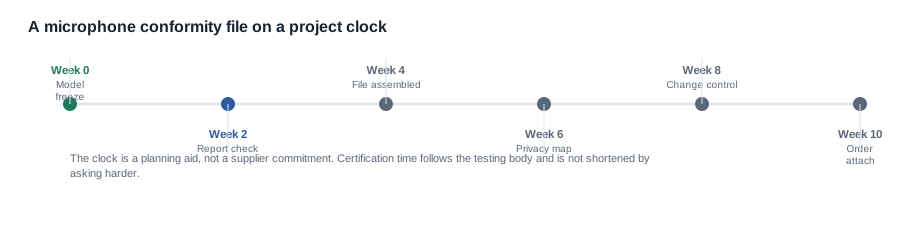
Assembling the file in the order that avoids rework
The file is assembled in a fixed order, and the order is chosen so that each step assumes the previous one passed. A failure at any step tells you what the next step would have told you, and it tells you before the sample has shipped.
Step one is to fix the model designations and the configurations you will actually ship. This sounds administrative and it is the step that blocks the most. Without a designation on the quotation, the artwork, the technical file and the customs description all wait on the same unanswered question.
Step two is to check which assessment report names a sample with the audio chain fitted. This is the step that catches the configuration mismatch, and it is the step most often skipped because the report is available and seems complete.
Step three is to request the technical file for the model and for every variant it covers, and to read the product description inside it against the product on the quotation.
Step four is to add the microphone rows, or a written statement that they are not published. The second option is legitimate and it is frequently the honest one; what is not legitimate is leaving the row empty with no statement attached, because an empty row is indistinguishable from an oversight.
Step five is to map the audio data path against the cyber requirements and the privacy file.
Step six is to fix the change-control rule for the chamber, the capsule and the wiring, and to attach a notice obligation to it.
Step seven is to attach the finished file to the purchase order and to the incoming inspection criteria, so that the document and the goods-in check describe the same product.

Matching the file to the units that actually ship
A conformity file is only evidence about the units it describes, and a microphone adds a specific way for that to go wrong. The chamber, the port positions, the seal and the capsule are not decoration; each of them changes the acoustic arrangement, and the acoustic arrangement is part of the product description. A change to any of them that is not in the file turns the document into a historical record.
The control that closes this is a short list attached to the purchase order, naming the acoustic arrangement as a controlled item, requiring notice before any change, and requiring the documentation pack to be reissued after a change. It is one clause, and it is the clause that determines whether a broker query three months later is a fifteen-minute answer or a programme disruption.
There is a second matching problem, and it is not about the microphone. A file that names a model but not a configuration covers the model and nothing else. A brand with one product in four colours and two lens options has eight configurations, and a family-level document does not travel to all eight without being extended deliberately.
Where a microphone certification file breaks, and what the rework costs
Five ways a microphone certification file breaks
The first break is the configuration mismatch: the report names a sample that did not have the audio chain fitted, and the file is correct about the product it assessed and silent about the product that ships.
The second is the acoustic change made without a notice. The symptom is a question from a broker in month three; the root cause is that the chamber was treated as a component and the file was never reissued.
The third is the voice function added to a platform that was assessed without one. Here the radio, the safety and the cyber files all need to be revisited, and the third is the one that has the longest lead time because it is not a test but a documentation and process obligation.
The fourth is the model designation that arrives last. The artwork, the technical file and the customs description all wait on it, and the programme discovers the dependency a month after the deposit.
The fifth is the family-level document treated as coverage for a branded configuration. It is the break that produces the most expensive response, because it appears at the border or at a marketplace listing rather than in a file review.
What the rework costs
The cost of a break is not the test. It is the schedule, and the schedule is dominated by the queue at the testing body rather than by anything the buyer does.
Three of the five breaks above are cheap to prevent at the quotation stage and expensive to prevent afterwards, because the prevention is a document request and the cure is a re-assessment with a lead time attached. A re-assessment of the radio and electromagnetic compatibility position is a cost and a wait, and the wait does not shorten when the request is escalated.
The two that are worth writing into the agreement rather than merely requesting are the acoustic change-control clause and the model designation on the quotation. Both cost nothing to add, both are routinely left out, and both are the reason a shipment can be stopped after the goods have been paid for.
The certification position we can and cannot state today
The certification position we can state
Stated plainly: a microphone is a quality question and a compliance question at the same time, and a supplier who publishes neither the acoustic description nor the data-handling statement is asking the buyer to accept both on trust. We publish the technical approach for the audio family, which includes open-ear acoustic structure, directional audio and intelligent noise reduction, and we publish the electrical rows for every model in it: Bluetooth V5.3 on the K01 and the K02, V5.4 on the YK12 and the G07, the LC-105-1 and the LC-105-2, and the D11 and the D12, with the cell configuration, the charging time, the rated runtime and the charging method stated for each. The sport models publish the same rows on the same terms, on Bluetooth V5.4 for the YKC02, the D17 and the ZH12.
We do not publish a microphone specification for any model. We will not fill in a pickup distance or a noise figure from typical values, because a typical value is a number that no test in the buyer's programme produced, and it is exactly the kind of number that ends up on a retail box. Our documentation carries an export-certification page of ten patent certificates, eight of them appearance-design patents and two utility-model patents, and names no CE, FCC or RoHS marking, and the model-level certificate numbers and test report numbers are written material to request and file, not entries anyone can read off a catalogue page.
There is one entry in our range where a published figure is large enough to change a regulatory conversation, and it deserves naming rather than avoidance. The bone conduction entry publishes an amplification gain of 35 dB, a 200 mAh cell, roughly seven hours of rated runtime, charging in two hours or less, and Type-C charging. A product that amplifies sound is making a claim about what a person hears, and in the United States that puts it near the boundary of the over-the-counter hearing aid classification at 21 CFR 800.30, which covers air conduction devices. That boundary is a legal question with a long lead time, and it is not a question a catalogue can answer. If an audio feature of that kind is in your programme, the classification question belongs with your legal function as the first conversation, not the last.
What to send us to get a specific answer
Four things let us give you a specific answer rather than a general one: the model or models you are holding, the destination markets, the environments the product will be used in, and whether a voice function is in scope. With those, we can tell you which of the ten questions above the catalogue closes today, which are answered by the document set rather than by a specification, and which have to come from the engineering and compliance teams.
The document set a shipped product has to match is set out at certification checklist. The audio technique behind the technology names is covered at open ear audio, the models referred to here are in the Bluetooth audio glasses range, and the voice data route behind an assistant is at AI features.
Related reading
- The audio technique the family is built on — open-ear audio
- The models the questions above refer to — Bluetooth audio glasses range
- The document set a shipped product has to match — certification checklist
- The voice data route behind the assistant — AI features
Tell us the environments, the markets and the voice features you intend to sell, and we will say which of the ten questions we can answer today and which remain open on our side.


