

Microphone myths in smart glasses are unusually durable, and the reason is that the product category is new while the expectation is old. Buyers arrive with a mental model formed by headsets, earbuds and phone calls — a world where microphone quality is a familiar, consumer-facing number — and they search for that number in a place where it does not exist and never did.
The catalogue row for our own models says "open-ear acoustic structure, directional audio, intelligent noise reduction" and lists Bluetooth versions, cell capacities, charge times and runtimes. It does not list a microphone specification, because there is not one to list: no pickup distance, no frequency response, no signal-to-noise figure, no noise cancellation depth. That is Not published, and it is worth understanding why that is a structural fact about the category rather than an omission by any one supplier.
So smart glasses microphone quality smart glasses myths is best approached by examining the specific beliefs that arrive pre-loaded and identifying what each one would have to be true for it to hold.
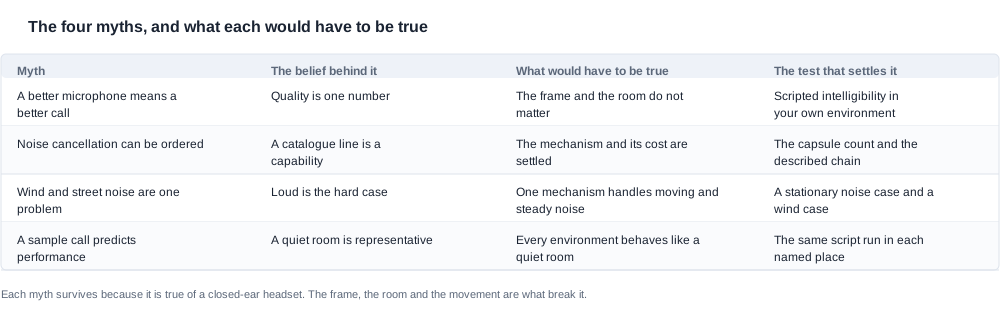
Why a myth costs money in a sourcing decision. Each of these beliefs is not a harmless piece of folk knowledge; each of them determines what a buyer asks for, and therefore what a supplier is asked to quote, and therefore what a programme is built. A buyer who believes that microphone quality is one number will ask for one number, receive a number that is meaningless, and close the question — having learned nothing, and having spent a sample order to learn it. A buyer who believes that a feature can be ordered will ask for a feature, receive a feature name, and close the question the same way. The myths are expensive because they make a question that appears answered.
Smart glasses microphone quality: why the wrong mental model arrives early
The headset inheritance. A generation of on-microphone measurement made the comparison intuitive: a headset is a sealed device held at a fixed distance from the mouth, the mouth distance is short and constant, and the measurement method is standardised enough that a number transfers between products. Every one of those conditions is false in an open-ear frame, and the buyer who is searching for a headset number is not asking a stupid question — the question is simply aimed at a different device.
Why the frame changes the arithmetic rather than the grade. In a sealed headset the capsule is close to the mouth, the enclosure excludes most of the environment, and the head forms part of the acoustic path. In an open-ear frame the capsule sits on a temple, the environment is not excluded at all, and the distance from the mouth is a property of how a frame sits on a head. Ambient sound therefore reaches the microphone through a path that has nothing to do with the capsule itself — it arrives from the temple, conducted through the frame, reflected off the cheek, and the wearer's own voice arrives through bone and tissue at a level that no sealed headset ever had to deal with. The acoustic environment is categorically different, and a scalar borrowed from the wrong category does not describe it.
The consequence for a buyer. "Microphone quality" is not something you rank, it is something you test in the environment that matters to you. A shortlist built on a single number is a shortlist built on a number that describes a laboratory, and the ranking it produces is a ranking of whatever the supplier chose to measure.
The three-part answer to the mental model problem. First, name the environment, because a belief about the hard case is usually a belief about an environment the buyer has not specified. Second, replace the scalar with a protocol, so that the result is comparable across suppliers and repeatable across lots. Third, decide what the result is allowed to change, because a measurement that does not feed a decision is a measurement that will not survive the next quarter. Those three steps are what the rest of this article applies to the four beliefs.
Myth one: microphone quality is a single number that ranks products
The belief is that microphone quality is a single scalar that ranks products, and that the better one wins. It is borrowed from headsets, where a generation of on-microphone measurement made the comparison intuitive.
The problem is that a call on an open-ear device is not a call on a closed-ear one, and the reasons are physical rather than rhetorical. The wanted signal and the unwanted signal arrive at the capsule over comparable paths, so the ratio between them is set by the environment and not by the component. The far end of the call contributes its own loss, and the codec and the network contribute theirs, so a result measured locally is a result about the local end. And the speaking voice changes the result, so a scripted test and a conversation are not the same measurement.
What the belief would have to be true for. It would have to be true that the frame, the room and the far end do not contribute to the outcome, and that one number produced in one condition describes the same performance in every other condition. Both are false, and they are false in a way that can be demonstrated in an afternoon with two units and one environment.
The test that settles it. Run the same scripted phrase on two units in the environment that matters, and then change one thing at a time: move the distance, change the background, change the far end. If a single scalar described the result, the ordering of the two units would not change. In practice it does change, and that is what tells a buyer the scalar was measuring the test rather than the product.
The commercial cost of holding the belief. A shortlist decided on a single number is a shortlist decided on a number whose provenance is unknown, and the usual outcome is that the buyer discovers the provenance after the first return rate, when the number cannot be recovered and the lot has already been paid for. The cost of a scripted protocol on a sample round is a fraction of that, and it is the only way of avoiding the same discovery in the next programme.
How to choose between two suppliers who both publish a figure. Do not compare the figures. Ask each of them for the condition the figure was produced under, and the source of the unit it was produced on. A supplier who answers both is a supplier whose figure can be placed next to yours. A supplier who declines one of them has told you that the figure is not a measurement of the product, whatever the listing says it is.
Myth two: noise cancellation is a feature you can order
"Intelligent noise reduction" appears across this range as a catalogue line, and it is frequently read as a specification. It is not. Cancelling noise is a system behaviour: it depends on how many microphones contribute, where they sit relative to the sound source and the user's mouth, what algorithm runs on them, and what the device is doing with the signal afterwards. None of those are published as numbers.
The honest reading of that catalogue line is that the manufacturer has implemented some form of noise suppression. Which form, how effective, and at what cost to the natural sound of the user's own voice — those are the questions to put in writing, and the useful answer will describe a test condition rather than a number.
What the belief would have to be true for. It would have to be true that a catalogue line describes a capability that can be ordered at a price, that the capability has a consistent meaning across suppliers, and that a buyer can compare two of them. None of the three holds, and the third is the one that matters commercially, because the comparison is what a quotation is based on.
What the belief actually does to a programme. It moves the decision to the wrong stage. A buyer who believes the feature can be ordered will ask for the feature in the requirement, receive a price for it, and treat the requirement as met. The feature then has to be evaluated, and the evaluation has to happen in an environment, which means the cost of the evaluation arrives after the cost of the feature.
The three questions that replace the belief. How many capsules contribute to the pickup, and where are they positioned relative to the mouth; the answer tells you the system type and therefore what the feature can physically do. What the supplier considers the hardest environment this model is used in; a specific answer is worth more than a generic one, and a refusal is informative. And whether the wind processing is automatic or user-switchable; manual control in a cycling product suggests the automatic mode is not sufficient on its own.
The commercial framing. The feature is not a line item that can be added; it is the outcome of an array decision, a tuning exercise and a test method, and the price of each of those is quoted separately. A buyer who asks for the feature in a requirement gets a quotation; a buyer who asks for the array, the tuning and the method gets a scope. The first is cheaper to write and more expensive to own.
Myth three: loud environments are the hard case
Buyers routinely ask about microphone quality on the assumption that the hard environment is a loud one. Often it is not. A stationary caller in a quiet room with a fan is a different acoustic problem from a cyclist at 25 km/h, and the two are not solved by the same processing.
Stationary background noise is largely a signal-to-noise problem: the wanted signal is buried in a steady spectral floor, and processing can pull it up. Moving-source noise is not: wind noise is broadband and non-stationary, traffic is impulsive, and neither is improved by the same mechanism that handles a steady hum. Devices that handle the second well often do nothing for the first.
If your users are in vehicles, outdoors or on industrial sites, the environment you test has to be the environment they are in, because the ratio of problem types is what determines which mechanism you need.
What the belief would have to be true for. It would have to be true that stationary noise and moving noise are the same problem, that one processing mechanism addresses both, and that the loud case is the worst case. The third is also wrong in a way that surprises people: the loud case is often the easier one, because a loud wanted signal sits above a moderate background, whereas a quiet wanted signal in a quiet room exposes the noise floor and the gating behaviour directly.
The trap this belief sets. A buyer who believes the loud case is the hard case will design the test around a loud case, will find that the device performs adequately, and will ship a product that fails in a quiet room, where the complaints are about hissing and about the call dropping out in the middle of a sentence. Those complaints arrive as support contacts rather than as returns, which makes them harder to trace and easier to misattribute to a pairing problem.
How to choose which environment to specify. Ask what proportion of the channel's use sits in each environment, and then test the one with the highest proportion rather than the one with the highest severity. When the two are different, the proportion wins, because the volume of the failure is what the returns and the support load are made of. The decision to specify is a commercial one and belongs to the buyer, while the mechanism to meet it belongs to the factory.
Myth four: a sample call predicts how the product will perform
A call in a quiet room is the least informative test available. It will pass on almost any device, which means it eliminates almost nothing.
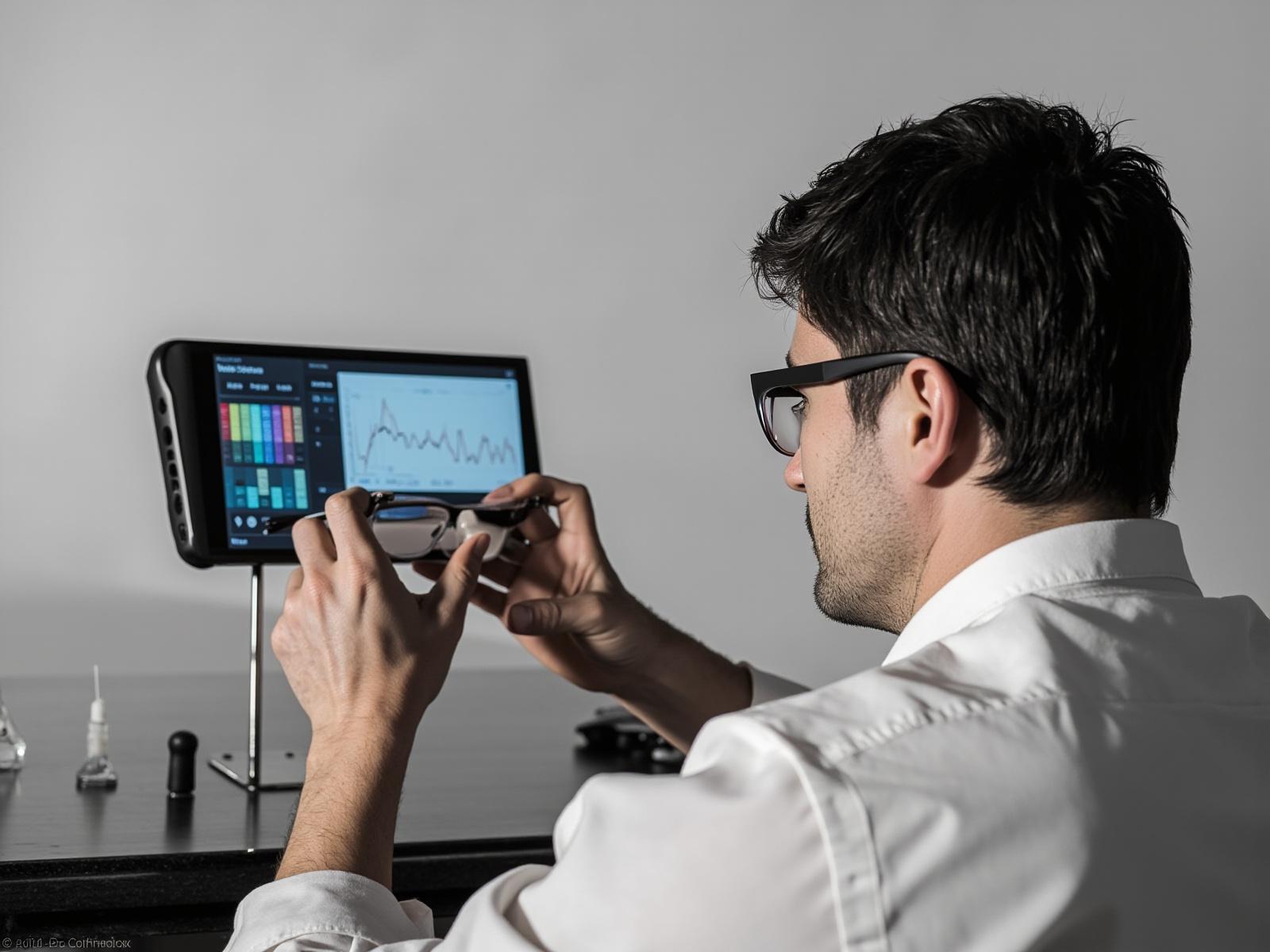
What actually separates devices is behaviour in bad conditions: does the far end still understand you when a fan is running, on a windy street, with traffic behind you. The useful test is a scripted one — a fixed sentence read at a fixed distance, recorded in each environment, judged by the same person, repeated across units. That is how you find out where a device breaks, and the break point is the only number worth having.
The uncomfortable part is that most suppliers will not volunteer their own weak environment, because the honest result is device-specific and they would rather you did not investigate. Asking directly, with a named environment, is the only way to get an answer.
Why the quiet-room demonstration is so widely used. It is the demonstration in which every plausible device succeeds, which means it can be performed without a rig, without a protocol, and without anyone being exposed. It is also the demonstration that is closest to the specification, because a capsule specification is usually produced in a quiet laboratory. A buyer who accepts the demonstration as evidence is accepting a measurement of the test rather than of the product.
What the belief would have to be true for. It would have to be true that the quiet room is representative, that the scripted phrase and the live conversation produce the same result, and that a single successful call is evidence of a capability rather than of the absence of a failure. The third is the one that catches people: a successful demonstration is evidence that nothing failed, which is a much weaker statement than evidence that the device works.
What to do instead. Ask the supplier to name the environment in which the model performs worst, and then test that environment yourself. The question is uncomfortable, which is why the answer is informative. A supplier that names a specific environment has a characterisation to point at; a supplier that declines has told the buyer something about how the product was developed.
What to ask instead of asking for the specification
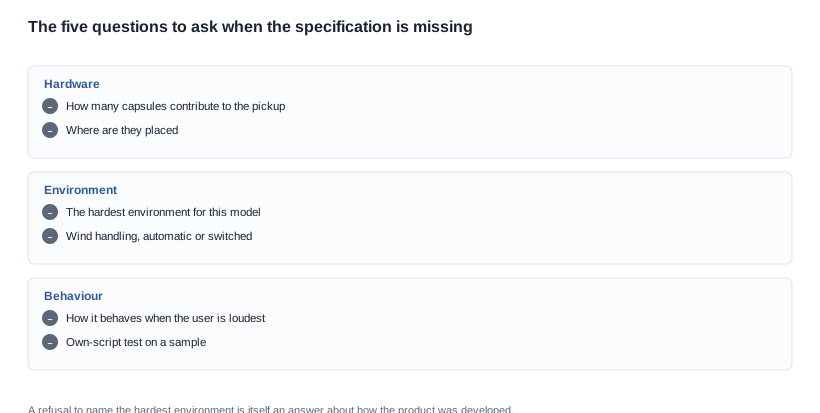
The replacement for a missing specification is a set of questions that produce answers a buyer can act on. Five of them are worth carrying into any evaluation in this category.
-
How many microphones contribute to the pickup, and where are they positioned relative to the mouth? The answer tells you the system type.
-
What does the supplier consider the hardest environment this model is used in? A specific answer is worth more than a generic one, and a refusal is informative.
-
Is there wind processing, and is it automatic or user-switchable? Manual control in a cycling product suggests the automatic mode is not sufficient.
-
How does the device behave when the user's own voice is the loudest thing present? Open-ear devices have a specific problem here that closed-ear ones do not, and it is the one users notice.
-
Can you run a scripted test on a sample in your own environment? If the answer is yes, the evaluation becomes yours and it becomes comparable.
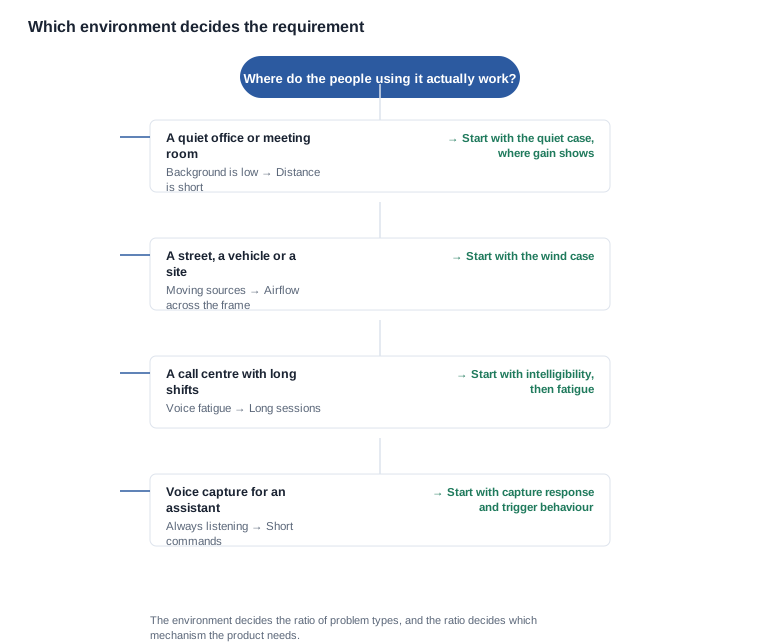
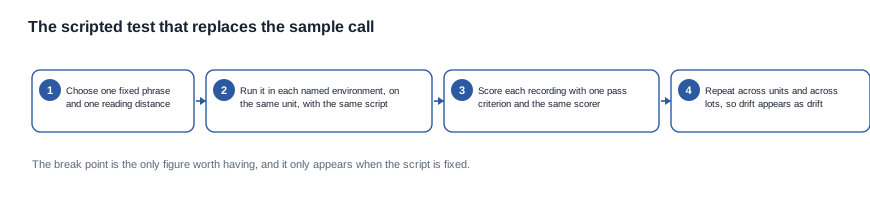
The order in which to use them. The first question is documentary and takes one meeting. The second is the one that most reliably reveals the character of the development, and it is the question to ask before you order rather than after. The third and fourth are technical and belong with the supplier's engineering. The fifth is the one that converts the whole evaluation from a comparison of claims into a measurement, and it is the one to secure before the sample order is placed.
The commercial terms that go with the five questions. Whether the supplier will run the protocol on production units rather than on engineering samples, and whether the recordings are supplied so the buyer can re-judge them. The minimum order quantity tiers and the share of units taken at a pilot tier. Whether the microphone test applies to every shipment or only to the first. The sample order cost and the terms on which it is credited against a first production order. And the number of models and markets the programme commits to in the first year, because that number determines the size of the conformity file and therefore the documentary cost of the launch.
The decision that the five questions are for. They exist to produce a decision, and the decision is which configuration to buy and what the listing may say about it. A buyer who has the five answers can write a specification that names the environment, the distance, the criterion and the consequence of failure, and that specification is what turns a set of published marketing lines into a product that can be defended in a channel and defended in a purchase order. A buyer who does not have them will end up with a marketing figure and no defence.
No Microphone Figure Survives a Sample Test. Our position is that no microphone figure in this category is worth buying unless it was produced on your own units, against a fixed protocol, in an environment that resembles your users' — because the published specifications for this range do not include microphone data, and we will not supply typical values from other products to fill the gap.
That is not a criticism of any supplier. It reflects where the category is. Microphone performance in open-ear glasses is genuinely hard to summarise in a single row, and a supplier who publishes one number for it is more likely describing a controlled laboratory condition than your street.
We will tell you the published specification for any configuration, and we will tell you plainly which questions we can answer from what we hold and which have to go to the acoustic team. If you need a specific environment tested, say which one. The open-ear framework is at Open ear audio technology, the expectations behind the myths are at Microphone quality for beginners, the design background is at Noise control and microphone pickup, and the use case is at Bluetooth audio glasses for calls.
Where the expectations come from
- Open ear audio technology
- Microphone quality for beginners
- Noise control and microphone pickup
- Bluetooth audio glasses for calls
Tell us the environment your users are actually in and we will say which questions are decisive for that environment.


