

Microphone faults are diagnosed by symptom rather than by component, because the component is invisible to the person reporting it and often invisible to the person receiving the return. A customer describes what they heard, not what failed, and the mapping from one to the other is not one-to-one.
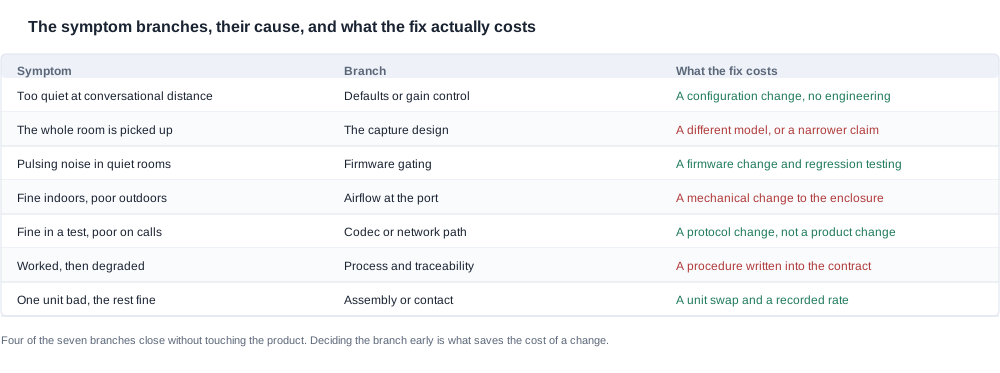
So smart glasses microphone quality smart glasses problems and fixes is a translation table, and the first column is the customer's words.
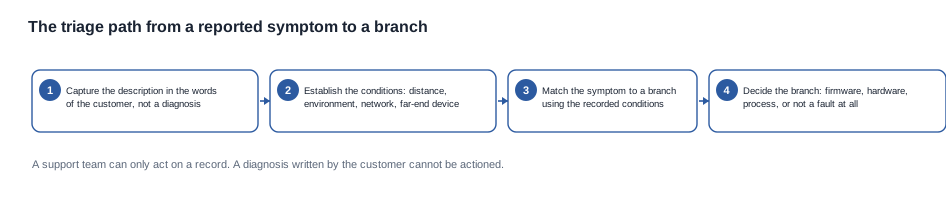
The buying task behind this article. The reader is a brand-side product manager, a channel quality manager or a sourcing buyer who has a returns file with a cluster in it and needs to decide whether the next action is a support script, a firmware branch, a mechanical change, a supplier conversation about traceability, or a change to the listing. Each of those is a different cost and a different owner, and the costliest mistake is treating a configuration or process fault as a design fault and commissioning engineering for it.
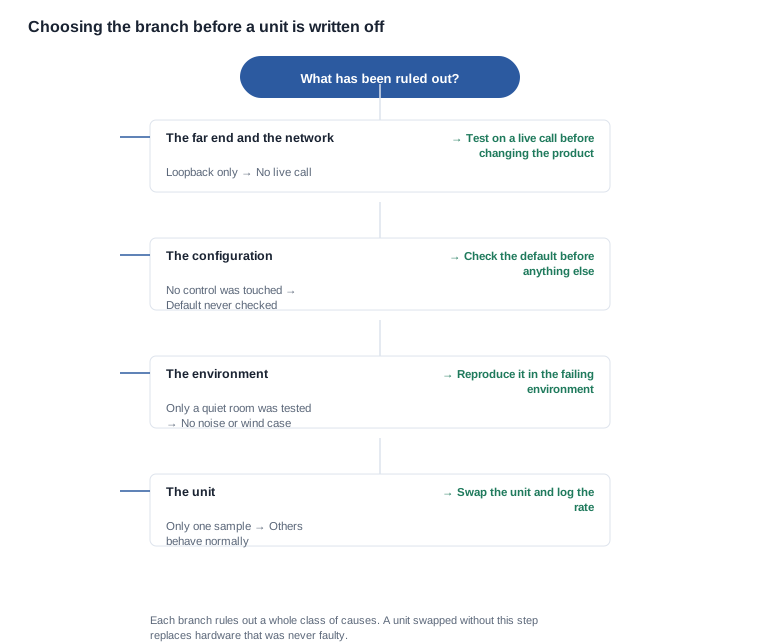
The cost of getting the branch wrong. A process fault routed to engineering produces a firmware branch that fixes nothing, costs a regression cycle, and is then reverted. A configuration fault routed to a channel produces a returns trend that runs for another quarter. A design fault routed to a support team produces a unit written off that was never faulty, which is a per-unit cost on every unit that arrives with the same complaint. The branch decision is the highest-leverage decision in the whole fault process, and it is made from the customer's own words.
What makes the branch decidable. Four pieces of information, and no branch should be assigned without them. The criteria for assigning a branch are fixed in advance rather than judged per case, because the way to evaluate a returns cluster is to group it by symptom first and to let the branch follow from the group, not to let an engineer's first impression set the grouping: the recording of what the far end actually heard, the conditions under which the call was made, the unit and lot it came from, and the result of a reconnect and retest. A symptom without those four is a story, and a story is what a customer service team will forward to engineering as though it were a defect report.
Smart glasses microphone quality: five branches a support team can act on
Symptom one: too quiet at conversational distance. Most likely a sensitivity issue or a default gain setting rather than a fault.
Check first whether the device has a user-facing volume or sensitivity control and whether the default is set correctly — a surprising proportion of microphone complaints are complaints about the default rather than the hardware. If the control exists, test the extremes.
If the signal is genuinely low with no control available, this is the one fault that usually needs a hardware change. Increasing gain digitally brings the noise floor up with the signal, so a customer whose problem was quietness may simply acquire a noisier microphone. Establish that before proposing a fix.
Symptom two: the whole room is picked up. A noise suppression question, and the diagnosis depends entirely on the design.
A single microphone cannot distinguish voices; any improvement is partial and comes from attenuating everything outside a target rather than from separating the speaker from the room. Beamforming uses two or more microphones in a defined geometry and can genuinely favour one direction.
Ask what the hardware is before accepting a fix. "AI noise reduction" describes neither, and a firmware change cannot deliver a hardware geometry that is not present.
Symptom three: pumping during silence. The signature of an aggressive noise gate or noise reduction chain, and the one most often misdiagnosed because it is invisible in testing.
It appears mainly in quiet conditions — a quiet office, a car at night — which is precisely where nobody tests. Recording thirty seconds of silence on a table exposes it immediately.
This is the clearest case for a firmware change, and it should be raised with a recording that demonstrates it, because "it makes a noise when it's quiet" is not something a support team can act on.
Symptom four: fine indoors, poor outdoors. Wind rejection, and the cause is mechanical.
A temple-mounted microphone sits directly in the airflow. Wind noise is low-frequency, which is the range a basic filter handles worst. Software reduces it; it cannot remove it, because the acoustic information is contaminated before the microphone receives it.
The interventions that work are physical: a windscreen, a change to the port geometry, or repositioning the microphone relative to the airflow. If a supplier proposes a firmware fix for wind, the expectation should be set accordingly before it is attempted.
Symptom five: fine in testing, poor on real calls. Test on a real network before changing anything.
A loopback test skips codec behaviour, packet loss and any processing that only engages on a network path — common causes of a wearable that sounds fine in testing and unusable in practice. If the problem reproduces on a live call and not locally, the diagnosis points at end-to-end behaviour rather than the microphone.
The branch summary. Five symptoms, five branches: configuration, capture design, firmware gating, mechanical airflow, and network behaviour. Only the first three can be closed without engineering, and only the third genuinely requires a firmware branch. A buyer who holds this table can route a returns cluster in one meeting instead of opening an engineering investigation. The question to ask a supplier when a branch is disputed is which of the five the symptom resembles and what evidence settles the difference, because a supplier that can answer that question is a supplier that has a process behind the branch.
The two faults that come from the process rather than from the design
Symptom six: worked, then degraded over time. This is the fault that most often gets attributed to the product rather than to the process, and it is the one with the clearest commercial remedy.
Microphone performance drifts between production lots more often than specification sheets suggest, usually because a component supplier changed and nobody on the project noticed. Without traceability and a retained golden sample, this cannot be detected until customers report it.
The remedy is procedural: keep a golden sample with its firmware version recorded, keep the recordings, and ask about lot traceability. All three cost nothing before an order and cannot be reconstructed after one.
Symptom seven: one unit bad, the others fine. Probably an assembly defect rather than a design fault. A seating or connection problem produces exactly this pattern.
Have a support team check the specific connection first — for magnetic charging this is the charging contacts, which wear and which present as battery symptoms. If a reconnect resolves it, it is an assembly issue; if not, replace the unit and record the occurrence so the rate is visible.
Why these two are process faults and the first five are not. A process fault has no signature in the product: the same unit from the same lot behaves correctly on the bench and the next lot does not, or one unit in a batch fails and its neighbours do not. The evidence that distinguishes them is the lot reference and the unit serial, and the reason they get misrouted is that they arrive in the same channel as the real faults, with the same customer's words and no test data. The commercial reason to get them right is that the remedy for both is a control, and a control is cheap, while the remedy for a design fault is an engineering cycle.
The contract language that prevents both. A change-notification obligation for anything that alters the capture chain, a lot traceability requirement on the production runs, a golden sample retention term naming who holds it, and a written definition of the defect rate at which a lot is rejected. Those four clauses convert a process fault from a returns trend into a conversation with a supplier, and they are far less expensive than the returns trend.
The commercial framing. A returns cluster in a single month is a product problem until the lot data says otherwise; a returns cluster that tracks a specific lot is a control problem until the data says otherwise. The total cost of the two readings is very different, and the negotiation with the supplier is a different conversation in each case, so the due diligence on the lot data has to happen before the commercial conversation rather than during it. The instruction to a support team is therefore to capture the lot on every return, because the lot is the only piece of information that separates the two readings, and it is the piece of information most often missing.
Building the evidence a support team needs before it can act
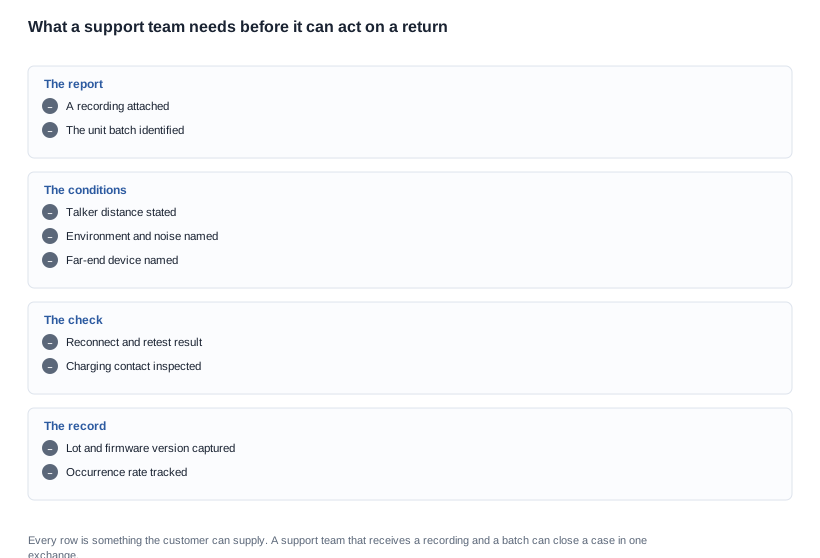
A support team can only act on a record. A diagnosis written by the customer cannot be actioned, and a unit returned with no context usually goes straight to the write-off pile, which converts a solvable configuration problem into a cost per unit.
The four questions to ask, in this order. Where were you when it happened, and what was the noise like. How far away was the other person, and were they on a call or a recording. What device was the other person using, and was it a call or a voice note. Has the unit been charged and reconnected since, and did the problem persist. These four questions take under a minute and they decide three of the five branches on their own.
The attachment that changes the outcome. A recording of what the far end heard, made on the same device in the same conditions. It converts "the other person says they cannot hear me" into an artefact that engineering can act on, and it is the difference between a case that is closed and a case that is forwarded. A recording made by the customer is better than none, and a recording made by the support team on a returned unit is better still, because it can be compared against a golden sample.
The unit and lot capture. The batch or unit identifier, the firmware version and the date of purchase on every return, recorded in one place. A returns database that holds the lot, the symptom text and the branch outcome is the single most useful artefact a channel can build, because it produces the rate by branch, and the rate by branch is what tells the buyer whether the cluster is a design fault, a process fault or a channel misunderstanding.
The occurrence rate that makes a trend visible. A single unit with a pumping noise is a case. Ten units with the same complaint across three months is a trend, and a trend is what a supplier conversation, a firmware branch or a listing change can be based on. The threshold at which a trend becomes a decision is a number the channel should set before it needs it, and the checklist below is the minimum a support team has to capture for the threshold to mean anything. Recording the rate against a fixed symptom description is what turns individual cases into a decision. The description matters: free-text complaints cannot be grouped, and the grouping is the analysis.
The three conditions of a usable support record. A symptom in the customer's words rather than a component name. The conditions attached to it. And a named branch, assigned from the table above rather than from intuition. A record with all three can be closed in one exchange; a record with only the first can be forwarded indefinitely.

What a returned unit should be checked for before it is written off
Check one, the charging and connection path. For the models in this range that charge magnetically, the charging contacts are the first thing to inspect, because a worn or mis-seated contact presents as a battery symptom and then as a signal symptom, since a unit that is not charging is a unit that is not being used as intended. A unit that resolves after a reseat is an assembly or contact issue, and it is counted rather than returned to the customer as a design problem.
Check two, the port and the surrounding assembly. Look for the debris, the residue or the damage that a windscreen or port geometry change was meant to address, and check whether the unit in the hand is the same configuration as the unit in the catalogue. A private-label unit that has been assembled with a different port treatment is not comparable to the published configuration, and it is a reason to re-check the change-notification record rather than to blame the design.
Check three, the firmware version against the golden sample. A unit that is behaving differently from a golden sample held on the same firmware version is a different case from one that is not, and the firmware version is the first field to check. It costs nothing to record and it is the field that most often separates a design branch from a configuration branch.
Check four, the symptom against the environment. Run the returned unit through the same protocol that was used on the sample, in the same environment, with the same scoring rule. If the returned unit now passes, the fault was in the configuration, the environment or the pairing, and the return is a support case rather than a defect. If it fails, the unit is a defect and the rate goes into the by-branch table.
Why the write-off is the last step. The cheapest unit to replace is one that was correctly identified as a fault, because the cost of the wrong write-off is not the unit but the rate, and a rate that is inflated by misrouted cases makes every future decision worse. The four checks above take a few minutes and they produce a number that the buyer can use, and the number is the point.

Where the fix stops being a software change
The three cases where a firmware branch is the wrong answer. Wind, because the contamination happens before the signal is captured and no filter can reconstruct what was not recorded. The capture geometry, because a single capsule cannot be made directional by a software change. And a component or lot change, because a firmware branch does not restore a part that a supplier substituted without notice. In all three, the honest answer to a customer is an expectation or a product change rather than a fix.
The case where the fix is nothing at all. A configuration or a default. The most common single cause of a microphone complaint in this category is a device that is set to a default the user never changed, and the remedy is a support script, a quick start instruction or a settings change, and all three cost nothing. The reason this case is worth naming separately is that it is invisible to the product team, because the product works exactly as designed and the design is not what the customer meant.
The case where the fix is the listing. When the product is sound and the complaint is that it did not do what the listing said it would do. The remedy is copy, and the cost of not making it is a return rate that will be attributed to the product by every downstream reader of the returns file, including the supplier, including the distributor, and eventually the brand. Distinguishing this case from the configuration case is the one remaining piece of judgement in the triage, and it is made by comparing the complaint against the wording rather than against the hardware.
The decision to escalate, and what escalation costs. Escalate when the rate for one branch exceeds the threshold the channel has set, when a single fault accounts for most of the returns, or when the same complaint appears in more than one market with the same lot. When to escalate and when to close is a choice about cost rather than about the product, and the trade-off is usually between a unit credit and an engineering cycle, which are not comparable numbers until someone puts them on the same sheet. An escalation that carries a recording, a lot reference, a branch and a rate is a request for a decision. An escalation that carries a complaint is a request for a unit replacement, and the two are answered at very different speeds and at very different costs.
The commercial terms to settle alongside the process. Whether the supplier runs the branch test on production units as part of incoming inspection rather than as a charge. Whether the recordings from the buyer's own protocol are supplied, so the branch diagnosis can be made on the buyer's units rather than on a returned sample. The defect rate at which a lot is rejected. The change-notification obligation on the capture chain. And the golden sample retention term, with a stated period, because a golden sample that is held for a quarter and then discarded cannot support a drift investigation in the following year.
Sometimes Software Cannot Resolve It
The short answer: we publish no microphone specification because we hold none, and we will not estimate one. Where you send samples or recordings we will tell you which branch the fault sits in and what the realistic fix is, including where the honest answer is that software cannot resolve it.
What we can do. Send us a recording of the failure and we will tell you what it is. Send samples and we will run a fixed protocol on them and report the result, including the rows where the result is worse than the expectation. We can state the published configuration for any model — the audio family names, the Bluetooth versions, the cell configurations, the charge times, the runtimes and the charging method — so that the branch decision is made against the right configuration rather than against a guess. And we can say which of the seven symptoms in the table above are decisive for the environment the product is used in.
What we will not do. We will not quote a pickup distance or a noise figure for any model, because we hold none, and because a figure in a support discussion becomes a figure in a listing. We will not present intelligent noise reduction as a measured result. And we will not sign off on a fault diagnosis for a unit we have not seen and a recording we have not heard, which means that a support team sending us a case will get a question back about the environment and the conditions rather than an answer on the first exchange.
What would make the first exchange a closing one. The recording, the conditions, the unit and lot, the firmware version, and the branch. Five items, and the last one is the only one that needs judgement. The questions to ask a support team on intake are therefore the four in the previous section, and the one question the supplier should be asked on escalation is the one that names the branch and asks what evidence settles a dispute about it. A buyer who wants to know how to choose between a firmware fix and a mechanical one should ask which of the five branches the symptom falls into and what the cost of each would be. A case that arrives with the first four and without the fifth will usually be closed by the person who reads it, because the branch is usually determined by the recording and the conditions, and a support team that has those two learns quickly to route cases without escalating them.
The protocol behind all of this is at how to test before ordering, the rows to request are at microphone specifications to request, and the design context is at noise control and microphone pickup.
Related reading
Send a recording of the failure and we will say which branch it sits in.


