

Six questions about smart glasses MOQ account for most of the confusion in this category, and they cause it because they sound as though each has one answer when in fact each has two or three. Here are the six, with the real answers rather than the expected ones. The short version is that the minimum order quantity is per configuration, it is quoted rather than published, and the reason attached to it is the only part worth negotiating.
Smart glasses MOQ: six questions, and the answer behind each one
Is the minimum per order, per model, or per configuration?
It is per configuration, and it is quoted rather than published. Our own documentation contains conflicting internal figures on the subject that we have not resolved, and we will not pick one of them to win an order and then have to defend it in writing later.
The per-configuration basis has an immediate consequence for anyone planning more than one stock keeping unit. A second colourway restarts the arithmetic, because a second colourway is a second material set. A channel planning three stock keeping units has to multiply before it decides anything, and that multiplication is the part that is usually missing from a launch plan.
Two related points belong in the same answer. A custom mould does not count toward the minimum, because it has its own cost and its own lead time and it is a separate commitment. And where our catalogue offers customisation, the scope runs from logo and colourway through temple or frame styling to packaging, with each element affecting the setup differently, so the setup has to be itemised rather than quoted as a single figure.
Can it be reduced, and what happens on the second order?
Sometimes, and the trades that work are specific rather than general. Accept a stock colourway, drop the custom packaging, or reduce the number of variants so that the order can share a production slot with other work. Those are the levers that work because each of them removes a material set rather than asking the factory to absorb a smaller batch.
A supplier who cannot name at least one lever is quoting a number rather than negotiating, and that is worth knowing before a second round rather than after it.
On the second order, the structure is different in a way that matters. The one-off costs have fallen away, the volume break may have moved the unit price, and the factory now knows the build. What does not change is the basis: the second order is still per configuration, and it is still quoted against a specific build.
There is no partial order in the sense of coming back later for less. What can be arranged is a second order scheduled alongside other work, which is the same question at a smaller scale, and it is worth asking in the first conversation because the answer constrains what a first programme can be.
Is the minimum the same for every model?
No, and the difference is usually large enough to matter. Our camera range and our audio range have different component structures, different packaging and different compliance positions, so a minimum quoted against one tells you nothing useful about the other. Ask per model, and treat any single figure that covers a catalogue as a catalogue figure rather than a commitment.
What is the unit price at the minimum, and at double it?
This is the question almost nobody asks, and it is the most informative one on the list. The answer tells you how much of the cost is fixed and how much is variable, and it is the only reliable way to know whether a larger order is worth the inventory risk.
The reasoning is straightforward. If the price barely moves between the minimum and twice the minimum, the cost is dominated by fixed costs, and doubling the order buys you very little. If the price falls materially, the cost is dominated by variable costs, and the larger order is genuinely cheaper per unit. Buyers who skip this question tend to assume the second case, because a falling unit price feels like the normal behaviour of a volume purchase.
Our published configuration rows apply regardless of quantity: cell capacity, charge time, rated use, Bluetooth version, charging method and case capacity are properties of the build, not of the order. What changes with quantity is the component cost and the amortisation of one-off work. A supplier who cannot explain which part of the price moves with volume is quoting a number rather than a structure.
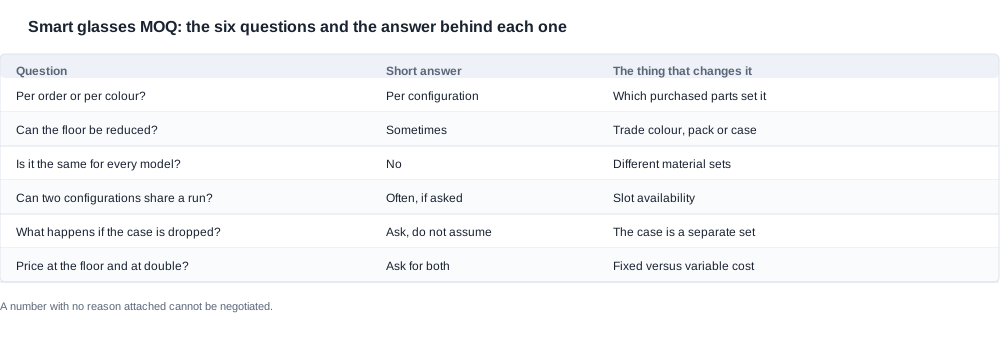
Can the minimum be met across two configurations?
Some suppliers will schedule one production run covering several order lines, which lets a buyer test two models without funding two full minimums. This is worth asking in the first conversation rather than the fifth, because the answer determines what a first programme can be.
The answer is not always yes, and it depends on the real constraint. Where the floor is set by a shared component, a shared run is often possible. Where it is set by a print run or by per-variant compliance work, it frequently is not, and the configurations have to be funded separately.
What happens to the minimum if the charging case is dropped?
Ask rather than assume. Case configurations are a meaningful part of the cost structure in this category. Across our published range, three camera models carry a 1400 mAh case, one carries either a 900 or a 1400 mAh case, one carries a 1200 mAh folding case, and one camera model carries no case at all.
Dropping a case removes a material set, so it can move the minimum considerably, and it can move it in either direction. It reduces the commitment for that configuration, but a buyer launching a camera programme without a case is also making a product decision that has a market consequence, and that consequence is outside the scope of the commercial question.

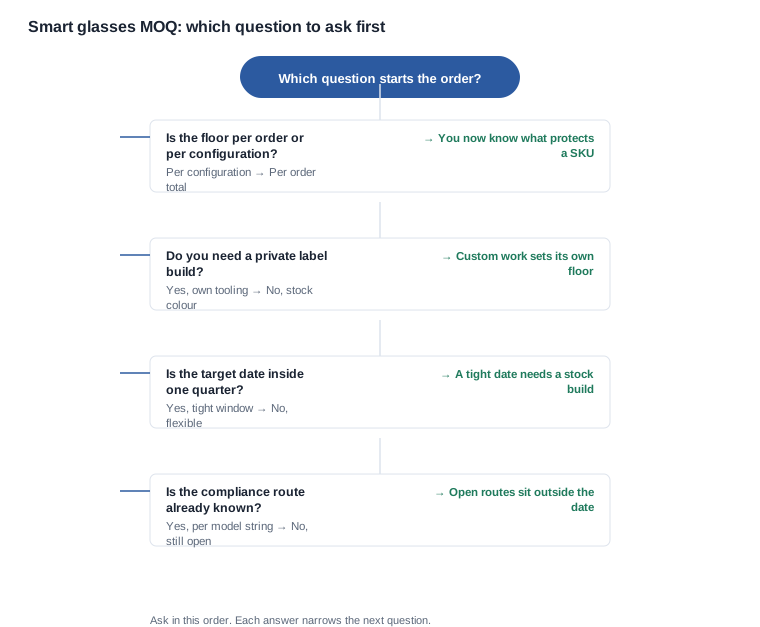
The questions that decide which one you are actually looking at
The six questions above are the ones buyers ask. The three below are the ones that determine the order in which they should be asked, and they are worth separating because they change what the answers mean.
Is the basis per configuration, per model, or per order? Everything else depends on this, and it is the cheapest question to ask and the most commonly skipped.
Do you need a private label build? A private label build adds a moulding or printing commitment on top of the electronic one, and that commitment has its own floor and its own lead time. A stock-colour programme and a private label programme are different commercial objects.
Is the target date inside a single quarter? A tight date is not compatible with an open configuration list. If the date is fixed and the configurations are not, the two will be reconciled by the factory rather than by the buyer, which is the worst arrangement available.
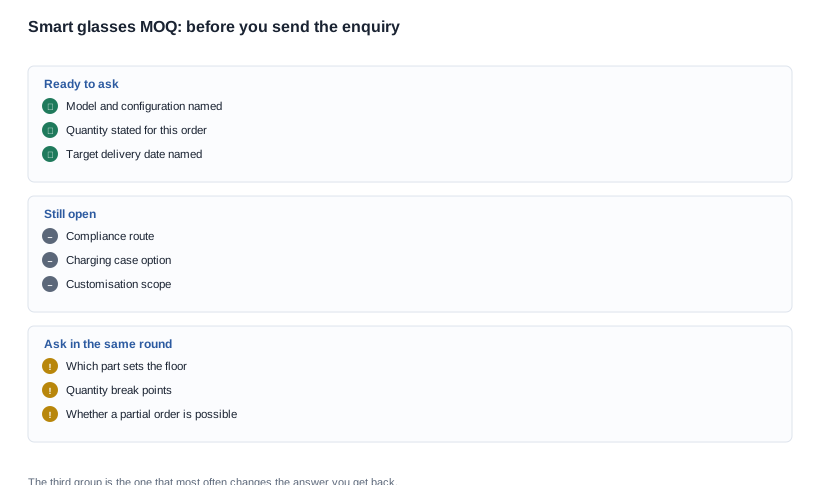
The third group in that chart is the one that most often changes the answer you get back. Those three questions, asked in the same round as the configuration request, turn a general quotation into a quotation against a build.
Two more questions that belong in the same conversation
What does the minimum become if the target date moves? A floor that is tied to a production slot and a floor that is tied to a component lot behave differently when the date moves. This question tells the buyer whether the date and the minimum are the same constraint or two constraints that happen to be quoted together.
What happens to the quoted unit price if the order ships as a consolidated shipment rather than alone? Freight and packing assumptions sit inside a unit price more often than buyers expect, and a price that assumes consolidation is not the price that will appear on a small standalone consignment. This is the question that catches the mismatch between a quoted price and an invoiced price on a first order.
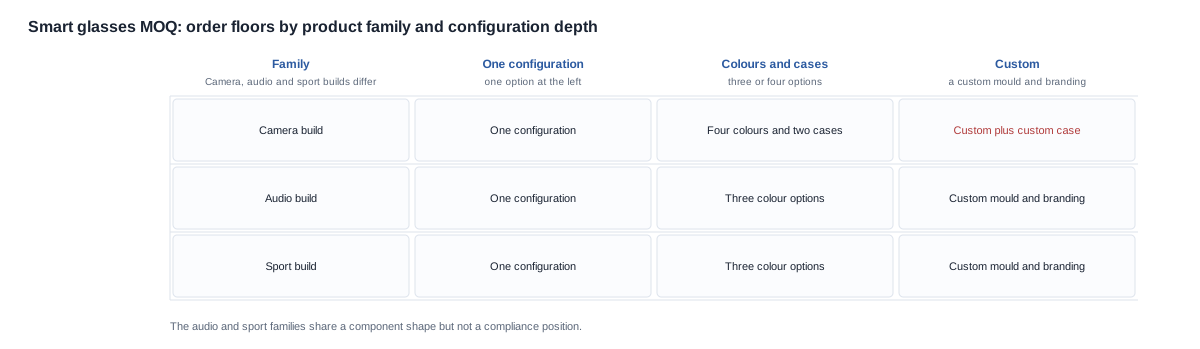
That matrix shows why the first question matters most. The audio and sport families share a component shape but not a compliance position, and the camera family carries more configuration axes than the others because the case and the lens options multiply the count. A single figure quoted across those families is not a cautious average, it is a number that is wrong for at least two of them.

The three drivers behind a minimum order quantity, and how to tell them apart
Every minimum order quantity in this category comes from one of three drivers, and the drivers behave differently enough that telling them apart is most of the work. A buyer who knows which driver is binding knows which lever exists, and a buyer who does not will negotiate the number when the real subject is the batch or the run or the file.
Component lot ordering is the driver that matters most often. Batteries, camera modules and charging cases are bought in lots, and a lot has a size. When the floor is set by a lot, the lever is the lot itself: consolidating this order with another buy, taking a shorter lot at a different price, or scheduling the order so that existing stock covers the first run. What the lever cannot do is make a lot smaller than the supplier's minimum purchase quantity, which is a property of the component supplier rather than of the factory in front of you.
There is a published example of why the distinction matters. Across our camera range, cell capacities are published at 220 mAh, 260 mAh, 265 mAh and 290 mAh across different models. A 290 mAh cell and a 220 mAh cell are almost certainly bought on different terms from different suppliers, and a floor attached to one says nothing about the other. The same applies to the case: three camera models publish a 1400 mAh case, one publishes either a 900 or a 1400 mAh case, one publishes a 1200 mAh folding case, and one publishes no case at all.
Production slot economics is the driver behind a floor that looks arbitrary but is actually arithmetic. A run has to be long enough to justify a changeover, and a changeover is what happens when the line moves from one colourway or one packaging format to the next. The lever here is the sequence and the number of distinct runs, not the unit count. Two colourways in one run and two colourways in two runs are the same number of units and completely different economics, and the second one is much worse than the arithmetic on the unit price suggests.
Compliance work per configuration is the driver that is easiest to overlook because nothing in the order looks like testing. A new variant can require a new technical file, new marking, and a new route through the conformity assessment for the destination market. Our product catalogue contains a company-level export certification page but no per-model certification line, which means the scope of documentation for a specific model string is something to be established in writing rather than read off a published table. Where that work sits inside the floor, the lever is the number of variants in the file, and that is a decision the buyer makes before the order rather than during it.
Telling the drivers apart from the answer alone
The cause is not always stated, but it can be inferred from how the floor moves. A floor that changes when the colourway changes points at a slot or a component lot that is specific to the colourway. A floor that does not change with anything except the model name points at a policy figure. A floor that changes when the destination market changes points at compliance work. A floor that disappears entirely when the custom elements are removed was a setup charge wearing a minimum's clothing.
The inference is less reliable than being told, and it is worth asking directly. The difference matters because the negotiation for a lot-driven floor is a scheduling conversation, the negotiation for a slot-driven floor is a range conversation, and the negotiation for a compliance-driven floor is a scope conversation. Asking for a lower number when the real subject is the number of variants in the file produces a refusal, because the answer genuinely cannot move.

What a minimum order quantity is not: four things buyers confuse it with
Four numbers get confused with the minimum order quantity often enough that it is worth naming each one, because in each case the confusion produces a bad decision rather than a small misunderstanding.
It is not the volume break point. The break point is where the unit price changes because the cost per unit falls. The minimum is where a commitment becomes worth making. A supplier can quote a break point at 500 units and a minimum at 300, and the gap between them is where a buyer should be looking, because an order of 400 units clears the minimum and misses the break. Buyers who treat the break point as the minimum end up ordering more than they need in order to reach a price, which is one of the least efficient ways to spend cash in this category.
It is not the lead time. The lead time says how long the order takes. The minimum says how big it has to be. They are frequently related, because a lot-driven minimum comes with the component's own schedule attached, but they are different facts and they are quoted separately. A buyer who assumes a shorter order clears the minimum is usually wrong, and a buyer who assumes a shorter minimum shortens the schedule is usually wrong too.
It is not the total order value. A minimum order quantity is a count of units. A total order value is a sum of money, and the two relate only through the unit price and the currency. In a market where the currency of the quotation is not the currency of the sale, a minimum expressed in units can become a very different commitment when the price is converted. Ask for the minimum in units and the value in the currency you will pay in.
It is not the sample order quantity. A sample order is a different commercial object with a different cost structure and usually a different, much smaller, quantity. It is worth separating the two in the request, because a supplier who reads "sample order" as a soft version of the production order will quote a production order, and a supplier who reads it as a small retail quantity will quote something that cannot be built. The sample route is set out in the samples material, and the point here is narrower: a sample quantity is not a minimum, and quoting one does not tell the buyer anything about the other.
What we will answer in writing before you commit
We will tell you the minimum for your configuration, the price breakpoints, the setup charges itemised, and which of the three drivers is binding: component ordering, production slot economics, or compliance work. We will also tell you which of our published rows apply to the build you have specified, and which of them are not published for it.
The figure that matters is not the minimum itself but the reason attached to it, because only a reason can be revisited. A minimum set by a component allocation cannot be negotiated away by goodwill. A minimum set by a print run can be moved by artwork timing. A minimum that is really a setup charge can be moved to a line where it can be amortised. When a number arrives without a reason, treat it as the largest number the factory believed you would accept rather than the smallest the process requires.
What we will not do is publish a minimum order quantity we cannot defend, quote a configuration we do not build, or fill an open row in the specification with a typical figure from another supplier's general data. The MOQ section covers the structure behind these answers, the sequence for working through it is under MOQ step by step, the four costs that sit behind the floor are under hidden costs, and the price breakpoints themselves are set out under pricing FAQ.
One note on the two figures that buyers most often expect and cannot get here. Our unit prices, minimum order quantities and lead times are not published, so a staged payment plan cannot be matched to a cash cycle in advance. And our certification material does not carry a per-model line: the catalogue carries a company-level export certification page, and the scope of documentation for a specific model string is a request to be made in writing against that string, with the documentary route covered in the certification material.
Send the configuration, the quantity and the target market and we will come back against that build rather than against a catalogue. If the configuration does not exist in the published range, we will say so, because a programme built on a build we do not make starts with a substitution somebody else has to discover later. If part of the answer depends on a sub-supplier, we will mark that part as open rather than presenting it as settled, and we will tell you which question to put to that sub-supplier so that the answer arrives with the goods rather than after them.
Related reading
-
MOQ step by step — how the number is built
-
Hidden costs — the four costs behind it
-
Pricing FAQ — the price breakpoints
Send the configuration, the quantity and the market, and we will say which parts of the minimum are settled and which are yours.


