

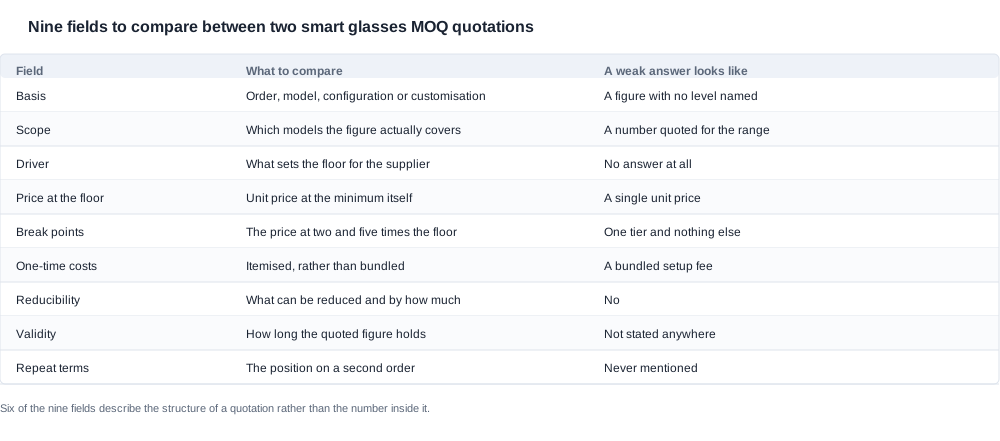
Two minimum order quantities are only comparable once you know whether they are measured the same way, and the first two fields in the table below are questions about scope rather than about number. Nine fields will settle a comparison between two suppliers' minimum order quantity terms in this category, and six of them describe the structure of a quotation rather than the figure inside it. A comparison run on price alone will reach the wrong answer reliably, because price is the one field that is always present and the one field that is least able to carry the decision.
Why two smart glasses MOQ quotations need a field-by-field frame
The two figures that appear comparable and are not
The most common comparison in this category is the simplest one: two quotations, two minimum order quantity figures, the lower number wins. It fails because a minimum order quantity in smart glasses is not a quantity. It is a quantity attached to a level, and the level determines how many commitments the figure creates.
The published configuration rows make the size of the difference concrete. Our range publishes three colours on the V03 Pro and four on the V06, and publishes the L2 Utral with either a 900 mAh or a 1400 mAh charging case, alongside a 1400 mAh case on the CY03 and the CY05, and the L1 Pro and a 1200 mAh folding case on the MT6. A plan with three V06 colours and one L2 Utral case option is four configurations. A per-configuration figure of 200 applied to that plan is a commitment of 800 units. A per-order figure of 200 for the same plan is a commitment of 200 units. The quotation with the smaller number in it is the one that costs four times as much cash, and nothing on the face of either document says so.
The second figure that misleads is the unit price. Two unit prices quoted for the same model are not the same price unless the configuration behind them is the same, and the configurations behind them are frequently different: one quotation may be for a magnetic-charging build and the other for a Type C build, or one may include a case and the other may not, or one may be for a standard firmware build and the other for a customised one. The price difference is then real but it is the price of two different products, and treating it as a margin difference is the error.
What a frame is for
A frame is a fixed list of fields that both quotations are read into, in the same order, with the same questions. Its purpose is not to produce a score. It is to make the gaps visible, because the gap is where the risk sits and the gap is invisible in a side-by-side price comparison.
There is a second purpose, which is more practical. Once a buyer has read two quotations into the same nine fields, the two suppliers can be asked the same follow-up questions in the same words, and the answers become comparable with each other. Without the frame, each supplier is answering a slightly different question, and the buyer ends up with two answers to two questions and no way to tell which one is more favourable.

The nine fields and how to read each one
The fields that describe the number
| Field | What to compare | A weak answer reads like |
|---|---|---|
| Basis | Order, model, configuration or customisation | A figure with no level named |
| Scope | Which models the figure actually covers | A number quoted for the range |
| Driver | What sets the floor for the supplier | No answer at all |
| Price at the floor | Unit price at the minimum itself | A single unit price |
The basis field is the one to read first and the one to read literally. A quotation that says "MOQ 200" without saying what the 200 counts has not answered the field, and the buyer should treat it as unanswered rather than as answered in the most generous reading.
The scope field is the one that is most often wrong in the buyer's favour, in the sense that a supplier quoting a per-order figure for a plan with several models appears to have quoted a better deal than a supplier quoting per model. The scope field is what makes that apparent.
The driver field is the one most suppliers will not answer directly, and the answer they give instead is informative. "Our minimum is set by the component supplier's batch size" is an answer, and it tells the buyer that the floor will move if the component market moves. "It is a commercial policy" tells the buyer that the floor is a position rather than a constraint, and that it can be negotiated on a differently structured order.
The fields that describe the structure
| Field | What to compare | A weak answer reads like |
|---|---|---|
| Break points | The price at two and five times the floor | One tier and nothing else |
| One-time costs | Itemised, rather than bundled | A bundled setup fee |
| Reducibility | What can be reduced and by how much | No |
The break points field is the one a buyer with a fixed launch quantity thinks is irrelevant, and it is the field that determines the cost of the second order. A quotation with a single price conceals the entire second-order economics. A quotation with a break schedule tells the buyer what happens when the volume doubles, which is exactly the number the cash planning for the following quarter needs.
The one-time costs field is the one that determines whether a small order is viable at all. A bundled setup fee cannot be evaluated, because the buyer cannot tell how much of it is tooling that repeats, how much is artwork that repeats, and how much is a one-off that a second order does not incur. The related cost analysis is at hidden costs.
The reducibility field is the one that tells the buyer what a negotiation could plausibly achieve. "No" is a complete answer and it is informative; a missing answer is not.
The fields that describe the future
| Field | What to compare | A weak answer reads like |
|---|---|---|
| Validity | How long the quoted figure holds | Not stated anywhere |
| Repeat terms | The position on a second order | Never mentioned |
The validity field matters more than its position suggests, because a quotation without a validity window is an indication of a price rather than a commitment to one. If the buyer assumes the figure holds and the supplier does not, the difference appears in the next quotation and the buyer has no basis for arguing about it.
The repeat terms field is the one that determines whether this is a purchase or a relationship. A supplier that has a stated position on the second order has already thought about the second order, and that supplier is usually the one that will hold a configuration across production lots.
Scoring two quotations on evidence rather than on price
The scoring method
Once both quotations have been read into the nine fields, they can be scored on the strength of the evidence rather than on the size of the number. The method below is deliberately crude, because a crude method applied consistently produces a better decision than a sophisticated one applied once.
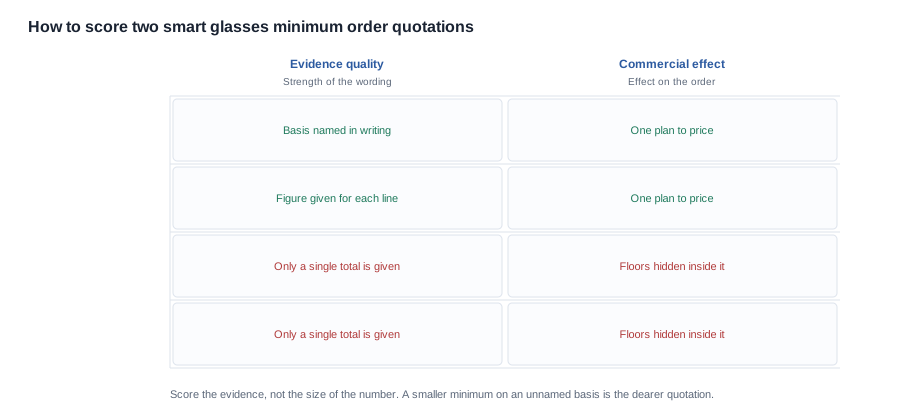
Each field is marked in one of three ways: comparable, meaning both quotations answer it in the same terms and on the same level; not comparable, meaning they answer it but on different levels or in different currency of meaning; or missing, meaning one or both leave it unanswered. A field marked not comparable is a question to ask before the comparison is allowed to conclude, and a field marked missing is a term the buyer will be asked to accept later at a moment of the supplier's choosing.
The output of the scoring is not a ranking. It is a list of follow-up questions, and it is usually a short list. Two quotations that score as fully comparable on all nine fields are rare, and a buyer who has found two that do score that way has usually found two suppliers who have prepared their quotations for a serious comparison rather than for a single order.
The marking scheme is worth writing down rather than keeping in the head, for the same reason the frame itself is written down. A comparison run on a spoken convention is re-argued at every meeting, and the argument is always about whether a particular answer was "really" a missing field. Whether a field is marked missing is a judgement, and a judgement that is not written down becomes a disagreement about the comparison rather than about the supplier — which is a conversation with no way to finish.
What a score does not tell you
Three things a score cannot produce, and a buyer should know them before relying on one.
It cannot tell you which supplier will hold a configuration across lots. That is a question about a factory's process, and it is answered by evidence from a production unit rather than by a document in a quotation.
It cannot tell you the total cost of the order, because the landed cost includes freight, duty, insurance and the cost of the documentation route, and none of those appear in a minimum order quantity comparison. They are handled separately.
It cannot tell you how the two suppliers will behave when something goes wrong. A defect remedy and a warranty window are commercial terms rather than minimum order quantity terms, and they belong in the agreement even though they are not among the nine fields.

Running the comparison session
The five steps of the comparison session
The comparison is a structured session rather than a piece of desk work, and the order of the steps matters as much here as it does in a negotiation.
- Put both quotations into the same nine-field frame, side by side. Field by field, not quotation by quotation. Reading one quotation all the way through before starting the second is the most reliable way to lose the comparison.
- Mark every field as comparable, not comparable, or missing. Write the marks down. A comparison held in someone's head is a comparison that is re-argued at every meeting.
- Ask each supplier the same question in the same words. The follow-up questions from step two, sent identically. The difference in the two answers is itself a finding, because it shows how each supplier handles a question that requires thought.
- Recalculate your plan against the basis each supplier actually used. Multiply each floor by the number of configurations the plan contains on that basis, and place the two results side by side. This is the step that converts a comparison of numbers into a comparison of commitments.
- Rank on landed cost, then read the missing fields out loud. Rank first, then read the gaps. A buyer who reads the gaps first never ranks, and a buyer who ranks without reading the gaps signs a contract that somebody else wrote.

The documents to bring
Two sets of documents, and the second set is the one that is usually missing.
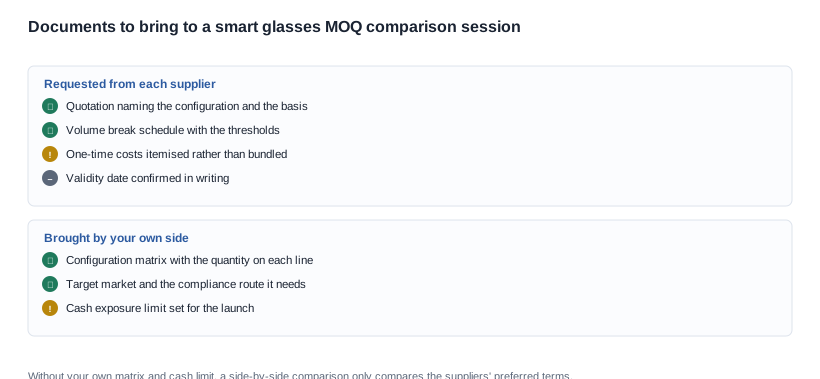
The first set is requested from each supplier and is the same list for both: the quotation naming the configuration and the basis, the volume break schedule, an itemisation of the one-time costs, and a written validity date. The second set is the buyer's own, and it is the set that makes the comparison real: the configuration matrix with the quantity on each line, the target market and the compliance route it needs, and the cash exposure limit set for the launch.
Without the second set, a comparison session compares the suppliers' preferred terms against each other and nothing else. A buyer who arrives with a matrix and a cash limit can ask whether a quotation is affordable, which is a question that has an answer.
The cash exposure limit deserves a note of its own, because it is the item that turns a comparison from descriptive into decisive. A limit set as a number gives the session a test: any quotation whose recalculated commitment exceeds the limit is not a candidate, whatever its unit price. A limit set as a percentage of the launch budget gives a weaker test, because the budget itself was probably built from one of the quotations, and a limit expressed as a percentage of a figure the quotation produced cannot reject that quotation. The useful discipline is to set the limit before the quotations arrive, which is one of the reasons to fix the range plan and the matrix first.
The market field is in the list for a different reason. Two suppliers quoting the same models for two different markets are not competing for the same order, because the documentation route differs and the route changes the cost, the schedule and the evidence each of them has to hold. A comparison that runs across two markets will produce a lower price for the supplier with the lighter route, and that lower price will not survive the moment the buyer specifies the market it actually needs.

What the field comparison exposes that a price comparison does not
Five findings that a price comparison cannot produce
The two quotations are for different products. The basis field exposes it, because the scope field will show that one quotation covers three models and the other covers one.
The cheaper quotation is the more expensive one. The recalculation in step four exposes it, and it happens whenever one supplier quotes per order and the other quotes per configuration.
The most confident quotation is the least complete. The driver field exposes it. A supplier that explains the mechanism behind its floor is usually a supplier that has a mechanism, and a supplier that answers "it is a policy" is usually quoting from a template.
The second order is the expensive one. The break points and the repeat terms fields expose it. A quotation that is competitive at the first order and silent on the second is a quotation that is competitive once.
The delivery dates are not comparable. The scope field and the configuration matrix expose it, because a date quoted for one model says nothing about a date for a different build of the same model.
The comparison has been made at the wrong moment. A frame run on quotations that were never intended to be compared produces a field-by-field account of a decision that was never on the table. This finding is not a criticism of either supplier. It is the usual result of asking for a price on a range before the range was fixed, and it is the reason the range plan and the configuration matrix have to precede the request rather than follow it.
The comparison that produces no answer
There is one outcome of this process that is worth naming, because buyers find it uncomfortable and then talk themselves out of it. Sometimes the nine fields cannot be filled from two quotations, because the supplier has not prepared a document that can be filled. A minimum order quantity quoted without a level, a break schedule that applies to a different configuration family, a validity window that cannot be found, a repeat position that does not exist: these are not weak answers to a comparison. They mean the comparison cannot be run.
The response to that outcome is not to proceed more carefully. It is to ask for the missing fields as a condition of proceeding, and to treat a supplier who will not produce them as a supplier who has decided the conversation is going to be conducted on their terms. A working template for the comparison is at pricing template, and the wider picture of how a minimum behaves is under smart glasses MOQ.
What we can and cannot put side by side for you
What a comparison needs from you
A comparison run on our side needs three things and cannot start without them: the configurations, the quantities per configuration, and the target market. Given those, we can read a supplier's quotation into the same nine fields, mark the gaps against a second quotation, and tell the buyer which fields are comparable and which are not.
We can also do the recalculation in step four, because the number of configurations in a plan can be counted from the published options without visiting a factory. What we cannot do is tell you which supplier will hold a configuration across production lots, or supply the certificate numbers and ingress test report numbers that would let a buyer verify a compliance claim independently, because those are issued against a product and a market and are not ours to publish.
What we will not do
We will not publish a minimum order quantity for our own operation, and the reason has not changed: three internal statements on the subject have not been reconciled, and a figure we cannot defend is worth less to a buyer than a structure they can use. We would rather be useful on the fields than wrong on one.
We will also not quote an industry benchmark as if it were our own performance, and we will not estimate what a supplier's floor is likely to be. A buyer who builds a budget on an estimated number finds the error in the quotation rather than in the estimate, and the quotation is the expensive place to find it.
The action to take now. Send the configurations, the quantities and the market, and we will build the nine-field frame for your plan, so that any quotation you receive can be read into it directly.
Related reading
- The hidden costs — smart glasses moq hidden costs
- The template — pricing template
- The structure used — smart glasses moq
Send the configurations, the quantities and the market and we will build the nine-field frame for your plan.


