
The cost breakdown of a small smart glasses order is not a unit price multiplied by a quantity. It is a unit price plus a set of fixed costs — moulds, artwork, certification, samples, expedited freight — that do not shrink when the order stays small, and that is why two quotations for the same model can differ by a wide margin and both be honest. We do not publish our own minimum order quantity figures, because three conflicting internal sources exist and none has been reconciled. What we can do is show where the money goes, so that a small order is priced for what it actually is.
Smart glasses MOQ: what a cost breakdown has to explain
Why two honest quotations can differ widely
Two suppliers quoting the same model at the same unit price can produce total costs that differ by a substantial margin, and neither of them has quoted badly. The difference is not in the unit price at all. It is in what each of them has included.
A quotation that shows a single unit price has told the buyer one thing about the cost structure. A quotation that shows a unit price, an itemised setup charge, a sample charge, a documentation charge and a freight line has told the buyer the structure, and the structure is what determines whether the order can be made to work. The first quotation is not wrong; it is incomplete in a way that makes comparison impossible.
There is a second reason the same two quotations differ. One supplier may be quoting a configuration the other is not. Our published range is broad enough that "the same model" is an unreliable description: the V03 Pro is published in three colours and the V06 in four; the L2 Utral is published with either a 900 mAh or a 1400 mAh charging case; the L1 Pro and the CY03, and the CY05 are published with a 1400 mAh case; the MT6 with a 1200 mAh folding case; and the V03 Pro with no charging case at all. A quotation for a magnetic-charging build and a quotation for a Type C build are not the same product at two prices.
The third reason is less obvious and is worth naming because it changes how a buyer reads a large number. Two suppliers can quote the same configuration at the same unit price and still produce totals that differ because one of them has included a first-article inspection that the other has not, or a packaging artwork setup that the other has treated as a buyer's cost, or a compliance charge for a market the buyer has not actually asked about. None of these is a price difference. They are scope differences inside the quotation, and the only way to see them is to read the quotations against a fixed list of cost pools rather than against each other.
The two piles
Split the quotation into two piles and the whole cost discussion becomes tractable.
The variable pile is per unit: electronics, cells, camera modules, frames, lenses, assembly labour and packaging. This is where volume negotiation works, and it is the pile most buyers look at first, because it is the pile with a number on it that moves.
The fixed pile is everything that gets paid once regardless of whether the buyer orders 200 units or 2,000: tooling or a mould for a customised part, first-article and sample charges, artwork and packaging setup, the compliance work for the destination market amortised across the run, and the inspection window. On a genuinely small order the fixed pile can approach the variable pile, and that is the entire explanation for why minimum order quantity discussions in this category get emotional.
The useful discipline is that the two piles are negotiated with two different instruments. The variable pile responds to volume and to a unit price at a threshold. The fixed pile responds to scope: a narrower range, a deferred customisation, a market that does not need a new route.

The four pools of a first order cost
The pools and what sits in them
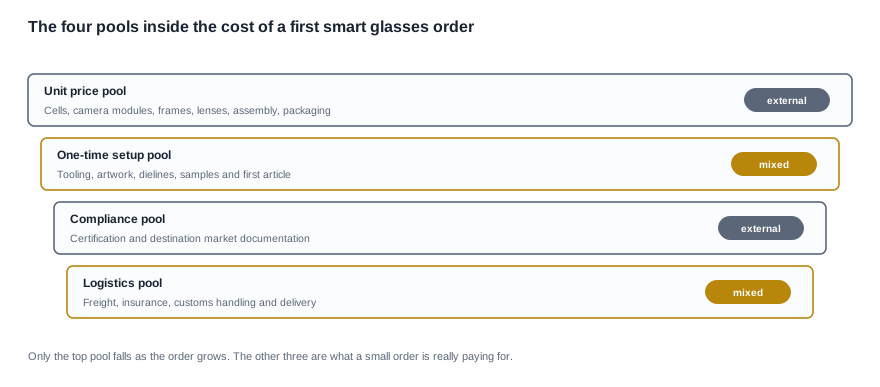
Breaking the fixed pile down into three named pools, alongside the variable one, makes the cost discussion specific.
| Pool | What sits in it | How it behaves as volume rises |
|---|---|---|
| Unit price pool | Cells, camera modules, frames, lenses, assembly, packaging | Falls per unit |
| One-time setup pool | Tooling, artwork, dielines, samples, first article | Constant, then repeated per configuration |
| Compliance pool | Certification and destination market documentation | Constant, then repeated per market |
| Logistics pool | Freight, insurance, customs handling, delivery | Falls per unit, but with a floor |
The layer diagram below shows the same four pools arranged by who controls them, which is a different and more useful ordering than the order of a quotation.
The unit price pool is the only one that behaves the way a buyer expects. Everything else has a floor, and the floor is set by scope rather than by quantity.
The pool that behaves differently
The compliance pool is the one most often missed, because it does not appear as a line on a factory's quotation at all. It is the cost of the regulatory route for the destination market, and for a European destination that route runs through the Radio Equipment Directive (EU) 2014/53/EU. The route for a market outside the European Union is a different set of requirements, not a lighter version of the same one, which is why a second market is a second cost rather than a second shipment.
Two published facts bear directly on this pool. The catalogue's IP54 marking appears on two models only, the V06 and the S7, and it is a catalogue annotation rather than a report-backed claim, so a buyer who needs an ingress result as a specification has to source it rather than cite us. And the catalogue does not publish the Bluetooth version for any of the camera models, so a tender document that needs it cannot be assembled from the range page. Both of those gaps belong in the compliance pool of the cost model, as questions to a supplier rather than as figures from us. The full route is set out under certification checklist.
The fixed costs that do not shrink with volume
The six items and what triggers each
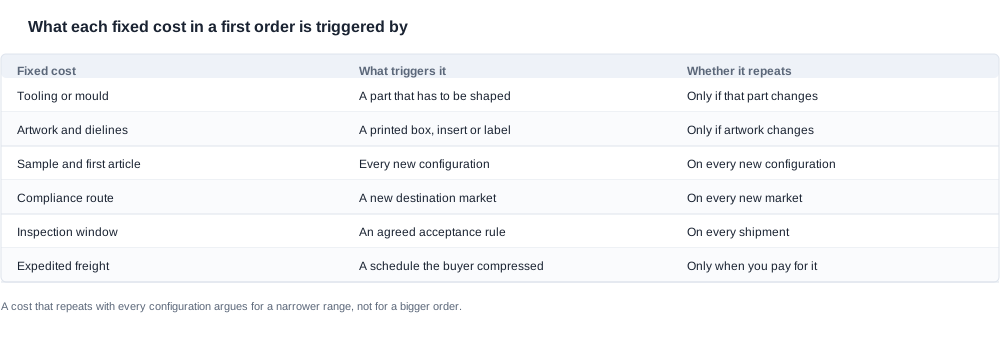
The reason a fixed cost is worth naming is that each one is triggered by something the buyer controls, and each one therefore has a decision attached to it.
| Fixed cost | What triggers it | Whether it repeats |
|---|---|---|
| Tooling or mould | A part that has to be shaped | Only if that part changes |
| Artwork and dielines | A printed box, insert or label | Only if the artwork changes |
| Sample and first article | Every new configuration | On every new configuration |
| Compliance route | A new destination market | On every new market |
| Inspection window | An agreed acceptance rule | On every shipment |
| Expedited freight | A schedule the buyer compressed | Only when it is paid for |
Two entries in this table are worth pulling out, because they are the ones that respond to a narrowing of the plan rather than to a larger order.
The sample and first-article cost repeats with every new configuration, not with every unit. A plan with five configurations therefore carries five of them, and a plan with three carries three. Narrowing the range is worth twice as much here as widening it.
The tooling and mould cost repeats only if the part changes, which means it is the one fixed cost that a careful first order can avoid entirely. A custom colour outside the published option list, a bespoke temple shape and a moulded logo treatment each potentially trigger it, and the published option sets are narrow precisely because the set is controlled.
Which of them repeat, and what that means for the second order
The distinction that matters for a programme is not fixed versus variable. It is fixed-once versus fixed-repeating, because the first amortises across the programme and the second accumulates as the range grows.
A first order that establishes one model, one colour and one packaging format creates a setup cost that will be amortised across every future order of that configuration. A programme that adds a colour, a case option and a custom packaging build in its first year creates three separate setup streams, none of which is large, and all of which have to be paid for again when they change. The cost of a wide range is therefore not the unit price difference; it is the accumulated setup and re-approval burden, and it is invisible until someone builds a schedule for it.
The related effect on the schedule is set out under production capacity, because a wider range consumes more of the same capacity that the launch date depends on.
A fourth category of fixed cost sits outside the factory entirely and is occasionally forgotten in a breakdown that is built only from a factory's quotation. The buyer's own costs of conforming the product to the destination market — the import clearance, the destination labelling, the retailer packaging, the insurance on a consignment that has not arrived — do not appear on any supplier's document and are real. They are also the costs that scale with the number of markets rather than with the number of units, which makes them the same kind of decision as the compliance route itself: a second market is a second fixed cost, and it is worth putting on the same page as the factory's own one-time charges before the buyer decides how many markets to launch into at once.

Turning a quotation into a true per-unit cost
The five steps of the amortisation
The arithmetic below is the whole of the method, and it is worth doing because it is the only step that makes a small order's price explicable.
- List every fixed cost in the quotation, itemised rather than bundled. If it is bundled, ask for it unbundled. A bundled setup fee cannot be amortised because its components are not known.
- Divide each one by the quantity actually committed, not by the quantity hoped for.
- Add the per-unit result to the unit price quoted. The sum is the true first-order unit cost, and it is the number that should be compared with a competitor's quotation.
- Run the same division against the quantity you might really place. The difference between the two results is the price of being wrong about your own forecast.
- Decide whether a narrower first order carries a lower true cost. This is the only step that is a decision rather than a calculation.

Why the arithmetic is the only part that matters
A buyer who performs this arithmetic discovers two things that are not visible any other way. The first is that the true cost of a small order is usually higher than the quoted unit price by a meaningful amount, and that the amount is dominated by a small number of identifiable items. The second is that the marginal value of a bigger order is not linear: doubling the quantity halves the per-unit share of the fixed costs, but it does not halve the cash requirement, because the deposit is usually calculated on the committed total rather than on the fixed component.
The second point is the one buyers get wrong most often, and it is the reason a larger order feels safer than it is. A buyer who doubles the order to halve the fixed cost per unit has also doubled the cash that leaves the treasury before anything is received. The fixed cost per unit falls, and the exposure rises, and the two effects are usually larger than the buyer's budget model can carry. A narrow first order with a small per-unit overhead is often the cheaper and the safer choice, and the two do not have to be traded against each other.
There is a third thing the arithmetic reveals, and it is the one that changes a negotiation. A buyer who has separated the fixed costs can ask a supplier to separate them too, and a supplier who separates them is making a statement about which of them are negotiable. A tooling charge that is itemised and attributed to a specific part can be discussed on its own terms. A tooling charge inside a bundled setup fee cannot. The request to unbundle is therefore not an accounting nicety: it is the step that converts an opaque number into a set of positions, and it is the step that tells a buyer which of the fixed costs it is worth arguing about.

When a narrower first order is the cheaper first order
The decision the breakdown makes possible
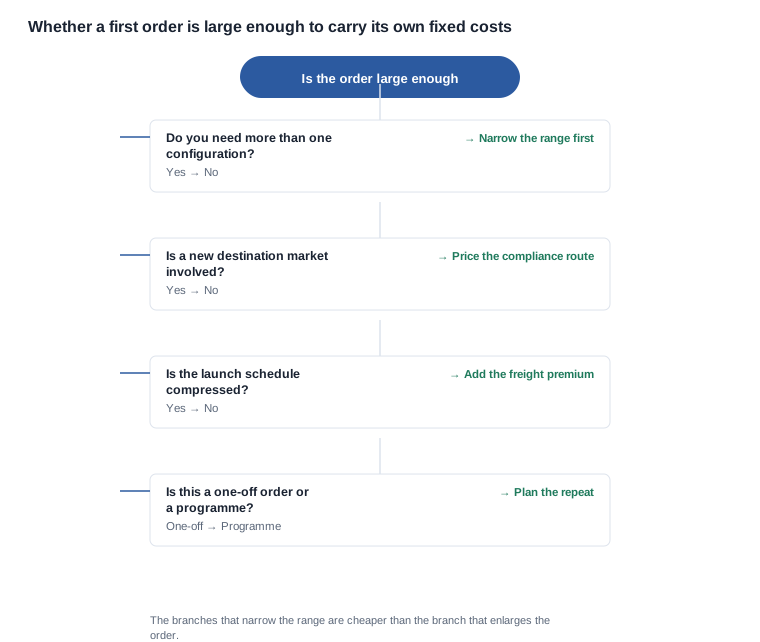
The breakdown produces one genuine decision, and it is a decision about scope rather than about volume. Three cases come out of it.
The wide first order. A launch with four colours, two case options and a custom printed box creates a large number of material sets, a large number of one-time setup charges and a large number of acceptance points to approve. Its true unit cost is lower and its cash exposure is higher. It is the right choice when the channel requires breadth, and it is the wrong choice when the channel does not.
The narrow first order. One model, one or two colours, standard packaging. Fewer setup charges, fewer approvals, a smaller cash exposure, and a true unit cost that is higher per unit but lower in total. It is the right choice when the forecast supports it and the launch is about learning what sells.
The deferred first order. The narrow first order with the customisation moved to a second order. The customisation is not removed, it is postponed, and the postponement removes a setup charge and an approval cycle from the critical path of the launch.
The three cases in terms of the published rows
The cases can be mapped onto the published range without inventing anything, and the mapping is what makes the decision concrete.
A launch built around the V06 in all four published colours creates four material sets. A launch built around the V06 in two published colours creates two. A launch built around the V06 in one colour and the L2 Utral with a 1400 mAh case creates two. A launch that adds a second L2 Utral case option at 900 mAh creates three, and the third one is not a variant of the second — it is a different configuration, with a different case in the box.
The MT6 is the one model in the range with a published weight, and the way it is published is instructive for a cost discussion. The 158 g is the weight of the glasses body including its 265 mAh cell and its camera and excluding the 1200 mAh folding charging case, whose own weight is not published. A buyer calculating what a case does to the packing volume and to the freight weight is working with a published number for one part of the assembly and no published number for the other, which is exactly the kind of gap that belongs in the cost model as an open question rather than as an estimate.
The cost lines we do not publish
What is published and what is not
We publish the specifications the cost is built on, because those are what make the cost model checkable: the published resolution tiers, with eight camera models at 8 MP — the V03 Pro and the KY06, the V03 and the CY05, the MT6 and the CY03, and the V06 and the MT5 — and three at 13 MP, the L2 Utral and the S7, and the L1 Pro. The cell capacity, the charging method, the charging case option and the charge time are published per model, with charge time published for all twenty-eight models and charging method published for all but four. The published colour options are on the record for the models that have them.
We do not publish our unit prices, our tooling charges, our artwork charges, our sample costs, our freight rates, our production capacity figures, our lead times, our defect rates or our minimum order quantity. None of those are published for our own operation, and the reason in each case is the same: our internal statements on the subject have not been reconciled, and a number we cannot defend is worth less to a buyer than a question they can put to us.
We also do not publish the weight of any model other than the MT6, the Bluetooth version of any camera model, ingress test report numbers, acoustic measurements, cycle life ratings, certificate numbers or their validity dates. Those belong to a supplier's own file, and the correct answer from us is a question.
What we can compute
What we can do is take a range plan and a set of quotations and rebuild the cost structure of the order in the form above: which costs are per unit, which are one-time, which repeat with each configuration, and which repeat with each market. We can then tell you which items in a quotation are bundled and what they would look like unbundled, and which part of the true unit cost is driven by a decision about scope rather than by a decision about volume.
That is a working document, not a published price list, and it is the most useful thing we can put on a desk before a first order is placed.
The action to take now. Send the range plan, the quotations and the target market, and we will separate the per-unit costs from the one-time costs, show which of the one-time costs repeat with each configuration, and tell you what a narrower first order would cost in total.
Related reading
- The compliance route — certification checklist
- The schedule effect — production capacity
- The approach — smart glasses moq
Send the range plan, the quotations and the target market and we will separate the per-unit costs from the one-time costs.