

The quality consequence of a minimum order quantity is not that the goods get worse. It is that the same specification produces a less predictable result as the lot gets bigger, and that the predictability is what your acceptance regime was quietly relying on. A first order that is small enough to inspect exhaustively tells you almost nothing about the fourth order, which is bigger, produced in a longer run, and checked on a sample. The quality cost of a minimum is therefore not the defect rate of the units you received; it is the gap between the units you received and the units you will receive.
The conclusion: price the quality regime, not the defects. That means the acceptance level, the inspection gates, the traceability and the sample retention are all cost lines that scale with the lot, and the specification clauses that protect them belong in the order rather than in a quality manual.
Smart glasses MOQ: the quality cost of the volume you chose
The conclusion, stated for use in a buying review
Choose the acceptance regime before you choose the quantity, because the regime is what the quantity has to live with. A specification with an agreed sample, a first-article check, a lot sample, a batch number on every carton and a retained sample is a specification that can absorb a large lot. A specification without them is a specification that can only be verified by inspecting everything, which is the strategy a small lot makes affordable and a large lot makes impossible. The total cost of a minimum includes that difference, and most buyers price the unit price and the setup charges while leaving the inspection regime unpriced.
The buyer managing this problem, and what they are actually managing
The reader is a procurement manager or a category buyer who has been asked to reduce returns, or who has seen a defect rate rise on a repeat order and is trying to work out why the first order was fine. That second case is the one worth naming, because the answer is rarely that the factory's quality fell. It is usually that the verification fell: the first order was small enough to inspect closely, the repeat order was larger and was inspected by sample, and the sample was checking a different configuration than the one that had been approved.
That makes the problem a documentation problem before it is a production problem. The specification is usually fine. What is missing is the chain that connects a unit in the warehouse back to the approval it was built against, and the chain gets thinner exactly as the lot gets bigger, because the assumption is that a bigger lot needs less verification rather than more.
There is a commercial side as well, and it is the one that gets a buyer into trouble. A buyer who negotiates the unit price hard and then accepts the default inspection regime has saved money on one line and accepted a larger expected cost on another. The trade is invisible because the second cost arrives later, in the returns channel, and it arrives in somebody else's budget.
Why a minimum changes the quality of a lot
Three mechanisms, and they are worth separating because they have different fixes.
The material set widens. A larger run draws from a wider pool of incoming material, and the tolerance on a component that was accepted at the start of a short run may be exercised more often in a long one. This is not a fault; it is a statistical consequence of a wider sample.
The line drifts. A production line that runs a single configuration for a long period accumulates process variation that a short run would not reach, and the drift appears first in the visible attributes — colour, print registration, lens tint — and last in the functional ones. Visible drift generates complaints; functional drift generates returns.
The configuration multiplies. This is the one most often missed, because it is a consequence of the range rather than of the volume. Where a minimum is quoted per configuration, a programme with several variants is not one larger lot but several lots, each of which has to be set up, approved and inspected. The number of production runs, and therefore the number of opportunities for drift, scales with the variant count.

The published rows that decide what you inspect
Six rows and what each one drives
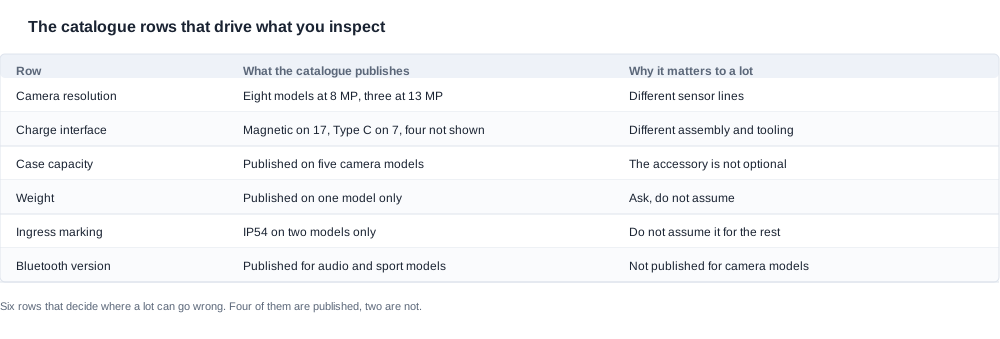
The table above sets out the published rows that have a direct bearing on where a lot can go wrong, and in each case the inspection consequence is different. Resolution, for instance, splits the eleven camera models into eight published at 8 MP and three at 13 MP, which means a lot cannot be verified against one reference across the whole camera range without a specification that names the sensor line. The charging interface splits the catalogue into seventeen entries on magnetic charging, seven on Type C and four that do not publish it at all, which means the four unpublished entries are the ones where the assembly method has to be established from a sample rather than from a document.
The accessory row matters more than it appears. Five of the eleven camera models publish a charging case capacity — the CY05 and the L1 Pro, and the CY03 — each at 1400 mAh, the L2 Utral at 900 or 1400 mAh, and the MT6 at a 1200 mAh folding case — while the KY06 and the MT5 carry a case whose capacity is not published and the V03 Pro is published with no case at all. Where the capacity is published, the case is a checkable item in the inspection. Where it is not published, the case is an uncheckable one, and the only way to close that gap is to agree a reference sample.
The rows published for one model, and the rule that follows
Two of the rows in that table are published for only a small number of models. The ingress marking appears on two models in the catalogue, the V06 and the S7, and a buyer who has read it as a category attribute will produce a specification that claims protection the product does not have. The weight appears on one model only, and it is published for the glasses body including the battery and the camera, with the MT6's 1200 mAh folding charging case given as a separate item whose own weight is not published. That single row is the one most often misread as a frame weight, and a specification annex built on the misreading will not survive an inspection.
The rule that follows applies to every unpublished cell in every table: an unpublished row is not a row to be interpolated from a sibling model. Ask for the figure for the configuration you are ordering, and where the supplier cannot provide it, record it as unpublished rather than carrying a number across from a related build. The quality consistency reference sets out what we can evidence directly, and the MOQ structure guide covers the commercial side of the same question.
The published figures and what they leave open
Two limitations are worth stating precisely, because both are the kind of gap that gets filled with an assumption in a quality plan. The first is that a published charge time has no start state and no end criterion — the catalogue does not say what state of charge the clock begins from, nor what level of charge counts as complete — so a charge time cannot be used to derive a maintenance interval inside a shift. The second is that the published use times are runtime ratings rather than test results; the camera entries carry five to eight hours, six to eight hours or about seven hours depending on the model, and none of them states the duty cycle behind the figure.
Where consistency risk sits across the range
The four quadrants
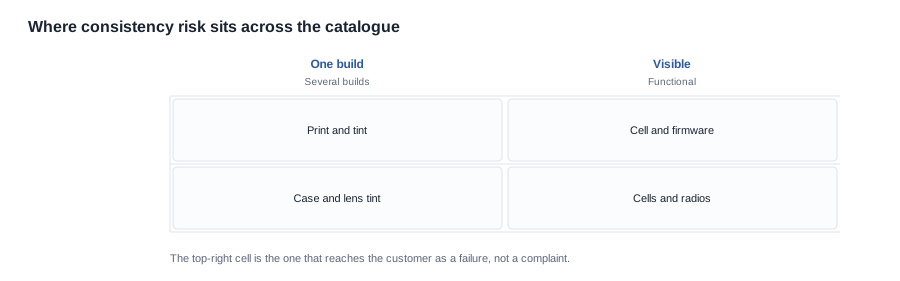
The matrix above splits the risk into four cases, using two axes that matter commercially: how many builds the programme contains, and whether what varies is visible to the customer or functional. A single build whose variation is visible — print registration, colour matching — is a quality problem that generates returns and is usually caught by an incoming check. A single build whose variation is functional — cell behaviour, radio behaviour, firmware — is a harder problem, because it will not be visible at incoming inspection and will surface in the field.
The difficult quadrant is the one with several builds and functional variation, because each build needs its own approval, its own reference and its own inspection scope, and because the total number of opportunities for drift scales with the build count rather than the unit count. That is also the quadrant a programme enters quietly, by adding a colourway or a case option to an existing plan.
Which quadrant your programme is in
Work it out before the order, because the quadrant determines the inspection scope and the inspection scope determines the cost. The question to ask is how many distinct builds the first order contains: one model in one colourway with one case option is a single build; the same model with three colourways and two case options is six builds, and each one carries its own setup, its own approval and its own first-article check.
The second question is which attributes can drift, and which of them the customer would notice. The published catalogue gives a partial answer: colourways exist and differ between models, the charging interface differs across the range, and the lens option differs again on the models that offer it. That is a specification with several variable attributes, and a specification with several variable attributes is one where the reference sample and the batch traceability carry more weight than they would on a single-build programme.

The inspection sequence that protects the first order
Six gates, in this order
- Approve a golden sample against a written specification. Not a photo and not a description: a physical unit that both sides hold, signed and dated, with the specification attached.
- Check the first article before the lot is released. This is the gate that catches a configuration change made during production, and it is the gate most often skipped when a schedule is tight.
- Sample the finished lot against the approved sample. Not against the specification alone. The specification says what was ordered; the sample says what was accepted.
- Verify the configuration on the box against the configuration ordered. A box that describes a different variant than the one inside is a defect that reaches the customer before the product does.
- Record the batch number before the goods leave. Batch traceability is what makes a future claim answerable, and it is the cheapest thing on this list to add and the most expensive to retrofit.
- Keep the sample for the next order. The retained sample is what the repeat order is inspected against, and it is the only reference that survives a change of personnel.

The acceptance level is a commercial decision, not a technical one
The acceptance level is the mechanism that decides how much of the lot is examined, and it is routinely set by default rather than by choice. Its commercial weight is easy to state: a stricter level costs more in inspection time and puts more of the burden of a discovered defect on the factory, while a looser level costs less and puts more of it on the buyer and the channel.
The right level depends on two things a buyer can actually establish. The first is how many builds the lot contains, because more builds mean more ways for the lot to be internally inconsistent and therefore more to check. The second is what a defect in this category costs downstream, which is not the value of the unit but the cost of the return, the second shipment, the channel adjustment and the customer who does not buy again.
What to ask, before you order, is what the acceptance level is, who signs it, what happens when it fails, and whether it is renegotiated at the repeat order or inherited. A level that is inherited silently is a level that is set by whoever placed the first order, and that is usually not the person who now owns the consequences.
Where the returns channel becomes part of the quality regime
A defect that is caught at incoming inspection is a cost. A defect that reaches a customer is a cost of a different kind, because it is paid in the returns channel and in the confidence of whoever bought the product. In this category the returns cost is not symmetric: a defective unit in a channel that resells through marketplaces has to be recovered, inspected, relabelled or destroyed, and the marketplace itself may impose its own conditions on the listing.
That asymmetry is a good reason to decide the acceptance level before the quantity rather than after it. A stricter acceptance level is expensive in inspection time and cheap in returns; a looser one is the reverse. Which side of that trade a programme should sit on depends on how many builds it contains and on what the downstream cost of a defect is for that particular channel, and both of those are knowable before the order. A buyer who leaves the decision to the default has decided it without the information.
There is one more consequence of lot size that belongs here rather than in the commercial section: the cost of an inspection rises with the number of distinct builds, not with the number of units. This means a programme with three colourways of one model has a lower inspection cost per unit than a programme with three models in one colourway, which is the opposite of what the volume alone would suggest, and it is the clearest argument for a narrow range over a wide one when the verification budget is fixed.
The clauses that hold quality through the order
What to write on the order
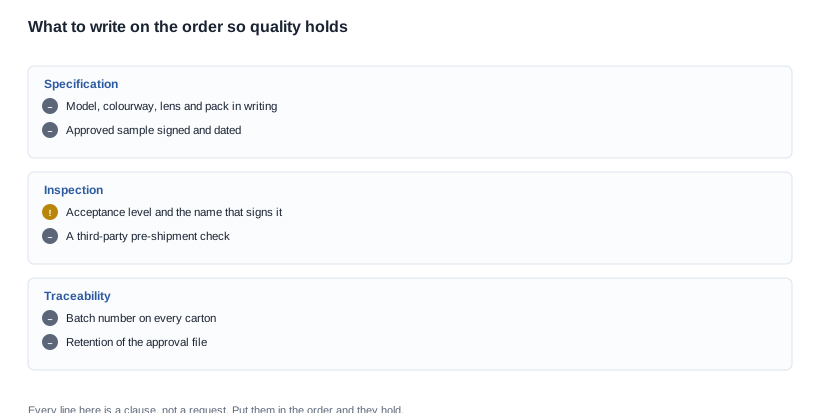
Every line in that checklist is a clause rather than a request, and the distinction is the whole point: a request in an email is an intention, while a clause in an order is something a buyer can point to when the goods arrive and something a supplier can price. The specification annex should name the model, the colourway, the lens option, the pack and the accessory position; it should attach the approved sample as a signed reference; it should state the acceptance level and the name that signs it; and it should require a batch number on every carton.
Two clauses are worth adding beyond the checklist. The first is a change-control clause: any substitution of a cell, a sensor, a radio module or a case component reopens the approval, because each of those is a different component with a different tolerance and a different regulatory position. The second is a retention clause for the approval file, with a stated period, so that the reference against which the repeat order is judged still exists.
The clauses that get skipped
Three clauses are skipped more often than the rest, and each one is skipped for a reason that seems reasonable.
The batch number clause. It is skipped because it looks like a logistics detail. It is not: without it, a defect found in the channel cannot be traced to a production window, and every claim becomes a negotiation rather than a process.
The change-control clause. It is skipped because it looks like distrust. In practice it is the clause that makes a substitution visible, and a substitution that is visible can be assessed before it reaches a customer.
The retention clause. It is skipped because it costs the supplier nothing visible and the buyer nothing visible. Its value is entirely in the future, which is exactly why it tends to be lost when the person who wrote it moves on.
Consistency, and what we can evidence for it
Our position
We publish the model-level data that a consistency regime can be built on: the interfaces, the charge times, the resolution classes, the cell capacities, the case options and the rated use times, the ingress marking on the two models that carry it, and the weight on the one model where it is published. We do not publish prices, minimum order quantities or lead times, because all three are confirmed per enquiry and depend on the configuration.
What we will do is tell you which of these figures we can evidence for the configuration you are ordering, and which we cannot, and we will supply the approval and inspection procedure for a production run on request so that it can be written into the order rather than described in a meeting. We would rather a buyer adopt clauses we can evidence than clauses we cannot, and the hidden costs article covers the other side of the same calculation — what the commitment costs before anything arrives.
Lens, case and first order quantity
Send the model, the colourway count, the lens and case options, the destination market, the first order quantity, the number of distinct builds in the plan, and the date the goods have to land. We will come back with the minimum for that configuration, the setup charges itemised, the price tiers, and the inspection and approval scope we would propose for the number of builds you have described. If you send a sample for assessment, we will tell you what we can confirm from it and what still requires a document.
Related reading
- Hidden costs behind the minimum — the commitment before the goods arrive
- Comparison table for buyers — how two quotations are compared field by field
- Practical advice before you order — the brief that carries the specification


