

This smart glasses MOQ worked example is a constructed structure, not a customer order, and it is constructed for the same reason we publish no unit price: a minimum order quantity is a term, and terms are agreed per configuration and per relationship. What can be shown is how one range plan creates several separate floors, because the number of floors is what a buyer has to plan around, and it is almost never the number they expect.
The plan: a new brand, one camera platform, a first season, one destination market.
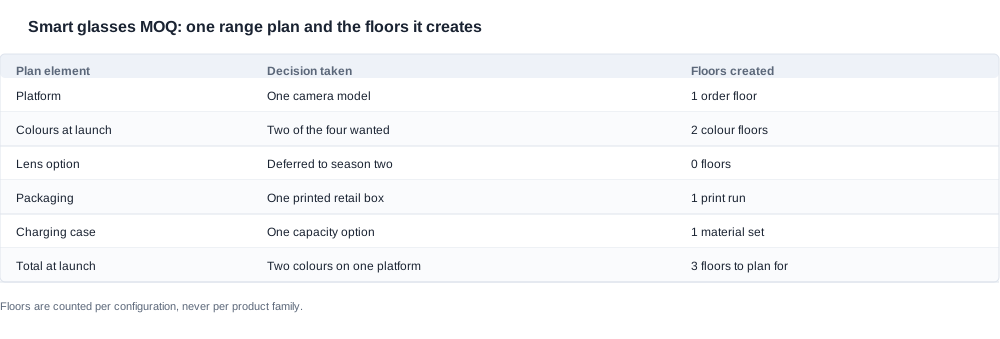
Smart glasses MOQ: a worked example of the three floors
The short answer before the arithmetic
If you are working from a single figure, you are working from a number that describes one configuration out of several. The floor that matters is the one your narrowest configuration carries, and the number of floors you have to fund is the number of configurations your order implies, not the number of products on your launch list. Narrowing the configuration list is the cheapest lever in the whole structure, because it costs no money, no engineering and no schedule, only product ambition.
The plan before the arithmetic
The buyer in this constructed scenario is a brand entering a single market with a single camera platform for a first season. The range plan as it arrives asks for four colours, a photochromic lens option, a printed retail box, and a charging case. The budget allows one platform and one print run. That gap between what the range plan wants and what the programme can fund is the entire subject of this example.
Two published facts shape the platform decision. The camera range covers eleven models, eight of them at 8 MP and three at 13 MP, and the cell capacities differ across the range rather than forming a single band. More usefully, the charging interface is not uniform: magnetic charging covers most of the catalogue, Type-C covers a smaller group, and four camera models publish no charging method row at all. A platform decision is therefore also a decision about which axis of the configuration the buyer is going to multiply.
The reason the second fact matters more than it appears is that an unpublished row is an open axis rather than a single option. Four of the eleven camera models publish a pixel count, a cell capacity, a rated use, a charge time and a case capacity, but no charging method row at all. A buyer who treats that as a single configuration has silently assumed one charging interface for a model where the interface is not stated, and the assumption will surface as a change request during production at the worst possible moment.
The other published distinction the platform decision turns on is the case. Three camera models publish a 1400 mAh case, one publishes either a 900 or a 1400 mAh case, one publishes a 1200 mAh folding case, and one publishes no charging case at all. A case is a separate material set, so a platform decision that includes a case is a platform decision that has added a second axis of commitment. In this example the case is retained, and the extra commitment is counted rather than absorbed.
Step one: the platform creates one order floor
One camera platform means one order minimum for the platform itself. If the chosen platform is one of the 13 MP models, the published rows are a 290 mAh cell, about seven hours of rated use and a charging case published at 1400 mAh. If it is one of the 8 MP models, the published rows differ: 220 mAh with five to eight hours, and a charging interface that is either magnetic, Type-C, or not published for four of the eleven camera models.
None of these figures is the floor. They are the inputs to the configuration list, and the floor follows from the list. But there is one point worth making here, because it is where buyers go wrong: the platform choice does not create the per-colourway floors. The platform creates one order-level commitment. The colourways create the rest.
Step two: two colourways instead of four
The range plan wanted four colours. Each colourway is a separate item with its own material set, so four colourways produce four per-colourway commitments where the plan wanted one platform to carry them all. Narrowing the launch to two colourways creates two commitments instead of four.
This is the cheapest lever available and it is also the one most often missed, because it does not look like a decision about the factory at all. It looks like a decision about the brand's launch. Nothing about it requires a negotiation, a concession or a delay. The buyer simply decides to launch with two colours instead of four, and the number of commitments falls with it.
The published colour data shows how narrow this lever can be. The V06 publishes four colour options and the V03 Pro publishes three. Choosing a platform with three published colours rather than four is one way to reduce the count before any commercial conversation happens, at the cost of a range decision rather than a commercial one.
Step three: the lens option creates nothing, if it is deferred
A photochromic lens configuration would create additional configurations, because each lens and colourway combination is a separate item. Deferring it to the second season creates no floor at all.
The option is real, and it is worth noting that the V03 Pro does publish a photochromic lens configuration, so this is a deferral rather than a concession. What is being traded is a range ambition in season one against a range breadth in season two. The published data also supports the deferral on the numbers: a photochromic configuration is a longer rated-use row than the standard one on the same platform, which means it carries more risk in a first season where the sell-through data does not yet exist.
Step four: the printed box is a cost effect, not a floor effect
One printed box with one artwork is a print run. It is not a minimum-order effect, but it interacts with the order minimum rather than replacing it. The print run has its own length, and if that length is longer than the order quantity then the packaging commitment exceeds the electronic build commitment, which inverts the usual assumption that the device is the bigger number.
There is a second reason to keep artwork count at one in a first season: every additional artwork is an additional approval cycle, and approval cycles sit on the critical path of the first shipment rather than on the production line. One artwork is one cycle, and one cycle is one date on the launch calendar.
Step five: the quantity is sized to what can be lost
The order minimum is met once, and the order is sized so that a flat demand curve is survivable. This is where the arithmetic and the commercial judgement meet. The minimum is a floor, and the order is a bet, and the gap between the two is the buyer's risk.
The gap should be sized deliberately, because a floor that is met exactly leaves no margin for a shipment that is short, a configuration that sells faster than expected, or a second season that has to be bought at a worse price. The formula is not ours and is not published here, but the shape of the judgement is: the floor sets the size of the commitment, and the forecast sets the size of the order, and the two should not be the same number.
Step six: the second season adds floors on evidence
The second season is the two additional colours, decided on the data from the first rather than on the ambition of the original plan. Each additional colour is one additional floor, and this time the floor is bought with information instead of with hope.
The contrast with the first season is the point of the whole example. In season one the buyer narrowed the range to protect the budget. In season two the buyer expands the range because the sell-through data justifies it. The same structural decision, made once under uncertainty and once under evidence.
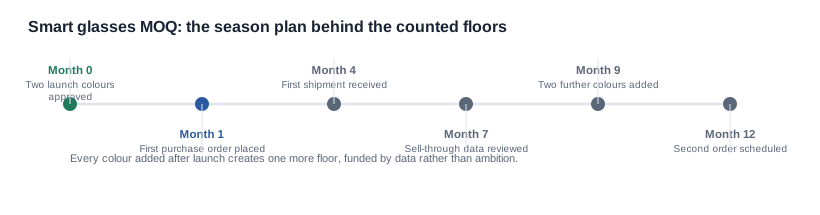

Counting the floors platform by platform
The counting procedure is worth separating out, because it is the part a buyer can apply to their own plan and the part that does not depend on any figure we publish.
- List the platform models, one line per model. One model gives one order-level commitment.
- For each model, list the colour options you will actually order. These are per-configuration commitments.
- For each model, list the charging and case options you will actually order. These are further per-configuration commitments, and they multiply the colour count.
- Multiply: every model by every colour by every case option. This is the number of per-configuration floors.
- Add the order-level floor for the consignment as a whole. If the supplier quotes per order rather than per configuration, this replaces step four rather than adding to it, and the distinction changes which arithmetic is the right one.
- Compare the total against the cash you can commit at launch. This is the only step that requires a number from the supplier, and it is deliberately last.

Steps one to three are the buyer's own work and can be completed before any supplier is contacted. Step four is pure arithmetic on the buyer's own plan. Step five requires the supplier's basis, not their number. Step six is where the commercial conversation actually happens.
Three ways the count goes wrong
The count is simple enough that the errors are worth naming, because each one produces a plan that looks right and is not.
The forgotten axis. The buyer counts models and colourways and forgets the case, or forgets that a case is optional on some models and mandatory on others. The count comes out one per colourway when it should be two, and the extra commitment shows up as an unpriced case line at the second order.
The merged count. The buyer treats a per-configuration floor and a per-order floor as one number, because they arrived in the same sentence. The order looks smaller than it is, because one of the two floors has been silently absorbed into the other. The check is whether the count has an internal total or an internal maximum, and the two require different answers from the supplier.
The count that includes a deferred item. The buyer counts the photochromic configuration in season one because it is in the range plan, and then defers it. The count should have excluded it from the start, and if it did not, the launch plan is carrying a commitment that no longer exists. This is the most common error in the example because the range plan and the launch plan are written at different times by different people.
None of the three is a factory problem. All three are planning problems, and all three are visible if the count is written down before the enquiry rather than reconstructed afterwards.

What the count changes: cash, colourway, and the second season
The count changes three things, and they are worth separating because two of them are commercial and one of them is organisational.
Cash. Each floor is a separate commitment, and separate commitments do not consolidate automatically. Three floors of equal size are not the same as one floor three times the size, because the cash sits in the factory against three different material sets and cannot be recovered by reducing one of them. This is why the per-configuration structure has a real cost at launch and why the order-level structure is easier to fund but less protective.
The colourway decision. Once the floors are counted, the range plan becomes a commercial document rather than a brand document. Two colours instead of four is not a compromise, it is the removal of two commitments and the associated cash, and it can be defended with arithmetic instead of with taste. That is a much better position to negotiate from than a preference.
The second season. A first season of two colourways produces two data sets, not four, which means the season-two decision is made on half the evidence it would have been with four. That is a real cost of the narrowing decision and it belongs on the same page as the saving. A buyer who narrows to two colours and then launches four colours in season two anyway has gained nothing and lost the cash.
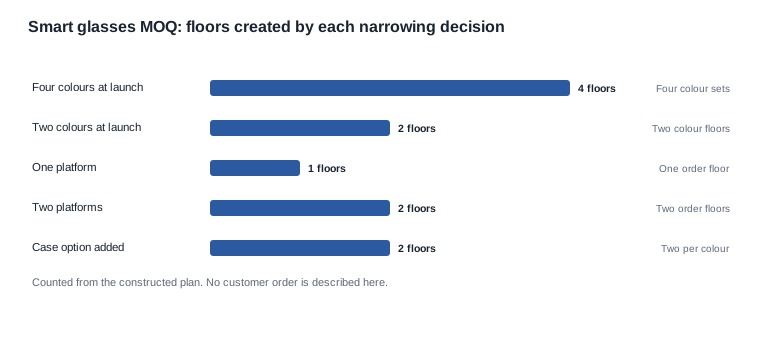
The bars above are counted from the constructed plan in this article, and they show the asymmetry clearly. Halving the colour count halves the per-colour commitments and costs nothing. Adding a second platform doubles the order-level commitments and costs the full cash of a second material set. Ordering more units against the same floors absorbs nothing and leaves the buyer with inventory they did not need.
The cash cycle consequence that the count does not show
The count tells the buyer how many commitments exist. It does not tell the buyer when the cash moves, and in a first season those are two different questions. Each commitment has a different date on which money becomes unrecoverable, and those dates are set by the production sequence rather than by the count.
A colourway commitment typically becomes unrecoverable at the point where the material for that colourway is bought, which is earlier than the point where the order as a whole becomes unrecoverable. A print run becomes unrecoverable when the artwork is signed, which is earlier still and is entirely within the buyer's control. A case commitment becomes unrecoverable when the case is ordered, which for a shared component can be the same date as the device itself and for a custom component can be much later.
That ordering matters because the payment schedule for a first order usually collects a deposit that is larger than the material spend actually committed at that point in the production sequence. The buyer who has counted the floors but not the dates will find that the cash cycle is worse than the structure implied, and the fix is not a smaller order but an earlier conversation about which milestones the deposit is tied to. The mechanics of that conversation sit in the payment terms material rather than here, but the dependency is worth stating plainly: the floor count and the payment schedule have to be negotiated together, because they are the same lever viewed from two ends.
The generalisation: floors multiply faster than range
Three things carry out of this example, and all three generalise past the particular plan.
The floors multiply faster than the range appears to. One platform with two colourways is three commitments, not one. A buyer who assumed one product was assuming one floor, and the gap between those two assumptions is the whole planning error.
The largest lever is the cheapest one. Narrowing the colour count costs nothing, requires no engineering and moves no date. Ordering more units to absorb the floors costs cash, occupies warehouse space and reduces the number of floors by none.
The second order is a different order. The one-off costs fall away, the volume break may move the unit price, and the colourways are decided on data rather than on the original plan. Treating the first and second orders as the same order is a mistake in the direction that costs the most, because the first order is where the commitments are set and the second order is where they are merely paid for.
The customisation interaction that this example deliberately avoided is set out separately under customisation options and MOQ impact, because custom work adds a floor rather than multiplying an existing one, and it behaves differently on the cash cycle.
Why we publish the structure and not the number
The short answer: we publish the structure and not the number, because three internal readings of our own minimum order quantity policy have not been reconciled and we will not print a quantity we cannot defend. We will not bundle the three floors in this example into a single figure either, because a buyer who cannot tell them apart cannot plan against them.
What we can do is take your range plan and count the floors the same way, platform by platform, colourway by colourway, configuration by configuration, and show where the commitments actually sit. The framework is under smart glasses MOQ, the buyer's list is in moq buyer checklist, and the way the floor interacts with the cash cycle is set out in the payment terms material. The count is yours to run before you contact anyone, and running it first is what makes the conversation about commitments rather than about a number.
One note on the boundaries of this example. The plan described above is constructed for illustration. It does not describe a client order, it is not a quotation, and the figures in the tables are counts of the constructed plan rather than published factory data. The published catalogue rows it relies on, including the 290 mAh cell on the 13 MP camera models, the 1400 mAh case, the 8 MP and 13 MP resolution split and the published colour counts, are set out in the product material. Where this article says a floor would be created by a given decision, it is describing the structure of a commitment, not quoting a quantity that any factory has agreed to.
Related reading
-
The structure used — smart glasses moq
-
The buyer's list — moq buyer checklist
-
The customisation interaction — customization options moq impact
Send us your range plan and we will count the floors the same way.


