

The most common mistake in a smart glasses minimum order decision is treating the minimum as a number the supplier picked. It is not a number the supplier picked. A minimum order quantity in this category is the quantity at which a component becomes worth ordering, a production slot becomes worth opening and the compliance work becomes worth repeating — and those three floors rarely sit at the same place.
That is why the answer to "what is your MOQ?" is rarely a useful thing to know. The useful thing to know is which of the three floors is binding for your configuration, because each one moves under different conditions and each one is negotiable against something different.
Six questions get you there. What follows is the working version of the minimum order criteria list, the questions to ask in the first round, the misconceptions the six questions are designed to break, and the routes to a quantity you can actually build.
Smart glasses moq: what a minimum order is spent on
Before the questions, it is worth being precise about the mechanism, because most of the misconceptions come from treating the minimum as a volume rule when it is a material rule.
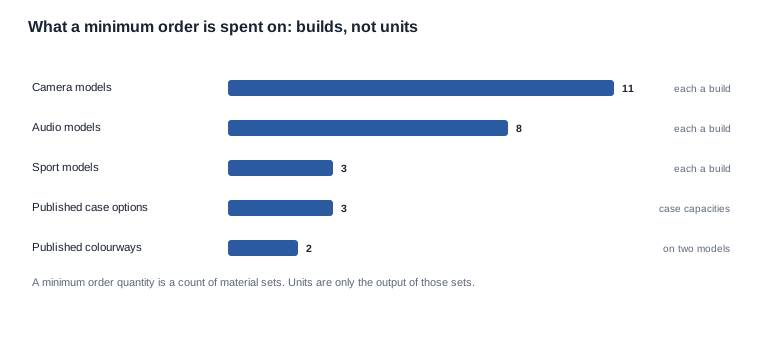
A minimum order is spent on builds, not on units. In this catalogue the camera models alone account for eleven distinct builds, the audio models for eight and the sport models for three, and each build is a separate material set with its own set-up. The published charging-case options make the point sharper still: cases appear at 1400 mAh, at 900 or 1400 mAh, and at 1200 mAh in a foldable case, so a single camera model can be two or three builds rather than one. The published colourway counts add more again, with four colourways on the V06 and three on the V03 Pro.
So the arithmetic behind a quoted minimum is roughly: the binding component lot, times the number of material sets, times the set-up cost amortised over the run. It is not a number of units at all, and a buyer who treats it as one will negotiate against the wrong thing.
The three floors behind it are worth separating, because they behave differently under pressure.
The component floor. A purchased part arrives in a lot, and the lot is the smallest thing that can be bought. The cell is the most common binding part in this category, and the published configurations span several capacities — 220 mAh on the V03, the V03 Pro and the MT5, 260 mAh on the KY06, the V06 and the S7, 265 mAh on the MT6, and 290 mAh on the L2 Utral and the L1 Pro, and the CY03 and the CY05 — with a second cell type introduced by the case. A cell lot floor is the floor that moves least under negotiation, because it is a fact about the supplier's purchasing and not a policy.
The slot floor. A production run has to be long enough to justify a changeover for the configuration. This floor moves with the number of configurations in the order, not with the unit count, and it is the floor most often negotiated successfully, because a buyer who accepts one colourway for the first run is buying a changeover rather than a volume.
The compliance floor. Some of the per-configuration work has to be repeated for each variant — a technical file, a declaration, a transport document set. Where that is the binding floor, the negotiation is not about volume at all; it is about which variants go into the first order.
The three floors ranked by how well they hold
Ranking the three floors by how firmly they hold under negotiation is the practical output of this section, because it tells the buyer which argument is worth making.
The component floor holds hardest, and it is not a negotiating position — it is a fact about how the supplier buys. A cell lot is bought, and the lot quantity is whatever it is. The one lever that exists is a forecast or a standing order that lets the supplier buy against a larger total, and that lever belongs to the buyer only in the sense that the buyer can offer it. It cannot be requested.
The slot floor holds softly, and it is the floor most buyers can move without spending anything. It moves when the number of configurations in the order drops, because a run of one configuration does not pay for a changeover the way a run of four does. Dropping a colourway, deferring a case option to the reorder, or launching on a stock build rather than a custom one all reduce it. None of these costs anything but a delay in having that variant available, and the delay is usually cheaper than the inventory.
The compliance floor sits between the two. It holds for as long as the configuration is fixed, and it drops the moment a variant is removed from the order rather than merely deferred — because the whole point of per-variant compliance work is that the variant exists. A buyer who can remove a variant rather than delay it has more leverage than a buyer who can only defer it.
The practical sequence that follows is worth stating, because most buyers run it in the wrong order. Ask which floor is binding before asking for anything. Ask what changes it before asking for a reduction. And then ask for the reduction against the specific floor you identified, because a supplier can move a slot floor and cannot move a component lot, and a request framed against the wrong one produces a flat no and no further progress.

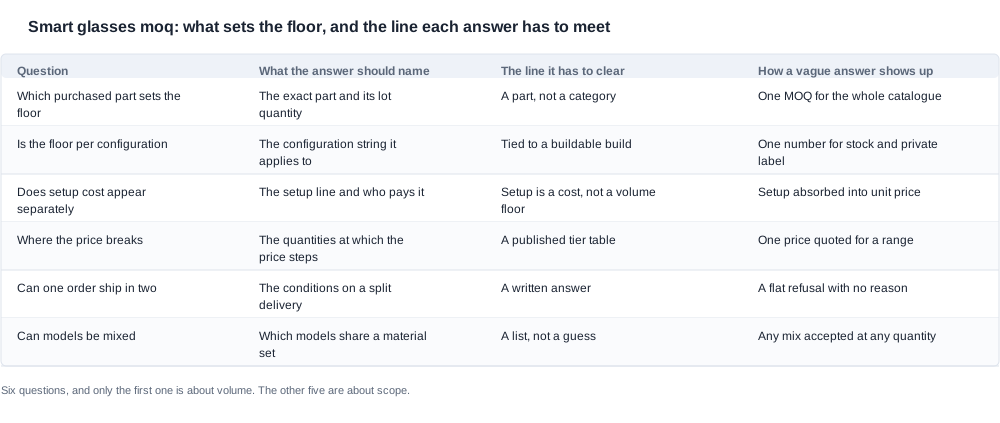
The six questions, and what a good answer looks like
| Question | What the answer should name | The line it has to clear | How a vague answer shows up |
|---|---|---|---|
| Which purchased part sets the floor | The exact part and its lot quantity | A part, not a category | One MOQ for the whole catalogue |
| Is the floor per configuration | The configuration string it applies to | Tied to a buildable build | One number for stock and private label |
| Does setup cost appear separately | The setup line and who pays it | Setup is a cost, not a volume floor | Setup absorbed into unit price |
| Where the price breaks | The quantities at which the price steps | A published tier table | One price quoted for a range |
| Can one order ship in two | The conditions on a split delivery | A written answer | A flat refusal with no reason |
| Can models be mixed | Which models share a material set | A list, not a guess | Any mix accepted at any quantity |
Two rows deserve a second reading: the first and the third. The first looks like a procurement detail and it is the one that decides whether a negotiation can succeed, because a floor set by a part arrives with that part's own lead time attached and cannot be argued away. The third looks like an accounting question and it decides whether the quoted minimum is a production constraint or a recoverable cost, which are entirely different things to argue about.
Before you order, the checklist is short: ask for the configuration string, ask for the measurement condition behind every figure, ask for the documentation route, and ask what happens to a unit that does not match. How to evaluate a row is to insist on the condition before the number, and how to compare two quotations is to set them out in the same order before the numbers are compared at all. The red flags are unremarkable on their own, and the trade-offs behind them are the same in every programme: a figure with no condition, a specification that names a product family rather than a buildable configuration, and a date with no owner.

The five misconceptions this set of questions is designed to break
The most valuable thing a buyer can do with a minimum order question is to stop assuming what the answer is going to be, and there are five assumptions that come up in this category more often than any others.
The misconception that one minimum applies to the whole catalogue. It does not, and a supplier who quotes one is quoting a catalogue minimum rather than an order minimum. The test is whether the answer names the configuration string it applies to. A minimum that is not tied to a build cannot be checked against your order, and it is not the number you will be held to.
The misconception that a lower minimum is always available on request. It depends entirely on which of the three floors is binding. A component lot floor does not move because the buyer asked nicely; a slot floor moves when the number of configurations drops; a compliance floor moves when a variant is removed from the order. So the productive question is not "can you lower the minimum" but "what is setting the minimum for my configuration".
The misconception that the minimum is a demand signal. It is a cost floor, and the two get confused most often when a buyer orders to a quoted minimum in order to reach a better price tier. The result is inventory that was bought to hit a price rather than to meet a demand, and the returns reserve on that inventory is not modelled anywhere in the programme.
The misconception that mixing models always fills an order. It fills an order only when the models share a material set. Two camera models with different published case capacities are two material sets and two floors, and the second one does not help with the first. The mixing models article covers the mechanics of when a mix genuinely counts as one build.
The misconception that a split delivery solves everything. It solves the schedule and the working-capital problem, and it does not solve the floor, because the component lot is still bought once and the compliance work is still done for the configuration. A split delivery is a way to consume a minimum gradually, and it has to be agreed in writing with the conditions attached.

The reader, and the three situations behind the minimum
The reader is a brand-side procurement lead, a channel buyer or an importer. The situations are three. A quotation has arrived with a minimum that does not fit the quantity the channel can absorb in a season, and the buyer needs to know whether to change the quantity, the configuration or the supplier. A first order is being opened and the buyer is deciding whether to take a custom configuration or a stock one, accepting the trade in exclusivity for a quantity that can actually move. Or a reorder is being planned and the question is whether the original minimum still applies to a quantity the business has grown into.
What is at stake in all three is not the minimum itself but the total cost of the programme, because a minimum that is above what the channel can absorb is not a production constraint. It is an inventory decision that was made by a purchasing system and delivered to the buyer as a fact.
That reframing matters for the negotiation. A buyer arguing to reduce a minimum is asking for a favour. A buyer arguing that a specific component lot, a specific number of material sets and a specific compliance scope produce a floor that does not fit the channel is presenting a fact, and the second position is the one that gets a different answer.
How to reach a quantity you can actually build
The decision diagram above sets out four routes to a workable quantity, and they are worth evaluating in order because the first two cost nothing.
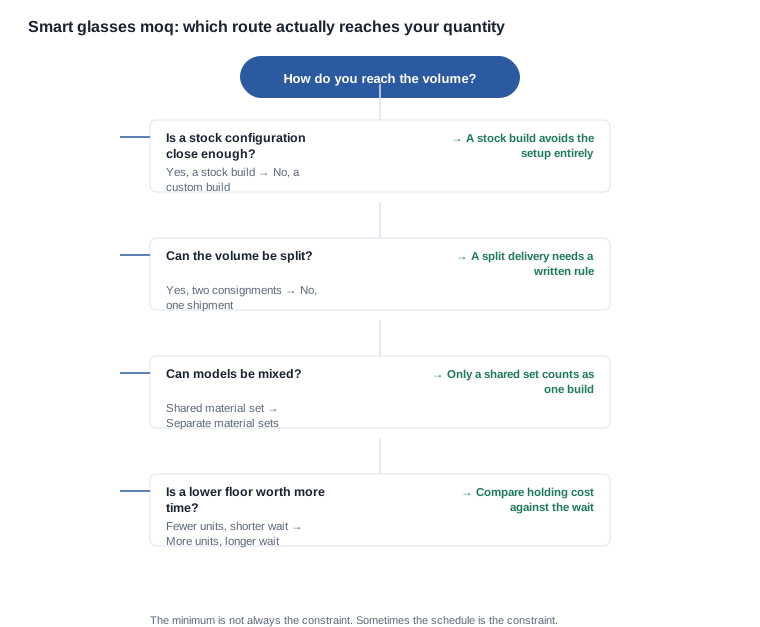
Take a stock configuration. This is the cheapest route and it is the one buyers avoid because it feels like a compromise. In practice it is a deliberate trade: exclusivity for a quantity that can move. The published catalogue supports this because the stock configurations already exist as material sets, so the component lot is already ordered and the compliance work is already done.
Split the delivery. One purchase order, two consignments, one frozen configuration. This solves the working-capital problem and the seasonal absorption problem, and it requires only a written rule with the conditions attached. It is worth asking about even when the minimum is comfortable, because it changes the shape of the cash flow at no cost to the supplier.
Mix models that share a material set. This one needs care, because the answer is a list rather than a general permission. Ask which specific models share a set, and treat any other answer as no.
Accept a longer schedule for a lower floor. This is the route that costs something and it should be the last one, not the first. The comparison is between the working capital tied up in inventory and the value of the earlier date, and it is close enough that it has to be made explicitly rather than assumed.

Smart glasses moq: terms to take and resist before you order
Sampling is a fixed cost and a poor negotiation target. Tooling and certification are different animals: tooling is usually amortised across the first order, while certification cost is per product family per market. Ask which one the quotation is charging you for before you decide what to argue about. The minimum order quantity itself moves on component lots and setup economics, so it is negotiable against configuration, not against volume alone.
What is worth putting in the agreement is the configuration string, the tolerance allowed on the published specification, the date the production slot was reserved, the documentation handed over with the goods, and the remedy for a unit that does not match the approved sample. The unit price is the least interesting line in the document; the configuration string and the remedy are the two that decide what happens when something arrives that you did not order.
The questions below are worth putting in the enquiry, because each one changes the price or the schedule:
-
Which purchased component sets the minimum, and what is its lot size?
-
Is the minimum quoted per configuration, and does it change with colourway, packaging or destination market?
-
At which quantities does the unit price step, and is the quotation's price on a published step?
-
Can one purchase order be delivered in two consignments against a frozen configuration?
-
Which models share a material set, so that a mix counts as one build?
A buyer who asks all of these in the first round is establishing which quotation is complete. The comparison only works between quotations that answer the same questions.
The total cost of a programme is the unit price plus the returns reserve plus the cost of the documentation route, and the trade-offs between those three are settled in the quotation rather than after it. Which one to negotiate hardest depends on where your own programme is weak, and that is why the review is worth doing before the order rather than after the first shipment.
Our position, and the rows we will and will not publish
It is worth being precise: the published material is the part of the specification we can stand behind, and the rest is a question for the supplier's own file. We publish what our documentation states, we mark the rows that are open, and we will not fill an open row with a typical figure from a supplier's general data. An estimated number used as the basis of a claim fails in the field rather than in the quotation, and the correction is more expensive than the question was.
The rows we do not publish for this configuration are these:
- Our own minimum order quantity is not published as a standing figure, and the reason is specific: our source material records three conflicting internal positions on it that have not been reconciled, so a published band would be wrong at both ends.
The rows our published data does settle are these:
-
The camera platforms in this catalogue appear with a 1400 mAh charging case, one appears with a 1200 mAh foldable case, and the audio models ship with and without a case.
-
A configuration with a 1400 mAh charging case is a different order, with a different material purchase and a different packing list, and the minimum follows the material.
The binding floor, and the lot behind it
Consider a hypothetical scenario rather than a real client project. A channel buyer needs a camera model with a charging case, and the supplier quotes a minimum that is roughly double what the channel can absorb in a season.
The first step is to establish which floor is binding, and the answer is the component lot rather than the slot, which changes the shape of the negotiation entirely. The part is a cell lot, the lot quantity is fixed, and no amount of discussion about volume moves it.
The second step is to count the material sets, and there are three of them rather than one: the two case capacities available on this model plus a second colourway that the buyer had not counted as a separate build. Dropping the second colourway to the reorder removes one set-up and one changeover.
The third step is the price tier table, and it changes the arithmetic. The quotation's price sits between two published steps rather than on one, so the buyer is being charged a blended rate at a volume the supplier does not price. Ordering at the published step below it is cheaper per unit than the quoted figure at the quoted quantity, which is not a usual result and is worth checking every time.
The fourth step is the split delivery, which the supplier agrees to in writing once the configuration is frozen. It does not reduce the component lot, but it converts the programme from one large absorption into two, and the second consignment lands against a demand signal the buyer has actually seen rather than a projection.
The result is a programme with two consignments of one configuration, one colourway, ordered at a published price step. The minimum was not reduced, and the inventory problem was solved without asking for the one thing that could not have been granted. That is usually the shape of a successful minimum order negotiation in this category, and it is worth naming because buyers tend to open with the request that cannot be granted and close with the one that can.
Send the models, the quantities and the target market, and we will tell you which configurations exist, which of them are open on the published data, and what the minimum order answer is for each one.
Related reading


