

This smart glasses payment terms case example is a constructed order, not a client project. No customer name appears in it, no client brief is described, and the dates are illustrative rather than historical. It is set out because the mechanics of a mixed order are hard to explain abstractly: three configurations with three different material structures do not fit one schedule, and the point at which a buyer discovers that is usually halfway through a payment that was already agreed.
What follows is one order built from three published configurations, taken through from the purchase order to the balance, with the document behind every milestone named.
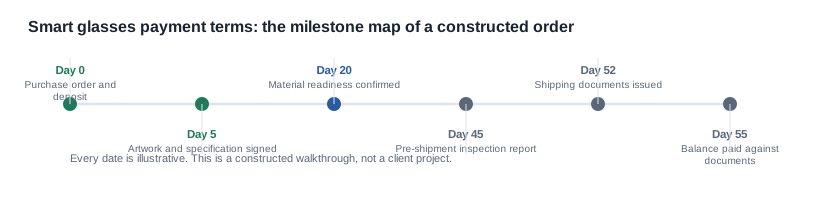
Smart glasses payment terms: a constructed order walkthrough
The order, and why it was built as three lines
The constructed buyer is a distributor opening a range rather than a brand launching one product. The commercial logic of a distributor is that it buys several models, presents them together, and recovers the cost of the range through the shelf rather than through one product. That logic has a direct consequence for payment terms, because three different material sets in one consignment is the hardest case a schedule has to handle.
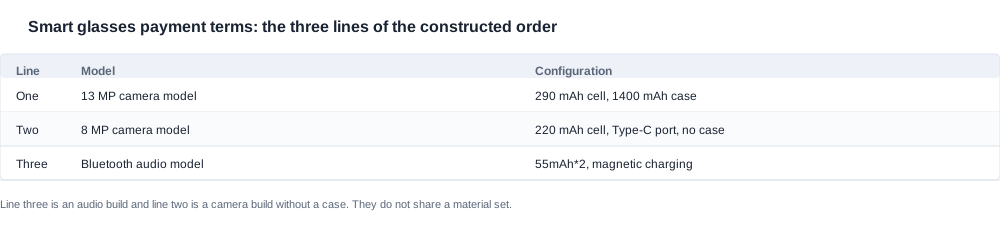
The three lines are built from published configurations, chosen so that each one is structurally different from the others.
| Line | Model | Published configuration |
|---|---|---|
| One | 13 MP camera model | 290 mAh cell, 1400 mAh charging case, about 7 h rated use, charge time up to 2 h |
| Two | 8 MP camera model | 220 mAh cell, Type-C port, no charging case, 5~8 h rated use, charge time up to 2 h |
| Three | Bluetooth audio model | 55mAh*2 cells, magnetic charging, Bluetooth V5.4, about 8 h rated use, charge time up to 2 h |
Two details in that table drive everything that follows. Line one and line two are both camera builds, and they are different camera builds: one carries a 1400 mAh case and the other carries no case at all, and the published charging method is not stated for four of the eleven camera models in the range, so the interface on line one has to be confirmed in writing rather than assumed from the catalogue. Line three is not a camera build at all. It is an audio build with a different component structure, a different bill of materials and a different compliance position, and it is the line that turns a single schedule into three schedules.
The criteria the three lines were selected against
The three lines were not chosen for variety. They were chosen against four criteria, and the criteria are the part of the construction worth copying, because they are the part that transfers to a real order.
The first criterion is material independence. A distributor wants lines that do not share a case, a cell or a package insert, because shared components mean a single supply failure takes out more of the range than it should. Line two has no case and line three has no camera module, so the three lines have three genuinely separate structures.
The second criterion is compliance independence. A line that requires a documentation route the others do not require is a line whose documentation delay does not hold the other two. That is the whole reason the balance could be split by line at the end of this walkthrough.
The third criterion is shelf economics. The three lines have to be comparable on a shelf, which means their per-unit economics need to be comparable, which is why the setup cost was not spread evenly across them. When you evaluate which model to add to a range, the practical question to ask is how to compare two lines that do not share a structure.
The fourth criterion is how a buyer would evaluate the alternative. A distributor that adds a third line is choosing between a third model and a deeper position in the first two. The trade-offs between those two are the real decision, and the checklist that supports it is a shortlist of lines compared on documentation dependency, on material independence, and on how long each takes to clear its own paperwork.
The first attempt at a schedule is always the obvious one: a deposit, a second instalment at production completion, and a balance on shipment. It is rejected here for two reasons, and both reasons are structural rather than stylistic.
The first reason is the shared production window. The three lines are scheduled into one window because they share a packaging run, and a shared run means one changeover rather than three. That is good for the price and awkward for the payment: a single milestone in a shared window has three different material sets landing at three different times inside it, so a milestone placed at "production completion" is placed at an average rather than at an event.
The second reason is the setup cost. One line carries the custom element for the whole order, and the recovery of that cost lands on whichever line it is charged to. If it lands on line one, then line one carries a cost that the other two lines helped create, and the per-unit economics of the three lines stop being comparable. A distributor that prices its range by comparing lines cannot accept that.
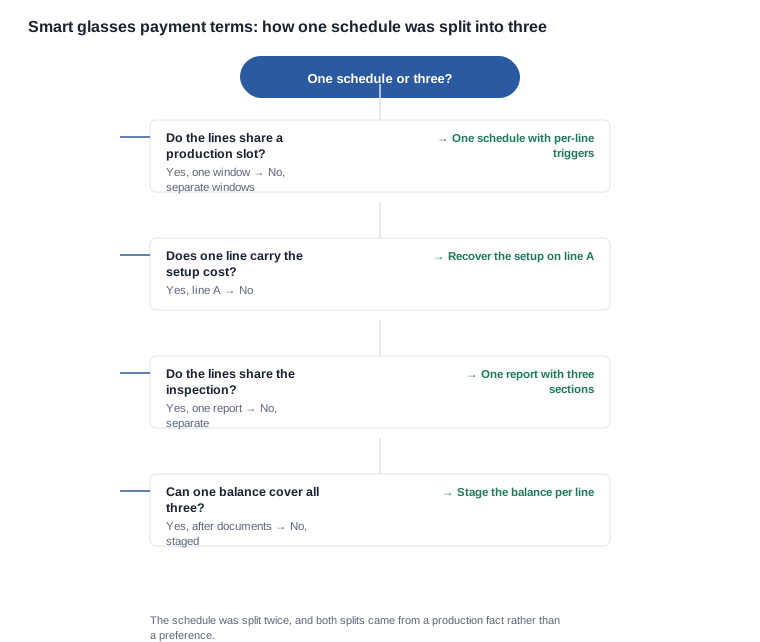
Both decisions in that tree came from a production fact rather than from a preference, which is the test worth applying to any schedule. If a split is justified by where the material sets land, it will hold up under a dispute. If it is justified by convenience, it will not.

The milestone map, and the document behind each one
The rewritten schedule has five payment events and a document behind each. The dates are illustrative and are used here only to show the spacing.
Day 0, the purchase order and the deposit. The trigger is the signed purchase order together with the confirmed configuration string for all three lines, including the charging interface for line one and the case configuration for each line. The deposit funds the purchased materials for the three lines and nothing else. It is deliberately not described as covering artwork or tooling, because those are recovered separately and a deposit described as covering everything cannot be unbundled later.
Day 5, artwork and specification sign-off. This is not a payment event. It is a document event, and it matters because the artwork approval is the one commitment in this order that the buyer controls completely. If the print run is the binding constraint on line one, the artwork date is what moves it, and the schedule has to show that.
Day 20, material readiness confirmed. The trigger is a written confirmation that the cells for all three lines, the camera modules for lines one and two, and the cases for line one have been called off and are against the schedule. This is the point at which the largest share of the material spend has committed, which is why the deposit sits here rather than at day 0, and why a second instalment can be placed here without it being a second deposit in disguise.
Day 45, the pre-shipment inspection report. The trigger is a typed report naming all three configuration strings, the number of units sampled against each line, and the checks performed. It is a single document covering three lines, with three sections, because the three lines are inspected in one window and producing three reports would be an administrative fiction. The report is dated, it states what was checked against which published row, and it is accompanied by a stated response period.
Day 52, the shipping documentation handover. The trigger is the conformity documentation package, the commercial invoice, the packing list reconciled to the three configuration strings, and the transport documentation for the lithium cells. This is the point at which the compliance work that was inside the production window is actually complete, and the agreement states what happens if any item in the package is missing.
Day 55, the balance against the documents. The trigger is the handover of the shipping documentation above. The balance for each line falls when the package covering that line is complete, so the two lines whose documentation is finished release earlier than the third.
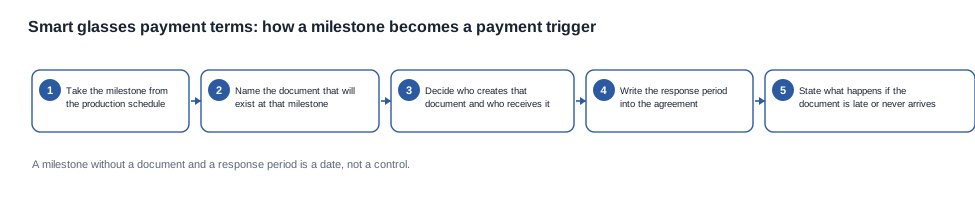
What each trigger actually settles
A trigger is worth nothing unless it changes what somebody is exposed to. Working through the five events makes the difference concrete.
The day 0 deposit settles who bears the cost of a cancellation before materials are called off. It is the smallest exposure the buyer can accept, because at day 0 the supplier has committed very little, and a buyer who accepts a larger deposit at day 0 is paying for a risk that has not yet been created.
The day 20 confirmation settles the point at which the material spend becomes irreversible. Once the cells and the camera modules are called off, the order is committed in a way that a cancellation cannot unwind, and the buyer should know that on the day it happens rather than discover it in a cancellation clause afterwards.
The day 45 inspection report settles the question of conformity. This is the only document in the schedule that can protect the buyer against goods that do not match the specification, and it is the document most often left out. Without it, the buyer learns about a defect after the balance has been paid, and the only remaining remedy is a claim against a supplier it has already paid in full.
The day 52 handover settles the compliance question. In this category the documentation is part of the goods as far as the buyer is concerned, because a consignment without the right conformity documentation is a consignment that cannot be sold in its destination market. The trigger therefore has to be the complete package rather than the dispatch date.
The day 55 balance settles the final risk transfer, and it is the only event that transfers the residual risk from the seller to the buyer.

The two points where the schedule was rewritten
Two rewrites happened during the construction of this order, and both are worth naming because they are the two that recur in real programmes.
The deposit was moved from day 0 to day 20. The opening schedule collected the deposit against the purchase order, which meant the buyer was funding the material spend roughly three weeks before it was committed. Moving the deposit to material readiness removed that gap without changing the amount, which is the cheapest improvement available in a payment schedule because it costs the supplier nothing once the schedule is understood. The cost of the change was that the buyer had to ask for a written material readiness confirmation, which the supplier would not otherwise have produced.
The balance was split by line. The opening schedule had a single balance at day 55 covering all three lines. Because the documentation package for line three completes later than the package for the other two, a single balance meant the buyer paid for lines one and two on day 55 while still exposed on line three. Splitting the balance by line released the completed lines on their own documentation and left only the unfinished line outstanding. The buyer gave up a small amount of timing control and gained a smaller amount of outstanding exposure, which was the right trade because the amount still outstanding after the split was the amount that had not yet been evidenced.
Two rewrites were not made, and the reasons are worth recording as well. The setup cost was not spread evenly across the three lines, because spreading it would have made the per-unit economics of the lines incomparable and the distributor's own shelf pricing depends on those being comparable. And the balance was not tied to the buyer's acceptance, because a distributor's acceptance procedure for a mixed consignment does not have a natural deadline, and a payment term without an end is worse than one with a short and specific window.

Red flags and pitfalls in a mixed-order payment schedule
Six things in this walkthrough could have gone wrong, and each of them is a trap that recurs in real mixed-order programmes. They are listed as red flags rather than as warnings because each one is visible in the schedule before the money moves.
A single milestone covering three material sets. The schedule names "production completion" and the three lines actually complete at three different moments inside one window. The pitfall is that the milestone looks precise on paper and averages three events on the ground. The fix is to move the milestone to the point where the materials have committed, which is an event with a date, rather than to a completion that has three.
The deposit collected against the purchase order. This is the most common red flag in the category, and the tell is a deposit described as funding production, artwork and tooling together. The buyer funds three things and can recover none of them, because at that point the supplier has committed nothing beyond a work order. The pitfall is that the buyer experiences the deposit as a sign of commitment rather than as an exposure. Ask what it funds before you accept it.
The balance tied to the buyer's acceptance. In a mixed consignment the acceptance procedure is genuinely difficult to run, because three lines arrive together and are not accepted together. The pitfall is that the schedule looks protective and is in practice open-ended. A short, specific window against a named document is better than an acceptance procedure with no end.
The inspection report that names no configuration. A report saying the goods conform is worth nothing if the buyer cannot show that the things inspected were the things ordered. The pitfall is that a supplier produces a good report and a buyer accepts it without checking the string, and the red flag appears only when a line turns out to have been built differently from the order. Require the configuration strings in the report.
The documentation package treated as part of the shipment. The conformity documentation is part of the goods, because goods that cannot be sold in their destination market are not goods. The pitfall is that the package is produced alongside the dispatch and the balance is released when the goods leave. What to ask for is the package as a named handover event, before the balance.
One balance covering lines with different completion dates. The final red flag is the schedule that treats the order as one financial object when the production treats it as three. The pitfall is that it is simple and it is wrong, because the buyer ends up paying for the two completed lines on the schedule of the one that is not finished. Splitting the balance by line is the correction, and in a mixed order it is usually the correction that matters most.
Why this is a constructed walkthrough and not a client project
This walkthrough is constructed for illustration. It does not describe a client order, it is not a quotation, and the dates and amounts in it are not drawn from a shipment record. It was built from published catalogue configurations so that the structural points are demonstrable rather than hypothetical: the two camera lines differ by a 1400 mAh case and a Type-C interface, the audio line shares no material set with either of them, and the charge times and rated use figures are the published ones.
What is published and what is not should also be said plainly, because the distinction matters for anyone reading this and then writing their own schedule. Our published material carries the electrical rows for every model, the configuration options, the colour options and the case alternatives. Our catalogue carries one company-level export certification page but no per-model certification line, so the documentation scope for a specific model string is something to establish in writing against that string. Our unit prices, minimum order quantities and lead times are not published, and the material spend behind the deposit in this walkthrough is therefore illustrative rather than derived.
The route for the sample and the route for the shipment are separate from the schedule and are set out under samples and logistics. The framework this walkthrough applies sits under payment terms, and the milestone logic behind it is set out in the buyer checklist material.
If you want the same walkthrough run against your own order, send the models, the quantities, the destination market and the date on which the cash has to move. We will map it against the same five events and tell you which of them cannot be evidenced for your configuration.
The due diligence on the supplier sits before this walkthrough rather than inside it. A payment schedule is a way of allocating risk between two parties, and it works only when the party carrying the risk can carry it. If the questions to ask about documentation scope, material availability and production capacity have not been answered, then the schedule below is the part of the programme that is settled, and it is the smaller part.
One practical note on the total cost of a mixed order, because it is where a schedule quietly changes the price. A deposit collected three weeks early is working capital, not free money, and a schedule that moves a payment date by three weeks changes the cash cycle even when no percentage changes at all. When you compare two schedules, compare the dates as well as the percentages, and put the resulting working capital difference into the total cost comparison rather than treating the schedule as a free adjustment to the unit price.
Related reading
Send the configuration, the quantity and the market, and we will say which parts of the schedule are settled and which are yours.


