

None of the five mistakes below is a negotiation error. They are sequencing errors — decisions taken in an order that leaves no room to correct them later — and they are worth reviewing before a first order precisely because the second order is where the cost appears. A buyer who agrees the payment structure before the configuration is fixed, who treats the deposit as leverage it is not, who omits the acceptance window, who lets the unit price reopen at artwork, and who files nothing for the reorder has not made five bad bargains. The buyer has made five decisions in the wrong sequence, and each of them compounds the next.
Smart glasses payment terms in this category are unusually sensitive to sequence, because a unit with a camera module and a charging case has a bill of materials that has to be committed to before the order is complete, and the commercial terms are written against that bill of materials. Fix the sequence and most of the individual terms become easy; leave it out and the terms themselves become the problem.

Smart glasses payment terms: five sequencing errors
The first error is agreeing terms against a configuration that then moves. Payment terms agreed against a specification that subsequently changes are not terms; they are a starting point that will reopen. In this category the specification genuinely moves during the process, particularly on artwork and on firmware, and a payment schedule that references "the agreed configuration" without naming the model code and the configuration string is a schedule that will be read differently by two people six weeks later.
The fix is dull and effective: fix the model code, the configuration and the quantity in writing, and agree the terms against that. A supplier who resists being pinned to a configuration string is telling you something specific — that the price and the schedule behind it are both provisional, and that the deposit will be sized against a hope rather than a bill of materials.
The second error is treating the deposit as leverage it is not. A deposit is money already transferred. The belief that a deposit creates pressure to deliver is common, entirely understandable, and it does not survive the first missed date. What a deposit actually does is fund materials, and a supplier who can buy your cells and boards with your money has a reason to hold your slot rather than to release it.
What creates accountability is not money held hostage but a date with a stated consequence — a remedy, a liquidated figure, a written commitment to a specific date, or an express right for you to withdraw. That distinction is the whole difference between a term and a feeling, and it costs nothing to write down.
The third error is ignoring the acceptance window. An acceptance window with no consequence attached to it is a formality, and no consequence is what happens by default: goods are accepted on arrival, because silence is the default in most agreements when nothing else is stated. The buyer then discovers that the inspection period had already closed while the carton was still open.
Decide before the order what happens if nothing is raised inside the window, and make sure it is written. This is also the window that makes a retention work, because a retention held back with no inspection period behind it protects nobody — there is no point at which the retained money could ever have been released against a finding.
The fourth error is letting the unit price reopen silently. Artwork approval is the moment a price becomes negotiable again, usually without anyone intending it. If the agreement does not say that the unit price is fixed at signature for the quoted configuration, then an approved artwork round is a legitimate opening, and the buyer who refuses it will be told the artwork "changed the specification".
Say explicitly that the unit price is fixed at signature for the quoted configuration, and state separately what happens if the specification changes materially afterwards. Those are two different sentences and they belong in two different places.
The fifth error is filing nothing for the reorder. This is the most expensive and the least visible. Without the quotation, the configuration lock sheet and a record of what was declined, the reorder is negotiated by someone new against a supplier who remembers their position perfectly. It is not a commercial dispute waiting to happen; it is an ordinary handover, and it costs real money simply because the information did not travel.

Why the second order is where these become expensive
The five errors are cheap at the point at which they are made, which is why they survive the first order. A deposit paid against a moving configuration costs nothing extra on day one, because the configuration still resolves in everyone's favour. An acceptance window with no consequence costs nothing extra on day one, because nothing is rejected on day one. A unit price that reopens at artwork costs nothing extra on day one, because the artwork is approved first time. The failure modes only trigger under pressure, and the pressures of a first order are not the pressures of a fifth order.
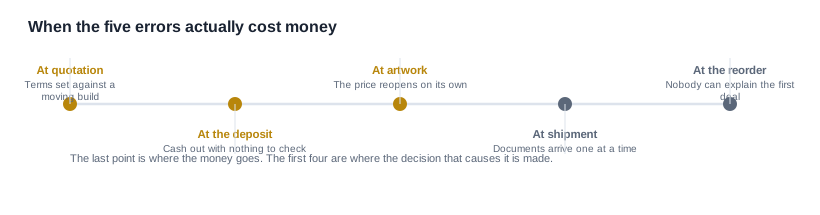
The second order changes the shape of the problem in four specific ways.
The buyer is no longer the person who holds the context. The person who agreed the terms with the supplier is often not the person who places the reorder, and in a growing business the procurement function is split between someone who selects the product and someone who signs the contract. The agreement has to survive that handover, which it will only do if the handover material exists.
The supplier's position is stronger than it was. A repeat order is a larger share of the supplier's revenue, so a supplier's willingness to revisit terms is lower, and their knowledge of what the buyer previously accepted is higher. A supplier who has seen a buyer accept a large balance before inspection once has a reasonable basis for expecting it again.
The configuration has accumulated history. By the second order there is a colour that sold out quickly, a case option that caused a packing problem, a firmware revision that generated a return, and an artwork round that took two attempts. Each of those facts is worth money, and each of them lives in somebody's memory unless it was written down at the time.
The margin has narrowed. A repeat order is usually larger and usually at a tighter price, so a payment structure that was survivable on a first order becomes material. The same deposit proportion on a larger order is more cash, and the same late balance is more exposure relative to a thinner margin.
None of this is a reason to be pessimistic about repeat ordering. It is a reason to treat the first order's paperwork as an asset rather than as administration, because that asset is what makes the second order cheaper to run than the first.
There is a counter-argument worth taking seriously, because it is sometimes correct. Buyers who reorder quickly and informally sometimes get better terms than buyers who document meticulously, on the grounds that an undocumented supplier is more willing to accommodate an unusual request. That can be true for a period, and it is usually true of the first two or three orders rather than the tenth. The reason is that the accommodating behaviour depends on the supplier having a reason to accommodate, and the reason is usually the forecast of repeat volume rather than the file. Once the volume stops growing, the accommodation stops, and it stops at the moment the buyer's internal knowledge is thinnest.
There is also a legitimate concern about effort. A thorough first-order file takes time that a small buyer may not have, and the temptation is to defer it to the point where the volume justifies it. The counter to that is arithmetic rather than principle: the cost of the file is a few hours spread across a team, while the cost of one mis-sequenced first order is the margin on the entire first order. At the volume levels most buyers in this category work at, those two numbers are not close.
A third point is worth making because it explains why the same buyer performs differently in different categories. In a category where the product is a single component with a long lead, the sequencing problem is mostly about timing, and a buyer can absorb some imprecision. In a category with a camera module, a charging case, market-specific artwork and a lithium transport file, the sequencing problem is about commitment, and the same buyer who is casual elsewhere will need to be precise here. That is not a difference in diligence; it is a difference in what the product forces you to decide.
The five errors, written as symptoms and controls
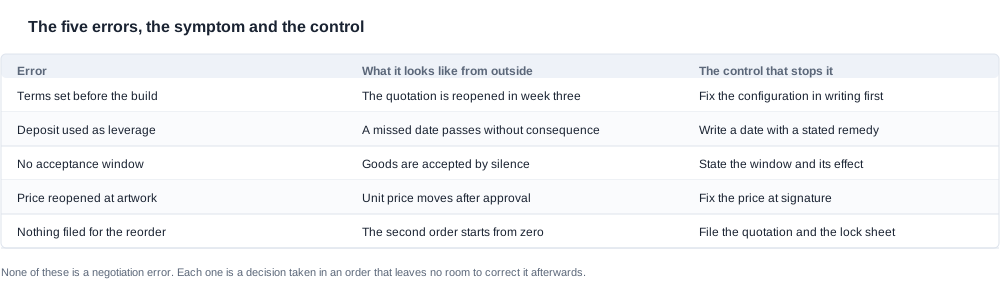
A failure mode is only useful to a buyer if it is written so that it can be recognised before it happens. The table below states each of the five as the symptom you would actually observe, the root cause behind it, and the control that stops it. Symptoms are described as they appear in practice — in a supplier's email, in a shipping instruction, in a warehouse — because that is the form in which you will meet them.
| Error | What it looks like from outside | Root cause | The control that stops it |
|---|---|---|---|
| Terms set before the build | The quotation is reopened in week three | Terms referenced a configuration that was never fixed | Name the model code, configuration and quantity before terms are agreed |
| Deposit used as leverage | A missed date passes without any consequence | No date with a remedy attached to it | Write a delivery date and the specific remedy for missing it |
| No acceptance window | Goods are accepted because nobody objected | Silence was left as the default | State the window length and what silence inside it means |
| Price reopened at artwork | The unit price moves after approval | The agreement was silent on price fixity | Fix the unit price at signature for the quoted configuration |
| Nothing filed for the reorder | The second order starts from zero | No commercial, technical or shipping file was kept | File the quotation, the lock sheet and the declined points |
The root cause column is worth reading on its own, because four of the five root causes are the same root cause wearing different clothes: something was left unstated, and in every case the thing left unstated was the part that only becomes visible under stress.
One control deserves a note because it is routinely misunderstood. Fixing the unit price at signature does not mean the supplier is bound to absorb a component cost movement on a large order; that is a separate conversation and, for a big enough order, a separate price. What it means is that the price does not move because a piece of artwork was approved, which is an event entirely inside the buyer's control. The distinction between an event inside your control and an event outside it is the whole basis for deciding which price clauses are reasonable.
How the five errors interact with one another
Treated separately, the five errors look like five small gaps. Treated as a sequence, they form a pattern, and the pattern is the reason a first order often goes smoothly and a second one does not.
The common thread is that each error removes a decision point. Terms agreed against a moving configuration remove the point at which the configuration would have been frozen. A deposit treated as leverage removes the point at which the delivery date would have been committed to. A missing acceptance window removes the point at which the goods would have been checked. Silence on price fixity removes the point at which the price would have been settled. An unfiled order removes the point at which the next negotiation would have started from evidence.
Five removed decision points do not produce five small problems later. They produce a single one: the order has no fixed points in it. Every subsequent event — an artwork change, a component substitution, a missed inspection date, a request for a price adjustment — is then negotiated from scratch, because there is nothing in the file that settles it. The supplier is not being difficult in that situation; the supplier is being reasonable, because the only reference point that exists is the supplier's memory.
This is also why the control for the fifth error is disproportionately valuable. Filing the quotation, the configuration lock sheet and the record of declined points does not prevent the other four errors; it repairs them retroactively, on the order after the one where they happened. A buyer who files properly converts an open-ended negotiation into a reference point, which is the single change that makes repeat ordering behave predictably.
The practical implication is a priority order that is the reverse of the order the errors occur in. If you can only do two things before the first deposit, do the third and the fifth: agree the acceptance window and its consequence, and start the file on the same day. The window protects the order you are placing. The file protects every order after it.

Filing the first order so the second one is easy
The practical return on a first order is a file that is self-sufficient. If a colleague could pick up the folder and understand what was agreed, what was tested, what was declined and why, the second order becomes an administrative task rather than an excavation.
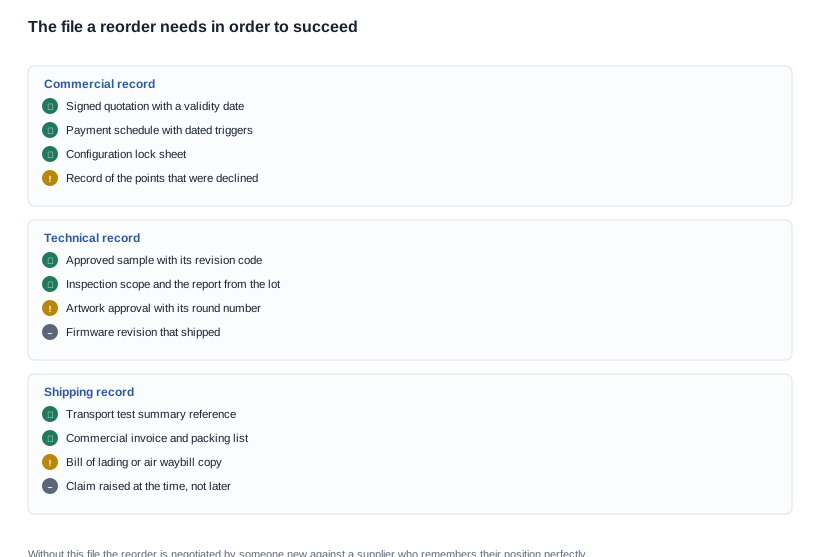
Three folders cover it, and each one has a different reason for existing.
The commercial folder holds the signed quotation with its validity date, the payment schedule with dated triggers, the configuration lock sheet, and the record of the points that were declined during negotiation. That last item is the one people leave out and the one that saves money: knowing that a buyer asked for open account terms and was refused is worth more at the reorder than knowing that open account terms were available in principle.
The technical folder holds the approved sample with its revision code, the inspection scope and the report from the production lot, the artwork approval with its round number, and the firmware revision that actually shipped. The reason this folder matters commercially is that it is the evidence base for a claim. A claim raised in week two of the next order against a supplier with no record of the first order is a claim made on the basis of memory, and memory is exactly what a supplier is not obliged to share with you.
The shipping folder holds the transport test summary reference, the commercial invoice and packing list, the copy bill of lading or air waybill, and any claim that was opened at the time rather than later. The rule here is simple: a claim raised at the time is evidence, and a claim raised in the next quarter is an argument about what happened.
Who owns the file, and where it should live
A file that nobody owns is not a file, it is a pile of documents in somebody's inbox, and the ownership question decides whether the five errors get repaired on the next order or get inherited.
Three properties matter, and only the first is obvious.
It has to have an owner. Not a team, not a department — a person or a named role. The owner is accountable for the file being complete at the moment the next order is placed, which means they need to know what complete means. The definition in the checklist above is a reasonable one: the quotation with a validity date, the lock sheet, the inspection scope and report, the artwork approval, the transport reference, the shipping documents and any claim.
It has to be readable by someone who was not in the negotiation. That is the test of whether it is a file or a set of private notes. If the only way to understand what was agreed is to ask the person who agreed it, then the knowledge is in a person rather than in a document, and it will be lost at exactly the moment it is needed.
It has to be reachable from the order. A file stored in a personal drive, an inbox archive or a supplier's portal is a file that the next buyer will not find. Where it sits is less important than the rule that it is attached to the order record rather than to a person's workflow.
None of this needs specialist systems. The version that works at the scale most buyers in this category operate is a small shared folder per programme, with the order number in the name of every document, and a checklist at the front that says what should be in it. The checklist is the artefact that does the work, because it can be handed to a new joiner in the procurement team on their first day and it does not require any knowledge of the supplier to complete.
The supplier's side of the file matters too, and it is cheap to ask for. A supplier who is used to being asked for the quotation, the approved proof with its revision code, the inspection report and the transport reference will produce them faster, and will produce them in a consistent form, because they have done it before. A supplier who is asked for these documents for the first time, on the first order, will produce something close to what you asked for.

What we will state in writing, and what stays open
Our payment structures are agreed per order and put in writing before the deposit, with an acceptance window and its consequence stated rather than left to default. That is a position rather than a description, and it is the reason our terms do not appear on a web page.
Production lead times, minimum order quantities and our unit prices are not published on this site and confirmed per enquiry, so we will not build a structure around figures you cannot audit. We will also not reopen a quoted unit price because an artwork round happened, unless the configuration itself changed, and when the configuration does change we will say so in writing with the reason and the date rather than leaving it to be discovered on an invoice.
What we will do is raise it ourselves if something on our side changes. What we will not do is hold a price against a specification that has moved and expect a buyer to notice, because that is the same sequencing error written from our side of the table.
The payment terms section covers the structures themselves, and the two articles below cover the parts of the agreement that sit around them.
Related reading
- Red flags — the structures to watch for
- Pricing SOP — the internal process
- Contract quality terms — the clauses that bind
The questions to take into the next supplier call
Five questions, asked in this order, will surface most of the sequencing errors before a deposit is on the wire.
- What exactly is being ordered? Ask for the model code, the configuration and the quantity in one line. If the answer comes back as a family name, the quotation is not comparable and the terms are not yet meaningful.
- What does the deposit fund? Ask for materials, production, or both, and whether any one-off recovery sits inside it.
- What releases the balance, and when is that? Ask for the document, not for the stage name. Then ask what happens to the money if that document is late.
- What happens if nothing is raised inside the acceptance window? The answer should be written into the agreement, and the window should be long enough to receive, open and check a consignment.
- What is the unit price fixed against? Ask what happens to the price at artwork approval, and what happens if the configuration changes.
If the answers to all five are in writing before the deposit, the five errors described above are structurally impossible for that order — not because the supplier is more careful, but because the sequence no longer leaves room for them.


