

The reason buying teams lose money on repeat orders is rarely the negotiation itself. It is that nobody recorded what was agreed, so the second order starts from scratch with no memory of what the first one established. A procedure is simply the discipline of writing things down at the moment they are decided rather than reconstructing them later.
This is a standard operating procedure rather than an article about price. It assumes a buying team that will run more than one smart glasses programme, or that has already run one and wants the second to be better than the first. It covers the six steps, the record each step produces, the events that force a re-quote, and the handover to whoever picks the file up next.
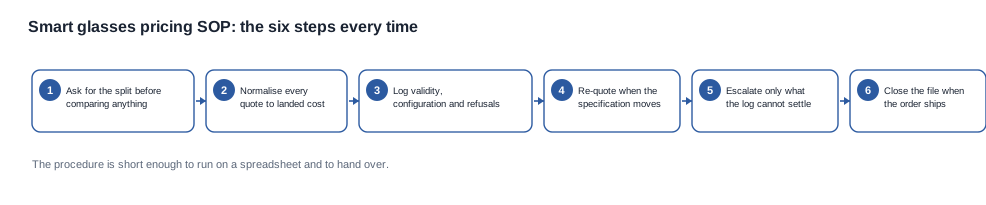
Two design decisions sit underneath it. First, the procedure is built around the quotation rather than around the product, because a quotation is the only artefact that binds. Second, every step produces a record, and a step that produces nothing is not a step. If the procedure cannot be evidenced, it cannot be handed to anybody else.
Smart glasses pricing SOP: the six-step routine for a buying team
What the procedure is actually for
The procedure exists to protect three things that are usually lost in the gap between two orders: the configuration that was agreed, the assumptions behind the number, and the boundaries of what the supplier had undertaken. Each of the three is recoverable on the first order and expensive to recover on the second, because on the second order the people who held the context have moved on.
That last point is the one that decides whether a procedure is worth running at all. A buying team of one does not need a procedure, because the one person is the record. A team of four, or a team spread across a sourcing lead, a finance approver and a channel manager, needs one badly, and the first symptom is always the same: a reorder that takes twice as long as the first order and produces a slightly different product.
Why the procedure is written as steps rather than as principles
Principles are what a team agrees with and steps are what a team executes. The distinction is not academic, because the moments where a pricing decision is made are usually moments of mild fatigue: a quotation arrived at the end of a week, a comparison was requested in a hurry, and somebody needs to decide whether to answer now or tomorrow. At those moments a principle such as "compare like with like" is not actionable, while a step such as "normalise every quotation to landed cost before reading the unit price" is.
There is a second reason for the step form. Every step in this procedure has a completion test, and that is what makes it auditable. If the procedure is going to survive a handover, the person picking it up has to be able to tell whether a step was done. "The split was requested and the answer filed" is checkable. "We were careful with the comparison" is not.
The six steps at a glance
- Request the split before comparing anything. Every quotation is separated into recurring lines and one-off lines before it is read.
- Normalise every quotation to landed cost. One destination, one incoterm, one basis, applied to all of them.
- Log validity, configuration and refusals. Three fields recorded for every quotation, without exception.
- Re-quote whenever the specification moves. A price attaches to a specification, and the procedure makes the link automatic.
- Escalate only what the log cannot settle. A defined route for the residual questions.
- Close the file when the order ships. The quotation, the lock sheet and the record of refusals are filed together.
The order is deliberate. Steps one and two make quotations comparable, step three makes the comparison durable, step four protects it against drift, step five keeps the team from burning time on settled arguments, and step six makes the next order cheap.

Steps one and two: splitting the quote and normalising smart glasses pricing
Why the split comes before the comparison
No comparison should start until every quotation has been separated into recurring and non-recurring lines. Comparing two unit prices when one carries an unmentioned setup charge is comparing a retail price with a wholesale price and calling the difference a saving, and that mistake is so common that it survives in teams that have been trained.
This step is the one people skip, because the split takes an extra request and the unit price is already on the page. It is also the step that produces the most value, because the split is what exposes the real difference between two suppliers. One quotation may carry artwork, packaging development and firmware work as visible one-off lines; the other may carry the same work inside a unit price that is lower for a different reason. Only the split tells you which is which.
The request that produces the split
The request is a single line in the first enquiry, and it is better made before the first quotation arrives than after. Ask for the quotation to separate the recurring unit cost from the non-recurring items, to list each one-off separately with its own amount, and to state which quantity the price assumes. A supplier that answers that request has already told you how its cost structure works, whether or not it realised it was doing so.
A complete split shows five things, and a split that shows three of them is worth asking about before the comparison rather than after it:
- The recurring unit cost, with the quantity it assumes.
- Each non-recurring item on its own line, with an amount.
- The trigger for each non-recurring item, so you can tell what you are paying for.
- The delivery terms, with the destination and the incoterm named.
- The validity period, with an issue date and an expiry date.
The third of those is the one most often missing, and it is the one that matters most on a reorder. A setup fee with a trigger attached tells you whether it will appear again on the next order. A setup fee without one is a line you will be asked to pay twice and discover the second time is the second time.
Normalising to landed cost, and why incoterms have to match
Take every quotation to a landed cost per unit at your destination: goods, freight, duty, destination charges, and the treatment of tax. Two quotations at different incoterms are not comparable at any level above the unit price, and normalising first prevents the situation where a supplier wins on unit price and loses on landed cost, with the negotiation conducted on the number that was never going to decide it.
For a product of this size, freight is usually settled by the volume of the box rather than by the weight of the device, and the catalogue publishes exactly one product weight: 158 g for the MT6 glasses body, which includes the battery and camera and excludes the folding charging case. A configuration that ships with a case therefore carries a freight contribution the buyer cannot calculate from published data, which is an argument for asking for the delivered figure rather than estimating it.
Steps three and four: the log that carries the specification into smart glasses pricing
Three fields, recorded without exception
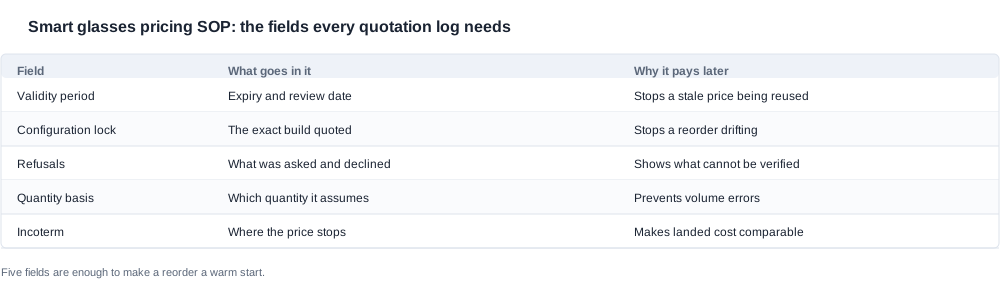
Three fields go into the log for every quotation, and the third is the one that pays later.
- The validity period. The date the price was issued and the date it expires, with a review date in between.
- The configuration lock sheet. The exact build quoted, in the form that will be sent to the factory and checked on arrival.
- What you asked for that was declined. The requests that did not get a yes.
The third field is the one that changes a team's behaviour. If a supplier declined to release a bill of materials, that is a fact about how much you can verify about their next quotation, and it belongs in the file rather than in someone's recollection of a meeting. Six months later, when a colleague asks why the two suppliers' numbers cannot be compared, the log answers the question in a sentence.
Why the log is not a spreadsheet of prices
The log records quotations, but its purpose is to record the state of the specification. A row in the log should let a reader reconstruct what the programme was, what was priced, what was promised and what was not answered, without opening an email. That is why the configuration field is a specification rather than a model name, and why the refusals field exists at all: the two together describe the evidence position, which is what a re-quote depends on.
What the log must contain when the file is closed
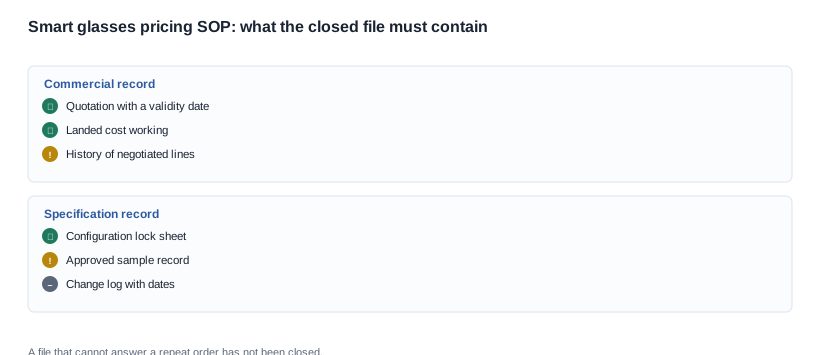
The closed file is the artefact the next order depends on, and it is short:
- The quotation as issued, with its validity period.
- The landed cost working, showing how the comparison figure was built.
- The configuration lock sheet, matched to the sample that was approved.
- The history of the negotiated lines, so a reorder does not re-argue a settled point.
- The record of what was declined, carried forward as a standing question.
- A change log with dates, so a specification change cannot be invisible.
None of these is expensive to produce while the programme is running. All of them are expensive to reconstruct afterwards.

Step five: the triggers that force a re-quote of smart glasses pricing
A price attaches to a specification
The procedure exists partly to make re-quoting automatic, because the failure mode is a configuration change made informally and a price assumed to carry over. The changes that trigger a re-quote are ordinary ones, and the list is short enough to put in the procedure:
- A change to the artwork or the packaging artwork.
- An added or removed colourway.
- A firmware or software change.
- A change to the destination market or the incoterm.
- A change to the quantity beyond the band the price was quoted for.
- A change to the box contents.
- A change to the case capacity or the charging method.
The band problem, and the reason a quantity change matters
The quantity trigger is the one teams argue about, because the quotation does not usually state the band. A price quoted at one quantity and applied at a very different one is an assumption, and the assumption is usually made by whoever writes the purchase order. The procedure's answer is to record the quantity basis with the price, so that the re-quote trigger is visible in the log rather than in a change nobody noticed.
A note on what does not trigger a re-quote
It is worth recording the opposite as well, because a procedure that re-quotes on everything is a procedure nobody follows. A change to the order quantity within the band the price was quoted for does not reopen the price. A change to the buyer's own internal forecast does not reopen the price. A change in the currency of the quotation does not reopen the price, though it does change the comparison. A question about a different model does not reopen the price, though it starts a new quotation.
Recording the exclusions has a second benefit. When the specification has genuinely not moved, the team can see that it has not moved, instead of relying on the absence of a complaint to establish it.
Escalating only what the log cannot settle
Step five is the step that keeps a procedure from becoming a burden. Some questions will never have a written answer: a supplier's defect rate, its yield, its capacity in a particular week, the reason a component changed. Those questions go into the refusals field and stop there. A team that re-asks them at every review will burn its credibility with the supplier and its own time, and the answer will not change between one review and the next.
What gets escalated is different. An unresolved question that affects a line in the contract, or a specification that has drifted from the lock sheet, or a price that has expired without a re-quote, goes to a named owner with a date against it. The distinction is between a question that has been answered no and a question that has been left open.

Step six: closing the file so a reorder is not a cold start in smart glasses pricing
The step teams reliably skip
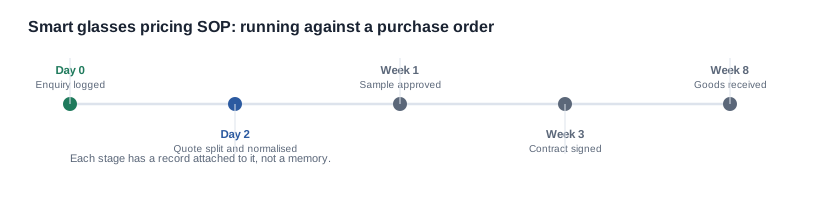
When the goods arrive, the quotation, the configuration lock sheet and the record of what was declined should be filed together as the reference for the reorder. Without that, the reorder is negotiated by someone who was not in the conversation, against a supplier who remembers their side of it clearly, and the handover is where the information normally goes.
The filing is cheap and it is the difference between a reorder that starts from an established position and one that starts from an introduction. Suppliers remember their last quotation; buyers frequently do not.
The handover, described properly
A handover is not a summary. It is the set of documents, in the order the next person needs them, with the open questions marked as open. The person picking up the file should be able to ask a supplier for a re-quote without first finding out what was ordered last time, and should be able to tell a finance approver what the number covered without reconstructing it from an email thread.
A single question that proves the file is in order
There is one question that will tell a buyer in under a minute whether the file is complete. Ask a colleague who was not on the original enquiry to read the file and say, without help, what was ordered last time, what the price covered, and what is still open.
If they can answer all three from the file, the procedure worked. If they can answer two, one field is missing. If they can answer one, the file is a collection of emails rather than a record, and the next order will start from an introduction again. This test is worth running before the reorder rather than during it, because it takes five minutes at the right moment and several weeks at the wrong one.
Where the information actually sits
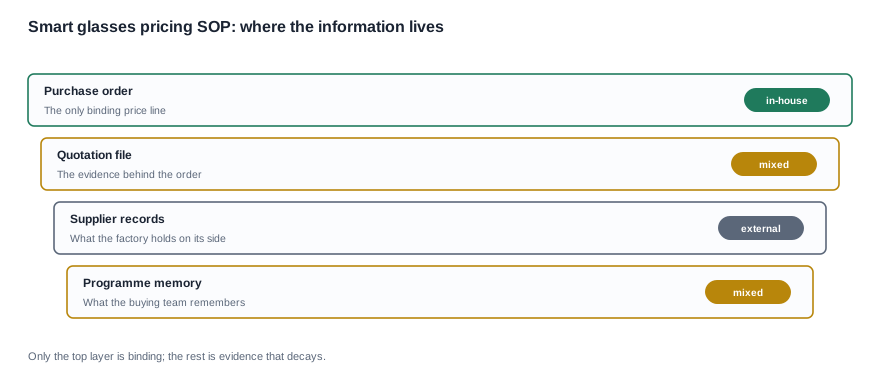
The layering matters because the four layers have different authority. The purchase order is the only binding price line. The quotation file is evidence, and it decays as suppliers change their price basis. The supplier's own records are theirs, not yours, and they are the layer a buyer should never rely on without a copy. The programme memory is the layer that is empty on the day a colleague takes over, and it is the layer the procedure exists to fill.
Why we publish a smart glasses pricing procedure and not a price list
What the procedure gives you that a price list cannot
A published price list would tell you what one configuration costs at one quantity on one day, which answers almost none of the questions a buying team actually arrives with. The procedure tells you how to obtain a number you can rely on, how to compare it against another, and how to keep it attached to the specification it belongs to once the programme moves on.
That is the reason we publish the method rather than the figure. A price that is correct for one configuration on one day is not wrong, it is narrow. A procedure that produces a comparable number for your configuration, your quantity and your destination is correct every time it is run, and it also tells you which parts of the number you have to verify yourself.
The boundaries we will not cross
We will provide the recurring and non-recurring split, a validity period and a configuration lock sheet on request, and we will tell you when a change to your specification reopens the price. We will not hold a price against a specification that has moved, and we will not re-quote a different configuration at the same number to avoid a conversation, because that number will not survive the first invoice.
We also will not answer questions about a competitor's price, or reconstruct a price for a configuration we have not quoted, or supply a general figure for a row our catalogue does not publish. A buyer who plans around an estimated number finds the error in the field rather than in the quotation, and the correction costs more than the question would have.
Running pricing as a checklist rather than a report
If you want to run this as a procedure, start by deciding which three fields your log holds and who owns the file. A checklist is the right instrument here, because it can be sent to a supplier as part of the enquiry rather than kept inside the buying team, and a checklist sent early is cheaper to complete than a report requested late. Then run it on the next quotation you receive and see whether the landed cost comparison survives contact with a real document. The pricing section covers the structure behind the quote, documents to request sets out the paperwork behind each step, and a worked example shows one quotation taken from line to line. For the parts of a supplier evaluation that sit outside the quotation, factory audit questions is where most teams start.
Tell us the configurations you buy, and we will send the split, the validity period and the lock sheet for each one so that your log has something to hold on the first order rather than on the second.


