

Smart glasses payment terms carry five warning signs that appear often enough to be worth naming in advance, and none of them is exotic. They are the consequences of a schedule written in a hurry by somebody who wanted to close a quotation, and they are all visible in the first two pages of a document that usually takes ten minutes to read. The purpose of naming them is not to make buyers suspicious of suppliers. It is to make the ten minutes count, because a flag that is spotted before the deposit leaves is a clause to negotiate, and the same flag spotted after the first shipment is a dispute with no leverage left in it.
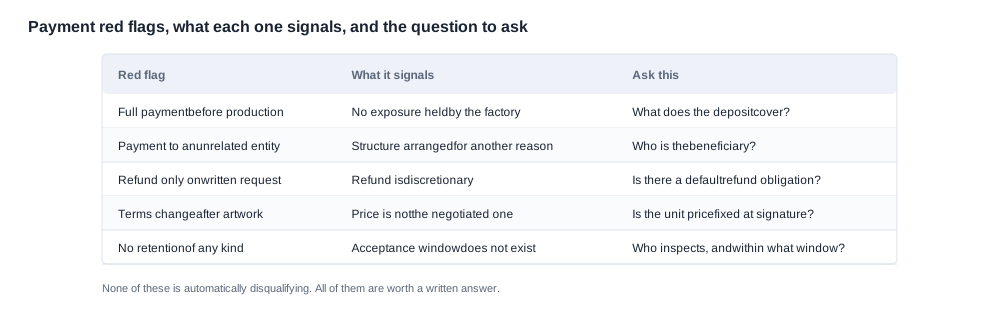
Smart glasses payment terms: the five red flags and their signals
What a red flag is, and what it is not
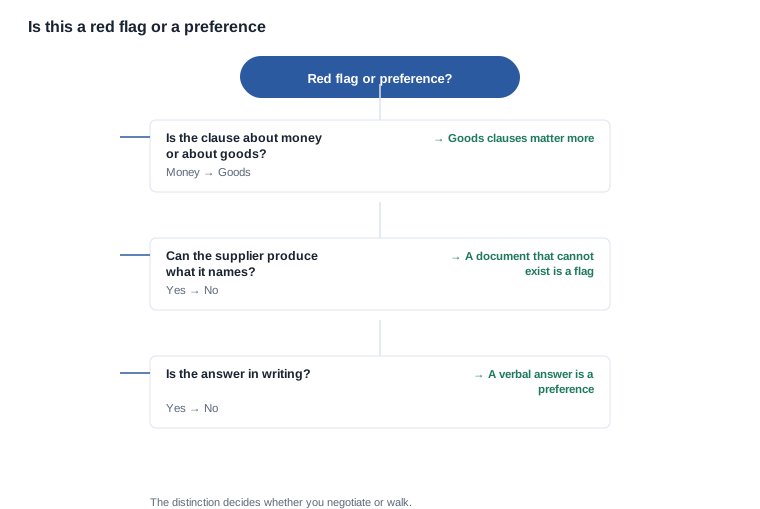
A red flag in a payment schedule is a clause that cannot be checked. That is the whole test, and it is narrower than it first appears. A clause that is unfavourable but checkable, such as a deposit the buyer would have preferred to be smaller, is not a red flag. It is a commercial position, and commercial positions are what negotiations are for. A clause that names an event nobody can confirm, a document nobody can produce, or a moment that has no owner attached to it is a red flag, because a buyer who relies on it has no way to find out whether it happened.
The distinction matters because the response to each is different. A commercial position is negotiated with a counterparty who has a reason to hold it. A red flag is either corrected in writing before the order, or it is priced as a risk the buyer has decided to carry.
There is a third category that is not a flag at all and is worth excluding explicitly: a preference. Buyers in this category often decline a structure because it is unfamiliar, and then accept the same structure two suppliers later without noticing. The test for a flag is that it fails a check, not that it fails a preference.
The five, in the order they usually appear
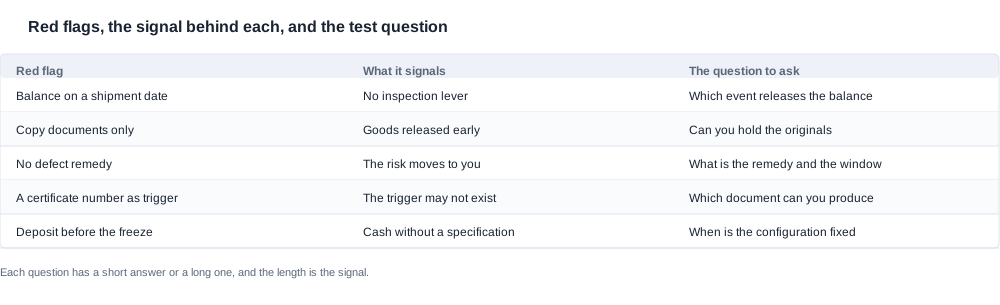
| Red flag | What it signals | The question to ask |
|---|---|---|
| Balance on a shipment date | No inspection lever at all | Which event releases the balance |
| Copy documents only | Goods released before anyone checks them | Can you hold the originals |
| No remedy and no window | The risk of a failed batch moves to you | What is the remedy and the window |
| A certificate number as the trigger | The trigger may not exist at all | Which document can you produce |
| A deposit before the configuration is frozen | Cash committed against a moving product | When is the configuration fixed |
The order is not arbitrary. The first flag is visible on the first page, the fifth is usually in the middle, and the middle two are the ones that a reader skips because they are phrased in the language of trade rather than of risk.
Three things that are not red flags, and why buyers treat them as ones
A buyer with a short list of warnings is at risk of applying them too widely, and three clauses get mistaken for flags often enough to be worth separating out.
A deposit that is larger than the buyer would choose. This is a commercial position and a supplier's reason for it is usually legitimate, because the deposit is the supplier's working capital in a category where components are bought before the goods are paid for. The test is not the size, it is the coverage: a deposit named against components and labour is a priced risk, while a deposit named against everything, including artwork and tooling, is a deposit against an unfixed product and deserves the freeze clause from flag five.
A balance due a fixed number of days after shipment. This looks like flag one, and it is not, provided the days are long enough for an inspection to happen at destination and a report to be produced. The number itself is the check. A schedule that allows a week or more and names who inspects is a different thing from one that allows a weekend, and a buyer who refuses every dated balance has refused a structure that would have served them.
A currency that is not the buyer's own. Currency choice is a cost, not a risk, and the cost is measurable. The questions that matter are the exchange rate spread, whether the invoice currency and the bank currency are the same, and whether the price holds for the validity period of the terms. If the terms carry an expiry, the currency question is manageable.
Separating the three matters because a buyer who treats everything as a flag negotiates badly and wins nothing. The purpose of the list is to find the clauses that cannot be checked, and everything else belongs in the ordinary conversation about price and timing.

The buyer who is reading a schedule for warnings, and the time available
Where the flags surface first
The reader is a procurement manager, a channel buyer or an importer who has a schedule in front of them and a supplier waiting for an answer. The situation is nearly always the same: a first order, a tight launch date, and two or three quotations to compare. The fear is not that the supplier is dishonest. It is that the schedule turns out after the goods have shipped to have released the money before anything was checked, and that the buyer's organisation discovers this at the point where it has the least room to respond.
The time available is genuinely small, and that shapes the method. A buyer with an afternoon can do this properly. A buyer with ten minutes before a call can still catch the first and the third flags, because both are visible in the trigger and the remedy clauses alone. The second, the fourth and the fifth require reading the schedule against the order rather than against itself, which is why they are worth a written request in advance.
The ten minutes that decide what you do with a flag
- Read the release event first. If it is a date, stop. Everything else in the schedule is secondary to the fact that the money moves on the calendar rather than on evidence.
- Find the named party. Find the party who confirms the release. A schedule that names only the supplier has given you a promise, not a condition.
- Check the remedy clause exists at all. A schedule with no remedy has usually been written by somebody who expects the goods to be accepted, which is a statement about confidence rather than about quality.
- Ask what the deposit buys. If the answer names components and labour, it is a production deposit. If it names everything including artwork and tooling, it is a deposit against an unfixed configuration.
- Note whether the terms have an expiry. Terms without an expiry are terms that will still be quoted after the component and freight markets have moved.
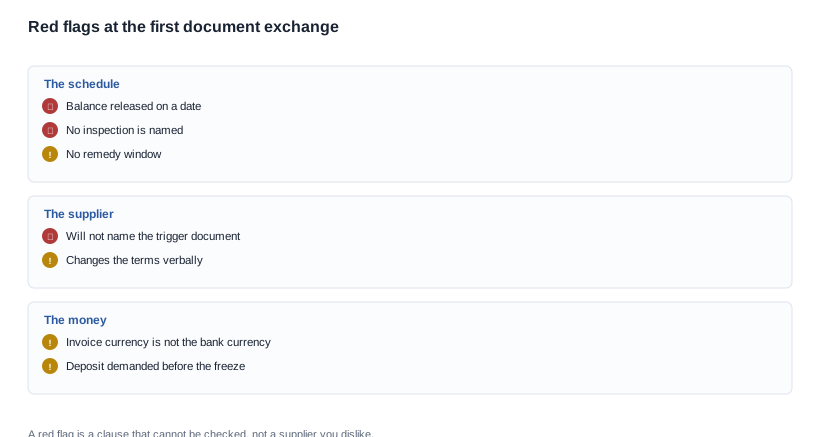
Flag one and flag two: the trigger and the documents
Flag one: the balance that releases on a date
The symptom. The balance is due on the shipment date, or on a number of days after it, and no inspection appears anywhere in the document. The root cause. A dates-only schedule is easier to agree, because it does not require anybody to define a method, a sample size or an owner. It defers the hard part of the order to a moment when the buyer has less leverage. The prevention. Name the inspection as the release event, with a named owner and a written report, and hold a small retention until the remedy window closes.
This is the most common flag in the category, and it is the most expensive one to accept, because it moves the entire cost of a defective batch onto the buyer at exactly the point where the buyer has the least room to do anything about it. A deposit that is too large is a negotiation. A balance that releases before anything is checked is a transfer of risk that nobody agreed to in words.
Flag two: copies where originals would do
The symptom. The balance is payable against a copy of the bill of lading, and nothing in the schedule suggests that the originals are held. The root cause. Copy release is a speed choice rather than a risk choice, and it is usually made by the seller because it simplifies the document flow. The consequence is that the goods leave the factory, the money is released, and the inspection happens afterwards, at destination, on units the buyer has already paid for. The prevention. Either ask for the originals, or arrange a pre-shipment inspection at the factory so that the evidence exists before the goods move, and name it in the schedule.
The distinction is not about paperwork. It is about whether the goods can still be stopped. The buyer who has paid against a copy of the bill of lading cannot stop anything; the buyer who is holding the originals can.

Flag three, four and five: the remedy, the certificate and the deposit
Flag three: silence on a failed batch
The symptom. The schedule has a payment structure and no remedy clause, or a remedy clause with no window. The root cause. Payment terms and quality terms are usually drafted by different people, and the quality people are not in the room when the schedule is agreed. The result is silence, and silence has a default meaning: the rejected goods are paid for on the same schedule as the accepted ones, and the remedy is whatever can be negotiated after the fact. The prevention. Add the remedy, the window and the point the window runs from. A window measured from shipment expires before a slow-moving channel has sold the first units, which is the ordinary reason a credit arrives too late to be useful.
Flag four: a certificate number used as the trigger
The symptom. The schedule names a certificate number, or a document reference, as the event that starts the clock or releases the balance. The root cause. It sounds precise, and precision is what a schedule wants. The problem is that a number which nobody has checked is less precise than a description, because it reads like a fact and behaves like an assumption. Our own catalogue carries a company-level export certification page rather than a per-model certification row, and publishes no certificate numbers and no validity dates, so a number quoted in a schedule cannot be verified against anything we publish. The prevention. Ask for the number and the list of models it covers, and if either cannot be produced, rewrite the trigger as the document set for the ordered configuration, with a named producer and a date.
Flag five: a deposit paid against a moving configuration
The symptom. The deposit is due at the order date, and the configuration, the artwork or the case option is still open. The root cause. The deposit is tied to the order rather than to the freeze, which means cash moves before the product is defined. The factory, reasonably, builds to the quotation, and the buyer receives a slightly different product from the one they had in mind. The prevention. Tie the deposit to a dated, frozen configuration string, and say in the schedule what happens to the deposit if the configuration changes before that date.
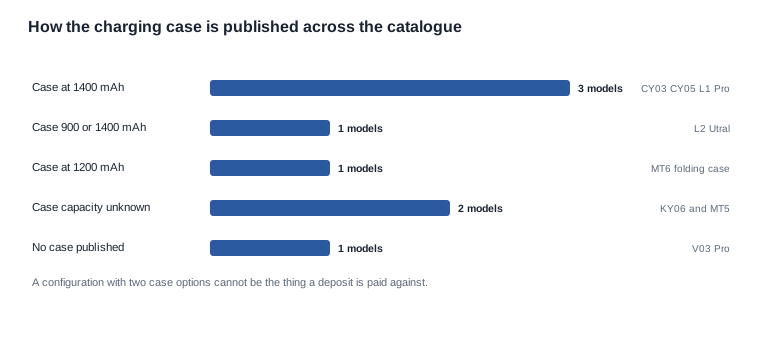
The published catalogue shows how easily this goes wrong in practice. A case option is not a decorative choice: the L2 Utral publishes a 900 mAh or a 1400 mAh case, the MT6 a 1200 mAh folding case, the CY05 and the L1 Pro, and the CY03 a 1400 mAh case, the KY06 and the MT5 a case whose capacity is not published, and the V03 Pro no case at all. A deposit paid against a model name that covers two different cartons is a deposit against an option rather than against a product.
A schedule read in ten minutes, with two flags found
A worked read is more useful than a list, so here is one. It is an invented schedule and it is deliberately ordinary, containing two of the five flags and none of the others.
The schedule opens with a deposit of thirty per cent of the order value, payable when the purchase order is raised, and states that the order is for the model, the quantity and the destination, without naming the colourway or the case option. It continues with a balance of seventy per cent due fifteen days after the shipment date, and it contains no inspection, no remedy clause and no named owner anywhere. The currency is stated and the terms carry a ninety-day validity.
Reading it against the five flags: flag one is present, because the balance releases on a date with no inspection behind it, and flag five is present, because the deposit falls due before the colourway and the case option are fixed. The other three are absent, because the schedule does name a currency, does not rely on a certificate number, and leaves the remedy as silence rather than as a bad clause.
The two questions that follow from that reading are narrow. The first is which event releases the balance and who confirms it, and the second is the date at which the configuration is fixed and what happens to the deposit if it changes before then. Neither question asks the supplier to change its price, and neither requires a long negotiation. The first one is a definition, and the second is a date.
That is the proportion worth knowing before starting: most flags in this category are corrected by a definition and a date, not by a concession. A buyer who arrives with the questions ready recovers most of the value that the flag represented, in a single exchange, before the deposit is paid.

What to do when you find one
The five-step response
A flag does not have to end the conversation, and ending it is usually the wrong response to the first one. The response that works is short and it keeps the commercial relationship intact while the clause gets fixed.
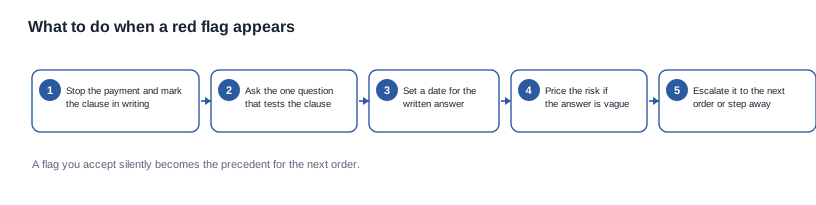
- Mark the clause. Do not describe the problem. Quote the sentence that contains it, because that is the only version of the objection that cannot be reinterpreted later.
- Ask the one question that tests it. Each flag in the table above has a single question attached to it, and the question is short enough to put in an email. A question with a specific answer is a conversation; a general objection is a delay.
- Set a date for the written answer. Terms that float are terms that get quoted again unchanged. A date turns an open clause into a pending one, and a pending clause can be escalated.
- Price the risk if the answer is vague. If the answer is evasive, work out what the clause is worth if it is ignored, and decide whether to accept that number knowingly. Most flags are survivable when the exposure is known, and uns survivable when it is not.
- Escalate it to the next order. A flag that is accepted silently becomes the precedent for every order that follows, and the precedent is the thing that actually costs money over a programme.
Escalating, and the point at which to step away
Two flags are worth escalating to a decision above the order, because they are about the counterparty rather than about the clause.
A supplier who will not put the terms in writing, or who changes them between the quotation and the order, has told the buyer that the schedule is not the agreement. That is a process fact, and it will repeat.
A supplier who names a document that cannot be produced, or an event that cannot be confirmed, has told the buyer that the inspection arrangement is a habit rather than a control. That is also a process fact, and it is the one that matters most, because it will apply to the quality of the goods as well as to the schedule.
Stepping away is a legitimate response and it is not a failure of the process. It is what the process is for. The question worth asking is not whether the supplier is acceptable, it is whether this schedule, as written, would leave the buyer able to do anything at all if the goods arrived wrong.
Where Cynrin stands on red flags, and the next step
Which release triggers we can support, and which we decline
We will tell a buyer when a clause in a schedule we have drafted cannot be evidenced, and we will say which document we can produce to prove a release event. We publish the model line, the configuration options, the camera tiers, the published battery and runtime rows, the published charging methods and the case options, and we mark the rows that are open rather than filling them with a typical figure.
We do not publish unit prices, minimum order quantities, production lead times, certificate numbers, or a per-model certification scope, and we will not quote a range for any of them. A buyer who builds a claim on an estimated number finds the error in the field rather than in the quotation, and the correction costs more than the question would have.
What we will not do is accept a trigger that names a document that cannot be produced, or agree a balance release on a date while leaving the inspection undefined. Those are the two flags in this list that we will not paper over, and we say so at the quotation stage rather than at the shipment stage.
Sending us the schedule for a second reading
Send the models, the quantities, the destination market and the schedule you have been given, and we will tell you which configurations exist, which parts of the schedule we can meet, which parts we would want defined, and where the published data leaves a row open that has to be specified by the buyer. The payment terms section sets out the commercial framework, common mistakes covers the errors rather than the flags, quality implications covers what the trigger buys in terms of inspection, and how to verify covers checking a structure clause by clause.
Send the configuration, the quantity and the market, and we will say which parts of the schedule are settled and which are yours to define.


