

Smart glasses payment terms say more about the quality of an order than most buyers realise, because a payment schedule is the only enforcement mechanism a buyer is guaranteed to have. A quality claim that arrives after the money has moved is a request. A quality claim that arrives before the money moves is a condition. Everything that separates a workable quality programme from a hopeful one sits in the trigger event and the remedy clause, not in the inspection report and not in the quality agreement. If the money releases before the goods are checked, then the quality conversation happens after the buyer has already paid, and the buyer will be conducting it from a position that the schedule itself created.
Smart glasses payment terms: where the inspection sits decides the quality outcome
The mechanism in one sentence
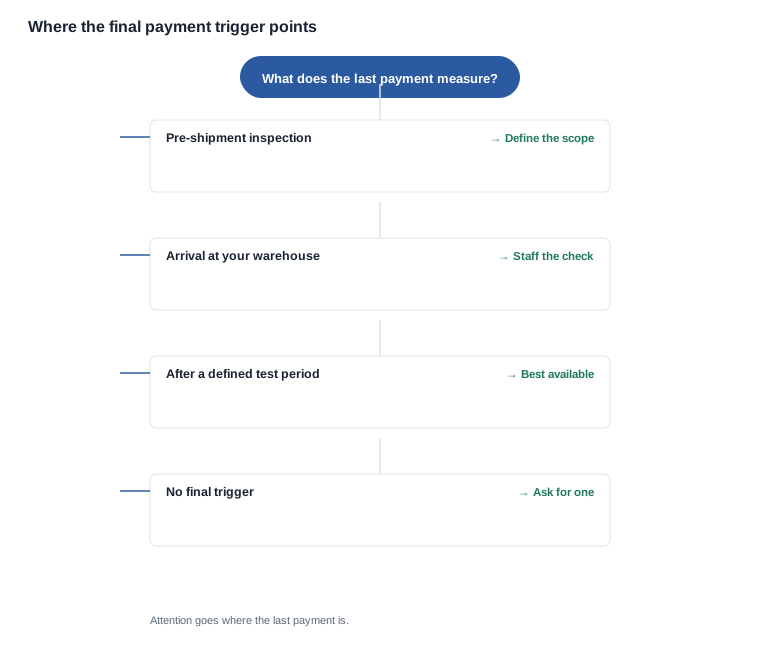
Every payment structure in this category puts the inspection either before the money or after it, and nothing else about the schedule changes that fact. When the inspection comes first, the buyer holds a condition, the supplier holds the obligation to satisfy it, and a failed batch returns to the factory. When the inspection comes after, the buyer holds a claim, the supplier holds the money, and a failed batch returns to the buyer's warehouse.
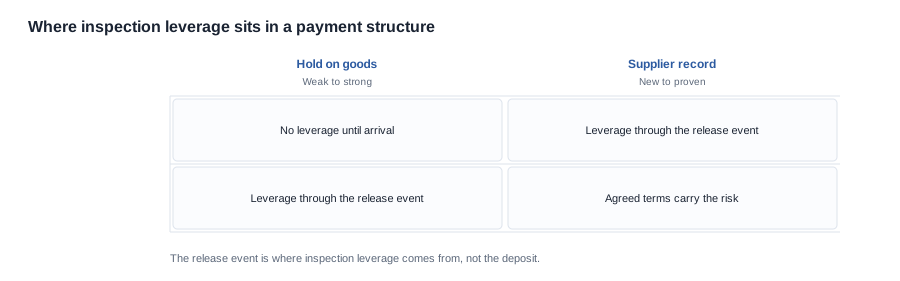
That single placement explains most of the difference between a good order and a bad one in this category, and it explains why the deposit percentage is the least important number in the document. A deposit of thirty per cent and a deposit of fifty per cent are both partial funding, and both leave the buyer exposed to the same failure if the release event sits after the inspection. Moving the release event in front of the inspection is worth far more than any movement in the deposit percentage.
Why the deposit percentage is the least important number here
There is a second reason the deposit gets more attention than it deserves, and it is a practical one: the deposit is the only number on the schedule that both sides can quote from memory. The release event requires reading a clause, and reading a clause takes a few minutes that a busy buyer does not have. So the easy number gets negotiated and the hard one gets inherited.
The result is a schedule that is precise about money and vague about goods, which is the exact inverse of what a quality programme needs.

The buyer who is buying quality, and the exposure they are managing
Acceptance criteria that can be measured
The buyer in this position is a procurement manager, a category manager or an importer who is not buying the cheapest unit but is buying units that will survive a channel, a review cycle and a returns window without damaging the brand. The exposure they are managing is not a single defective unit. It is a batch that reaches the channel and has to be withdrawn, and the cost of that is not the unit price. It is the returns handling, the channel's lost confidence, the review cycle, and the fact that a quality problem in this category is public in a way that a logistics problem is not.
That exposure is only manageable if something forces the supplier to check before the goods move. The supplier will check anyway if the checking is cheap and the consequences of not checking are real. The payment schedule is the only place where the consequence can be made real for a specific order, and that is why it belongs in the quality conversation rather than the finance one.
What the published rows can and cannot become a criterion
Acceptance criteria have to be measurable, and this category publishes more usable rows than buyers generally realise. The catalogue publishes twenty-eight models across eleven camera models, eight audio models, three sport models and six further lines, and it publishes the camera tiers: eight models with an 8 MP camera, including the MT6, and three with a 13 MP camera, including the S7. A camera tier is an excellent acceptance criterion, because it is objective, it is recorded in a test report, and a failure is visible in the sample rather than in the channel.
The published rows are also useful precisely where they stop, and the stops are instructive.
- Charge time is published for every model in the range, twenty-six at two hours or less and two at about an hour, but no starting state and no termination criterion are published. That is enough to plan against and not enough to inspect against. "Charges in two hours" is not a criterion until somebody defines the starting state, the charger and the method, because otherwise the same unit can pass or fail depending on who measured it.
- Runtime is published per model, and the published bands are broad. The camera models run between about five and about eight hours, the audio models between about six and about eight, and the case option changes the answer for several. A criterion of "eight hours" that does not name the mode, the volume and the starting state is a criterion that will be argued rather than applied.
- Some rows cannot be closed at all. The catalogue publishes no Bluetooth version for any of the eleven camera models, publishes a weight for one model only, at 158 g for the MT6 glasses body including the 265 mAh cell and the camera and excluding the folding case, and publishes no per-model certification row. A criterion that depends on a row the supplier has not published is a criterion the buyer has to write and hand over, and that is a useful thing to do, because it converts an open question into a test.
The general principle: the catalogue is best used as the source of the acceptance criteria, and the payment schedule is best used as the mechanism that makes them binding.
Who signs the inspection, and why that single line decides the outcome
The named owner on the release event is the line that buyers most often leave vague, and it carries more weight than the length of the inspection itself. An inspection performed by the factory's own quality team before loading is a genuine check, because the report is attached to a shipment that has not left. An inspection performed by the factory's own team after the buyer has been invoiced is a record of something that has already happened, and it does not create a condition; it documents the loss of one.
The three arrangements a buyer is likely to be offered are worth comparing directly, because they produce very different evidence.
- A pre-shipment inspection by a third party, at the factory. The report is produced before loading, at the point where the goods can still be held, and the buyer's own team does not have to travel. This is the arrangement that makes an inspection-linked release event worth having, and its cost is a per-inspection fee that is small compared with a batch of defective units.
- A pre-shipment inspection by the factory's own team. The evidence is cheaper to produce and weaker to rely on, and it becomes considerably stronger if the acceptance criteria are specific enough that a report against them is a measurement rather than a statement of intent.
- An inspection at destination. The goods have moved and the money has gone, and the inspection produces a record of a loss rather than a condition. It still has a value, because it establishes the scale of the problem, but it is the weakest of the three and it should not be dressed up as a release event.
Whichever arrangement is chosen, the question that settles it is simple and it is worth asking before anything else: can the goods still be stopped at the point where the report is produced? If the answer is yes, the inspection is a condition. If the answer is no, it is a record, and the schedule should not pretend otherwise.
Three structures, three quality outcomes
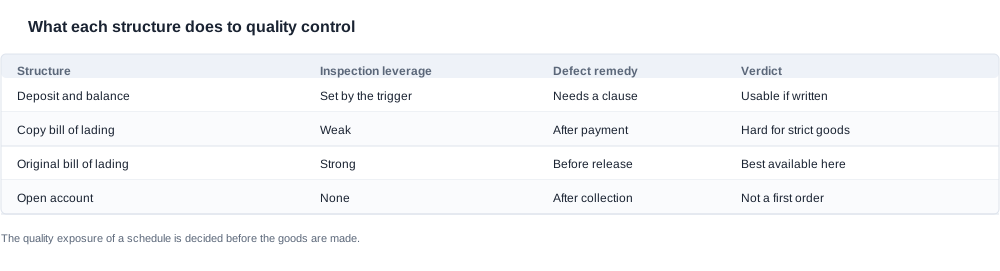
Deposit and balance
This is the structure most buyers receive, and it is capable of carrying a strict quality programme, but only if the trigger event is rewritten. As usually written, the balance falls due on the shipment date, which places the inspection after the money, and a failed batch is a claim rather than a condition. The single change that reverses this is to name the inspection as the release event, with a named owner and a written report.
There is a second element that belongs with it. If the release event is the inspection, the buyer has given up the leverage that the payment was supposed to provide, and the terms have to compensate somewhere. A retention held until the remedy window closes is the standard way to do that, and it is a small amount of money held for a defined period against a defined outcome.
Documents against copy and against originals
The copy and original distinction is a quality distinction in disguise. Payment against a copy of the bill of lading releases the goods and therefore releases the money, so the inspection happens at destination after the goods have arrived, and the buyer has paid in full for goods that have not been checked. Payment against originals holds the goods, and holding the goods is holding the leverage.
The practical question is what the inspection arrangement is at origin. If there is a reliable inspection at the factory before loading, copy documents are acceptable because the evidence already exists by the time the goods move. If there is not, the buyer is choosing between paying before checking and paying for an inspection, and the second is usually cheaper than the first.
Open account
Open account, where the balance is paid after delivery and collection, places the inspection as far from the money as it can be placed, and it therefore has the weakest quality protection of any structure in this category. It is also the structure that only makes sense with a counterparty whose build quality the buyer has already established, because it is a statement of trust extended over the entire period between shipment and collection. It is not a first-order structure in this category, and it should not be treated as one.

The clauses a quality programme needs in the schedule
Six clauses, and what each one prevents
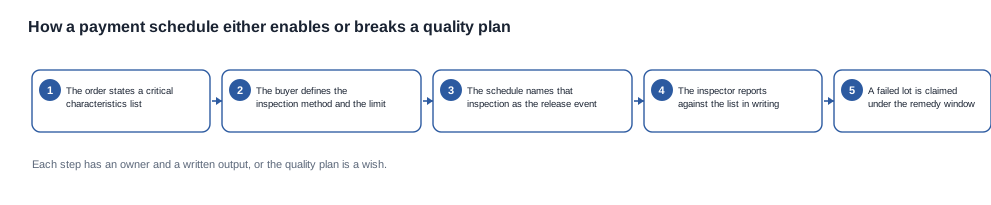
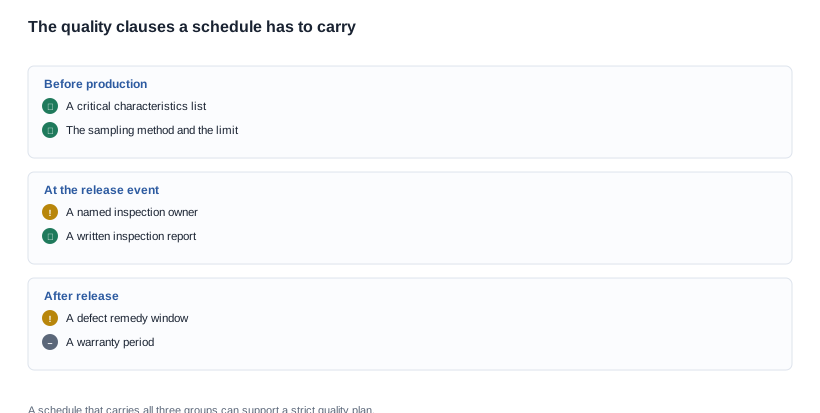
A quality programme in a payment schedule is made of six clauses, and each one prevents a specific and common failure.
- The configuration string. It prevents a dispute about which product was ordered, which is the failure that turns a quality problem into an accounting problem.
- The critical characteristics list. It prevents an inspection that is an opinion. Without a list, the inspector checks what happens to be visible.
- The inspection method, the sample size and the limit. It prevents a result that cannot be reproduced, and it is what turns a dispute into a measurement.
- The release event with a named owner. It prevents the payment from releasing because a date arrived while the inspection was still outstanding.
- The remedy and its window. It prevents the credit from arriving after the channel has moved on, which is the ordinary reason a quality dispute becomes a commercial loss.
- The warranty period, stated separately. It prevents the confusion between the remedy window, which is short, and the warranty, which is long and covers a different set of events.
Each of the six costs nothing to add and each one is routinely absent. That combination is the reason a quality programme in this category so often depends on goodwill rather than on documentation.
The checklist criteria for a usable acceptance clause
An acceptance clause is usable when a third party could apply it without asking a question. The criteria are short:
- Does it name the characteristic? A model and a parameter, not a general description.
- Does it name the method? How the characteristic is measured, by whom, and with what equipment.
- Does it name the limit? A number, a range or a pass and fail condition.
- Does it name the sample size? A lot of twenty units and a sample of three is a different commitment from a lot of five hundred and a sample of three.
- Does it name the owner? The person or company who signs the result.
- Does it name the consequence? What happens to the money and to the goods if the limit is not met.
If a clause survives all six, it can be handed to an inspection company without a telephone call. If it fails the first two, it is an aspiration, and an aspiration cannot be the release event for a payment.
The three documents that make a release event real
A release event is only real if something exists afterwards that proves it happened and shows what it found. Three kinds of document do that work, and they are worth asking for explicitly, because a supplier who cannot produce any of them has not built an inspection process, they have a habit of one.
- The inspection report itself. It should carry the date, the lot or serial identifiers, the sample size, the characteristics examined, the limits applied and the result. A report that records a pass without a sample size does not establish that the sample was taken.
- The batch or packing record. This is what connects the report to the specific goods that shipped rather than to a batch that existed on the day of the inspection. Without it, a report can be attached to the wrong units, and the buyer has no way to tell.
- The document that starts the clock. Where the schedule makes the release conditional on a document from the compliance side, that document has to be producible and has to cover the ordered configuration. The catalogue lists a company-level export certification page rather than a per-model certification row and publishes no certificate numbers, so a number quoted in a schedule cannot be checked against anything we publish, and the honest version of the trigger is a document set with a named producer and a date.
These three together are what allows a buyer to answer a question that will be asked later, usually by somebody who was not in the original conversation: which units in this shipment were covered by which report, and what did it find. Without them, the buyer can still make a claim, but the claim has to be rebuilt from scratch.

A quality dispute worked through on a hypothetical order
The order and the batch that failed
This account illustrates how the clauses interact. It describes no live project, no named customer and no real order, and the configuration, quantity and dates in it are assumed throughout.
The scenario: a brand orders a camera model at a volume that justifies a first production run, on a schedule with a deposit at order and a balance on the shipment date. The brand has a quality agreement with the supplier that describes the goods in general terms. The first production batch of one hundred and twenty units arrives, and thirty-one of them fail a function test that the brand runs on receipt. The brand's own channel window is six weeks from arrival.
What the schedule allowed, and what it should have allowed
The schedule allowed exactly what was written. The balance was paid on the shipment date, which is before the brand's function test existed as an event in the commercial relationship. The quality agreement described the goods in general terms, so there was no method, no sample size and no limit to argue about. The remedy window, where it existed at all, ran from shipment, and thirty-one units found by a function test on receipt fall outside a window that has already spent its time in transit.
So the brand is in the worst position: it has paid in full for a batch that is partly unusable, it has a quality dispute with no measurable criteria, a remedy window that has probably closed, and a channel window of six weeks against which to work.
What the schedule should have allowed is straightforward and is worth stating as a counterfactual because every element of it is available before the order. The camera tier is published, so the critical characteristics list could have named the resolution tier the order was for, which is a fact rather than a description. The function test the brand runs could have been written into the inspection with a method, a sample size and a limit, and the inspection could have been the release event with the brand's own inspector named as the owner. A retention of a few per cent of the order could have been held until the remedy window closed, and the remedy window could have run from receipt rather than from shipment. Under those terms, the same batch would have been stopped before it shipped, the brand would have held a measurable dispute, and the credit would have arrived inside the six-week window.
The gap between the two versions is not a difference of attitude towards quality. It is the difference between a quality agreement and a payment schedule that carries it.
Where Cynrin stands on quality and payment terms, and the next step
The published rows, and the rows that stay open
We publish the model line, the camera tiers, the published battery and runtime rows, the published charging methods and the case options, and those are the rows a critical characteristics list should be built from. We do not publish unit prices, production lead times, minimum order quantities, certificate numbers or a per-model certification scope, and we will not invent a tolerance where the catalogue does not publish one.
What we will do is agree the release event with you, name the document that proves it, put the inspection method and the limits in the schedule, and put the remedy and its window in the same document. If the criteria have not been agreed before the order, we will say so rather than accept a balance release that cannot be evidenced.
Where to send the configuration and the schedule
Send the model, the case option, the quantity, the destination and the schedule you have been given, and we will tell you which parts of it can carry an inspection-linked release event, which documents we would produce to prove it, and where the catalogue leaves a row open that you will have to specify. The payment terms framework sets out the commercial structure, the quality consistency checklist covers the acceptance criteria on the product side, the decision sequence covers the order in which the clauses have to be settled, and contract mistakes covers the clauses that sit around the schedule.
Send the configuration and the schedule, and we will tell you where the inspection can be placed so that it actually binds.


